
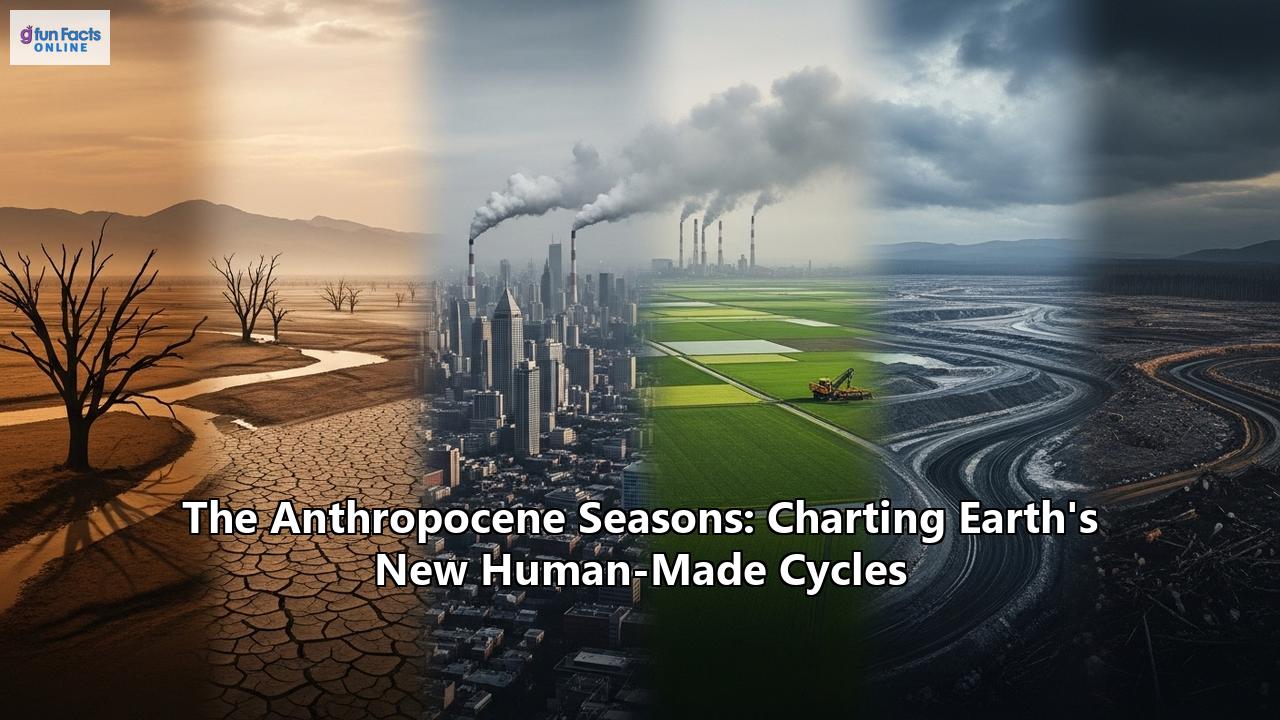
For millennia, the rhythm of Earth has been defined by the gentle, predictable procession of the seasons. Spring’s thaw, summer’s warmth, autumn’s harvest, and winter’s slumber have been the metronome for life, shaping ecosystems, cultures, and the very cadence of our existence. But this ancient clock is falling out of sync. Humanity has become a planetary-scale force, altering the very systems that govern our world. We are living in a new, proposed geological epoch: the Anthropocene, the age of humans. In this era, the familiar seasons are being rewritten, and entirely new, human-made seasons are emerging, charting a new and often unsettling chapter in Earth's history.
Part 1: Welcome to the Anthropocene: The Age of Human-Driven Change
The concept of the Anthropocene, derived from the Greek words 'anthropo' (human) and 'cene' (new), was popularized in 2000 by atmospheric chemist Paul Crutzen and biologist Eugene Stoermer. They argued that human activity has so profoundly altered the planet that we have pushed Earth out of the Holocene—the remarkably stable 11,700-year epoch that allowed human civilization to flourish—and into a new, more volatile geological age. While the term is widely used across various disciplines, its formal adoption as a geological epoch remains a subject of scientific debate.
In 2024, the official bodies responsible for the geologic time scale, the International Commission on Stratigraphy (ICS) and the International Union of Geological Sciences (IUGS), rejected a proposal to formalize the Anthropocene as an epoch. This decision, however, doesn't negate the overwhelming evidence of human impact but rather reflects the complexities of defining a precise starting point, or "golden spike," for such a widespread and ongoing process.
The Great Acceleration: A World TransformedWhether an official epoch or a descriptive event, the scale of human-induced change is undeniable, particularly since the mid-20th century—a period known as the "Great Acceleration." Following World War II, nearly every indicator of human activity, from population growth and resource consumption to greenhouse gas emissions and international trade, skyrocketed. This unprecedented surge has left a permanent mark on the planet.
Fingerprints on the Planet: The Markers of a New AgeGeologists of the far future will find clear evidence of our time in the rock strata. These markers distinguish the Anthropocene from the Holocene and include:
- Radionuclides: Fallout from nuclear weapons testing in the 1950s and 60s has left a distinct, global layer of radioactive elements like plutonium.
- Plastics and Concrete: The mass production of these materials has created a new type of "rock" that will persist for geologic timescales.
- Fossil Fuel Particles: Black carbon from burning fossil fuels is now embedded in sediments and ice cores worldwide.
- Altered Nitrogen and Phosphorus Cycles: The widespread use of artificial fertilizers has doubled the amount of these elements in the soil, a shift unparalleled in Earth's recent history.
- Mass Extinction: For the first time in Earth's history, a single species is knowingly causing a mass extinction event, with species disappearing at a rate significantly faster than for millions of years prior.
Scientists in the Anthropocene Working Group (AWG) even proposed a specific location to mark the start of this new age: the sediments at the bottom of Crawford Lake in Ontario, Canada. The annually layered sediment there provides an exquisite record of environmental changes, showing a clear shift around 1950 with the appearance of plutonium fallout, microplastics, and pollutants from fossil fuels.
Part 2: The Warping of the Old Seasons
The Earth's traditional four seasons are a product of its 23.5-degree axial tilt, which governs the amount of solar radiation received by the Northern and Southern Hemispheres throughout the year. This celestial clockwork has been reliable for eons. Now, human-caused climate change is directly interfering with this natural rhythm, creating what some scientists call "syncopated seasons"—familiar cycles with new, unsettling emphases. The fundamental "heartbeat" of the seasons is becoming stronger and more erratic.
Spring's Hasty Arrival and Ecological DisarrayAcross the globe, spring is springing sooner. Warmer temperatures are advancing the timing of crucial biological events, a phenomenon known as phenology. Plants are leafing out and flowering earlier, and animals are migrating and breeding ahead of schedule.
For indigenous communities like the Menominee in Wisconsin, these shifts disrupt long-held cultural practices. The sugaring season, when sap is harvested from maple trees, once took place in April but now often concludes before the end of March because the sap flows earlier in the year. Similarly, culturally significant plants like the bridle flower bush are blossoming up to a month earlier than they did just a few decades ago.
This temporal shift creates dangerous ecological mismatches. For example, if insects hatch before the plants they feed on have flowered, or if migratory birds arrive after their primary food sources have peaked, entire food webs can be disrupted. This asynchrony threatens biodiversity and the stability of ecosystems that have co-evolved over millennia.
The Long, Fierce SummerSummers are not only getting hotter but also longer. Studies show that in the Northern Hemisphere, the seasonal temperature swing has increased, with summer temperatures rising faster than winter temperatures. This intensification is a direct fingerprint of human influence on the climate.
The result is the more frequent and intense occurrence of extreme heat events like heatwaves and "heat domes." These are no longer rare occurrences but a defining feature of the modern summer, placing immense stress on public health, straining power grids, and creating tinderbox conditions for wildfires. In the oceans, prolonged heat leads to catastrophic coral bleaching events, turning vibrant underwater cities into ghostly white graveyards.
Autumn's Altered Hues and Fiery DispositionThe crisp arrival of autumn is becoming a more drawn-out affair. Delayed first frosts are extending the growing season in many regions, which might seem beneficial for agriculture but can also have unforeseen ecological consequences. The timing of fall foliage, a beloved seasonal spectacle and a vital tourist draw, is also becoming less predictable.
More ominously, autumn in many parts of the world is now synonymous with a new, terrifying season: "fire season." What was once a relatively contained period of risk has expanded into a months-long state of emergency in places like western North America, Australia, and parts of the Mediterranean. Drier, hotter conditions prime forests to burn, and human activity provides the overwhelming majority of ignitions.
A Waning WinterWinter is losing its bite. Many regions are experiencing "snow droughts," with less snowfall and earlier snowmelt. This has profound consequences far beyond the ski industry, which increasingly relies on artificial snow to stay open. Mountain snowpack is a critical natural reservoir, storing water that replenishes rivers and aquifers during the drier spring and summer months. Its decline threatens water supplies for millions of people and for agriculture.
Species adapted to the cold, from wolverines that rely on deep snow for their dens to plants that require a certain period of chill to germinate, are finding their habitats shrinking. The paradox of a warming world is that while average winter temperatures rise, the disruption of atmospheric patterns like the polar vortex can still lead to shocking, record-breaking cold snaps in some areas, adding another layer of volatility to the changing seasons.
Part 3: The Dawn of Human-Made Seasons
Beyond simply altering the traditional four seasons, human activity is now creating entirely new, recurring phenomena that can be defined as anthropogenic seasons. These are not governed by the Earth's tilt but by the cycles of our own industry, agriculture, and waste.
Fire Season: A Global InfernoThe concept of a predictable "fire season" is becoming obsolete. In many regions, the threat of major wildfires is now a year-round reality. Fueled by a combination of climate change-induced drought, historical land mismanagement that has allowed fuel to build up, and expanding human settlement into wildland areas, megafires are reshaping landscapes on a continental scale. The smoke from these fires can travel thousands of miles, causing air quality to plummet and creating a "haze season" that affects the health of millions far from the flames.
Pollution Seasons: Cycles of ContaminationHumanity has created distinct seasons of pollution that cycle through our air and water.
- Ozone Season: In many urban areas, the summer months have become synonymous with high levels of ground-level ozone. The combination of intense sunlight, heat, and emissions from cars and industry cooks up a toxic smog that poses a serious threat to respiratory health.
- Particulate Matter Season: In contrast, some regions experience their worst air quality in winter. In places like northern India and parts of China, temperature inversions can trap a thick blanket of particulate matter from agricultural burning, industrial emissions, and household heating, leading to hazardous air quality for extended periods.
- Algal Bloom Season: In late summer and early autumn, many lakes, rivers, and coastal areas now experience a toxic "red tide" or algal bloom season. Nutrient-rich runoff from agricultural fertilizers and wastewater flows into water bodies, feeding massive blooms of algae that deplete oxygen, kill fish, and can be harmful to humans.
- Trash Season: On the shores of places like Bali, a grim new season has emerged. Between November and March, ocean currents and tidal patterns conspire to wash ashore enormous quantities of plastic waste, blanketing beaches in a tide of human refuse.
While hurricanes, cyclones, and typhoons are natural phenomena, their "seasons" are being amplified by human-caused climate change. Warmer ocean waters provide more fuel for these storms, leading to an increase in their intensity, wind speed, and the amount of rainfall they can unleash. The result is more destructive storms that cause more widespread flooding and damage. There is also evidence that the "season" itself is expanding, with powerful storms forming earlier and later than the historical norm.
The Seasons of the TechnosphereOur globalized, industrial society has its own rhythms that impose themselves on the planet.
- The Agricultural Year: The ancient cycles of planting and harvesting are now executed on an industrial scale. Vast monoculture landscapes dominate entire regions, and the "fertilizer season" and "pesticide season" introduce massive, coordinated pulses of chemicals into the environment.
- The Consumption Cycle: The global economy has its own seasons, most notably the holiday shopping season. This period drives a massive increase in manufacturing, global shipping, and, ultimately, waste generation, placing a heavy, cyclical burden on the planet's resources.
- The Tourism Rush: The annual migration of tourists creates seasonal hotspots of intense environmental pressure. Popular destinations can see their water consumption, waste production, and stress on local ecosystems skyrocket during peak "tourism season."
Part 4: Charting the New Rhythms of a Changing Planet
Understanding and navigating these new seasonal realities requires a new generation of scientific tools and techniques. Scientists are no longer just observing the weather; they are tracking the vital signs of a planet in flux.
The Watchful Eye in the Sky: Satellite MonitoringSatellites are our primary tool for monitoring planetary-scale changes. From space, we can track the shrinking of polar ice caps and glaciers, the pace of deforestation, the spread of urban areas, and the intensity of wildfires. Satellite instruments can measure sea surface temperatures to forecast the intensity of hurricanes, detect the chlorophyll signature of massive algal blooms, and even monitor air pollutants like nitrogen dioxide. This continuous, global view is essential for identifying the patterns and trends of the Anthropocene.
Modeling the Future: Climate SimulationsTo separate the "signal" of human influence from the "noise" of natural climate variability, scientists rely on sophisticated computer models. By running simulations of Earth's climate with and without the influence of human-caused greenhouse gas emissions, researchers can perform "fingerprint" studies. These studies have shown with overwhelming confidence that the changes we are observing—from the warming of the troposphere to the intensification of seasonal temperature swings—cannot be explained by natural factors alone. The odds of the observed shifts being a result of natural variation are estimated to be as low as five in a million. These models are also our primary means of projecting future scenarios and understanding the potential consequences of our current trajectory.
On-the-Ground Truth: Phenology and Sensor NetworksTechnology is complemented by on-the-ground observation. Phenology networks, many powered by citizen scientists, meticulously track the timing of biological events—the first leaf, the first flower, the first migrating bird. This data provides a rich, high-resolution picture of how ecosystems are responding to seasonal shifts. Meanwhile, vast networks of sensors monitor air and water quality in real-time, providing crucial data on the various "pollution seasons."
Harnessing Big Data and AIThe sheer volume of data being collected from satellites, sensors, and models is immense. Making sense of these massive datasets requires the power of Big Data analytics and Artificial Intelligence. AI algorithms can identify subtle patterns and correlations that might be missed by human analysts, helping to detect emerging trends, improve forecasts for extreme weather, and understand the complex, interconnected nature of Earth's new cycles.
Part 5: Navigating a World Out of Time
The seasons of the Anthropocene are more than a scientific curiosity; they are a fundamental challenge to our way of life. Living on a planet whose rhythms are becoming increasingly unpredictable and extreme requires a profound shift in how we build our societies, manage our resources, and define our relationship with the natural world.
The Risk of Tipping PointsOne of the most concerning aspects of these changes is the potential to cross climatic "tipping points." These are thresholds where a small change can trigger a large, rapid, and often irreversible shift in a major Earth system. Scientists have identified several potential tipping points, including the collapse of the Amazon rainforest, the melting of the Greenland and West Antarctic ice sheets, and the shutdown of major ocean circulation patterns. The altered seasons we are now experiencing may be early warning signs that we are approaching these critical thresholds. The current trajectory, if unchecked, could lead Earth towards a much hotter, less biodiverse, and more hostile state often referred to as "Hothouse Earth."
Adaptation: Learning to Live on a New PlanetGiven that some degree of further change is already locked in, adaptation is essential.
- Resilient Agriculture: Farmers must adapt to longer, hotter summers, more erratic rainfall, and shifting growing seasons. This may involve planting new crop varieties that are more heat and drought-tolerant, investing in more efficient irrigation, and diversifying farm operations.
- Future-Proof Cities: Urban areas need to be redesigned to cope with extreme heat, increased flood risk, and strained resources. This includes expanding green spaces to mitigate the "urban heat island" effect, building improved storm drainage systems, and securing resilient water and energy supplies.
- Proactive Public Health: Healthcare systems must prepare for the health impacts of hotter summers, more prevalent air pollution, and the potential for new diseases to spread as climate zones shift.
Ultimately, adaptation alone is not enough. The only way to prevent the most catastrophic consequences of the Anthropocene and begin to stabilize Earth's new seasons is through mitigation—a rapid and drastic reduction in the human impacts that are driving these changes. This requires a fundamental transformation of our global society, including:
- A Transition to Clean Energy: A swift move away from fossil fuels to renewable energy sources like solar, wind, and geothermal is the single most important step.
- A Circular Economy: Shifting from a "take-make-dispose" model to a circular economy that emphasizes reuse, recycling, and waste reduction is critical to reducing resource extraction and pollution.
- Sustainable Land Use: Protecting and restoring forests, wetlands, and other natural ecosystems is vital for absorbing carbon dioxide, preserving biodiversity, and maintaining essential environmental services.
The emergence of the Anthropocene seasons is a stark reflection of humanity's immense power to reshape a planet. We have moved from being passengers on Earth to being the pilots, yet we are often flying without a clear understanding of the controls. The erratic, syncopated, and sometimes dangerous new seasons are the planet's feedback to our actions. They are a call for a new kind of awareness, a new humility, and a new sense of responsibility.
Charting these new human-made cycles is the first step. The next, far more critical step is to consciously choose which cycles we want to perpetuate. Will we continue the seasons of fire, pollution, and consumption, or can we begin to foster new seasons of restoration, renewal, and sustainability? The answer to that question will define not just the climate of the future, but the very character of the Anthropocene itself.
Reference:
- https://earth.org/explainer-what-is-the-anthropocene/
- https://en.wikipedia.org/wiki/Anthropocene
- https://www.youtube.com/watch?v=ZZ845voIiOE
- https://earth.org/what-is-the-anthropocene/
- https://www.vice.com/en/article/iwelcome-to-the-anthropocenei-charts-250-years-of-humanitys-impact-on-planet-earth/
- https://www.usgs.gov/centers/pcmsc/news/new-study-scientists-identify-key-markers-anthropocene-epoch
- https://psmag.com/environment/meet-me-in-the-anthropocene/
- https://www.vaia.com/en-us/textbooks/environmental-science/environmental-science-for-a-changing-world-4-edition/chapter-1/problem-9-what-are-some-of-the-proposed-geologic-markers-in-/
- https://www.ucl.ac.uk/news/2023/jul/spot-marking-beginning-anthropocene-identified-ucl-researchers
- https://www.quora.com/How-were-the-four-seasons-created
- https://www.livescience.com/planet-earth/climate-change/earth-appears-to-be-developing-new-never-before-seen-human-made-seasons-study-finds
- https://www.iflscience.com/humans-are-causing-earths-seasons-to-change-in-a-way-never-seen-before-48910
- https://www.llnl.gov/article/44541/human-influence-detected-changing-seasons
- https://timesofindia.indiatimes.com/science/human-influence-detected-in-changing-seasons-study/articleshow/65085024.cms
- https://www.pbslearningmedia.org/resource/nasa11.sci.life.eco.cmn2/the-seasons-are-moving/
- https://www.upi.com/Science_News/2018/07/20/Humans-are-changing-global-seasonal-climate-cycles-satellite-data-shows/4331532090108/
- https://snowbrains.com/new-study-humans-shifting-seasons/
- https://www.youtube.com/watch?v=HvD0TgE34HA