
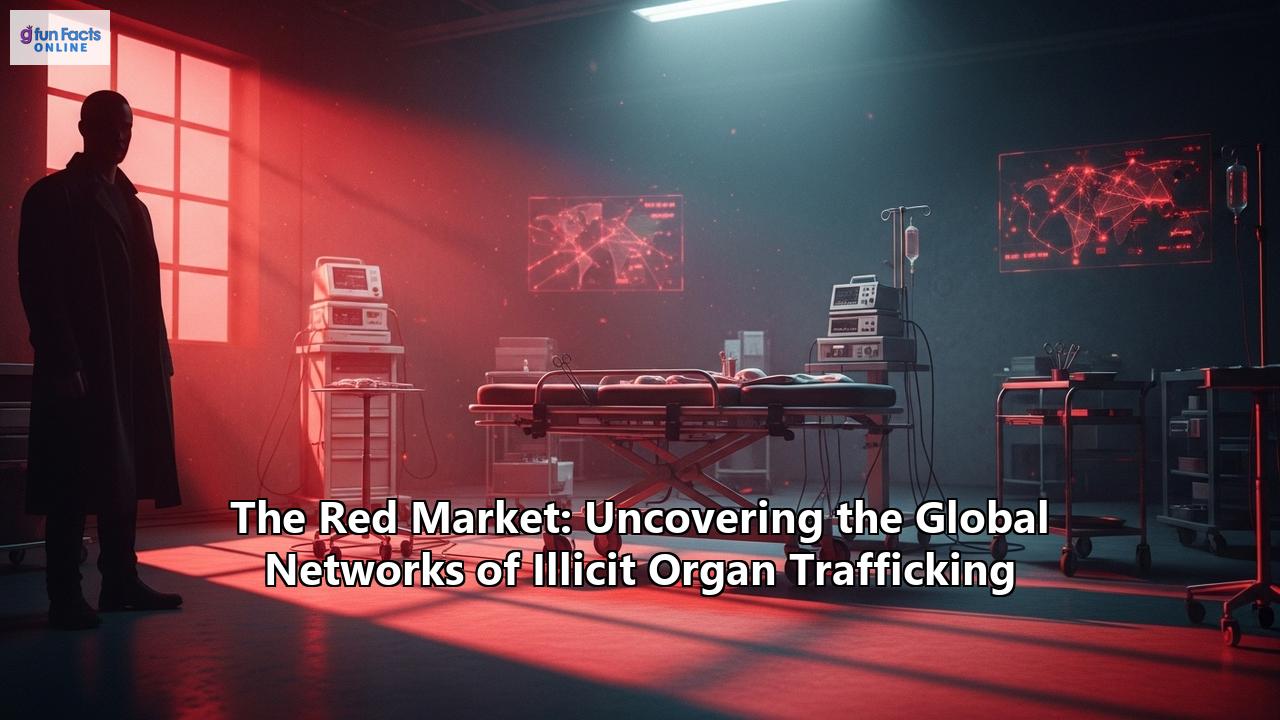
The Red Market: Uncovering the Global Networks of Illicit Organ Trafficking
In the sprawling, shadowy recesses of the global black market, there exists a particularly chilling commerce, one that trades not in narcotics or weapons, but in the very components of human life. This is the "red market," the illicit trade in human organs, a multi-billion dollar criminal enterprise built on a foundation of desperation, exploitation, and the profound imbalance between the supply of and demand for life-saving organs. It is a world where the impoverished are reduced to a collection of spare parts and the wealthy are offered a chance at survival, often at a terrible human cost. This clandestine industry, with its intricate networks of brokers, complicit medical professionals, and desperate individuals, stretches across continents, leaving a trail of broken bodies, shattered lives, and profound ethical questions that challenge the very essence of our shared humanity.
The World Health Organization (WHO) defines organ trafficking as any activity involving the removal of organs from living or deceased donors without valid consent or authorization, or in exchange for financial gain. This illegal trade is estimated to generate between $840 million and $1.7 billion annually, with some estimates suggesting that 5% to 10% of all organ transplants performed worldwide are illicit. While kidneys are the most commonly trafficked organ, the red market also deals in livers, hearts, lungs, and corneas. The victims are overwhelmingly from poor and vulnerable populations in developing nations, while the recipients are typically from wealthier countries. This stark reality underscores the deeply exploitative nature of the red market, a macabre manifestation of global inequality where life itself has become a commodity.
The Genesis of a Macabre Trade: A History of the Red Market
The roots of the modern organ trade can be traced back to the 1980s, a period that saw significant advancements in transplantation medicine. As the success rates of organ transplants soared, so too did the demand for organs, quickly outstripping the available supply from legal donation systems. It was during this decade that experts began to observe a new phenomenon: "transplant tourism." Wealthy individuals, primarily from Asia, began traveling to India and other parts of Southeast Asia where they could purchase organs from impoverished donors. Before 1994, India had no laws prohibiting the sale of organs, which, combined with low costs and a ready supply of donors, transformed the nation into a major hub for kidney transplants. However, this unregulated market was rife with exploitation, with donors often receiving far less than the promised payment, or in some horrific cases, having their kidneys removed without their consent during unrelated medical procedures.
The international community began to take notice of this burgeoning and unethical trade. In 1987, the World Health Organization took a firm stance, declaring the commercial trade of organs a violation of the Universal Declaration of Human Rights. Despite this condemnation, the red market continued to expand, with new destinations like Brazil and the Philippines emerging as hotspots. The trade was also fueled by disturbing allegations against China, which was accused of harvesting organs from executed prisoners to supply its burgeoning transplant industry. Estimates from as recently as 2006 suggested that thousands of prisoners were executed annually to provide organs for foreign buyers. In the 2000s, further accusations arose that China was systematically harvesting organs from living Falun Gong practitioners, a claim detailed in the Kilgour-Matas report. While China has since implemented reforms and established a voluntary donation system, these allegations cast a long and dark shadow over the history of transplantation medicine.
As the grim realities of the organ trade came into sharper focus, a more organized international response began to take shape. The year 2008 was a pivotal moment, with the establishment of the Declaration of Istanbul on Organ Trafficking and Transplant Tourism. This landmark declaration, supported by over 100 transplant organizations worldwide, provided clear definitions of organ trafficking and transplant tourism and established ethical guidelines for organ donation and transplantation. The Declaration spurred several countries, including China, Israel, the Philippines, and Pakistan, to strengthen their laws against the commercial organ trade. The Philippines, for instance, banned the sale of organs in 2008, following in the footsteps of India, which had passed the Transplantation of Human Organs Act in 1994.
Despite these legislative efforts and international condemnations, the red market has proven to be remarkably resilient. Transnational criminal organizations have become increasingly sophisticated, adapting their methods to circumvent new laws and regulations. The rise of the internet provided a new and powerful tool for these networks, allowing brokers to connect with potential donors and recipients across the globe with relative anonymity. The clandestine nature of the trade, coupled with a lack of awareness among law enforcement in many countries and the complexities of international jurisdiction, has made it incredibly difficult to combat. The story of the red market is one of a constantly evolving criminal enterprise, one that continues to prey on the most vulnerable and exploit the universal human desire to live.
The Legal and Ethical Labyrinth: Defining the Illicit
The global response to organ trafficking is built upon a foundation of international conventions and ethical guidelines that unequivocally condemn the commercialization of the human body. These frameworks seek to establish a clear line between altruistic donation and the exploitative nature of the red market. At the forefront of this effort is the World Health Organization (WHO), which has long advocated for ethical organ procurement. The WHO's Guiding Principles on Human Cell, Tissue and Organ Transplantation emphasize the importance of free, informed, and specific consent from donors, and expressly state that cells, tissues, and organs should not be subject to commercial transactions. These principles also call for transparency in donation and transplantation processes and equitable access to these life-saving treatments.
A pivotal international agreement is the Council of Europe Convention against Trafficking in Human Organs, also known as the Santiago de Compostela Convention. This legally binding treaty, which entered into force in 2018, requires signatory states to criminalize the illicit removal of human organs from both living and deceased donors. The convention specifically targets acts where removal is performed without free and informed consent, or where financial gain is involved. It also criminalizes the solicitation and recruitment of donors and recipients for financial advantage, and provides for the protection and compensation of victims. The convention represents a significant step forward in creating a harmonized international legal framework to prosecute organ traffickers.
The Declaration of Istanbul on Organ Trafficking and Transplant Tourism, established in 2008, serves as a crucial ethical compass for medical professionals and policymakers worldwide. While not legally binding, its principles have been endorsed by over 100 countries and have been influential in shaping national laws and professional codes of conduct. The Declaration distinguishes between legitimate "travel for transplantation" and exploitative "transplant tourism." The latter is defined as travel that involves organ trafficking or commercialism, or that undermines a country's ability to provide transplant services to its own citizens. This distinction is vital in a world where patients increasingly cross borders for medical care. The Declaration firmly states that organ trafficking and transplant commercialism are violations of the principles of equity, justice, and respect for human dignity and should be prohibited.
A cornerstone of ethical organ donation is the concept of brain death, which is legally recognized as a definition of death in many countries. Brain death is the irreversible cessation of all brain function, and its determination allows for the procurement of viable organs for transplantation while ensuring that the donor is, in fact, deceased. The establishment of clear legal and medical criteria for determining brain death is crucial to maintaining public trust in the organ donation system and preventing the premature harvesting of organs.
Despite these international agreements and ethical guidelines, the reality on the ground is often a patchwork of national laws with varying degrees of enforcement. Many countries, including India, Pakistan, the Philippines, and Egypt, have enacted legislation to combat organ trafficking, but the practice persists, often due to corruption, weak law enforcement, and legal loopholes. Some countries operate under a "presumed consent" or "opt-out" system, where individuals are considered organ donors unless they have explicitly stated otherwise. This is in contrast to "informed consent" or "opt-in" systems, where individuals must actively register to become donors. While presumed consent systems are often touted as a way to increase donation rates, their effectiveness is a subject of ongoing debate.
The traffickers who operate in the red market are adept at exploiting the inconsistencies and weaknesses in these legal and ethical frameworks. They thrive in the gray areas of international law and prey on the desperation of both donors and recipients, creating a global network of illicit activity that continues to challenge the international community's efforts to uphold the sanctity of the human body.
Inside the Engine Room of the Red Market: How the Networks Operate
The global networks of illicit organ trafficking are complex and highly organized criminal enterprises, often mirroring the structure and methods of other forms of transnational crime. These networks are populated by a cast of characters, each playing a specific and often chilling role in the commodification of human life. At the heart of these operations are the brokers, the shadowy intermediaries who connect desperate recipients with vulnerable donors. These brokers are often adept at psychological manipulation, preying on the financial desperation of their victims with promises of large payouts for a "painless" procedure. They may use a variety of recruitment tactics, from online advertisements and social media to in-person approaches in impoverished communities, refugee camps, and even hospitals. In some cases, recruiters are former "donors" themselves, sent back to their communities to lure others into the trade.
The methods of coercion and deception employed by these networks are manifold. Victims are often lied to about the nature of the surgery, with some being told that their kidney will grow back or that they have a spare one they don't need. They are frequently promised sums of money that they never fully receive, with brokers taking a significant cut of the final price paid by the recipient. In the most horrific cases, individuals are drugged and their organs are removed without their knowledge or consent, or they are lured with false promises of jobs and then forced into giving up an organ.
The role of medical professionals in the red market is a particularly disturbing aspect of this illicit trade. While many doctors and nurses are unwitting pawns in these schemes, some are active and willing participants, their medical expertise essential to the success of the trafficking networks. These complicit professionals may work in clandestine, makeshift operating rooms or, more brazenly, within established hospitals and clinics, where they can falsify documents and disguise illegal transplants as legitimate procedures. They may be motivated by financial gain or a misguided sense of helping desperate patients, but their involvement is a profound betrayal of their ethical obligations. The case of the Medicus clinic in Kosovo, where doctors were convicted of harvesting kidneys from donors who had been lured from Eastern Europe and Central Asia with false promises of payment, is a stark example of this medical complicity. The donors were promised up to €15,000 for their organs, while recipients, mainly from Israel, paid as much as €100,000 per transplant.
"Transplant tourism" is the primary mechanism through which the red market operates on a global scale. This involves patients, typically from wealthy, developed nations, traveling to countries where organs are more readily available for purchase. Popular destinations for transplant tourism have included India, Pakistan, China, the Philippines, Egypt, and parts of Eastern Europe and Latin America. The cost of a black market organ can vary dramatically, with a kidney fetching anywhere from a few thousand dollars to over $150,000. The "donor," however, often receives only a fraction of this amount, with the majority of the profits lining the pockets of the brokers, surgeons, and other intermediaries in the trafficking chain.
Law enforcement agencies face immense challenges in dismantling these transnational networks. The cross-border nature of the crime creates jurisdictional hurdles, and the clandestine methods of the traffickers make it difficult to gather evidence and secure convictions. Corruption within local law enforcement and government agencies in some countries further complicates efforts to combat the trade. However, there have been some notable successes. A landmark case in the United Kingdom saw the conviction of a prominent Nigerian politician, his wife, and a doctor for conspiring to traffic a young man to London to harvest his kidney for their daughter. The victim, who had been promised a better life in the UK, bravely came forward, leading to the first-ever conviction for organ trafficking under the UK's Modern Slavery Act. In Pakistan, police busted an organ trafficking ring after a 14-year-old boy was found in an underground lab with his kidney removed. These cases, while representing only a small fraction of the global trade, offer a glimpse into the dark and complex world of the red market and the immense challenges faced by those who seek to bring its perpetrators to justice.
The Human Toll: A Legacy of Broken Bodies and Shattered Lives
The consequences of the red market extend far beyond the sterile operating rooms where illegal transplants take place, leaving a devastating and often permanent impact on the lives of both those who sell their organs and those who receive them. For the "donors," who are more accurately described as victims of exploitation, the act of selling a part of themselves is rarely the panacea for their financial woes that they were led to believe. In fact, for many, it is the beginning of a downward spiral into even greater hardship.
The physical consequences for these individuals can be severe. The surgeries are often performed in clandestine and unsanitary conditions, leading to a high risk of infection and other complications. A crucial and often-overlooked aspect of this trade is the near-total lack of follow-up care for the donors. Once the organ has been harvested, they are often abandoned by the brokers and medical professionals who facilitated the transplant, left to deal with the long-term health consequences on their own. Many experience a significant deterioration in their health, with some developing chronic pain, fatigue, and even kidney failure, ironically putting them in the same position as the recipients they once "helped."
The psychological trauma inflicted on these victims is equally profound. Many suffer from depression, anxiety, and post-traumatic stress disorder (PTSD) as a result of their experiences. The deception and coercion they endured, coupled with the physical and emotional scars of the surgery, can lead to a deep sense of shame, guilt, and worthlessness. This is often compounded by social stigma and ostracism within their own communities, where selling a kidney can be seen as a sign of moral depravity.
Financially, the sale of an organ rarely provides a long-term solution to poverty. Studies have shown that the vast majority of individuals who sell a kidney do so to pay off debts, but a significant percentage remain in debt even after the sale. The small amount of money they receive is often quickly consumed by immediate needs, and their diminished health often leaves them unable to perform the manual labor they once relied on for income. This creates a cruel cycle of poverty and poor health, trapping them in a state of perpetual vulnerability.
For the recipients of trafficked organs, the decision to participate in the red market is also fraught with peril. While they may be driven by desperation and the fear of dying on a long transplant waiting list, they are not immune to the consequences of this illicit trade. The organs they receive often come from poorly screened donors, putting them at risk of contracting serious infections such as HIV and hepatitis. The lack of proper medical records and the clandestine nature of the procedures can also lead to a higher rate of post-transplant complications and organ rejection.
Beyond the medical risks, there is a heavy ethical and psychological burden that comes with receiving a trafficked organ. Many recipients are unaware of the exploitative conditions under which their new organ was procured, while others may choose to turn a blind eye. However, the knowledge that their chance at life may have come at the expense of another's well-being can lead to feelings of guilt and moral distress. The stories of regret are not limited to donors. There are also accounts of families who, in a moment of grief and confusion, refused to donate a loved one's organs, only to be haunted by that decision later.
The red market, in its entirety, is a system that preys on the vulnerabilities of both the poor and the sick, creating a chain of suffering that extends far beyond the initial transaction. It is a stark reminder of the devastating human cost of a world where the value of a human life can be reduced to the price of its component parts.
The Fightback: Global Efforts to Dismantle the Red Market
The fight against the global networks of illicit organ trafficking is a multi-faceted and ongoing battle, waged on legal, law enforcement, and public health fronts. International organizations, national governments, law enforcement agencies, and non-governmental organizations (NGOs) are all playing a crucial role in the effort to dismantle the red market and protect the world's most vulnerable populations from exploitation.
At the international level, a framework of conventions and resolutions provides the legal and ethical foundation for combating this transnational crime. The Council of Europe Convention against Trafficking in Human Organs, the Declaration of Istanbul, and the WHO Guiding Principles are key instruments in this regard, establishing a global consensus that the commercialization of the human body is unacceptable. These frameworks call for international cooperation, the criminalization of organ trafficking, and the protection of victims. The United Nations has also taken a strong stance, urging member states to take effective measures to prevent and combat trafficking in persons for the purpose of organ removal.
Law enforcement agencies like Interpol and Europol are working to facilitate cross-border cooperation and intelligence sharing to target the criminal networks that operate the red market. However, they face significant challenges, including the clandestine nature of the crime, jurisdictional hurdles, and a lack of awareness and resources in many countries. The transnational nature of these trafficking rings often requires complex investigations that span multiple countries, making it difficult to gather evidence and prosecute offenders. Despite these difficulties, there have been some successes. Coordinated international efforts have led to the dismantling of trafficking rings and the conviction of traffickers in countries around the world.
A crucial element in the fight against the red market is the effort to increase the supply of legally donated organs. The vast majority of illicit organ trafficking is driven by the simple fact that the demand for organs far outstrips the available supply from altruistic donors. In response, many countries are implementing strategies to boost their organ donation rates. These include public awareness campaigns to educate citizens about the importance of organ donation, the creation of donor registries, and, in some cases, the adoption of "presumed consent" or "opt-out" systems. While the effectiveness of these different approaches is still a subject of debate, there is a general consensus that increasing the number of legal donors is essential to undermining the business model of the red market.
Non-governmental organizations (NGOs) play a vital role on the front lines of this battle. They are instrumental in raising public awareness about the horrors of organ trafficking, advocating for stronger laws and policies, and providing support to the victims of this crime. Organizations like The Declaration of Istanbul Custodian Group work to promote ethical transplantation practices globally, while others, like the Coalition for Organ-Failure Solutions, focus on policy advocacy and survivor support. NGOs are often the first point of contact for victims, providing them with medical care, psychological counseling, and legal assistance to help them rebuild their lives.
In addition to these efforts, there is a growing focus on financial tracking as a tool to combat organ trafficking. By following the money trail, law enforcement and financial intelligence units can identify and disrupt the financial flows that sustain these criminal networks. This includes monitoring suspicious transactions related to "transplant tourism" and investigating the complex financial arrangements that are often used to launder the proceeds of this illicit trade.
The fight against the red market is a long and arduous one, requiring a sustained and coordinated effort from all sectors of the global community. While significant challenges remain, the growing international consensus against organ trafficking and the dedicated efforts of those on the front lines offer hope that this horrific trade can one day be consigned to the darkest chapters of human history.
The Path Forward: Towards a More Ethical Future
The existence of a thriving global market for human organs is a stark indictment of our collective failure to address the profound inequalities that fuel this trade. As long as there are those who are desperate enough to sell a part of themselves to survive, and those who are wealthy enough to buy a second chance at life, the red market will continue to exist in the shadows. To truly dismantle this criminal enterprise, we must move beyond a purely punitive approach and address the root causes that allow it to flourish. This requires a comprehensive strategy that not only targets the traffickers but also empowers the vulnerable, supports the sick, and fosters a global culture of altruism.
A critical component of any long-term solution is the reduction of demand for black market organs by increasing the supply of legally and ethically procured organs. This necessitates a multi-pronged approach to boosting organ donation rates worldwide. Public awareness campaigns are essential to dispel myths and misconceptions about organ donation and to encourage individuals to register as donors. These campaigns must be culturally sensitive and tailored to the specific contexts of different countries and communities. Furthermore, healthcare systems must be strengthened to ensure that the process of organ donation is as seamless and efficient as possible, from the identification of potential donors to the recovery and allocation of organs. The debate over "opt-in" versus "opt-out" consent systems will likely continue, but it is clear that any system must be built on a foundation of public trust and transparency.
In addition to increasing the supply of organs, we must also address the systemic poverty and vulnerability that make individuals susceptible to the lures of organ traffickers. This requires a broader commitment to global social justice, including efforts to reduce poverty, improve access to education and healthcare, and protect the rights of migrants and refugees, who are often the most targeted by these criminal networks. By creating a world where no one is so desperate that they feel compelled to sell a part of their body, we can cut off the supply of "donors" that the red market depends on.
Strengthening international law enforcement cooperation is also paramount. This includes not only enhancing the capacity of agencies like Interpol and Europol to investigate and prosecute transnational organ trafficking rings, but also ensuring that national laws are harmonized to prevent traffickers from exploiting legal loopholes. Extraterritorial legislation, which allows countries to prosecute their citizens for participating in illegal organ trafficking abroad, is a powerful tool in this regard. Furthermore, we must hold accountable all those who participate in this illicit trade, not only the brokers and traffickers, but also the complicit medical professionals who betray their ethical oaths for financial gain.
Finally, we must continue to support the non-governmental organizations and civil society groups that are on the front lines of this fight. These organizations are often the only lifeline for the victims of organ trafficking, providing them with the care and support they need to recover and rebuild their lives. They are also powerful advocates for change, working to raise awareness, influence policy, and hold governments accountable.
The red market is a dark and complex problem, but it is not an intractable one. By addressing both the supply and demand sides of this illicit trade, by strengthening our legal and law enforcement frameworks, and by working to create a more just and equitable world, we can begin to dismantle the global networks of organ trafficking and ensure that the gift of life is never again a commodity to be bought and sold. The path forward is challenging, but it is a path we must walk together to uphold the fundamental principle that every human life is sacred and inviolable.
Reference:
- https://pubmed.ncbi.nlm.nih.gov/23749286/
- https://humanrights-lawyer.com/blog/interpol-s-role-and-the-crimes-it-deals-with/
- https://www.numberanalytics.com/blog/combating-organ-trafficking-transplant-immunology
- https://lop.parl.ca/sites/PublicWebsite/default/en_CA/ResearchPublications/202083E
- https://www.organtraffickingresearch.org/lawenforcement/
- https://en.wikipedia.org/wiki/Organ_trade
- https://jsslawcollege.in/wp-content/uploads/2021/08/ROLE-OF-NON-GOVERNMENTAL-ORGANIZATIONS-IN-COMBATING-HUMAN-TRAFFICKING%E2%80%93AN-CRITICAL-ANALYSIS.pdf
- https://www.numberanalytics.com/blog/comparative-criminal-justice-organ-trafficking-guide
- https://pace.coe.int/files/10176/html
- https://www.unodc.org/documents/commissions/CCPCJ/CCPCJ_Sessions/CCPCJ_25/2016_Resolutions_Decisions/03.CCPCJ_2016/Resolution_25_1.pdf
- https://www.researchgate.net/publication/352105642_Understanding_the_challenges_to_investigating_and_prosecuting_organ_trafficking_a_comparative_analysis_of_two_cases
- https://www.bmj.com/content/350/bmj.h3103
- https://www.unodc.org/e4j/en/tip-and-som/module-9/key-issues/challenges-to-an-effective-criminal-justice-response.html
- https://dtifoundation.com/working-against-organ-trafficking-2/
- https://www.unodc.org/res/human-trafficking/glo-act2/tip-for-or-toolkit/Module_1.pdf
- https://www.coe.int/en/web/trafficking-human-organs/frequently-asked-questions
- https://pmc.ncbi.nlm.nih.gov/articles/PMC6411225/
- https://pmc.ncbi.nlm.nih.gov/articles/PMC8464643/
- https://theexodusroad.com/organ-trafficking-facts/
- https://www.mdtfjss.org.rs/archive/file/The%20role%20of%20civil%20society%20in%20the%20development%20of%20victims%E2%80%99%20rights%20and%20delivery%20of%20victims%20services.pdf
- https://www.dhs.gov/blue-campaign
- https://www.unodc.org/documents/human-trafficking/Toolkit-files/08-58296_tool_4-10.pdf
- https://intercollegium.com/interpol-vs-europol-whats-the-difference/
- https://www.theisn.org/blog/2024/07/15/help-combat-organ-trafficking-support-the-dicgs-campaign-for-world-day-against-trafficking-in-persons/
- https://lop.parl.ca/sites/PublicWebsite/default/en_CA/ResearchPublications/202029E
- https://www.declarationofistanbul.org/
- https://books.openedition.org/editionsmsh/10770?lang=en
- https://www.gov.uk/government/news/improved-system-of-organ-use-to-save-lives
- https://pmc.ncbi.nlm.nih.gov/articles/PMC6121056/
- https://www.acamstoday.org/organ-trafficking-the-unseen-form-of-human-trafficking/
- http://docs.manupatra.in/newsline/articles/Upload/FE524038-CCBA-412B-A5B4-7CE15C978CDA.pdf
- https://www.wlu.edu/mudd-center/mudd-undergraduate-journal-of-ethics/volume-10-spring-2025/selling-organs-to-make-ends-meet
- https://books.openedition.org/editionsmsh/10770
- https://www.osce.org/files/f/documents/b/3/405197_0.pdf
- https://www.coe.int/en/web/anti-human-trafficking/role-of-ngos
- https://www.unodc.org/documents/human-trafficking/Toolkit-files/08-58296_tool_9-19.pdf
- https://www2.fundsforngos.org/articles-searching-grants-and-donors/10-international-ngos-supporting-anti-trafficking-initiatives/