
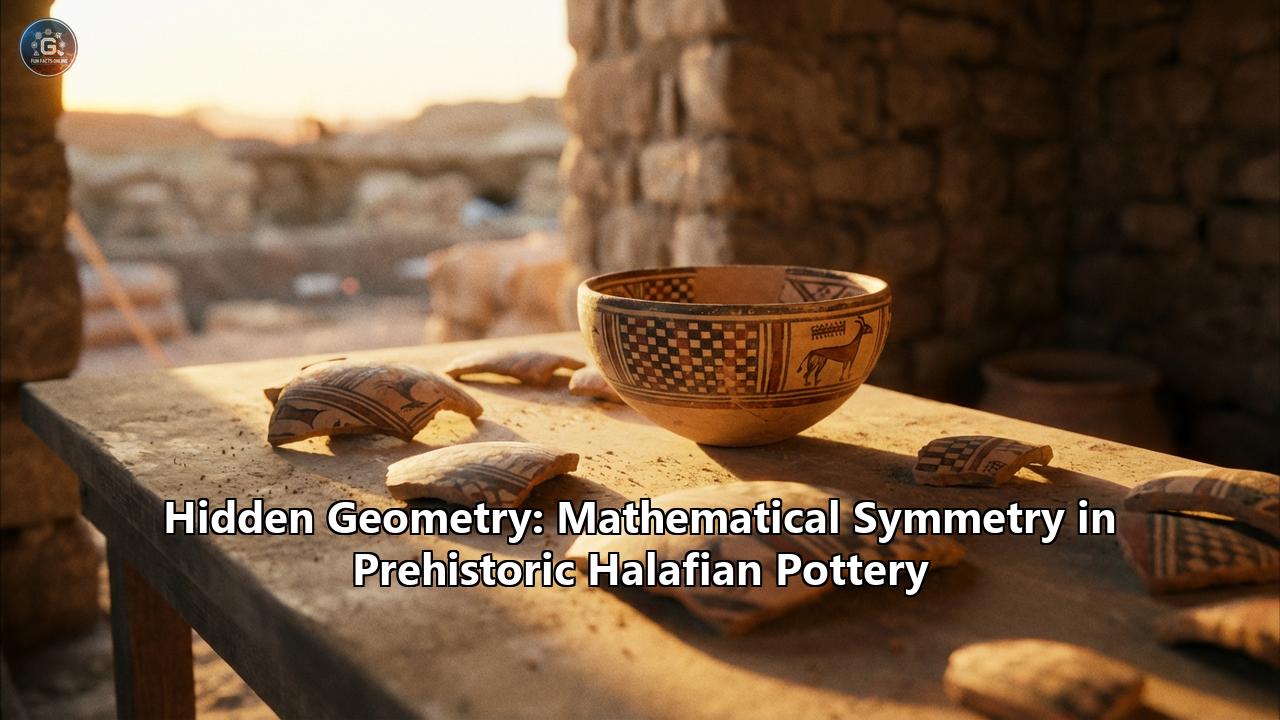
The ancient clay speaks, if one knows how to listen. But on the dusty plains of Northern Mesopotamia, scattered across the modern borders of Syria, Turkey, and Iraq, the clay does not merely whisper; it sings in perfect, rhythmic equations.
Here, over 8,000 years ago, a Neolithic people known as the Halafians achieved something extraordinary. Long before the ziggurats of Sumer scratched the sky, and millennia before Pythagoras or Euclid formalized the laws of geometry, the potters of the Halaf culture were painting complex mathematical theorems onto their ceramic vessels. They were not just decorating; they were encoding the very structure of the universe—symmetry, rotation, reflection, and geometric progression—into the everyday objects of their lives.
This is the story of that Hidden Geometry, a silent mathematical revolution painted in iron-oxide and apricot slip, waiting thousands of years to be decoded.
Part I: The Architects of the Painted Void
To understand the pottery, we must first understand the world that spun it into existence. The Halaf period (c. 6100–5100 BC) represents a flowering of culture in the Late Neolithic. Unlike the massive, centralized city-states that would follow, the Halafians lived in small, egalitarian villages. Yet, their reach was vast. Their distinctive pottery has been found from the shores of the Mediterranean to the Zagros Mountains of Iran, a "prehistoric horizons" style that unified a massive geographic area not by the sword, but by the sheer aesthetic power of its art.
The Master Potters
The creation of a Halaf vessel was no simple craft; it was a high-technology discipline of its time. These potters did not use the fast potter’s wheel—that invention was still centuries away. Every vessel was hand-built, using coil and slab techniques, yet they achieved walls as thin as eggshells, sometimes measuring less than 3 millimeters in thickness.
The clay was carefully selected and levigated (washed) to remove impurities, resulting in a fabric so fine it rings like porcelain when tapped. They built kilns capable of controlling oxidation and reduction atmospheres, allowing them to produce the vivid oranges, blacks, and reds that characterize their "polychrome" ware.
But the true genius lay in the painting. The surface of a Halaf bowl was not a blank canvas to them; it was a geometric plane waiting to be divided.
Part II: The Code of the Flowers (Proto-Mathematics)
In late 2025, a groundbreaking study by archaeologists Yosef Garfinkel and Sarah Krulwich shed new light on what was previously thought to be simple "floral motifs." For decades, scholars looked at the rosettes and "sunburst" patterns on the center of Halaf bowls and saw pretty flowers. Garfinkel and Krulwich saw an algorithm.
The Geometric Progression
When you look at a daisy in a field, the petal count is often random or follows the Fibonacci sequence naturally. But on Halaf pottery, the "flowers" are not naturalistic; they are rationalized. The study found a deliberate, non-random application of geometric progression.
- The Rule of 4: The most basic division of the circle is into four quadrants—a cross.
- The Rule of 8: By bisecting each quadrant, the potter creates an 8-pointed star or rosette.
- The Leap to 16 and 32: Here is where the "hidden geometry" becomes startling. Halaf potters frequently divided their circular fields into 16, 32, and even 64 perfectly even sections.
To achieve a 32-petal design on a curved concave surface without measuring tools requires a sophisticated understanding of spatial division. You cannot simply "eyeball" 32 even sections. It implies that these potters possessed a cognitive "algorithm"—a step-by-step geometric procedure (bisect, bisect again, bisect again) that they applied recursively.
This is proto-mathematics. It is the visualization of arithmetic (multiplication by 2) before the invention of written numbers. A Halaf potter painting a 64-sectored design was essentially performing the calculation $2^6$ through physical action.
Part III: The Grammar of Symmetry
While the center of the bowls held the "floral" calculus, the bands wrapping around the vessels displayed a different kind of genius: the mastery of Symmetry Groups.
Mathematicians and crystallographers today classify 2D repetitive patterns into 7 distinct "Frieze Groups" and 17 "Wallpaper Groups." A "Frieze" is a pattern that repeats in one direction (like a band around a pot), while a "Wallpaper" pattern repeats in two directions (covering a surface).
Remarkably, Halaf pottery displays an intuitive mastery of these complex groups.
1. The Frieze Groups (The Infinite Band)
When a Halaf potter painted a band of dancing geometric goats or interlocking triangles around the rim of a jar, they were selecting from a finite set of mathematical possibilities.
- Translation ($p1$): The simplest symmetry. A motif repeats: A A A A.
- Vertical Reflection ($pm11$): The motif mirrors itself across a vertical line. A butterfly pattern.
- Horizontal Reflection ($p1m1$): The motif mirrors across the central line of the band, like a mountain reflected in a lake.
- Glide Reflection ($p1a1$): The most complex for the human brain to process quickly. A footprint pattern—step, mirror, step, mirror.
Halaf designs are famous for their heavy use of Glide Reflection and 180-degree Rotation ($p2$), symmetries that require the artist to mentally manipulate the object in 3D space. They didn't just paint what they saw; they painted how objects transform.
2. The Wallpaper Groups (The Tiled Plane)
On the bodies of large jars, Halaf artists moved beyond simple bands to cover entire surfaces with interlocking designs, known as tessellations. They used "checkerboard" patterns (technically the cmm group) and complex "bucrania" (bull horn) motifs that interlock like an M.C. Escher drawing.
This "covering of the plane" suggests a horror vacui—a fear of empty space—but mathematically, it demonstrates an understanding of infinity. The pattern implies that it could go on forever, extending beyond the physical limits of the pot.
Part IV: The Geometry of Form (The Tholos Connection)
The "Hidden Geometry" was not limited to paint. It was built into the architecture of their lives. The signature building of the Halaf culture is the Tholos (plural: tholoi)—a round, domed structure, often with a rectangular antechamber, resembling a keyhole from above.
The Circle as a Cognitive Anchor
In a world where most Neolithic houses were becoming rectangular (a trend started in the PPNB period), the Halafians stubbornly returned to the circle.
- Round Houses (Tholoi)
- Round Pottery (Globular Jars)
- Round Seals (Stamp Seals)
Why the circle? Geometrically, the circle is the most efficient shape—it encloses the maximum area for a given perimeter. A round house uses less building material for the same floor space as a square one. A round pot is stronger and less prone to cracking than a square one.
But the connection goes deeper. The symmetry analysis of Halaf pottery often reveals a Radial Symmetry that mirrors the floor plans of their homes. A person sitting in the center of a domed Tholos, looking up at the roof beams, would see the same "spoked" geometric structure painted on the bowl in their hands. The pot was a microcosm of the house, and the house was a microcosm of the cosmos.
Part V: Why Did They Do It? (The Cognitive Scaffold)
Why would a prehistoric farmer spend dozens of hours painting a pot with 64 perfectly tapered petals? Why maximize geometric complexity?
1. Social "Blockchain"
Anthropologists like Dorothy Washburn have argued that symmetry preferences are markers of cultural identity. In a decentralized society without kings or borders, these complex patterns served as a social "blockchain"—an unforgeable proof of belonging.
To produce a "correct" Halaf pot required years of training in the specific geometric grammar of the culture. A knock-off or a clumsy imitation would be instantly spotting by the errors in its symmetry. The complexity made the culture robust; you couldn't fake being Halaf.
2. Mnemonic Devices for Trade
The "Geometric Progression" (4, 8, 16...) might have served a practical economic function. Before writing, how do you track debts or harvest shares?
- A bowl with 4 sectors might represent a specific unit of measure or a specific type of trade exchange.
- A bowl with 16 sectors might be a "multiplier" vessel.
The pottery itself could have acted as an accounting device, a prehistoric spreadsheet baked into clay.
3. Cognitive Training
The most fascinating theory is that this art was a form of cognitive scaffolding. The human brain is not naturally wired for complex multiplication or abstract geometry. By externalizing these concepts onto pottery—by physically handling and painting these divisions—the Halafians were "teaching" their brains to think mathematically. They were building the neural pathways that would eventually lead to the invention of writing and number systems in Mesopotamia a few millennia later.
Conclusion: The Legacy of the Shards
When the Halaf culture eventually transitioned into the Ubaid period, the pottery changed. The hyper-complex, obsessed-with-symmetry designs faded, replaced by simpler, more mass-produced styles. The "Golden Age of Geometry" ended.
But the code remained. The geometric principles discovered by these potters—the division of the circle, the tiling of the plane, the rhythm of the frieze—laid the foundation for the visual language of the Near East. You can see the echoes of Halaf geometry in the later tilework of Babylon, the mosaics of Rome, and the arabesques of Islamic Art.
When we hold a shard of Halaf pottery today, we are not just holding a piece of a dried mud. We are holding a fossil of human thought. We are looking at the moment when the human mind first looked at the chaos of the natural world and decided to organize it with the beautiful, hidden logic of geometry.
They didn't just make pots; they made the first textbooks of mathematics, written in the universal language of symmetry.
Reference:
- https://www.ri.cmu.edu/pub_files/pub2/liu_yanxi_1998_1/liu_yanxi_1998_1.pdf
- https://en.wikipedia.org/wiki/Frieze_group
- https://en.wikipedia.org/wiki/Symmetries_of_Culture:_Theory_and_Practice_of_Plane_Pattern_Analysis
- https://www.metmuseum.org/essays/the-halaf-period-6500-5500-b-c
- https://en.wikipedia.org/wiki/Halaf_culture