
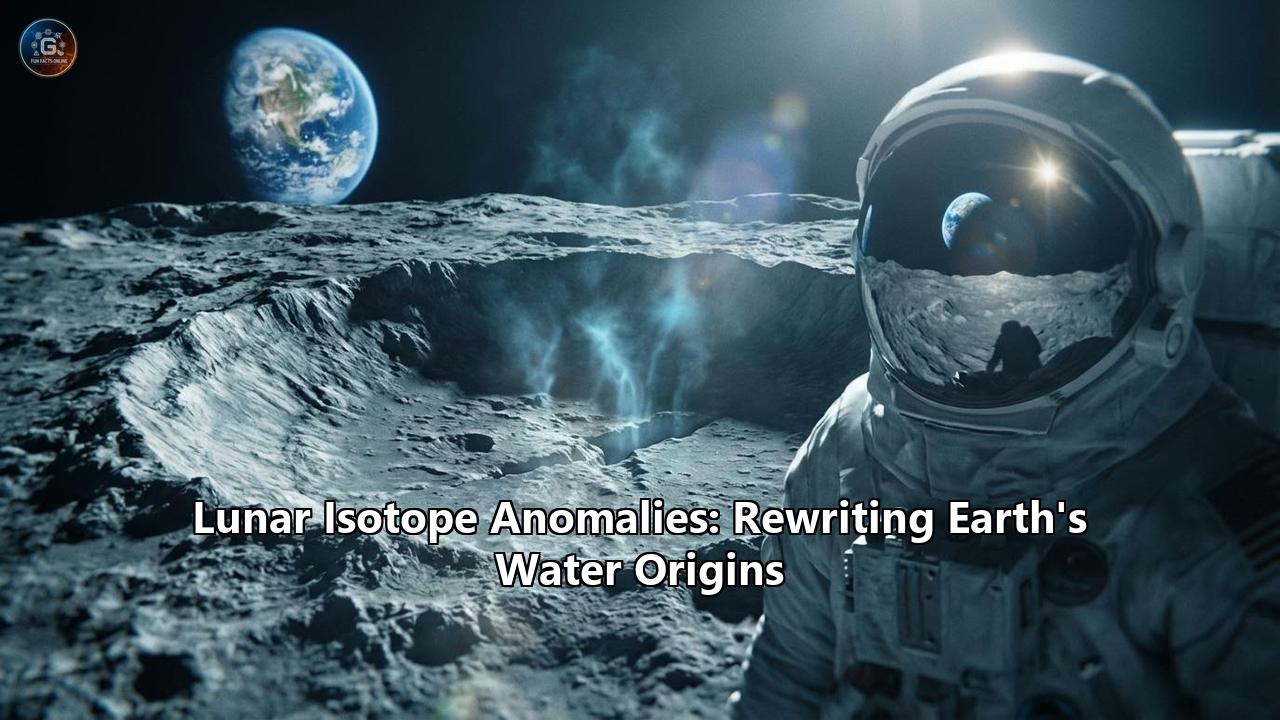
The pale, crater-pocked surface of the Moon has long been viewed as a desolate, bone-dry wasteland—a silent witness to the chaotic early days of our solar system. For decades, it stood in stark contrast to Earth, our vibrant, water-drenched blue marble. When scientists looked at the two bodies, they saw a profound paradox. How could two worlds, locked in an intimate orbital dance, have such wildly different fates? Where did Earth get all its water, and why was the Moon seemingly robbed of it?
For generations, the answers to these questions seemed settled in the textbooks. The prevailing theory held that Earth’s water was a cosmic afterthought, delivered by icy comets and water-rich asteroids late in the planet’s development. But over the last few years—culminating in a series of groundbreaking discoveries between 2024 and 2026—the Moon has begun to tell a radically different story.
By analyzing lunar dust and rock samples brought back over fifty years ago by the Apollo missions using unprecedented, next-generation isotopic technology, scientists have uncovered chemical fingerprints that are rewriting the history of our solar system. The isotopic anomalies hidden within lunar regolith suggest that the “late delivery” theory is mathematically and geochemically flawed. Instead, the evidence points to a much more profound and surprising reality: Earth was likely born wet, and the ingredients for life were baked into our planet from the very beginning.
To understand how the Moon is rewriting Earth's water origins, we must first travel back 4.5 billion years to a cataclysm that changed the solar system forever.
The Theia Catastrophe and the "Late Veneer"
To appreciate the magnitude of the recent isotopic discoveries, it is essential to understand the scientific dogma they are overturning. According to the Giant Impact Hypothesis, roughly 4.5 billion years ago, a Mars-sized protoplanet named Theia collided with the proto-Earth. It was an event of unimaginable violence. The impact liquefied the Earth’s surface, turned rock into vapor, and blasted a massive ring of molten debris into orbit, which eventually coalesced to form the Moon.
Because of the extreme temperatures generated by this cosmic collision, planetary scientists naturally assumed that all "volatiles"—elements and compounds that easily vaporize, like water, carbon, and nitrogen—were boiled off into the vacuum of space. The newly formed Moon, lacking the gravity to hold onto an atmosphere, was left utterly dry. Earth, while massive enough to cool and retain an atmosphere, was theoretically left barren and parched by the inferno.
So, how did we get oceans?
The traditional answer was the "Late Veneer" theory. This hypothesis posited that millions of years after the Earth and Moon had cooled, a heavy bombardment of water-rich carbonaceous meteorites and icy comets from the outer solar system pelted the Earth. This late-stage delivery system supposedly brought the water that would eventually form our oceans, rivers, and the biological foundation for all life.
It was a neat, elegant theory. But as analytical technology advanced, the chemical evidence began to stubbornly refuse to fit the narrative.
The Isotopic Fingerprint: A Cosmic DNA Match
In geology and astrophysics, isotopes act as a form of cosmic DNA. Elements like oxygen and hydrogen exist in different variations (isotopes) depending on the number of neutrons in their nucleus. The specific ratio of these isotopes in a rock acts as a permanent fingerprint, indicating exactly where in the solar system that rock formed.
If Earth’s water and surface materials were delivered by a "late veneer" of meteorites from the outer solar system, the isotopic fingerprints of Earth's mantle should reflect that distant origin. Furthermore, because the Moon did not have the gravity to capture and retain the same massive oceans of late-arriving water, Earth and the Moon should have noticeably different isotopic signatures.
But they don’t.
In a landmark 2024 study published in the Proceedings of the National Academy of Sciences (PNAS), researchers conducted hyper-precise measurements of oxygen isotope ratios in lunar and terrestrial rocks. The results were staggering: there is an isotopic match between the Earth and the Moon at a sub-parts-per-million (ppm) level, with almost no heterogeneity between Earth's upper mantle and lunar samples.
This identical isotopic composition contradicts the prevailing models of the Moon's formation. If a late veneer of water-rich meteorites had covered the Earth, it would have altered Earth's oxygen isotope ratio, driving a wedge between the Earth's signature and the Moon's signature. The fact that the two bodies remain isotopically identical places incredibly tight constraints on what kind of material could have struck Earth after the Moon formed.
The data suggested a massive paradigm shift: the water on Earth and the Moon must have originated from a well-mixed, primordial reservoir long before any "late veneer" arrived.
Enter the Enstatite Chondrites: The "Dry" Rocks That Weren't
If the late veneer didn't bring the water, where did it come from? The search for a suspect with the exact same isotopic DNA as Earth and the Moon led scientists to a rare class of meteorites known as enstatite chondrites (ECs).
Enstatite chondrites are forged from the inner solar nebula—the exact same primordial material that clumped together to build the proto-Earth. For decades, these rocks were presumed to be totally dry. Because they formed in the inner solar system, close to the young, blazing Sun, temperatures were assumed to be far too high for water to condense.
However, advanced X-Ray Absorption spectroscopy and mass spectrometry over the past few years have shattered this assumption. A 2020 study by researchers in France, later expanded upon by a highly detailed 2025 study from the University of Oxford, revealed that these "dry" rocks are actually packed with hidden hydrogen.
By chemically fingerprinting the meteorites, the Oxford team proved that the hydrogen locked inside the non-crystalline parts of enstatite chondrites was intrinsic to the rocks themselves, not a result of modern terrestrial contamination. The implications are breathtaking. Calculations show that these inner solar system rocks—the very building blocks of Earth—contained enough hydrogen to deliver at least three times the amount of water currently sloshing around in Earth's oceans.
Earth didn’t need a special delivery of water from the outer solar system. It was built out of materials that already contained the seeds of the oceans. The ingredients for a blue marble were present 4.55 billion years ago.
The 2026 Breakthrough: Apollo's Dust Settles the Debate
While the enstatite chondrite discoveries strongly suggested Earth was born wet, the final nail in the coffin for the "Late Veneer" theory as the primary source of our oceans came in January 2026.
Because Earth's surface is constantly recycled by plate tectonics, weathering, and volcanism, our planet has erased the physical record of its early asteroid bombardments. The Moon, by contrast, is a geologically dead time capsule. Its surface is covered in regolith—a layer of loose, pulverized rock and dust created by billions of years of meteorite impacts. The Moon has faithfully recorded everything that has hit the Earth-Moon system.
Historically, scientists tried to measure this impact history by looking for "metal-loving" (siderophile) elements in the lunar dust. But repeated meteorite impacts melt, vaporize, and endlessly rework the lunar soil, muddying the chemical evidence and making it nearly impossible to tell exactly how much meteorite material was added versus how much was indigenous lunar rock.
A team led by Dr. Tony Gargano at NASA's Johnson Space Center and the Lunar and Planetary Institute (LPI) took a revolutionary new approach. Instead of looking at trace metals, they looked at oxygen—the most abundant element in the rocks—using high-precision triple oxygen isotope measurements.
Because oxygen isotopes remain relatively stable even during high-energy, vaporizing impacts, Gargano’s team was able to separate the isotopic signals of the original lunar rock from the foreign meteorite material. They could finally pull a clear impactor fingerprint out of a mixture that had been churned for four billion years.
Their findings, published in PNAS, were definitive. By calculating the isotopic offsets, they determined that over the last 4 billion years, impactor-derived material (specifically from carbon-rich meteorites) accounts for only about 1% of the mass of the lunar regolith.
When the team took that 1% figure and scaled it up to account for Earth's larger size and higher gravity, the mathematical reality was stark: the total amount of water delivered to the Earth-Moon system by late meteorites over the last 4 billion years is practically negligible. Even under the most generous assumptions, late meteorite delivery could only have supplied a minute fraction of Earth's total water inventory.
"Our results don't say meteorites delivered no water," noted Dr. Justin Simon, a co-author from NASA's Astromaterials Research and Exploration Science Division. "They say the Moon's long-term record makes it very hard for late meteorite delivery to be the dominant source of Earth's oceans."
The late veneer was mathematically dead as the creator of Earth's oceans. The water had to have been here from the start, surviving the cataclysm of the Moon's formation.
A Dual Heritage: The Water Inside the Moon
If Earth managed to hold onto its water during the Giant Impact, what about the Moon? The old view of a bone-dry Moon has been spectacularly dismantled in recent years.
In late 2024, researchers from the Vrije Universiteit Brussel (VUB), using a technique developed by Dr. Morgan Nunn Martinez, analyzed water trapped inside nine Apollo lunar samples. They used a method called stepwise heating—baking the samples at 50°C, 150°C, and 1,000°C—to separate water that was loosely bound to the surface from water that was tightly trapped deep inside the mineral glasses.
What they found was a stunning "dual heritage" of lunar water.
First, the deep, tightly bound water inside the lunar minerals had an oxygen isotopic composition that perfectly matched the early-Earth enstatite chondrites. This means that the Moon inherited indigenous water from the Earth during the chaotic collision 4.5 billion years ago. The water actually survived the vaporization of the Giant Impact and became trapped in the cooling lunar magma.
Secondly, the loosely bound surface water showed isotopic signatures linking it to later cometary impacts. Notably, this study vastly reduced the importance of the "solar wind" theory, which previously argued that most lunar water was created on the surface when hydrogen from the sun reacted with oxygen in the lunar dust. Instead, the Moon's water is a complex mix of ancient, Earth-like reservoirs and minor outer-space additions.
The Cold Traps and the Future of Human Exploration
While the amount of water delivered by meteorites and comets to the Moon is tiny compared to an Earth ocean, it is of monumental importance to the future of humanity.
Because the Moon lacks an atmosphere to distribute heat, its temperatures are highly extreme. At the lunar poles, deep craters exist in permanent shadow, never seeing the light of the sun. Research spearheaded by the University of New Mexico has mapped these regions, revealing temperatures that plunge to 25 to 50 Kelvin (around -400°F)—far colder than the deepest interior of Antarctica.
In these freezing abysses, known as "cold traps," the minor fraction of water delivered by those late meteorite impacts over billions of years has been preserved as ice. The very meteorites that Gargano’s 2026 study proved were insufficient to fill Earth's oceans were just enough to leave behind a vital oasis on the Moon.
As NASA’s Artemis program prepares to return humans to the lunar surface to establish a permanent presence, these cold traps are the ultimate prize. The isotopic anomalies that scientists have spent years decoding in laboratories are no longer just academic curiosities; they are a treasure map. The ancient, frozen water locked in the Moon's shadowed craters will be harvested to provide drinking water for astronauts, oxygen for breathing, and hydrogen for rocket fuel to push humanity further into the solar system.
A Wet Earth from the Start
The study of lunar isotopes has brought us full circle. For decades, we looked to the outer edges of the solar system—to icy comets and wandering asteroids—to explain the miracle of our blue planet. We believed that Earth was a barren rock that had to be rescued by cosmic rain.
But the dust brought back by the Apollo astronauts has forced us to look inward. The hyper-precise measurements of triple oxygen isotopes and the discovery of water hidden within enstatite chondrites have painted a beautiful, resilient picture of our origins.
The Earth was not born dry. The building blocks of our world were already infused with the hydrogen needed to form oceans. When the planet Theia smashed into the proto-Earth, tearing a ring of debris into the sky to form the Moon, the water was not entirely lost to the void. It survived the inferno. It remained locked deep in the cooling mantle of the Earth, and it was seeded into the molten rock of the newly birthed Moon.
The "Late Veneer" did happen, but as the lunar regolith definitively proves, it was merely a dusting of snow on an already flooded world.
This revelation is profoundly optimistic for the search for life beyond our solar system. If water is not just a fragile compound that boils away at the first sign of planetary violence, but rather a resilient, native ingredient tightly bound to the inner-system rocks that build terrestrial planets, then rocky exoplanets across the galaxy might be far wetter, and far more hospitable, than we ever dared to imagine.
When we look up at the Moon tonight, we are not looking at a dry, dead rock. We are looking at a chemical vault. A vault that held onto the isotopic secrets of our own oceans for four and a half billion years, patiently waiting for us to develop the technology to read them. It turns out the story of how Earth got its oceans was written on the Moon all along.
Reference:
- https://karmaka.de/?p=23431
- https://news.unm.edu/news/unm-researchers-analyze-moon-record-challenging-earths-water-origins
- https://www.google.com/search?q=time+in+Provincia+di+Foggia,+IT
- https://science.nasa.gov/science-research/astromaterials/nasa-finds-lunar-regolith-limits-meteorites-as-source-of-earths-water/
- https://www.sci.news/space/earths-water-enstatite-chondrite-like-asteroids-08793.html
- https://www.earth.ox.ac.uk/article/scientists-uncover-crucial-evidence-origin-water-earth
- https://source.washu.edu/2020/08/meteorite-study-suggests-earth-may-have-always-been-wet/
- https://www.sciencealert.com/origins-of-earths-water-may-not-be-as-complicated-as-we-thought
- https://www.pnas.org/doi/10.1073/pnas.2531796123