
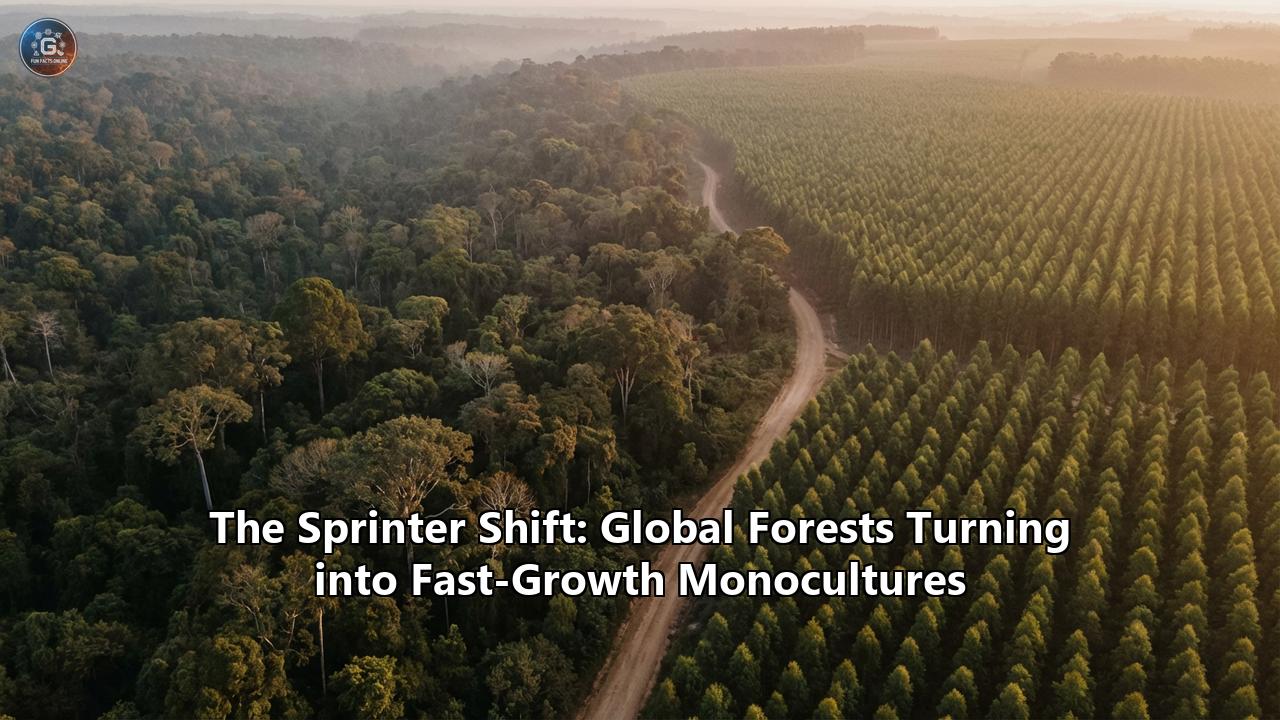
If you were to walk through a forest in central Chile, the peatlands of Sumatra, or the rolling hills of New Zealand today, you might notice something striking. The trees are tall, straight, and green. To the untrained eye, this is a thriving ecosystem, a testament to nature’s resilience or humanity's commitment to "greening" the planet. But look closer. The undergrowth is sparse, the silence is heavy—devoid of the chaotic symphony of bird calls and insect hums—and the trees themselves are uniform soldiers, standing in perfect rows.
This is not a forest. It is a farm.
We are witnessing a planetary transformation that scientists have termed "The Sprinter Shift." It is a phenomenon where the complex, slow-growing, and resilient "backbone" species of the world’s forests are being systematically replaced by "sprinters"—fast-growing, short-lived, and resource-hungry trees. From the industrial plantations of Eucalyptus in South America to the vast monocultures of Acacia in Southeast Asia and Pine in Europe, the world’s arboreal makeup is shifting from a marathon to a sprint.
This shift is not merely an aesthetic change; it is a fundamental rewiring of the Earth's biosphere. Driven by an insatiable economic appetite for timber, pulp, and bioenergy, and paradoxically accelerated by well-intentioned but flawed climate policies, this transition threatens to destabilize the global carbon cycle, decimate biodiversity, and displace communities. We are trading the ancient stability of the oak, the teak, and the mahogany for the fragile speed of the pine and the poplar. In doing so, we are building a house of cards out of the world’s forests—one that may not withstand the coming storms of the Anthropocene.
Chapter 1: The Biology of the SprinterTo understand why the world’s forests are changing, we must first understand the fundamental biological trade-off that governs the life of a tree. In ecology, this is known as the "fast-slow" life history spectrum.
The Tortoise and the HareFor millions of years, the world’s most stable ecosystems were dominated by "conservative" species. These are the tortoises of the plant kingdom. Trees like the European Oak (Quercus robur), the Amazonian Mahogany (Swietenia macrophylla), and the Southeast Asian Dipterocarps evolved to play the long game. They invest heavily in dense, durable wood and thick, nutrient-rich leaves. They grow slowly, often spending decades in the shaded understory before reaching the canopy. Their high wood density makes them resistant to rot, pests, and physical damage. Physiologically, they are built for survival, capable of weathering droughts and storms that would snap lesser trees in half.
In contrast, the "sprinters"—species like Pinus radiata, Eucalyptus globulus, and Acacia mangium—are the hares. They evolved to colonize disturbed lands quickly. Their strategy is "acquisitive." They have low wood density, light and cheap leaves, and hydraulic systems designed to pump water at breakneck speeds to fuel rapid photosynthesis. A sprinter does not care about longevity; it cares about dominating a space before anyone else can.
The Hydraulic GambleRecent research published in Nature Plants (2026) has revealed a terrifying vulnerability in this strategy. The study, which analyzed over 31,000 tree species globally, found that the very traits that make sprinters profitable—fast growth and efficient water transport—make them deadly fragile.
Trees transport water from their roots to their leaves through a network of conduits called xylem. Sprinters have wide xylem vessels that allow for massive water flow, supporting their rapid growth. However, this is a high-risk gamble. When a drought hits, the tension in these water columns increases. If the tension becomes too great, the water column snaps, creating an air bubble—an embolism. This process, known as hydraulic failure or cavitation, blocks the flow of water.
Conservative trees have narrower, safer vessels that can withstand immense tension. Sprinters do not. When pushed by the hotter, drier droughts of the 21st century, sprinters suffer from "rapid hydraulic collapse." They don't just slow down; they die suddenly and catastrophically. By replacing the world's drought-tolerant backbone species with hydraulic gamblers, we are creating forests that are one heatwave away from total collapse.
Chapter 2: The Economic EngineThe Sprinter Shift is not an accident of nature; it is an engineered outcome of the global economy. The drivers are threefold: the traditional demand for fiber, the rising bioeconomy, and the newly monetized value of carbon.
The Pulp and Paper VoracityThe demand for packaging, tissue, and paper products has never been higher. To meet this demand, the forestry industry has standardized its operations around a handful of "miracle" species. Eucalyptus, originally from Australia, is now the most planted hardwood on Earth. It can be harvested for pulp in as little as 5 to 7 years in tropical climates. No native hardwood can compete with that turnover.
This economic logic has turned vast landscapes into "fiber farms." In countries like Brazil and Indonesia, the conversion is stark. Native forests, with their messy complexity and centuries-old trees, are viewed as inefficient assets. They are cleared to make way for the "green oil" of eucalyptus and acacia.
The Bioenergy ParadoxA newer, perhaps more insidious driver is the "bioeconomy." In an effort to wean off fossil fuels, nations—particularly in Europe—have turned to biomass energy. Power plants are converted to burn wood pellets, theoretically a carbon-neutral fuel.
However, this demand creates a hunger for wood that natural forests cannot sustainably feed. The solution? More plantations. Fast-growing pine and willow are planted specifically to be harvested, chipped, and burned. This creates a perverse incentive where "forests" are grown not to store carbon, but to be emitted into the atmosphere, all subsidized by green energy policies.
The Carbon Credit TrapPerhaps the most tragic driver of the Sprinter Shift is the very mechanism designed to save us: the carbon credit market.
Corporations racing to reach "Net Zero" are pouring billions into reforestation projects. But carbon markets are often myopic. They pay for "tonnes of CO2 sequestered," and they want those tonnes now.
A slow-growing oak might sequester a massive amount of carbon over 200 years, but in the first 10 years—the timeframe relevant to a corporate quarterly report or a 2030 climate target—it sequesters very little. A sprinter like a poplar or pine, however, sucks up carbon furiously in its first decade.
This "time value of carbon" bias creates a financial penalty for planting native, slow-growing trees. Carbon project developers, incentivized by the market, opt for monocultures of fast-growing exotics. They can sell the credits sooner and at a higher volume. The result is "carbon junk": forests that look good on a spreadsheet today but may burn down, die of drought, or be harvested in 15 years, releasing that carbon right back into the atmosphere.
Chapter 3: Regional Deep DivesThe abstract trends of the Sprinter Shift manifest in brutal, tangible ways across different continents.
Chile: The Green Desert and the Mapuche StruggleIn the Biobío and Araucanía regions of Chile, the Sprinter Shift is a story of violence and thirst. During the dictatorship of Augusto Pinochet, the regime passed Decree Law 701, a subsidy that paid up to 75% of the cost of planting pine and eucalyptus.
The policy worked. Today, millions of hectares of central Chile are covered in dense, dark plantations of Pinus radiata and Eucalyptus globulus. The forestry industry boasts of its contribution to the economy, but the local reality is different.
Indigenous Mapuche communities call these plantations "green deserts." The trees are planted so densely that no light reaches the forest floor, killing the undergrowth where medicinal herbs and berries once grew. Worse, these thirsty sprinters act as biological pumps, sucking the groundwater dry.
In the summer of 2017 and again in 2023, these regions burned. The plantations, filled with resinous, flammable pine and dry leaf litter, acted as colossal fuel loads. The fires moved with terrifying speed, fueled by the very biology of the sprinters. For the Mapuche, the Sprinter Shift is not just an ecological issue; it is a continuation of colonization, where their ancestral, diverse lands are replaced by a foreign, extractive monoculture that steals their water and invites fire.
Indonesia: The Peatland CatastropheIn Sumatra and Kalimantan, the Sprinter Shift has collided with one of the world's most critical carbon sinks: tropical peatlands.
Peatlands are waterlogged ecosystems that store gigatonnes of carbon in the soil. To grow Acacia crassicarpa for pulp and paper, companies dig vast canals to drain the water. The peat dries out and begins to oxidize, releasing massive amounts of CO2 even without fire.
But the fire always comes. The dried peat is like tinder. When the acacia plantations—themselves highly flammable—catch fire, the peat underneath ignites. These fires can burn underground for months, creating a toxic haze that chokes Southeast Asia.
The irony is palpable. The acacia is planted to produce "renewable" paper and packaging, yet its cultivation on peatlands turns the land into a carbon bomb. The "restoration" efforts often involve planting more trees, but if those trees are the wrong species—thirsty sprinters that require drainage—the cycle of destruction only accelerates.
China: The Grain for Green ParadoxChina’s "Grain for Green" program is the largest reforestation effort in human history. Billions of trees have been planted to stop desertification and reduce soil erosion. On satellite maps, China looks greener.
However, studies reveal that a significant portion of this "forest" is actually monoculture. In many areas, diverse farmlands or native scrublands were replaced by single-species stands of Japanese cedar, bamboo, or fruit trees.
While green cover increased, biodiversity in some regions plummeted. Native birds and bees, adapted to complex ecosystems, found no home in the silent rows of the new forests. Furthermore, in the arid Loess Plateau, the planting of thirsty, fast-growing trees has depleted soil moisture to dangerous levels, threatening the long-term survival of the very trees meant to save the land.
Chapter 4: The Ecological ConsequencesThe shift from diverse backbones to uniform sprinters has cascading effects that reshape the entire web of life.
The Biodiversity CrashA natural forest is a hotel with a million rooms. The cracked bark of an old oak, the varying heights of the canopy, the dead wood on the floor—each niche supports a different species.
A sprinter monoculture is a hotel with only one type of room. It supports only the few generalist species that can adapt to it. A study in the Amazon found that replacing primary forest with plantations resulted in the loss of over 90% of bird, amphibian, and beetle species. The complex interactions—pollination, seed dispersal, predation—collapse.
The Homogenization of EarthBiologists worry about "functional homogenization." As we spread a handful of commercially viable species across the globe, we are erasing the unique biological identity of regions. A pine plantation in South Africa looks, smells, and functions eerily similar to one in Scotland or Chile. We are McDonald-izing the world’s forests, creating a generic, simplified biosphere that lacks the unique adaptations evolved over millions of years to handle local pests and climates.
The Stability CrisisMonocultures are structurally unsound. In a diverse forest, pests and diseases have a hard time finding their hosts. If a beetle kills one tree, the next tree is likely a different species that is immune. The forest survives.
In a monoculture, the next tree is a genetic clone of the victim. An infestation spreads like wildfire. The mountain pine beetle outbreaks in North America or the nematode attacks on pine in Asia are previews of what happens when we put all our eggs in one genetic basket.
Furthermore, sprinters are physically weaker. Their low wood density makes them susceptible to "windthrow." As climate change increases the intensity of storms, these tall, brittle plantations are snapping like matchsticks, turning a carbon sink into a source of emissions overnight.
Chapter 5: The Carbon IllusionWe are banking on these forests to save us from climate change. We are counting the carbon they sequester in our national inventories and corporate offset portfolios. But this math is dangerous.
The Volatility of Stored CarbonCarbon stored in a 500-year-old Redwood is "safe" carbon. It is locked in rot-resistant wood and a stable soil ecosystem. Carbon stored in a 15-year-old Eucalyptus is "volatile" carbon. It is held in a system that is prone to fire, drought, and harvest.
When we replace a natural forest with a plantation, or when we claim a plantation offsets fossil fuel emissions, we are trading permanent geological carbon (fossil fuels) for temporary, vulnerable biological carbon. If the plantation burns or dies of hydraulic failure, that carbon returns to the atmosphere.
The Soil Carbon DeficitMuch of a forest's carbon is underground. Sprinter plantations often disturb the soil during planting and harvesting. Research shows that while the trees above ground grow fast, the soil carbon below often depletes, especially when plantations replace grasslands or old-growth forests. In some cases, the net carbon benefit of a plantation is zero or even negative when soil loss is accounted for.
Chapter 6: Voices from the ResistanceThe Sprinter Shift is not going unchallenged. Across the globe, a coalition of scientists, indigenous peoples, and activists is fighting to reclaim the definition of a forest.
The Mapuche Land DefendersIn Chile, the struggle is visceral. Mapuche communities have occupied plantations, demanding the return of their ancestral lands. They are not just fighting for territory; they are fighting for the return of the lawen (medicinal plants) and the water that the plantations have stolen. Their vision of the land is one of a mosaic—crops, native forests, and homes—not a monolithic industrial grid.
The Scientists’ WarningThe academic community is raising the alarm. The "Lübeck Model" in Germany serves as a beacon of resistance. In the city forest of Lübeck, foresters abandoned the industrial model 30 years ago. They stopped clear-cutting, stopped planting monocultures, and allowed the forest to regenerate naturally.
The result? The forest became more diverse, more resilient to storms, and—crucially—more profitable. By harvesting fewer, higher-quality trees and minimizing management costs, the Lübeck forest outperformed its industrial neighbors. It proved that you don't need sprinters to make a living from the forest; you need patience.
Chapter 7: The Path Forward – From Sprint to MarathonWe cannot simply stop using wood. Humanity needs timber and fiber. But the current trajectory is suicidal. We need a new paradigm for global forestry.
1. Assisted Natural Regeneration (ANR)The most effective tree planter is not a drone or a human with a shovel; it is a squirrel, a bird, or the wind. Assisted Natural Regeneration involves protecting land from grazing and fire and letting nature do the rest.
In the Sahel region of Africa, this approach has worked miracles. Through "Farmer Managed Natural Regeneration" (FMNR), farmers in Niger and Burkina Faso regenerated millions of hectares of land by simply pruning and protecting the "underground forest" of living stumps that had been dormant for decades. No nurseries, no expensive foreign saplings. Just the resilience of native, backbone species returning to life.
2. Mixed-Species PlantationsIf we must plant, we must plant mixtures. A study of global forestry data found that four-species mixtures stored 70% more carbon than monocultures. Mixed forests are more productive because different species use different resources—some root deep, some root shallow; some fix nitrogen, some provide shade. They are also infinitely more resilient to pests and drought.
3. Reforming Carbon MarketsWe need "Premium Carbon." A credit from a monoculture plantation should not be worth the same as a credit from a restored, biodiverse native forest. We need a grading system that values biodiversity, water security, and permanence. If the market pays a premium for "backbone" carbon, the Sprinter Shift will lose its financial fuel.
4. The Rights-Based ApproachWe must recognize that the best guardians of forests are the people who live in them. Indigenous territories contain the highest biodiversity and the most stable carbon stocks on Earth. Strengthening their land rights is not just a social justice imperative; it is the most effective climate strategy we have.
Conclusion: The Cathedral vs. The WarehouseWe are at a crossroads. We can continue to treat the world’s forests like warehouses—places to store standardized goods for quick retrieval. If we do, we will inherit a world of "green deserts," fragile ecosystems that crumble under the weight of a changing climate, leaving us with wood but no water, trees but no life.
Or, we can start treating forests like cathedrals—complex, enduring structures built for the ages. We can embrace the slow, messy, beautiful complexity of the backbone species. We can accept that true resilience takes time.
The Sprinter Shift is a temptation of the modern age: the desire for a quick fix, a fast return, a simple metric. But nature does not run on quarterly cycles. It runs on deep time. If we want our forests to survive the turbulent century ahead, we must stop sprinting. We must learn, once again, how to stand still and grow strong.
Deep Dive: The Physiological Mechanism of Hydraulic Failure
To truly grasp the peril of the Sprinter Shift, one must zoom in to the microscopic level of a tree's vascular system. The xylem of a tree is essentially a bundle of straws. As water evaporates from the leaves (transpiration), it creates a negative pressure—a pulling force—that drags water up from the roots.
This is a physical feat of defying gravity. In a 30-meter tall Eucalyptus, the tension is immense.
- Sprinter Anatomy: Fast-growing trees prioritize efficiency. They build "cheap" xylem with wide vessels and thin walls (low wood density). Wide vessels conduct water massively fast, fueling rapid leaf growth. However, under drought conditions, when the soil is dry, the tension required to pull water up increases drastically.
- The Snapping Point: If the tension exceeds the structural limit of the xylem, the water column breaks. Air is sucked in through microscopic pores in the pit membranes between vessels. This air bubble blocks the vessel.
- Runaway Embolism: In sprinters, because the vessels are wide and interconnected to maximize flow, an embolism can spread rapidly from one vessel to another. This leads to systemic hydraulic failure. The tree, unable to transport water, desiccates and dies in a matter of days or weeks. This is why we see "flash droughts" killing plantations seemingly overnight.
- Backbone Anatomy: Slow-growing species (e.g., Oaks, hard Maples) build "expensive" xylem. They use high wood density to reinforce the vessel walls. Their vessels are narrower, which creates more friction (slowing growth) but provides immense safety against air bubble entry. They can sustain photosynthesis even in parched soils where a sprinter would have long since perished.
The replacement of native forest with plantations in Chile is not just an environmental issue; it is a geopolitical one. The ancestral territory of the Mapuche people, the "Wallmapu," overlaps almost perfectly with the forestry industry's heartland.
- Medicinal Loss: For the Mapuche, the forest is a pharmacy. Specific native trees are essential for their Machi (healers). Plantations of pine and eucalyptus destroy the microclimates these medicinal plants need.
- Water Theft: The exotic trees are evergreen and grow year-round, transpiring water continuously. Native deciduous forests in Chile rest during the summer or have lower water rates. The result is that streams that have flowed for centuries dry up when plantations arrive. Communities are forced to rely on water trucks delivered by the government—a humiliation that fuels radical resistance.
- The Conflict: Groups like the CAM (Coordinadora Arauco-Malleco) have engaged in sabotage, burning logging trucks and machinery. The state responds with anti-terrorism laws. At the heart of this "conflict" is the tree itself—the Sprinter—standing as an occupier on stolen land.
The Lübeck forest in Germany challenges the central dogma of modern forestry: that you need to plant trees to have a forest.
- The Method: "Integrated Process Protection." They do not clear-cut. They harvest single, high-value trees. They leave dead wood (crucial for fungi and insects). They rely 100% on natural regeneration.
- The Economics: By eliminating planting costs (nurseries, labor, fencing) and reducing thinning costs, they drastically lower their overhead. The wood they harvest is older, denser, and of higher quality, commanding a better price.
- The Resilience: During recent European windstorms and bark beetle outbreaks, the mixed, uneven-aged forest of Lübeck suffered minimal damage compared to the spruce monocultures of neighboring regions, which were decimated. It is a living proof that working with the slow rhythms of nature is, in the long run, the most economically rational choice.
Why does the carbon market favor sprinters? It comes down to "Additionality" and "Time Horizons."
- The Discount Rate: Economic models discount the future. A dollar today is worth more than a dollar in 50 years. Similarly, a tonne of carbon sequestered today is valued more than one sequestered in 2100.
- The Growth Curve: A sprinter has a sigmoidal growth curve that shoots up vertically in the first 10-20 years. A backbone species has a linear or exponential curve that starts slow and accelerates later.
- The Result: If you are a project developer looking for a 20-year return on investment, the sprinter is the only logical choice. You get the credits, sell them to an airline or oil company, and exit. What happens to the forest in year 30 is not your financial problem. This short-termism is baking instability into the planetary climate system.
The Sprinter Shift is a mirror of our civilization. We have built an economy based on speed, consumption, and the illusion of infinite growth, and we have imposed that model onto the natural world. But the forest is not a factory. It is a living entity with its own rules, rules that prioritize endurance over speed.
As the "green deserts" expand, we are learning a hard lesson: you can plant a billion trees, but you cannot plant a forest. A forest must grow, slowly, in conversation with the soil, the rain, and the generations of life that call it home. The future of our planet depends on whether we are willing to slow down and listen.
Reference:
- https://www.yourweather.co.uk/news/science/the-world-s-forests-are-becoming-more-uniform-and-that-s-a-problem-scientists-say.html
- https://villarsinstitute.org/posts/how-carbon-forestry-can-preserve-biodiversity/
- https://www.youtube.com/watch?v=-JpkauMvxDQ
- https://www.ecoforestryfoundation.se/en/ecosystem-based-forestry/
- https://reliefweb.int/report/burkina-faso/regreening-sahel-quiet-agroecological-evolution
- https://www.oneearth.org/case-study-10-farmer-managed-natural-regeneration-of-trees/
- http://www.integrateplus.org/uploads/images/Mediacenter/Field_Guide_Luebeck_Final_EN.pdf
- https://www.youtube.com/watch?v=oF6zJwbNeIw
- https://www.youtube.com/watch?v=EZad_7OZJyk
- https://www.naturebasedsolutionsinitiative.org/news/species-richness/
- https://www.youtube.com/watch?v=4oZ59lni3RQ
- https://pmc.ncbi.nlm.nih.gov/articles/PMC8072240/
- https://naturwald-akademie.org/en/forestry/