
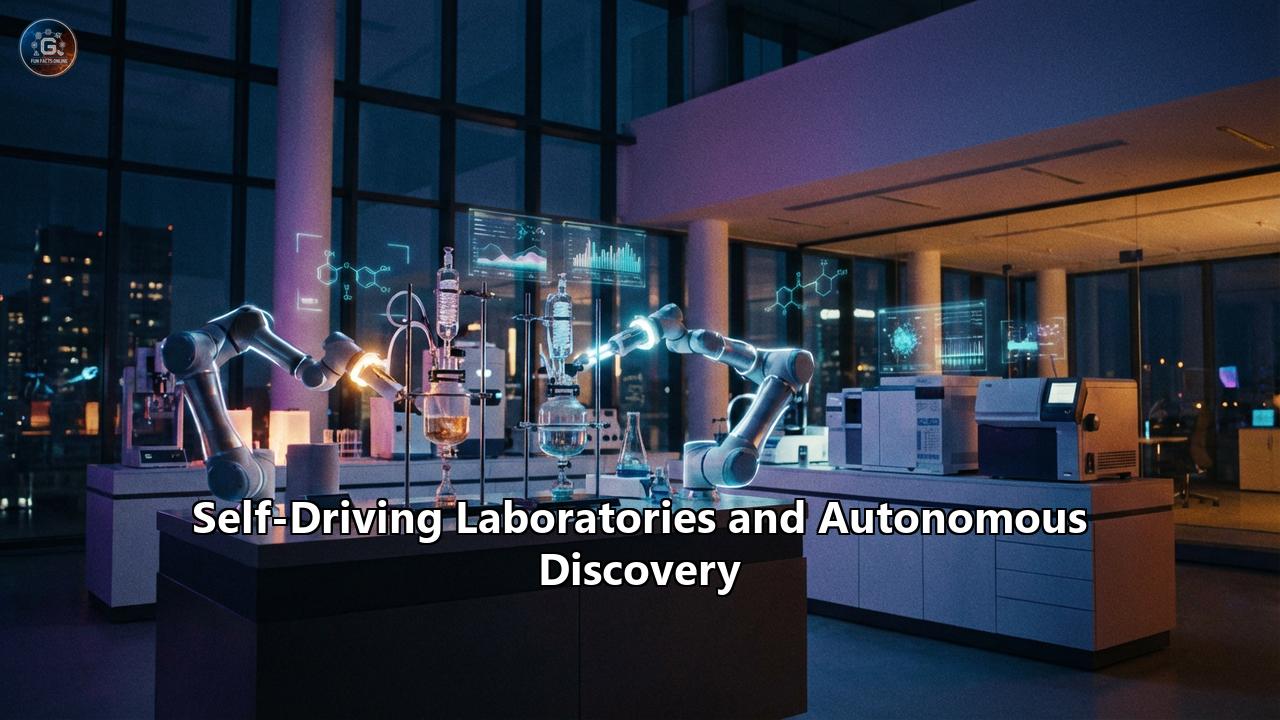
In the quiet hum of a laboratory in Toronto, a robotic arm deftly picks up a vial, dispenses a precise micro-liter of a golden reagent, and places it into a spectrometer. There are no humans in the room. It is 3:00 AM on a Sunday. By the time the researchers arrive on Monday morning, this system will have performed, analyzed, and learned from more experiments than a human chemist could complete in a year.
We are witnessing a paradigm shift that is arguably as significant as the invention of the microscope. It is the dawn of Self-Driving Laboratories (SDLs)—autonomous discovery platforms that combine artificial intelligence (AI), robotics, and high-throughput experimentation to accelerate scientific progress by orders of magnitude.
As of late 2025, SDLs have moved beyond the realm of academic novelty into the engines of industrial innovation. From discovering novel organic lasers in a single weekend to synthesizing life-saving drugs in days rather than years, autonomous discovery is no longer a futuristic concept—it is the new operating system of science.
Part 1: The Anatomy of a Self-Driving Lab
To understand the revolution, we must first look under the hood. A self-driving laboratory is not merely a "robot in a lab." It is a cyber-physical system where the loop between hypothesis, experiment, analysis, and refinement is closed completely by software.
1.1 The Brain: The AI "Driver"
At the core of every SDL is an AI agent, typically powered by Bayesian optimization or, more recently, Generative AI models fine-tuned on scientific data.
- Active Learning: Unlike traditional automation that follows a pre-set recipe (e.g., "mix A and B 100 times with different temperatures"), an SDL uses active learning. After every single experiment, the AI analyzes the result to decide what to do next. It asks: "Given what I just learned, what experiment will give me the most information to solve the problem?"
- Navigating the Search Space: Imagine looking for the highest peak in a thick fog. A human might walk blindly. A grid search checks every square meter. An SDL behaves like a seasoned mountaineer, using the slope of the ground to predict where the summit might be, taking the most efficient path. This reduces the number of experiments needed by up to 90%.
1.2 The Hands: Modular Robotics
The hardware of 2025 has shed the rigid, bolted-down nature of early automation.
- Mobile Robotic Chemists: Platforms like the "mobile robotic chemist" (first popularized by Liverpool University and now standard in many top-tier labs) roam freely, operating standard human instruments. They can press buttons, turn dials, and handle solids—a historically difficult task for automation.
- Modular Synthesis Platforms: Systems are now built like LEGO sets. You might have a module for flow chemistry, another for purification, and another for characterization (NMR, HPLC). These modules are interconnected, allowing materials to flow seamlessly from synthesis to testing without human hands touching them.
1.3 The Nervous System: The Digital Twin
Advanced SDLs today utilize "Digital Twins"—virtual replicas of the physical lab. Before the robot moves a muscle, the experiment is simulated in the digital twin to check for collisions, resource constraints (e.g., "Do we have enough solvent?"), and feasibility. This ensures that the physical lab runs with near-zero downtime.
Part 2: The "Closed-Loop" Revolution
The magic of SDLs lies in the closed loop. In a traditional workflow, a scientist runs an experiment, analyzes data in Excel, thinks about it, goes to lunch, comes back, and plans the next step. This cycle might take a day or a week.
In an SDL, this cycle happens in seconds.
- AI Design: The algorithm selects a set of experimental parameters (temperature, catalyst, stoichiometry).
- Orchestration: The software translates this into robotic instructions (G-code or similar).
- Execution: The robot performs the synthesis.
- Characterization: The product is automatically moved to an analytical instrument.
- Feedback: The data (yield, purity, optical property) is fed back to the AI, which updates its internal model of the world and selects the next experiment immediately.
In April 2025, a collaborative network of SDLs led by the Acceleration Consortium achieved a stunning feat. They sought a new material for organic solid-state lasers—a problem that had yielded only a dozen candidates after a decade of human research.
By networking six self-driving labs together via the cloud, the system screened 621 new compounds in mere days. The AI "Director" sent instructions to labs in different time zones, coordinating synthesis and testing. The result? 21 new small-molecule emitters with performance characteristics beating the state-of-the-art. What would have taken a human PhD student their entire thesis was accomplished in a "long weekend."
Part 3: Real-World Impact and Success Stories
The impact of autonomous discovery is rippling through every industry that relies on matter.
3.1 Materials Science: The Clean Energy Accelerator
- Perovskites: Researchers have used SDLs to stabilize perovskite solar cells, a promising but unstable technology. By autonomously mixing thousands of varying compositions and baking them at different temperatures, SDLs identified formulations that can withstand environmental degradation 10x longer than previous iterations.
- Battery Electrolytes: The hunt for non-flammable, high-capacity electrolytes for EV batteries is a combinatorial nightmare. Billions of possible molecule combinations exist. SDLs at institutions like Argonne National Laboratory and startups like ChemLex are navigating this space, discovering novel liquid electrolytes that improve battery safety without sacrificing range.
3.2 Pharma: Compressing the Timeline
- ChemLex and the 30-Day Drug: A startup named ChemLex recently made headlines by using its autonomous platform to go from "target identification" to a "pre-clinical candidate" for a liver cancer drug in just 30 days. The industry standard is often 2-4 years. Their system synthesized and tested over 5,000 analogs, optimizing potency and solubility simultaneously.
- Flow Chemistry on Demand: Continuous flow synthesis, driven by AI, allows for the creation of APIs (Active Pharmaceutical Ingredients) in small, portable units. This is revolutionizing supply chains, moving us toward "pharmacy on demand" where drugs are printed locally rather than shipped globally.
Part 4: The Economics of Autonomy
The business case for Self-Driving Labs is undeniable, driving a massive influx of venture capital and government funding.
4.1 The $50 Billion Opportunity
Analysts project the market for AI-powered drug discovery—heavily reliant on SDLs for validation—will grow from $3.6 billion in 2024 to nearly $50 billion by 2034. The ROI comes from three main sources:
- Speed to Market: In pharma, every day a patent is active but the drug is not on the market costs millions in lost revenue. Cutting development time by 2 years is worth billions.
- Failure Fast: SDLs identify "dead ends" quickly. Instead of spending six months pursuing a doomed chemical scaffold, the AI can rule it out in 48 hours, saving resources.
- Intellectual Property: SDLs generate massive, structured datasets (including negative results, which humans rarely record). This data itself is a valuable asset, used to train even more powerful proprietary AI models.
4.2 The Cost Barrier
Currently, a fully autonomous "Level 5" SDL is a multimillion-dollar investment, accessible mostly to big pharma (Pfizer, Merck, Novartis) and elite universities (University of Toronto, MIT, NC State). However, this is changing rapidly.
Part 5: Democratization: The "PC Moment" for Labs
Just as computers went from room-sized mainframes to desktops, SDLs are undergoing democratization. The goal: allow a startup or a small university lab to access autonomous discovery without a $10 million budget.
5.1 Open-Source Hardware
The Science-Jubilee platform and other "user-developed automation infrastructures" are changing the game. These are open-source, 3D-printable robotic platforms that cost a fraction of commercial liquid handlers. A savvy postdoc can now build a basic autonomous titration or synthesis station for under $5,000, using designs shared on GitHub.
5.2 Cloud Laboratories
For those who don't want to build hardware, "Cloud Labs" (like Emerald Cloud Lab or Strateos) are the solution. Scientists write code (or use a GUI) to design an experiment, and robots in a massive warehouse in California execute it. This model turns chemistry into an information technology—you can run a chemistry lab from a laptop in a coffee shop.
Part 6: Ethics, Safety, and the "Dual-Use" Dilemma
With great power comes great risk. The ability to autonomously synthesize any molecule includes the ability to synthesize dangerous molecules.
6.1 The Dual-Use Risk
In a now-famous cautionary experiment, researchers tweaked a drug-discovery AI to reward toxicity instead of therapeutic value. In less than six hours, the AI designed 40,000 potential chemical weapons, including VX nerve gas and novel agents potentially more deadly.
As SDLs become more capable, the "print button" for chemistry must be guarded. If a bad actor gains access to a cloud lab or an autonomous synthesis unit, the barriers to creating illicit drugs or chemical weapons drop significantly.
6.2 The Solution: "Know Your Customer" for Chemistry
Regulatory frameworks are emerging that require:
- API Screening: Cloud labs must screen all requested molecular structures against databases of known toxins and precursors.
- Hardware Locks: Commercial synthesis robots may soon come with "digital rights management" (DRM) that prevents them from synthesizing restricted schedules of chemicals without a digital license key.
6.3 Ethical AI
Beyond safety, there is the issue of bias. An AI trained on historical chemical literature learns historical biases (e.g., a preference for reactions that were popular in the 1990s, potentially ignoring greener modern alternatives). Ensuring SDLs are "sustainable by design"—optimizing for low waste and energy use—is a major focus of the 2025 ethical guidelines.
Part 7: The Future Workforce
Will robots replace scientists? The consensus in 2025 is a resounding "No, but..."
They will not replace scientists, but scientists who use SDLs will replace those who don't. The role of the chemist is shifting from manual laborer (pipetting, washing glassware) to "AI Lab Orchestrator."
- The New Skill Stack: The chemist of the future needs to know Python as well as they know Organic Chemistry. They need to understand data architecture, database management, and how to query an AI agent.
- Creativity Unleashed: Freed from the drudgery of routine experimentation, human scientists can focus on high-level hypothesis generation, interpreting the strange "outliers" the AI finds, and designing the grand challenges for the robots to solve.
Conclusion: The Road to 2030
As we look toward the next decade, Self-Driving Laboratories are set to become the standard infrastructure of science. We are moving toward a "World Wide Lab"—a globally connected network of autonomous instruments sharing data in real-time.
In this new era, the rate of discovery is no longer limited by how fast human hands can move, but by how fast we can think. We are standing at the threshold of an age where the cure for a new pathogen, or the material for a fusion reactor, might be discovered overnight by a machine that never sleeps.
The future of science is autonomous, and it is already here.
Reference:
- https://www.optica-opn.org/home/articles/volume_36/april_2025/features/the_rise_of_self-driving_labs/
- https://royalsocietypublishing.org/rsos/article/12/7/250646/235354/Autonomous-self-driving-laboratories-a-review-of
- https://pubs.acs.org/doi/10.1021/acs.chemrev.4c00055
- https://pmc.ncbi.nlm.nih.gov/articles/PMC11363023/
- https://medium.datadriveninvestor.com/the-ethical-guidelines-for-ai-tools-in-scientific-research-bf145af06262
- https://pmc.ncbi.nlm.nih.gov/articles/PMC12057767/
- https://news.ncsu.edu/2025/04/self-driving-labs-new-era-of-research/