
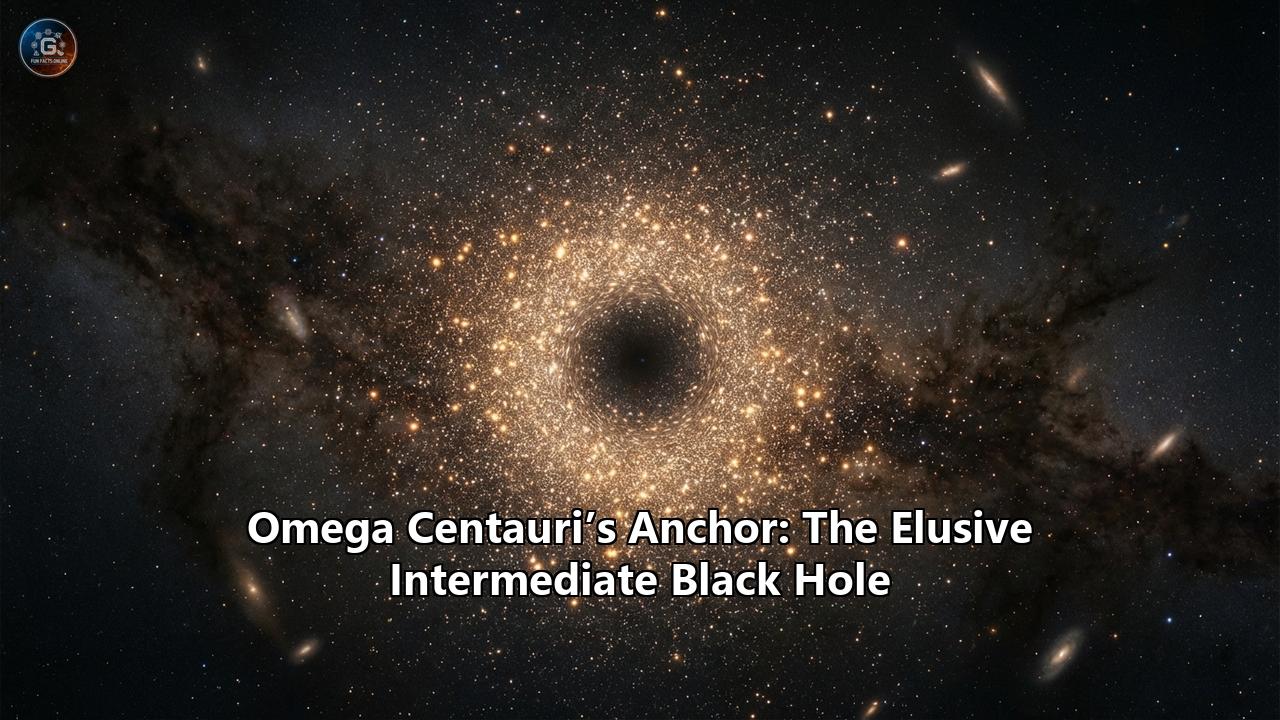
The night sky is a deceiver. To the unaided eye, the cosmos appears static, a tapestry of fixed points of light that have guided sailors and inspired poets for millennia. But this tranquility is an illusion. Beneath the velvet stillness lies a universe of violence and velocity, where galaxies cannibalize their neighbors and gravity sculpts the fabric of spacetime itself. Nowhere is this deception more profound, or more beautiful, than in the southern constellation of Centaurus, where a "star" named Omega Centauri has hidden a dark secret for billions of years.
For centuries, astronomers believed Omega Centauri was a star. Then, with better telescopes, they thought it was a globular cluster—a ball of millions of stars. But in the mid-2020s, a team of researchers pulled back the final veil to reveal the truth: Omega Centauri is neither a star nor a mere cluster. It is the skeletal remains of a dead galaxy, and locked within its heart, anchoring the chaotic swirl of ten million suns, lies one of the most elusive objects in astrophysics: an Intermediate-Mass Black Hole (IMBH).
This is the story of that discovery—a detective saga spanning two decades of Hubble Space Telescope data, involving millions of measurements, seven runaway stars, and the confirmation of a "missing link" that bridges the gap between the stellar graveyards and the monsters that rule the galaxies.
Part I: The Imposter in the South
To understand the magnitude of the discovery, one must first understand the object itself. Omega Centauri is the largest, brightest, and most massive globular cluster in the Milky Way galaxy. Located roughly 17,700 light-years from Earth, it is visible to the naked eye as a fuzzy, star-like blob, which is why the ancient astronomer Ptolemy cataloged it as a single star nearly 2,000 years ago. It wasn’t until Edmond Halley (of comet fame) observed it from the island of St. Helena in 1677 that it was recognized as a nebula, and later by John Herschel as a globular cluster.
But Omega Centauri has always been the "odd one out." A typical globular cluster is a homogeneous retirement home for stars—a collection of a few hundred thousand stars that were all born at roughly the same time from the same gas cloud. They are cosmic time capsules, preserving the chemistry of the early universe.
Omega Centauri, however, breaks all the rules. It is ten times more massive than a typical cluster, containing nearly 10 million stars packed into a sphere only 150 light-years across. In its core, the stars are so densely packed that they are separated by only a fraction of a light-year. If you lived on a planet orbiting a star in the center of Omega Centauri, your night sky would not be black. It would be a blazing white roof of diamonds, shining with the intensity of a thousand full moons.
More puzzling than its size is its complexity. Unlike normal clusters, Omega Centauri’s stars are not all the same age. They possess different "metallicities"—astronomer-speak for the abundance of elements heavier than hydrogen and helium. This implies that Omega Centauri didn’t just form once and stop; it had multiple bursts of star formation over billions of years. It sustained itself. It evolved.
For decades, this anomaly led astronomers to a radical hypothesis: Omega Centauri is not a globular cluster at all. It is the stripped nucleus of a dwarf galaxy.
The theory goes like this: Billions of years ago, a small galaxy (let’s call it the "Omega Galaxy") ventured too close to the Milky Way. Our galaxy, being far more massive, ensnared the intruder in its gravitational web. As the Omega Galaxy plunged through the Milky Way, the tidal forces stripped away its outer spiral arms, its gas, and its dark matter halo. All that remained was the dense, tightly bound core—the nuclear bulge. This core, battered and naked, settled into an orbit around the Milky Way, a fossil of a galactic meal.
If this theory was true, then Omega Centauri should look like the center of a galaxy. And the centers of galaxies are known for one thing above all else: they house black holes.
Part II: The Great Mass Gap
Black holes are the universe’s most extreme objects, regions where gravity is so intense that nothing, not even light, can escape. For decades, astronomers have comfortably categorized them into two distinct families.
On the lighter end, we have Stellar-Mass Black Holes. These are the corpses of massive stars. When a star about 20 times the mass of the Sun runs out of fuel, it collapses under its own weight, triggering a supernova explosion and leaving behind a black hole weighing between 5 and 100 solar masses. We see these everywhere; they litter the Milky Way, often spotted feeding on companion stars in X-ray binary systems.
On the heavier end, we have Supermassive Black Holes (SMBHs). These are the monsters. Weighing millions or even billions of solar masses, they sit at the exact center of nearly every large galaxy, including our own Milky Way (which hosts Sagittarius A, a 4.3 million solar mass black hole). These titans orchestrate the evolution of their host galaxies, blowing out jets of energy that can halt star formation.
But there is a problem. A chasm exists between these two groups. We see black holes that are 10 times the mass of the Sun, and we see black holes that are 10 million times the mass of the Sun. But we have historically found almost nothing in between.
This is the "Intermediate-Mass Black Hole" (IMBH) gap. An IMBH would weigh somewhere between 100 and 100,000 solar masses.
The absence of these middleweights is a major crisis for cosmology. It creates a "chicken or the egg" problem for the supermassive black holes. How did the monsters get so big? Did they start as stellar black holes and eat their way up? If so, we should see IMBHs in the "teenager" phase of growth. Did they collapse directly from massive clouds of gas in the early universe?
Finding an IMBH is like finding a missing link in human evolution. It proves that the monsters didn't just appear by magic; they grew. And the best place to hide a medium-sized black hole is in the center of a medium-sized object—like the stripped core of a dwarf galaxy. Like Omega Centauri.
Part III: The Two-Decade Stare
The hunt for Omega Centauri’s black hole has been a rollercoaster of claims and refutations. In 2008, a team led by Eva Noyola used data from the Hubble Space Telescope and the Gemini Observatory to claim they had found evidence of a 40,000 solar mass black hole. They looked at the total amount of light coming from the center and the average speed of stars moving there.
However, the scientific community pushed back. In 2010, another team led by Jay Anderson and Roeland van der Marel analyzed newer Hubble images and argued that the center of the cluster was not where Noyola thought it was. They concluded that the motions of the stars could be explained without a black hole. For years, the debate stalled. The problem was one of crowding. In the center of Omega Centauri, the stars are so packed that ground-based telescopes see a blur. Even Hubble struggled to distinguish individual movements over short periods.
To settle the debate, astronomers needed something better than a snapshot. They needed a movie.
Enter Maximilian Häberle.
In 2024, Häberle, a PhD student at the Max Planck Institute for Astronomy in Germany, led a team that performed one of the most exhaustive data analyses in the history of cluster astronomy. They didn't just take a new picture. They dug into the archives.
Häberle and his team compiled over 500 images of Omega Centauri taken by the Hubble Space Telescope over a span of 20 years. These images were originally taken for various different purposes—mostly to calibrate Hubble’s instruments. But by stitching them together, the team created a timeline.
Their goal was to measure the proper motion of the stars. In astronomy, most velocity measurements are done via "redshift" or "blueshift" (radial velocity), which tells you if a star is moving towards or away from you. But radial velocity doesn't tell you how a star is moving across the sky. Proper motion does.
By meticulously aligning the images from 2002 to 2024, the team tracked the tiny shifts in position of 1.4 million individual stars. It was a monumental computational task, akin to tracking the movement of a million individual gnats in a swarm from miles away.
They were looking for "fast movers."
Part IV: The Seven Needles in the Haystack
In a gravitationally bound system like a star cluster, there is a speed limit. It’s called the escape velocity. If a star moves faster than this limit, it should fly out of the cluster and disappear into the void of the galaxy. The escape velocity depends on the mass of the cluster holding the star back.
If there is no black hole in the center of Omega Centauri, the stars in the core should be moving randomly, buzzing around like bees, but generally staying below a certain speed determined by the gravity of the other stars.
However, if there is a massive, invisible object in the center—a gravitational anchor—stars close to it will be whipped into a frenzy. They will orbit the invisible point at breakneck speeds, just as Mercury orbits the Sun faster than Neptune.
Häberle’s code sifted through the 1.4 million tracks and flagged something extraordinary.
Seven stars.Deep in the innermost region of the cluster, right where the density is highest, seven stars were moving significantly faster than they should be. These were not subtle anomalies. They were screaming across the core.
"We discovered seven stars that should not be there," Häberle explained upon the release of the study. "They are moving so fast that they would escape the cluster and never come back."
But they hadn't escaped. They were still there, caught in a tight, frantic dance. The fact that they were still confined to the center meant something was holding them—something with immense gravity.
The team ran the numbers. They calculated the mass required to keep these seven "high-velocity" stars in orbit without letting them fly apart. The result was specific and undeniable.
At least 8,200 solar masses.The only object that can pack 8,200 times the mass of the Sun into a region smaller than our solar system, without emitting light, is a black hole.
This wasn't a statistical average. This wasn't a guess based on the brightness of the background. This was kinematic proof. Just as we proved the existence of the supermassive black hole in our own Milky Way by watching stars orbit an empty point in space (work that won Andrea Ghez and Reinhard Genzel the Nobel Prize), Häberle’s team had done the same for Omega Centauri.
They had found the anchor.
Part V: The Frozen Core
The confirmation of an 8,200-solar-mass black hole (with upper estimates ranging potentially higher, depending on the exact orbital mechanics) changes our understanding of Omega Centauri from a curiosity to a cornerstone of galactic history.
It confirms the "stripped nucleus" theory. A simple globular cluster formed from a gas cloud has no mechanism to create such a massive black hole. A black hole of this size forms in the chaotic, high-density environment of a galactic core.
Omega Centauri is a fossil. It is a "frozen" galaxy.
Imagine the timeline: 10 billion years ago, the Omega Galaxy was a thriving dwarf galaxy, perhaps similar to the Large Magellanic Cloud. It had gas, dust, star formation, and a central black hole that was slowly growing. It was an IMBH, on its way to becoming supermassive.
Then came the collision. As it fell into the Milky Way, the larger galaxy’s gravity stripped away the fuel. The gas was siphoned off. The star formation stopped. The outer stars were peeled away to become part of the Milky Way’s halo (the "Gaia-Enceladus" or "Sausage" merger event is a likely candidate for this type of accretion).
The central black hole was starved. Without gas to eat, it stopped growing. It was locked in time, stuck at ~8,000 solar masses, while its cousins in undisturbed galaxies gorged themselves and grew into the multimillion-solar-mass giants we see today.
For astronomers, this is better than finding a supermassive black hole. This is finding a seed*. By studying Omega Centauri’s black hole, we are looking at the baby pictures of the monsters that rule the universe. We can study what black holes looked like in the early universe before they became too big to comprehend.
Part VI: The Silence of the Lambs
One of the most intriguing aspects of this discovery is how "quiet" the black hole is. Following the kinematic discovery, other teams (such as those using the Australia Telescope Compact Array) looked for radio waves coming from the center of Omega Centauri.
Black holes, famously, do not emit light. But the material falling into them does. As gas spirals into a black hole, it heats up to millions of degrees and screams in X-rays and radio waves.
The radio search for Omega Centauri’s black hole came up empty. It is radio silent.
This lack of emission might seem like a point against the black hole theory, but it actually fits the "stripped nucleus" model perfectly. Globular clusters are notoriously gas-poor. The gas was blown out billions of years ago or stripped by the Milky Way. There is nothing left for the black hole to eat. It is a dormant beast, sitting in the dark, revealing its presence only by the terrifying speed of the stars that dare to venture too close.
This "starvation" explains why it was so hard to find. We couldn't see it glowing; we had to see it pulling.
Part VII: The Future of the Search
The discovery of the seven fast stars is just the beginning. The 8,200 solar mass figure is a lower limit. We only see the motion of the stars across the sky (2D motion). We do not yet know their full 3D velocity (how fast they are moving toward or away from us).
To get the full picture, astronomers have been granted time on the James Webb Space Telescope (JWST). JWST’s sensitive integral field spectrographs will be able to measure the radial velocities of these faint stars deep in the glare of the core.
When we combine the Hubble proper motions with the JWST radial velocities, we will have full 3D orbits. We will be able to weigh the black hole with unprecedented precision. We might find that it is actually larger—perhaps 20,000 or 30,000 solar masses—or we might find more high-speed stars that were too faint for Hubble to track.
Furthermore, the European Southern Observatory’s upcoming Extremely Large Telescope (ELT), currently under construction in the Atacama Desert, will have the resolution to see even closer to the event horizon.
Conclusion: The Anchor in the Night
For thousands of years, humans have looked up at the southern sky and seen a fuzzy star. We named it Omega Centauri. We charted it for navigation. We admired its beauty through backyard telescopes.
We had no idea that we were looking at the corpse of a galaxy. We had no idea that in the heart of that shimmering jewel, a monster was lurking—not a titan like the one in the center of our galaxy, but a rare, medium-sized predator, frozen in a state of arrested development.
The discovery of the Intermediate-Mass Black Hole in Omega Centauri is a triumph of patience. It required twenty years of staring at the same spot, waiting for the stars to move just a fraction of a pixel. It serves as a reminder that the universe is not just what we see; it is defined by the invisible forces that bind it together.
The "fast stars" of Omega Centauri are like moths fluttering around a dark lantern. They have revealed the anchor that holds the cluster together, and in doing so, they have given us the key to understanding how the universe built its greatest giants. The missing link is missing no more.
Reference:
- https://www.youtube.com/watch?v=Dr8CJAOlGVc
- https://www.esa.int/Science_Exploration/Space_Science/Hubble_finds_evidence_for_rare_black_hole_in_Omega_Centauri
- https://science.nasa.gov/missions/hubble/nasas-hubble-finds-strong-evidence-for-intermediate-mass-black-hole-in-omega-centauri/
- https://www.stsci.edu/contents/news-releases/2024/news-2024-015
- https://esahubble.org/news/heic2409/
- https://www.astronomy.com/observing/weird-object-omega-centauri/
- https://www.mpg.de/22157737/black-hole-in-omega-centauri
- https://www.universetoday.com/articles/radio-observations-find-nothing-at-omega-centauris-heart
- https://physics.stackexchange.com/questions/416050/why-can-detecting-middleweight-black-holes-be-harder-than-the-other-types
- https://physicsworld.com/a/speedy-stars-point-to-intermediate-mass-black-hole-in-globular-cluster/
- https://earthsky.org/space/intermediate-mass-black-hole-omega-centauri/
- https://telescope.live/blog/insights-intermediate-mass-black-hole-omega-centauri-author-max-haberle
- https://aasnova.org/2020/02/12/a-pulsed-discovery-in-omega-centauri/
- https://scitechdaily.com/omega-centauri-a-galaxy-core-frozen-in-time-reveals-its-black-hole/
- https://english.tachyonbeam.com/2024/07/12/new-evidence-for-the-presence-of-an-intermediate-mass-black-hole-in-the-omega-centauri-globular-cluster/
- https://www.sciencedaily.com/releases/2024/07/240710130803.htm
- https://scitechdaily.com/cracking-the-code-how-intermediate-mass-black-holes-form/
- https://www.labroots.com/trending/space/6312/intermediate-sized-black-holes-elude-astronomers