
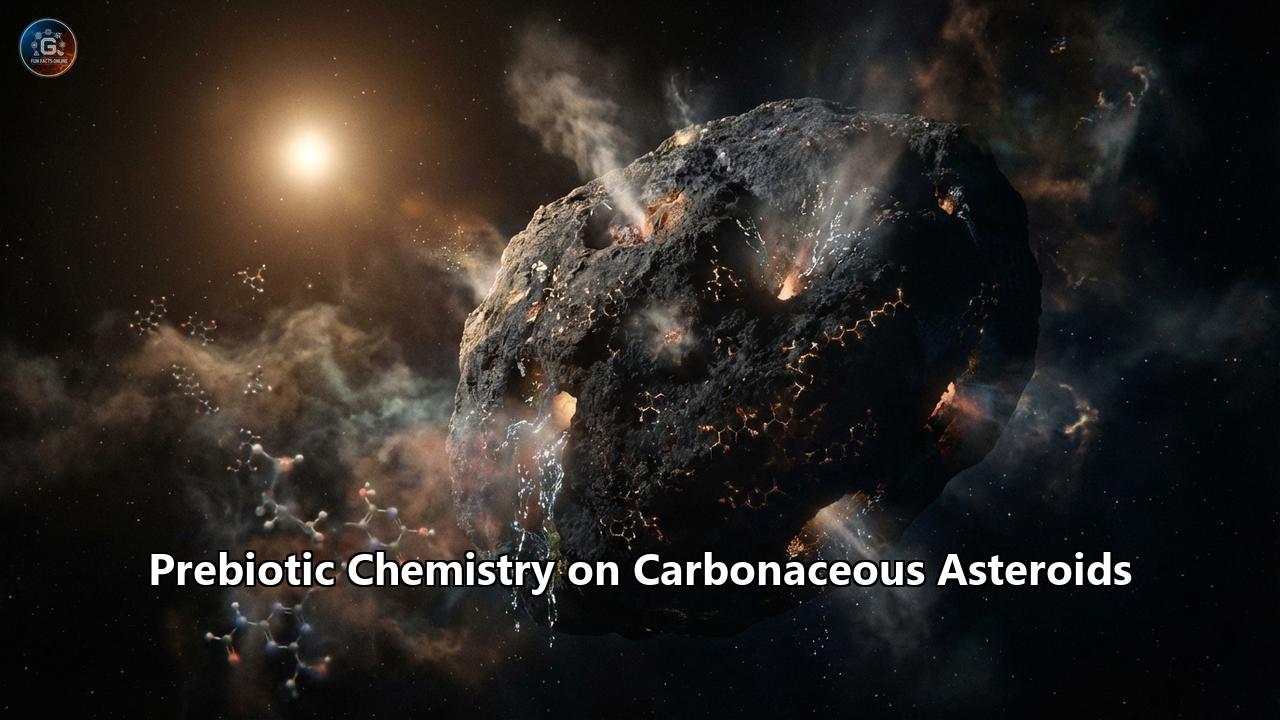
In the vast, silent theatre of the cosmos, where stars are born in violent nebulae and galaxies drift through the dark, a microscopic drama has been unfolding for billions of years. It is a story not of giants, but of the minuscule; not of fiery suns, but of cold, dark rocks. For decades, humanity looked upon asteroids as the "vermin of the skies"—dead, inert remnants of the solar system's formation, menacing debris that occasionally threatened our planet with catastrophe. But a revolution in planetary science has overturned this grim view. We now know that these celestial wanderers, particularly the dark, carbon-rich class known as carbonaceous asteroids, are not dead at all. They are dormant chemical factories, grand laboratories that have been brewing the ingredients of life long before the Earth was cool enough to hold a drop of water.
This revelation changes everything. It suggests that the blueprint for biology is not a miracle unique to Earth, but a cosmic imperative, written into the very chemistry of rocks drifting between Mars and Jupiter. Through the daring exploits of sample return missions like JAXA’s Hayabusa2 and NASA’s OSIRIS-REx, we have finally brought these distant laboratories into our own, unlocking secrets that bridge the gap between the astrophysical and the biological.
This article delves into the deep, complex, and fascinating world of prebiotic chemistry on carbonaceous asteroids. We will explore the molecules found within them, the exotic chemical reactions that forged them, the minerals that acted as the first "enzymes," and the profound implications this holds for the origins of life on Earth and beyond.
Part I: The Black Treasure — Unveiling the Chemical Inventory
The story begins with the rocks themselves. Carbonaceous chondrites, the meteorites derived from these asteroids, are some of the most primitive materials in the solar system. They are time capsules, frozen at the moment of their birth 4.5 billion years ago. When scientists crack them open, they do not find just silicates and iron; they find a cornucopia of organic complexity that rivals the inventory of a chemistry lab.
1. The Building Blocks of Proteins: Amino Acids
Perhaps the most striking discovery is the presence of amino acids, the monomers that link together to form proteins, the workhorses of life. In the famous Murchison meteorite, which fell in Australia in 1969, scientists have identified over 70 different types of amino acids.
- The Usual Suspects: These include glycine, alanine, and valine—amino acids that are encoded in terrestrial DNA and found in every living organism on Earth.
- The Exotic Cousins: Crucially, these asteroids also contain amino acids not used by life on Earth, such as isovaline and alpha-aminoisobutyric acid. This distinction is vital; it proves that these molecules are not contaminants from Earth bacteria but are truly extraterrestrial in origin.
- Recent Triumphs: The analysis of samples from asteroid Ryugu (returned by Hayabusa2) and Bennu (returned by OSIRIS-REx) confirmed this beyond doubt. In the pristine, vacuum-sealed chambers of Japan and the US, researchers found these molecules in samples that had never touched Earth's biosphere, silencing skeptics who claimed meteorites were simply contaminated upon impact.
2. The Code of Life: Nucleobases
For life to begin, it needs instructions. In modern biology, this information is stored in DNA and RNA, long chains made of "letters" called nucleobases.
- Uracil found on Ryugu: In a landmark finding published in 2023, scientists detected uracil in the Ryugu samples. Uracil is one of the four key nucleobases of RNA. Its presence suggests that the components for the first genetic code were already present in the solar nebula.
- The Missing Link: While DNA bases like thymine are harder to find, the presence of uracil supports the "RNA World" hypothesis—the idea that early life used RNA for both genetic storage and catalysis, a role it could fulfill using ingredients delivered from the stars.
3. The Sweet Spot: Sugars
You cannot build RNA without a backbone, and that backbone is made of sugar.
- Ribose in Murchison: In 2019, researchers finally detected ribose—the "R" in RNA—in carbonaceous meteorites. This was a massive breakthrough. Sugars are notoriously fragile; they degrade easily in heat and radiation. Finding them preserved in a space rock implies a mechanism for both their synthesis and their protection.
- Bennu’s Sweet Surprise: The OSIRIS-REx samples have further expanded this inventory, showing evidence of bio-essential sugars like glucose and ribose, suggesting that the "sugar coating" of the early Earth might have been dusted from the cosmos.
4. Vitamins and "Space Plastic"
The inventory goes deeper.
- Niacin (Vitamin B3): Found in Ryugu samples, this vitamin is a critical cofactor in metabolism, helping enzymes drive reactions. Its presence implies that not just structural building blocks, but also metabolic helpers were available abiotically.
- "Space Plastic": One of the most puzzling and exciting finds from asteroid Bennu was a gum-like organic polymer. Informal dubbed "space plastic," this material is a complex hydrocarbon network. While not "plastic" in the artificial sense, these polymers act as a protective matrix, shielding more delicate molecules from the harsh radiation of space. They represent a step toward complexity—large, structured molecules rather than just simple compounds.
Part II: The Cosmic Kitchen — How Rocks Cook Life
Finding these molecules is one thing; understanding how they formed in the freezing vacuum of space is another. Carbonaceous asteroids are not just storage bins; they are active chemical reactors. The secret ingredient? Water.
1. Aqueous Alteration: The Great Solvent
We tend to think of asteroids as dry, dusty rocks. But billions of years ago, soon after their formation, these bodies were wet. Radioactive elements (like Aluminum-26) trapped inside the asteroid decayed, releasing heat. This heat melted the internal ice, creating vast hydrothermal systems inside the rock.
- The Mudball Phase: For millions of years, the interior of bodies like the parent of Ryugu was a warm, muddy sludge. This process, known as aqueous alteration, is the engine of prebiotic chemistry.
- Hydrolysis and Mixing: Water acts as a solvent, allowing simple molecules like formaldehyde and ammonia (frozen in the original ices) to mix, react, and transform. It breaks down recalcitrant minerals and liberates ions that act as catalysts.
2. The Strecker Synthesis: Making Amino Acids
How do you get from simple ammonia to complex amino acids? The primary pathway believed to operate in these wet asteroid interiors is the Strecker Synthesis.
- The Recipe: Take hydrogen cyanide (HCN), ammonia (NH3), and an aldehyde (like acetaldehyde).
- The Reaction: In the presence of water, these react to form an intermediate called an aminonitrile.
- The Result: The aminonitrile is then hydrolyzed by the warm water to form an alpha-amino acid.
This elegant reaction explains why we see such a specific suite of amino acids in meteorites. The raw materials (cyanide, ammonia, aldehydes) are abundant in interstellar ices, and the reactor (warm water) was provided by the asteroid itself.
3. The Formose Reaction: Brewing Sugars
Sugars are harder to make. The leading theory is the Formose Reaction.
- The Polymerization: It starts with formaldehyde (HCHO), a very common molecule in space. Under alkaline conditions (high pH), formaldehyde molecules begin to link together.
- The Cascade: Two formaldehydes make glycolaldehyde (a simple sugar). Add another, you get glyceraldehyde. Keep going, and you eventually build up to five-carbon sugars like ribose.
- The Bennu Connection: The mineralogy of asteroid Bennu indicates a past environment that was alkaline—perfect for driving the Formose reaction. The presence of carbonate minerals confirms that the fluids were rich in CO2 and had the right pH to turn simple formaldehyde into the sugars of life.
4. Fischer-Tropsch-Type (FTT) Synthesis: The Hydrocarbon Engine
To build cell membranes, you need long chains of carbon and hydrogen (lipids).
- The Industrial Analog: On Earth, we use the Fischer-Tropsch process to turn gas into liquid fuel. Inside asteroids, a similar natural process occurred.
- Serpentinization: When water reacts with iron-rich rocks (olivine), it produces hydrogen gas (H2). This is called serpentinization.
- The Synthesis: This H2 reacts with carbon monoxide (CO) on the surface of mineral catalysts (like magnetite) to forge long hydrocarbon chains—the precursors to the fatty acids that make up cell membranes.
5. The Pyruvate Reaction Network
Recent research has identified an even more complex system: the Pyruvate Reaction Network. Pyruvate is a central molecule in Earth metabolism (the Krebs cycle). Its discovery in meteorites, along with a suite of related dicarboxylic acids, suggests that asteroids were hosting a "proto-metabolism."
- Feedback Loops: This network is not just a straight line of reactions; it involves feedback loops where products help synthesize more reactants. This is a crucial step toward life—a chemical system that sustains itself.
Part III: The Chefs — Mineral Catalysts
You cannot cook a gourmet meal without pots and pans. In the context of prebiotic chemistry, the "cookware" is the mineral matrix of the asteroid. Organic chemistry in water is messy; without something to organize it, you often just get "tar"—a useless black sludge. Minerals provide the order.
1. Phyllosilicates: The Clay Womb
Phyllosilicates, or clays, are ubiquitous in carbonaceous asteroids. They consist of microscopic sheets stacked on top of each other.
- The Concentration Effect: The space between these sheets is nanometers wide. Organic molecules get sucked into these interlayers like water into a sponge. This concentrates the reactants, making them millions of times more likely to collide and react than they would be floating in the open water.
- Protection: Once inside the clay layers, delicate molecules like sugars are protected from destructive hydrolysis. The clay acts as a "nursery," allowing complex molecules to grow without being immediately broken down.
2. Magnetite: The Electro-Catalyst
Magnetite (Fe3O4) is a magnetic iron oxide often found in these asteroids (and used by early sailors as lodestones).
- The Spark: Magnetite surfaces are chemically active. They can facilitate the transfer of electrons, driving redox reactions that are essential for energy storage.
- Nitrogen Fixation: Some models suggest magnetite played a key role in converting inert nitrogen gas (N2) into ammonia (NH3), a form that biology can actually use. This "Haber-Bosch process in a rock" would have been critical for creating the nitrogen-rich amino acids and nucleobases.
3. Sulfides: The Energy Source
Minerals like pentlandite and troilite (iron-nickel sulfides) are also common.
- Metabolism First: These minerals are central to the "Iron-Sulfur World" hypothesis of the origin of life. They can catalyze the synthesis of acetyl-CoA, a vital metabolic molecule. Finding these minerals in close association with organics in Ryugu and Bennu lends weight to the idea that the "metabolism first" steps could have begun in space.
Part IV: The Mystery of the Left Hand — Homochirality
One of the deepest mysteries in biology is homochirality.
- The Mirror Problem: Many organic molecules, like amino acids, are "chiral"—they come in two shapes, Left-handed (L) and Right-handed (D), which are mirror images of each other.
- The Biology Bias: When you make amino acids in a beaker (or via Strecker synthesis), you get a 50/50 mixture (racemic). But life on Earth is extremely picky: it uses only L-amino acids for proteins and only D-sugars for DNA/RNA.
- The Meteorite Clue: For years, scientists assumed this selection happened on Earth. But when they analyzed the Murchison meteorite with extreme precision, they found a shock: some amino acids showed a slight excess of the L-form (up to 15-18% excess for isovaline).
The Cause: Starlight and Magnetism
How did a rock in space develop a preference for "Left" hands?
- Circularly Polarized Light (CPL): The leading theory points to the environment where the asteroid's parent body formed. In massive star-forming regions (like the Orion Nebula), radiation from neutron stars or white dwarfs can become circularly polarized.
- The Filter: This spiraling UV light interacts differently with L and D molecules. It might have preferentially destroyed the D-amino acids (or their precursors) in the dusty nebula, leaving behind a surplus of L-amino acids.
- Amplification: Once this slight bias (1-2%) was baked into the asteroid, the aqueous alteration processes inside the rock could have amplified it. Inside the clay layers or on crystal surfaces, a crystal seeded with an excess of L-molecules would recruit more L-molecules, eventually leading to the significant excesses we see in meteorites.
- The Implication: This suggests that the "handedness" of life on Earth was not a coin toss. It was dictated by the specific astrophysical conditions of the nebula where our solar system was born. We are "Left-handed" because the light of a dying star told us to be.
Part V: Delivery — The Great Seed
We have established that carbonaceous asteroids are factories full of amino acids, sugars, and lipids, processed by water and selected by starlight. But how did they get here?
1. The Late Heavy Bombardment
About 4.0 to 3.8 billion years ago, the orbits of the giant planets (Jupiter and Saturn) shifted. This gravitational dance destabilized the asteroid belt, sending a deluge of rocks raining down into the inner solar system.
- The Flux: It is estimated that billions of tons of carbonaceous material struck the early Earth during this period.
- Soft Landings: While large impacts vaporize everything, smaller rocks and dust (Interplanetary Dust Particles - IDPs) can slow down in the upper atmosphere and drift gently to the surface. This "cosmic dust" delivers organics without destroying them.
2. Seeding the Prebiotic Soup
Imagine the early Earth. It had water, but its atmosphere was likely dominated by CO2 and N2—not the highly reducing (methane/ammonia) atmosphere Miller and Urey used in their famous experiment. Making amino acids from scratch in a CO2 atmosphere is very difficult.
- The Delivery Truck: Carbonaceous asteroids solved this supply chain problem. They brought the "hard-to-make" compounds—the ribose, the complex amino acids, the vitamins—and dumped them directly into the primitive oceans.
- Concentration: These meteorites are porous. When they landed in shallow pools or near hydrothermal vents, they acted as concentrated "pills" of nutrients. Life didn't have to assemble molecules from the dilute ocean; it could start in the rich, chemical slurry leaking from a dissolving meteorite.
Part VI: Tales from the Sample Return Missions
The theories above were built on meteorites that had sat in museums for decades. But recently, we have entered the "Golden Age" of asteroid exploration, bringing pristine samples back to Earth.
1. Hayabusa2 and Ryugu
- The Journey: JAXA’s Hayabusa2 visited Ryugu, a diamond-shaped "rubble pile" asteroid. It blasted a crater to get subsurface material—protecting it from space weathering.
- The Findings: The samples were pitch black, resembling charcoal. They were incredibly porous (density of just 1.2 g/cm³).
- The Water Record: Analysis showed Ryugu’s parent body was once 97% water-altered minerals. It was essentially a ball of mud.
- The "Dark Inclusions": The samples contained tiny clasts called "dark inclusions" that were even richer in organics than the surrounding matrix, suggesting multiple generations of organic processing.
2. OSIRIS-REx and Bennu
- The Sample: NASA’s OSIRIS-REx returned a massive haul (over 120 grams) from Bennu in 2023.
- The "Space Plastic": The detection of the gum-like polymer was a surprise. It implies that Bennu preserves a stage of chemical evolution where simple organics polymerized into solids—a crucial step toward cell walls and structural biology.
- Ancient Stardust: Bennu was found to be rich in "presolar grains"—microscopic diamonds and silicon carbide crystals that formed around other stars before our sun existed. These grains traveled through the interstellar medium, were incorporated into the asteroid, and survived billions of years to tell us about the galaxy's history.
- The Heterogeneity: Different pebbles in the Bennu sample showed different organic chemistries. This proves that the "parent body" was a dynamic world with different geological zones—some wetter, some drier, some hotter—creating a diverse menu of prebiotic ingredients.
Part VII: Beyond Earth — The Universal Blueprint
The implications of these findings extend far beyond our own origins.
1. Mars
If asteroids delivered these ingredients to Earth, they delivered them to Mars, too. Mars, having no plate tectonics, might still preserve these ancient carbonaceous rocks on its surface. The search for life on Mars is, in part, a search for these same prebiotic pathways.
2. Icy Moons (Europa and Enceladus)
The chemistry found in these asteroids (aqueous alteration of silicate rock) is exactly what we believe is happening right now on the seafloors of Europa and Enceladus. The "mudball" phase of Ryugu is a frozen snapshot of the active hydrothermal vents on these moons. If Ryugu could make uracil and niacin, Enceladus likely can too.
3. The Universality of Life
Perhaps the most profound takeaway is the resilience of this chemistry. We found these molecules on airless rocks exposed to the vacuum for 4 billion years. We found them forged in the cold dark. This suggests that the chemistry of life is robust. It is not a fragile, one-in-a-trillion accident requiring a perfect warm pond. It is a sturdy, industrial process that happens on wet rocks everywhere in the universe.
Wherever there is carbon, water, and heat, the universe makes amino acids. It makes sugars. It makes the building blocks. The "Lego kit" of life is standard issue in the cosmos; the only variable is where it gets assembled.
Conclusion: We Are Stardust, Processed by Rocks
We often look up at the stars and feel small. But the story of prebiotic chemistry on carbonaceous asteroids tells us that we are intimately connected to that vastness. The nitrogen in our DNA, the calcium in our teeth, the iron in our blood—these elements were forged in stars. But the molecules—the specific arrangement of atoms that allows us to live, think, and dream—may well have been forged in the dark, wet belly of a passing asteroid.
These humble, charcoal-black rocks are the bridges between the astrophysical and the biological. They are the vessels that carried the fire of life across the cold desert of space. As we study the grains of Ryugu and Bennu, we are not just studying rocks; we are reading the opening chapter of our own autobiography. We are discovering that before life could conquer the Earth, the cosmos had to prepare the way, turning the cold dust of the universe into the seeds of possibility.
Reference:
- https://tsukuba.repo.nii.ac.jp/record/2010091/files/Astrobiology_23-10-0140.pdf
- https://watchers.news/epicenter/sugars-from-asteroid-bennu-complete-the-extraterrestrial-inventory-for-lifes-building-blocks/
- https://en.wikipedia.org/wiki/Strecker_amino_acid_synthesis
- https://www.masterorganicchemistry.com/2018/11/12/the-strecker-synthesis-of-amino-acids/
- https://www.thebrighterside.news/post/asteroid-bennu-samples-reveal-ancient-water-offering-new-clues-about-the-origin-of-life-on-earth/
- https://www.mdpi.com/2075-163X/11/8/799
- https://www.pnas.org/doi/10.1073/pnas.2512461122
- https://www.hou.usra.edu/meetings/issol2017/pdf/4171.pdf
- http://hoffman.cm.utexas.edu/courses/homochirality.pdf
- https://www.zmescience.com/science/news-science/nasas-asteroid-sample-reveals-an-amino-acid-linked-to-happiness-and-the-origins-of-life/
- https://www.chemistryworld.com/news/super-reactive-molecule-could-solve-space-sugar-mystery/3009487.article
- https://www.researchgate.net/figure/Prebiotic-formation-of-sugars-via-the-Formose-Reaction-FR_fig7_375425806