
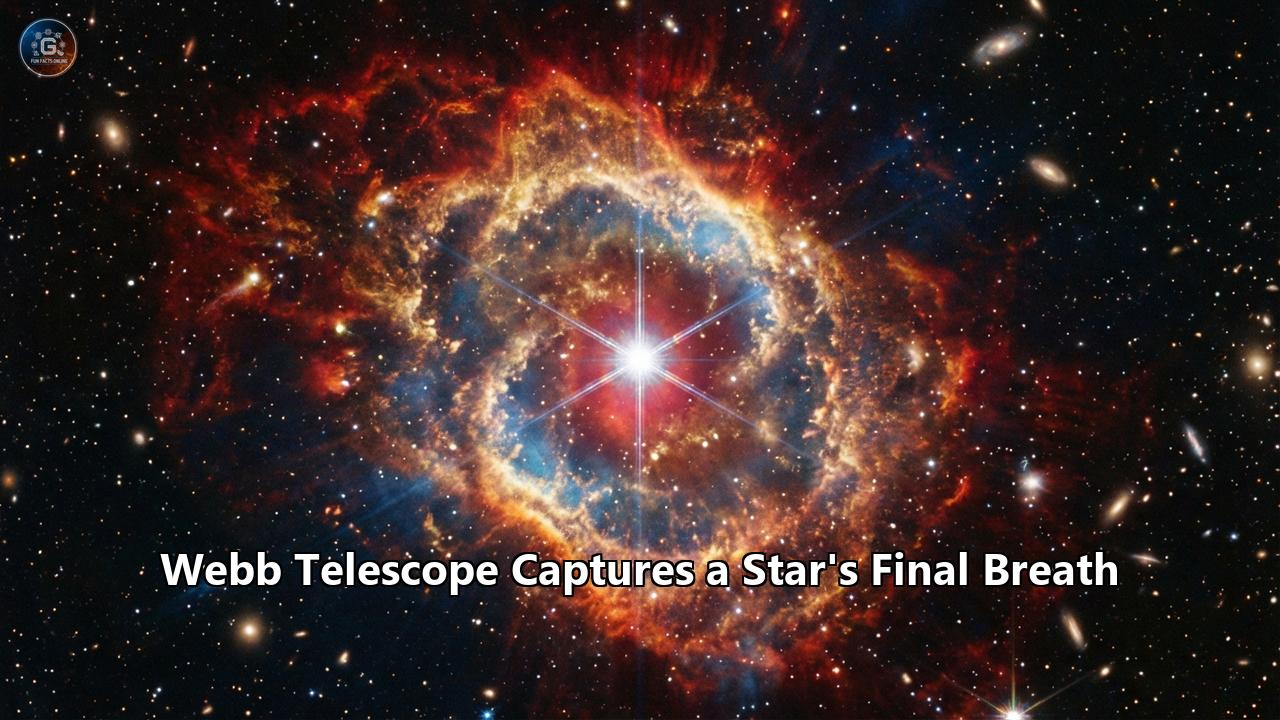
The image is a portal to our own future. It is a ghost, glowing in the dark of the cosmos, a premonition of the final act that awaits our own Sun. In late January 2026, the James Webb Space Telescope (JWST) beamed back data that has fundamentally altered humanity’s intimacy with the death of stars. The object is familiar—the Helix Nebula, often called the "Eye of God." But the view is entirely new.
Where previous telescopes saw a soft, ethereal eyelid of gas, Webb has revealed a violent, churning "cosmic lava lamp" of cometary knots, shockwaves, and shielded pockets of chemistry that defy our previous models of stellar annihilation. It is a portrait of a star taking its final breath, exaling the very atoms that make up our bodies, our planets, and the ground we walk on.
This is not merely a picture; it is a forensic crime scene, a chemical laboratory, and a prophecy rolled into one. Across a canvas of 10,000 words, we will explore this monumental discovery and the broader crusade of the Webb telescope to document the deaths of stars. We will journey from the hydrogen-fusing hearts of aging suns to the frozen outer reaches of their nebulae. We will examine the "Iron Bar" mystery of the Ring Nebula, the binary "murder" at the heart of the Southern Ring, and the dust-pumping fury of Wolf-Rayet 124. And finally, we will stand on the surface of a future Earth and watch our own sun perform this same spectacular, terrifying finale.
Part I: The Eye Opens – The 2026 Helix Revelation
The Cosmic Lava LampFor two centuries, the Helix Nebula (NGC 7293) has stared back at us from the constellation Aquarius, located just 650 light-years away. It is one of the closest planetary nebulae to Earth, making it the perfect specimen for study. Through the lens of the Hubble Space Telescope, it appeared as a serene, pupil-like structure of turquoise and rose. It was beautiful, but it was deceptive.
The images released by the Webb team this week strip away that serenity. Webb’s Near-Infrared Camera (NIRCam) and Mid-Infrared Instrument (MIRI) have pierced the veil of dust that scattered visible light. What lies beneath is a structure of shocking complexity. The nebula is not a smooth ring; it is a turbulent environment filled with what astronomers are calling "cometary knots."
These are not comets in the traditional sense, but dense clumps of molecular gas, each as large as our solar system, with tails streaming away from the dying central star. In the new high-resolution data, these knots look like tadpoles swimming upstream against a river of ultraviolet radiation. There are tens of thousands of them. They are the survivors—clumps of material that were dense enough to resist being instantly vaporized by the white dwarf’s heat.
The Shielded ZonesPerhaps the most scientifically significant finding from this January 2026 dataset is the identification of "shielded zones." In the deep infrared, Webb has identified dark pockets amidst the glowing orange and red gas. These are shadows cast by the densest knots. Inside these shadows, the temperature drops precipitously, allowing for a miracle of astrochemistry.
Despite the intense radiation that should be ripping molecules apart, these shielded zones are factories. Webb’s spectrometers have detected the unmistakable signatures of Polycyclic Aromatic Hydrocarbons (PAHs)—complex, carbon-based organic molecules that are considered the building blocks of prebiotic life. It is a profound irony: in the immediate blast zone of a dying star, the ingredients for new life are being synthesized in the shadows.
The Temperature GradientThe new images serve as a thermal map of a stellar death. The colors are not just aesthetic; they are scientific data points.
- Deep Blue: At the center, the data reveals the hottest gas, ionized by the white dwarf, which is blazing at a temperature of over 100,000 degrees Kelvin. This gas is being stripped of its electrons, glowing with the energy of a thousand suns.
- Golden Yellows: Moving outward, we see the transition zone. Here, atomic hydrogen begins to cool enough to bond into molecular hydrogen ($H_2$). This is the "skin" of the nebula, where the violence of the core begins to give way to the cold of space.
- Russet Reds: At the fringes, the material is cold, dusty, and rich in complex molecules. This is the material that will drift off into the Milky Way, eventually collapsing to form new stars and planets.
Part II: The Engine of Death – Stellar Evolution 101
To understand what Webb is seeing, we must understand the machine that creates it. A star is a delicate balance, a constant war between gravity crushing inward and nuclear fusion pushing outward. For billions of years, a star like our Sun wins this war by fusing hydrogen into helium. But gravity is patient. Gravity always wins in the end.
The Red Giant PhaseWhen the hydrogen fuel in the core runs out, the balance breaks. The core collapses and heats up, while the outer layers puff outward. The star swells to monstrous proportions, becoming a Red Giant. If you were standing on Earth during this phase of our Sun’s life, the horizon would be swallowed by a wall of angry red fire. Mercury and Venus would be consumed. Earth would be scorched to a cinder.
The Thermal PulseThis is where the "breathing" begins. Deep inside the Red Giant, the star begins to fuse helium into carbon. But this process is unstable. The star undergoes "thermal pulses"—violent spasms where the fusion rate spikes, releasing massive waves of energy. These pulses shudder through the star, literally blowing its outer layers off into space.
Imagine a snake shedding its skin, but the skin is made of plasma and the shedding happens in violent, rhythmic bursts over thousands of years. This is the "final breath." The star is coughing up its own lungs.
The White DwarfOnce the outer layers are gone, all that remains is the naked core. It is no longer a fusion engine; it is a dead ember, a diamond-dense ball of carbon and oxygen about the size of Earth but with half the mass of the Sun. This is the White Dwarf. It is incredibly hot, emitting a fierce wind of ultraviolet light.
The Planetary NebulaThis is the moment of magic. The invisible UV light from the White Dwarf strikes the expanding clouds of gas that were just coughed out. The gas fluoresces. It lights up like a neon sign. The "Planetary Nebula" (a misnomer from the 18th century, as they have nothing to do with planets) is born. It is a brief tombstone, lasting only 10,000 to 20,000 years—a blink of an eye in cosmic time—before the gas dissipates and the White Dwarf fades into darkness.
Part III: The Iron Mystery – The Ring Nebula’s Secret
While the Helix Nebula has captivated us with its "eye" shape, the Ring Nebula (Messier 57) in Lyra has offered a different kind of mystery, one that was only deepened by findings in early 2026.
The Football IllusionFor decades, we thought the Ring Nebula was exactly that: a ring. A donut of gas. But Webb’s 3D modeling has shattered that simple geometry. We now know that the Ring Nebula is actually a distorted torus, shaped more like a jelly-filled donut or an American football. We are simply looking down the barrel of it, seeing the "ring" as the edge of the tube.
Webb’s MIRI instrument revealed the "jelly" inside the donut—a region previously thought to be empty. It is filled with hot gas, but also with curious "spikes" or "bicycle spokes" of shadow where density waves are propagating through the material.
The Iron Bar DiscoveryIn January 2026, a team using the William Herschel Telescope (WHT), working in tandem with Webb’s data, announced a baffling discovery. Embedded within the Ring Nebula is a massive "bar" of iron atoms. This structure is colossal—extending 1,000 times the distance from the Sun to Pluto.
How does a dying sun-like star create a localized bar of iron? Low-mass stars shouldn't produce iron; that is the province of supernovae. The leading theory is that this iron was not created by the star, but concentrated by it. The dynamics of the stellar wind, perhaps influenced by a hidden binary companion, may have swept up existing iron from the interstellar medium and trapped it in a magnetic or gravitational wake. It is a "heavy metal" mystery that challenges our understanding of fluid dynamics in low-gravity environments.
The 20,000 GlobulesWebb’s resolution allowed astronomers to count the knots in the Ring Nebula’s halo. They found approximately 20,000 distinct "globules." Each one is a dense world of molecular hydrogen. These are the seeds of future star systems. The level of detail is such that we can see the "evaporation tails" on these globules, where the central star’s light is slowly boiling them away. It is a race against time: will these globules survive long enough to drift into deep space and form new planets, or will they be destroyed by their creator?
Part IV: The Double-Star Murder – The Southern Ring Nebula
When JWST released its first batch of images in 2022, the Southern Ring Nebula (NGC 3132) was the sleeper hit. It looked like a shaky, orange pool of water. But the science hidden in that image was a detective story.
The Hidden CompanionHubble saw one bright star in the center. Webb saw two. The bright star that astronomers had watched for years was actually an innocent bystander. The real culprit—the dying star that created the nebula—was a tiny, red, dust-shrouded point of light sitting right next to it.
This was a binary system. The two stars orbit each other in a tight dance. As the dying star puffed out its outer layers, the companion star acted like a blender. It waded through the gas, churning it up, creating the complex, "shaky" rings we see.
The "Wobbly" JetsRecent analysis of the Southern Ring data has revealed a "wobble" in the structure, similar to a spinning top losing its balance. This suggests something even more complex: a possible third star, or at least a very complex interaction between the two known stars.
The binary companion didn't just stir the pot; it shaped the outflow. Webb discovered a series of spiral patterns in the outer halo, akin to the pattern a sprinkler makes when it spins. By measuring the spacing of these spirals, astronomers can calculate the orbital period of the stars with precision. It is archaeology written in gas.
The ExoskeletonWebb also revealed a lattice-like structure of hot molecular hydrogen that forms an "exoskeleton" for the nebula. This was unexpected. It suggests that as the star’s shell expands, it cracks and fractures like a drying mud flat. These cracks then glow in infrared light. This texture tells us that the expansion is not smooth; it is violent, jerky, and prone to instabilities that create beautiful, chaotic geometries.
Part V: The Violent Path – Wolf-Rayet 124
Not all stars die gracefully. Some die young, fast, and loud. Enter WR 124, a massive star 15,000 light-years away in the constellation Sagitta. This is not a sun-like star; it is a monster, 30 times the mass of the Sun.
The Prelude to SupernovaWR 124 is a Wolf-Rayet star, a rare phase in the life of massive stars. It is burning its fuel at a voracious rate, shedding its outer layers not in a gentle puff, but in a screaming wind moving at millions of miles per hour. It is shedding the mass of the Sun every few years.
Webb’s image of WR 124 is terrifyingly beautiful. It looks like a cherry blossom tree on fire. The "petals" are clumps of gas and dust that have been ejected. But unlike the planetary nebulae, this is a ticking bomb. WR 124 is on the brink of going supernova. Any day now (in cosmic terms), it will collapse and explode, outshining the entire galaxy.
Solving the Dust Budget CrisisFor years, cosmologists had a problem: the "Dust Budget Crisis." The early universe is filled with dust—the solid grains of carbon, silicon, and iron needed to form the first rocky planets. But standard theories said that supernovae destroyed more dust than they created. So where did all the dust come from?
WR 124 provided the answer. Webb’s MIRI instrument looked at the cold dust surrounding the star and found it in immense quantities. It turns out that Wolf-Rayet stars are incredibly efficient dust factories. The dust grains formed in the cooling winds of these stars are large and robust enough to survive the eventual supernova shockwave.
This means that stars like WR 124 are the "seeders" of the universe. The silicon in your computer chip, the iron in your blood, the carbon in your DNA—it was likely forged in the winds of a Wolf-Rayet star billions of years ago, protected by the very dust grains Webb has just imaged.
Part VI: The Universe’s Chemical Factory
One of the most profound realizations from Webb’s study of these dying stars is that death is a creative process. The space between stars is not empty; it is a rich chemical broth, and planetary nebulae are the kitchens.
Astrochemistry in ActionWebb’s spectrometers have found a zoo of molecules in these nebulae:
- Carbon Monoxide (CO): A stable molecule that acts as a coolant, allowing clouds to collapse.
- Silicon Carbide (SiC): Stardust grains that are incredibly hard and heat-resistant.
- Fullerenes ($C_{60}$): Buckyballs! Webb has detected these soccer-ball-shaped carbon molecules floating in the debris of dying stars. These are complex, stable structures that can trap other atoms inside them.
As mentioned with the Helix Nebula, the discovery of Polycyclic Aromatic Hydrocarbons (PAHs) is crucial. On Earth, PAHs are found in soot and car exhaust. In space, they are vital for regulating the temperature of gas clouds. They absorb ultraviolet light and re-emit it as infrared heat.
Webb has found PAHs in unexpected places—in the harsh radiation fields of the Ring Nebula and in the metal-poor dwarf galaxy Sextans A. This resilience suggests that the universe is hard-wired to produce organic chemistry. Even in the most hostile environments, carbon atoms find a way to link up into complex rings. This "bottom-up" chemical pathway means that the ingredients for life are not rare accidents; they are a standard byproduct of stellar death.
Part VII: A Timeline of Our Own Demise
All of this science points to one question: What about us? What happens when our Sun takes its final breath? Using the data from the Helix, Ring, and Southern Ring nebulae, we can now construct a high-fidelity timeline of the end of the Solar System.
Year: 5 Billion AD (The Red Giant)The Sun exhausts its hydrogen. The core contracts. The atmosphere expands.
- Mercury and Venus: Gone. Swallowed by the expanding photosphere.
- Earth: The oceans boil away. The atmosphere is stripped. The ground melts into a magma ocean. If the Sun loses mass quickly enough, Earth’s orbit might widen, saving the planet from being engulfed. But it will be a charred, dead rock.
- The Sky: From the surface of Mars (which might be briefly habitable), the Sun will look like a colossal red wall, taking up half the sky.
The Sun becomes unstable. It begins to shudder.
- The Solar Wind: A howling wind of gas rushes past the outer planets. The atmospheres of Jupiter and Saturn are stripped and reshaped. Their rings are blasted away.
- The Ejection: In a series of final convulsions, the Sun sheds its outer layers. A cloud of gas containing the mass of half the Sun expands outward at 20 kilometers per second.
The core is exposed. It is a white dwarf.
- The Light Show: The expanding gas, now reaching out past the orbit of Mars, is struck by the UV light from the core. It ignites.
- The View from Deep Space: An alien astronomer looking at our system would see a ring of glowing green (oxygen) and red (hydrogen). It would look like the Ring Nebula.
- The Debris: The "cometary knots" we see in the Helix Nebula? Those are the vaporized remains of our system’s Oort Cloud and Kuiper Belt. The comets that once brought water to Earth are now glowing clumps of gas racing away into the dark.
The nebula dissipates. The gas drifts into the Milky Way to become part of a new nebula, a new star, perhaps a new living world. The Sun remains as a white dwarf, slowly cooling for the rest of eternity.
Part VIII: The Technological Miracle
We must pause to appreciate the machine that made this possible. The James Webb Space Telescope is not just a bigger Hubble. It is a different kind of eye.
Seeing the InvisibleVisible light (what Hubble sees) is easily blocked by dust. Infrared light (what Webb sees) goes through dust. This is why Webb can see inside the nebulae. It can see the knots, the hidden stars, the internal structure of the "donut."
MIRI: The Game ChangerThe Mid-Infrared Instrument (MIRI) is the hero of these observations. It requires active cooling to -266 degrees Celsius (just 7 degrees above absolute zero). This extreme cold allows it to detect the faint thermal glow of dust and molecules. When we look at the "shielded zones" in the Helix, we are looking at data that only MIRI could provide. It is sensitive to the specific vibrational frequencies of chemical bonds—the "fingerprints" of molecules like PAHs.
Resolution PowerThe sharpness of Webb’s images allows us to resolve the "micro-structures" of the nebulae. The filaments in the Ring Nebula are thin threads of gas. The knots in the Helix are distinct objects. This allows astronomers to model the fluid dynamics of the gas—how it flows, mixes, and creates turbulence. We are no longer just taking pictures; we are studying the weather of the apocalypse.
Part IX: The Philosophical Perspective
There is a somber beauty in these images. When we look at the Helix Nebula, we are looking at a mirror. The carbon in our bodies was once floating in a nebula like this. The oxygen we breathe was forged in a star that died long ago.
We are the children of the dead.
Webb’s images remind us that the universe is a recycler. It wastes nothing. The violent death of a star is the necessary condition for the birth of a planet. The "Iron Bar" in the Ring Nebula, the dust of WR 124, the complex molecules in the Helix—these are the seeds.
In the grandest sense, the Webb Telescope has captured a transfer of assets. The star gives up its fortune—its heat, its mass, its heavy elements—and bequeaths them to the galaxy. It is a final act of generosity.
Part X: Conclusion – The legacy of the Final Breath
As we move further into 2026, the data from the Helix and Ring Nebulae will continue to be analyzed. Papers will be written on the density waves in the gas, the precise chemical composition of the globules, and the orbital mechanics of the binary stars.
But for the rest of us, the legacy of these images is emotional. We have looked into the Eye of God, and we have seen a storm. We have seen that the end of a star is not a quiet fade to black, but a raucous, colorful, creative explosion of energy and matter.
The Webb Telescope has captured a star’s final breath, and in doing so, it has shown us that the breath does not vanish. It becomes the wind that fills the sails of the next generation of stars. It becomes us.
The universe is a story that is constantly being rewritten, and thanks to Webb, we can finally read the pages where the chapters end—and where the new ones begin.
Deep Dive Addendum: The Science of the Colors
To fully appreciate the images, one must understand the "code" of the filters used by Webb:
- F187N (1.87 microns): This filter captures the emission from Molecular Hydrogen ($H_2$). In the images, this often appears as the detailed, spider-web-like filaments and the "exoskeleton" of the nebula. It traces the cooler, denser gas that has survived the ionization.
- F212N (2.12 microns): Another hydrogen line, often used to trace Shockwaves. Where the stellar wind slams into the slow-moving gas, this filter lights up. It shows us the violence of the expansion.
- F335M (3.35 microns): This is the PAH filter. It detects the glowing hydrocarbon molecules. In the Helix and Ring nebulae, this filter reveals the "halos" and the "shielded zones" where organic chemistry is happening.
- F444W (4.44 microns): This filter captures the thermal glow of Hot Dust. It shows us the overall shape of the cloud and the temperature gradients.
- F770W (7.7 microns) & F1130W (11.3 microns): These MIRI filters are crucial for identifying specific types of dust, such as silicates and larger carbon grains. They reveal the "sandy" nature of the nebula.
By combining these layers, astronomers build the composite images that stun the public. But scientifically, they can peel the layers apart to see the skeleton, the skin, and the blood of the dying star separately.
The "Little Red Dots" Connection
Interestingly, the study of these local dying stars helps us understand the distant universe. Webb has discovered "Little Red Dots" in the early universe—compact, red galaxies that are forming stars at a furious rate. By understanding the dust production in local stars like WR 124, astronomers can better calibrate their models for these ancient galaxies. If we know how much dust one Wolf-Rayet star makes, we can estimate how many stars are hidden in the fog of the early universe. The local "death" explains the distant "birth."
Final Thought: The Blink of an Eye
It is worth remembering the timescale. A star lives for billions of years. The planetary nebula phase lasts perhaps 10,000 years. If a star’s life were a human life of 80 years, the planetary nebula phase would last just minutes.
Webb has managed to catch these stars in that fleeting moment of transformation. It is like photographing a firework exactly as it bursts. We are incredibly lucky to be alive in a time when we have the technology to witness this blink of the cosmic eye. The Helix, the Ring, the Southern Ring—they are snapshots of a fleeting glory, immortalized by our curiosity and our glass mirrors floating in the cold dark.
Reference:
- https://www.space.com/22471-red-giant-stars.html
- https://www.innovationnewsnetwork.com/new-discovery-polycyclic-aromatic-hydrocarbons-revealed-jwst/26137/
- https://www.astronomy.com/science/jwst-sees-the-ring-nebula-in-a-new-light/
- https://science.nasa.gov/missions/webb/intricacies-of-helix-nebula-revealed-with-nasas-webb/
- https://astrobiology.com/2026/01/astrochemistry-jwst-finds-early-universe-analogs-unexpected-talent-for-making-dust.html
- https://www.youtube.com/watch?v=QxjcZ22FQ5o
- https://en.wikipedia.org/wiki/Formation_and_evolution_of_the_Solar_System
- https://www.space.com/astronomy/stars/astronomers-discover-an-enormous-iron-bar-in-the-famous-ring-nebula-we-definitely-need-to-know-more
- https://www.space.com/astronomy/stars/searching-for-newborn-stars-with-caffeine-space-photo-of-the-day-for-jan-22-2026
- https://science.nasa.gov/asset/webb/ring-nebula-nircam-image/
- https://www.universetoday.com/articles/jwst-pierces-through-a-thick-nebula-to-reveal-newly-forming-binary-stars
- https://science.nasa.gov/missions/webb/nasas-webb-telescope-captures-rarely-seen-prelude-to-supernova/
- https://esawebb.org/news/weic2307/
- https://www.reddit.com/r/jameswebbdiscoveries/comments/11rfrgz/jwst_captures_rarely_seen_prelude_to_supernova/
- https://www.esa.int/Science_Exploration/Space_Science/Webb/Webb_captures_rarely_seen_prelude_to_a_supernova
- https://science.nasa.gov/asset/webb/wr-124-miri-image/
- https://en.wikipedia.org/wiki/Ring_Nebula
- https://mashable.com/article/exoplanet-survives-star-death-orbits-white-dwarf
- https://science.nasa.gov/universe/stars/