
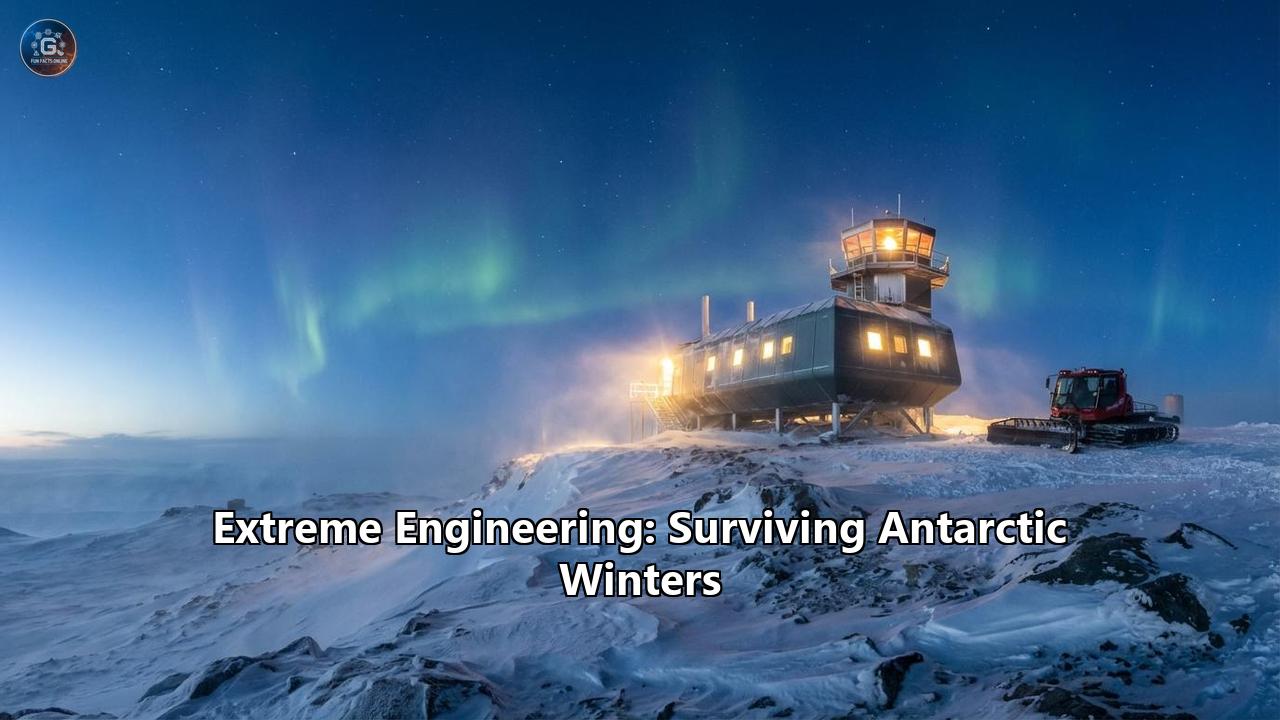
Imagine standing in a place where the temperature plummets to -80°C (-112°F), where katabatic winds howl at over 200 miles per hour, and where the sun disappears below the horizon for six unrelenting months. This is Antarctica—the coldest, driest, highest, and windiest continent on Earth. For most of human history, it was a frozen fortress, entirely hostile to life. Yet, today, it is home to some of the most advanced, resilient, and mind-boggling architectural and engineering marvels ever conceived.
Building a research station in Antarctica is not merely a construction project; it is a battle against the fundamental laws of thermodynamics and fluid dynamics. To survive the Antarctic winter, engineers must design structures that function more like spacecraft than traditional buildings. They must conquer sinking ice shelves, materials that shatter like glass in the deep freeze, and the psychological toll of utter isolation. This is the realm of extreme engineering, where human ingenuity is pushed to its absolute limits to sustain life in the planet's ultimate proving ground.
The Foundation Conundrum: Building on a Moving, Sinking Ocean of Ice
Before a single wall is insulated or a generator fired up, engineers face a monumental terrestrial challenge: the ground in Antarctica is actively trying to swallow everything built upon it.
Most of the continent is covered by an ice sheet that is miles thick in places. This ice is not static; it flows toward the ocean like a slow-motion river. Furthermore, the relentless wind drives snow across the flat expanse, burying anything that creates friction. A traditional building placed on the Antarctic surface will act as a snow fence. Within a few years, it will be entirely entombed in compacted snow, subjected to crushing pressures that will eventually rip its superstructure apart.
To solve this, modern Antarctic stations have adopted a paradigm shift: they no longer fight the snow; they rise above it.
At the Amundsen-Scott South Pole Station, operated by the United States, engineers designed a sprawling 65,000-square-foot facility elevated entirely on a network of hydraulic columns. By lifting the station off the ground, the aerodynamic design allows the relentless wind to scour the snow beneath the building, significantly reducing the rate of drift accumulation. However, even this is not a permanent fix. Because the ice sheet at the Geographic South Pole is 8,850 feet thick and creeps toward the coast at a rate of approximately 10 meters (33 feet) per year, the entire multi-million-dollar facility is constantly in motion. Furthermore, as snow inevitably builds up over the decades, the station was designed to be incrementally jacked up, extending its lifespan and keeping it from being buried alive.
While the South Pole Station elevates, the British Antarctic Survey’s Halley VI Research Station takes a decidedly more nomadic approach. Located on the Brunt Ice Shelf, Halley VI sits on a floating slab of ice that is constantly fracturing and calving massive icebergs into the Weddell Sea. If the station were permanently anchored, it would eventually be carried out to sea.
Designed by Hugh Broughton Architects and AECOM, Halley VI is the world's first fully relocatable research facility. It resembles a futuristic, brightly colored train elevated on giant, ski-fitted hydraulic legs. It is composed of eight interconnected modules. When snow accumulates, the hydraulic legs individually push down, lifting the module higher, before the skis are packed with fresh snow, allowing the station to mathematically "climb" out of the rising surface. Even more remarkably, if a chasm opens in the ice shelf—as it did in 2017—the modules can be decoupled, hitched to specialized traverse tractors, and towed miles inland to safety. Halley VI is not a resident of Antarctica; it is a highly sophisticated visitor.
The Thermal Fortress: Advanced Insulation and Materials Science
Once the foundation is secure, the next battle is thermal management. At -80°C, the physical properties of everyday materials undergo terrifying transformations. Standard carbon steel becomes dangerously brittle and can shatter upon impact. Rubber hoses snap like dry twigs. Plastics disintegrate.
To build the structural skeletons of these bases, engineers utilize specialized cold-weather alloys and composites. But keeping the cold out and the heat in requires an absolute mastery of insulation and the elimination of "thermal bridging"—the pathways through which heat can escape the building's envelope.
When Brazil’s original Comandante Ferraz Antarctic Station was destroyed by a tragic fire in 2012, the nation launched an international competition to build its replacement. The winning design by Curitiba-based Estúdio 41 is a masterclass in thermal defense. Measuring nearly 53,000 square feet, the new Comandante Ferraz takes the form of two aerodynamic, teal-hued linear vessels elevated on stilts to minimize wind drag (which can reach 200 km/h) and snow accumulation.
The thermal envelope of Comandante Ferraz is a high-tech fortress. Its external shell is constructed from durable carbon steel, wrapping around a double-layer thermal insulation system composed of thick polyurethane panels and rock wool. Crucially, these layers are separated by a 60-centimeter (23.6-inch) internal air gap. Air, when trapped and prevented from circulating, is an outstanding insulator. This buffer zone entirely isolates the living quarters from the lethal exterior, while hot water circulating through radiators maintains a comfortable, shirt-sleeve environment inside.
Other stations and field equipment have begun experimenting with ultra-advanced materials like Vacuum Insulated Panels (VIPs) and Aerogels. VIPs operate on the same principle as a thermos flask: by creating a vacuum between two layers, conductive and convective heat transfer is almost entirely eliminated. While difficult to integrate into large-scale structural walls due to their fragility and cost, VIPs offer thermal resistance 10 to 25 times higher than conventional insulation, making them invaluable for protecting sensitive battery banks and scientific instruments left out in the deep freeze. Triple-glazed windows with inert gas fills and low-emissivity coatings are standard across all modern stations, kept intentionally small to minimize heat hemorrhage.
The Energy Equation: Powering the Unforgiving Dark
Thermal insulation is useless without a reliable heat source. For decades, the lifeblood of Antarctic survival was special, cold-weather diesel fuel (often JP-8 or AN-8), which contains additives to prevent it from turning into a gel at sub-zero temperatures. But transporting millions of gallons of fuel via icebreaker ships and overland tractor traverses is an incredibly expensive, dangerous, and environmentally risky endeavor.
The Holy Grail of Antarctic engineering is achieving energy independence through renewables, a monumental task in a land defined by six months of total darkness and winds that can tear standard turbines to shreds.
Enter the Princess Elisabeth Antarctica, operated by the International Polar Foundation. Perched on the granite Utsteinen ridge, it holds the prestigious title of the continent's first "zero-emission" research station. Unlike traditional stations that rely on massive diesel generators, Princess Elisabeth runs entirely on solar and wind energy.
Achieving zero emissions in Antarctica requires a flawless synergy of engineering and software. The station harnesses the continent's violent katabatic winds using nine specialized wind turbines strung along the ridge. During the austral summer, a vast array of photovoltaic solar panels feeds the station's grid, while thermal solar panels melt snow and heat water for the bathrooms and kitchen.
Because renewable generation is inherently intermittent, the heart of Princess Elisabeth is its colossal battery room (utilizing heavy-duty lead-acid batteries) and a highly sophisticated micro smart grid. Driven by a Programmable Logic Controller (PLC)—the "brain" of the station—the system constantly monitors energy generation and consumption. It autonomously prioritizes life-support and critical scientific equipment. If power runs low, the smart grid automatically sheds non-essential loads, proving that human survival in extreme environments requires not just endless power, but intelligent energy management. The station itself acts as a passive thermal battery; its aerodynamic, multi-layered wooden structure is anchored deep into the permafrost to withstand 190 mph winds, capturing and recirculating every watt of heat generated by the equipment and the human bodies inside.
The Oasis in the Ice: Fluid Dynamics and Sourcing Water
If energy is the heartbeat of a station, water is its lifeblood. In a frozen desert, sourcing liquid water is a daily battle. You cannot simply drill a well into the dirt; beneath you is solid ice.
Historically, stations relied on bulldozers to scoop surface snow into massive, diesel-fired melters. This method is incredibly labor-intensive, vulnerable to bad weather, and wildly energy inefficient. Modern engineering solved this with an ingenious system known as the "Rodwell" (Rodriguez well), first pioneered by the US Army at Camp Century in Greenland and perfected at the Amundsen-Scott South Pole Station.
A Rodwell is essentially a subterranean lake of drinking water created deep within the ice sheet. Engineers use a hot-water drill to melt a shaft down through the compacted snow (firn) and into the solid ice, often 500 feet below the surface. Once at the desired depth, they continuously pump hot water into the hole, melting a massive, bell-shaped bulb or cavern in the ice. A submersible pump is then lowered into this artificial sub-glacial lake.
The physics of maintaining a Rodwell are a delicate balancing act. Continuous thermal energy must be injected into the well to keep the water from freezing solid. At the South Pole, waste heat from the station's massive diesel generators is captured and routed deep into the ice to maintain the Rodwell, which provides approximately 650,000 gallons of pristine freshwater to the station every year. When the cavern grows too large and the water level drops too deep, the well is decommissioned (eventually freezing solid over decades) and a new one is drilled nearby in a carefully planned honeycomb pattern.
Waste management is equally critical. The Antarctic Treaty mandates the strict protection of the continent's pristine environment. All blackwater (sewage) and greywater (sinks and showers) must be aggressively treated. Modern stations utilize advanced multi-stage wastewater treatment plants, employing bioreactors populated by engineered bacteria that can survive the harsh environment, followed by UV sterilization. The resulting effluent is practically clean enough to drink, ensuring that humanity leaves no toxic footprint on the ice.
Psychological Engineering: Designing for the Mind
Surviving Antarctica isn't just a matter of structural integrity; it is a profound test of human psychology. During the austral winter, crews are entirely cut off from the rest of the world for up to nine months. No flights can land; no ships can arrive. They are trapped in the dark, surrounded by a lethal vacuum of cold. The resulting sensory deprivation, isolation, and disruption of circadian rhythms can lead to "winter-over syndrome," characterized by depression, insomnia, and cognitive decline.
Modern extreme engineering places a heavy emphasis on human-centric architecture. When Hugh Broughton Architects designed Halley VI, they worked closely with color psychologists to combat the sensory monotony of the white landscape. The interiors are bursting with warm, vibrant colors. Lighting systems are biologically programmed to mimic the daylight spectrum, adjusting color temperature throughout the day to keep the crew's circadian rhythms stable. Stations like Comandante Ferraz intentionally incorporate libraries, gyms, and sweeping social spaces with localized acoustic dampening to provide both community interaction and vital private sanctuary.
But perhaps the greatest psychological and physiological breakthrough in Antarctic engineering is the integration of bio-regenerative life support. For decades, wintering crews subsisted on frozen, canned, and freeze-dried food. Today, they have the EDEN ISS.
Operated by the German Aerospace Center (DLR) near the Neumayer III Station, the EDEN ISS is a state-of-the-art, high-tech hydroponic greenhouse built into modified shipping containers. It is an entirely closed-loop environment. Outside, storms may rage at -40°C, but inside the Future Exploration Greenhouse, the temperature is a balmy 21°C with 65% humidity.
Plants in the EDEN ISS are grown without a single grain of soil. Their roots are suspended in the air and misted with an advanced nutrient delivery system, while high-power, water-cooled LED arrays provide optimized light recipes for photosynthesis. During a nine-month winter isolation period, this tiny technological oasis produced a staggering 270 kilograms (nearly 600 pounds) of fresh produce, including tomatoes, cucumbers, kohlrabi, radishes, and lettuce, for the 10-person crew.
The impact of the greenhouse goes far beyond nutrition. It serves as a vital psychological refuge. The smell of fresh basil, the sight of vibrant green leaves, and the physical act of harvesting a crisp cucumber provide an immeasurable boost to crew morale in a world utterly devoid of color and life.
Stepping Stone to the Stars
The colossal effort required to keep a handful of scientists alive in Antarctica might seem almost absurd in its complexity. Why go to such extreme lengths? The answer lies not just in the vital climate, astronomical, and geological data retrieved from the ice, but in the future of our species.
Antarctica is the ultimate analogue for outer space. The Amundsen-Scott Station and the Halley VI base are not just buildings; they are terrestrial space stations. The life support systems, the zero-emission microgrids of Princess Elisabeth, the psychological architecture of Comandante Ferraz, and the closed-loop hydroponics of the EDEN ISS are the direct precursors to the technology we will use to colonize the Moon and Mars.
When we figure out how to thrive in the darkest, coldest, and most unforgiving environment on Earth, we are actively writing the survival manual for humanity's journey into the cosmos. Extreme engineering in Antarctica is more than a fight against the cold; it is a breathtaking testament to the resilience, adaptability, and unbreakable exploratory spirit of humankind.
Reference:
- https://www.researchgate.net/publication/327834383_Status_of_the_EDEN_ISS_Greenhouse_after_on-site_installation_in_Antarctica
- https://www.esa.int/gsp/ACT/coffee/2022-06-17%20-%20Paul%20Zabel/
- https://www.quora.com/How-do-they-insulate-Antarctic-bases-from-the-cold
- https://www.marketdataforecast.com/market-reports/europe-building-thermal-insulation-market
- https://www.tiger-corporation.com/en/jpn/for-business/development_episode/
- https://bio.physik.fau.de/publications/Richter%20Methods%20in%20Eco%20and%20Evo%202018.pdf
- https://www.dlr.de/en/research-and-transfer/projects-and-missions/eden-iss
- https://polarjournal.net/eden-iss-the-greenhouse-in-antarctica/
- https://www.quora.com/Is-using-Aerogel-and-vacuum-insulated-panels-to-insulate-my-home-recommended
- https://www.dlr.de/en/research-and-transfer/projects-and-missions/eden-iss/the-eden-iss-greenhouse