
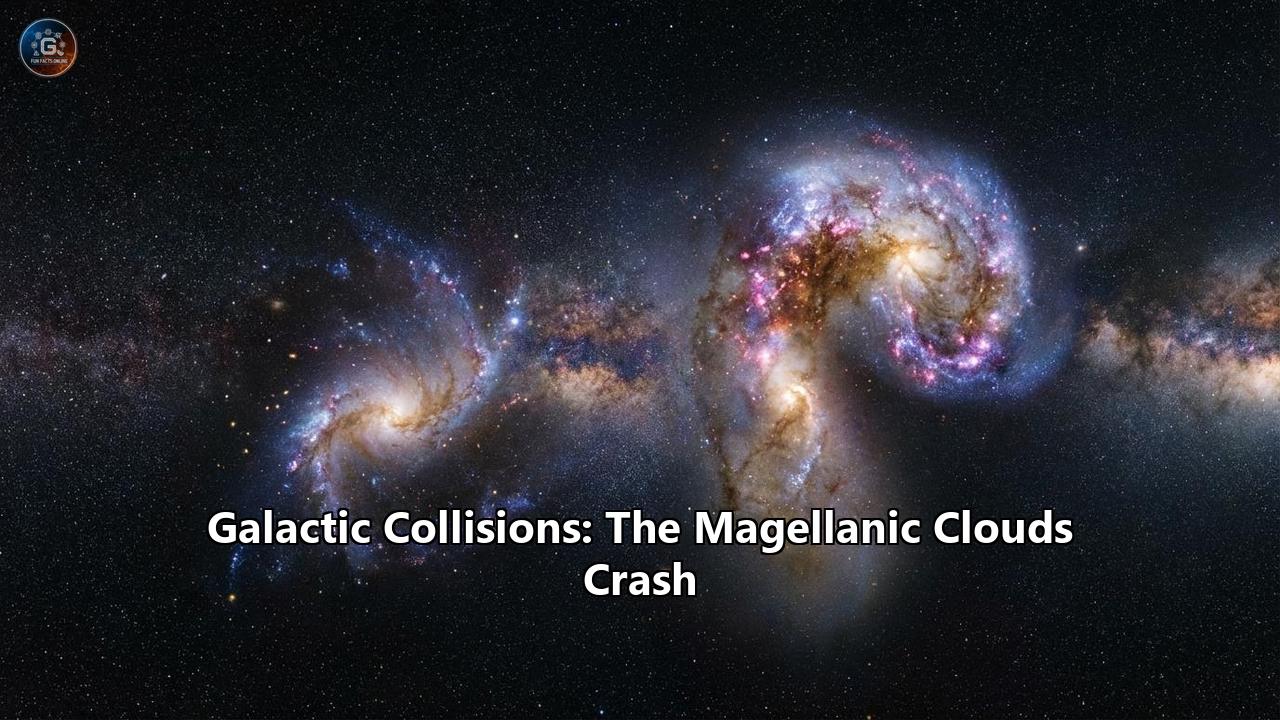
If you step outside on a clear night in the Southern Hemisphere, far away from the blinding glare of city lights, your eyes will be drawn to two luminous, mist-like patches suspended against the velvet backdrop of space. For millennia, these celestial apparitions have been woven into the mythologies of Indigenous cultures across the global south. To modern astronomers, they are known as the Large Magellanic Cloud (LMC) and the Small Magellanic Cloud (SMC)—two of the Milky Way’s closest galactic neighbors. But do not let their serene, cloud-like appearance deceive you. These twin galaxies are not peacefully drifting through the cosmos. They are the battered survivors of an ancient, catastrophic collision, and they are currently hurtling toward an inevitable, apocalyptic crash with our own Milky Way galaxy.
For decades, astronomers viewed the Magellanic Clouds as textbook examples of dwarf galaxies, using them as baseline benchmarks for understanding how galaxies evolve throughout the universe. But recent advancements in astrophysics, propelled by the unparalleled precision of instruments like the Hubble Space Telescope and the European Space Agency's Gaia observatory, have completely overturned this peaceful narrative. We are not looking at a static snapshot of galactic satellites. Instead, we are bearing witness to a violent, chaotic transformation in live action. The Magellanic Clouds are locked in a relentless gravitational war—both with each other and with the colossal mass of the Milky Way.
To understand the sheer magnitude of the impending collision with the Milky Way, we must first look at the traumatic history shared by the LMC and the SMC. For over half a century, the Small Magellanic Cloud posed a puzzling mystery to astrophysicists. In nearly all galaxies, gas and stars rotate around a central axis in a predictable, orderly fashion. Early telescope observations of the SMC seemed to indicate a similar rotation, with a velocity gradient suggesting that its gas was spinning at a rate of 60 to 100 kilometers per second. This neatly placed the SMC on standard astrophysical scales, such as the Baryonic Tully-Fisher Relation, which links a galaxy's mass to its rotation speed. However, as astronomers peered deeper, the stars within the SMC refused to conform to this model. Rather than orbiting the galactic center, the stars in the SMC are moving in chaotic, disorganized, and highly random patterns.
The answer to this riddle, published in early 2026 by researchers at the University of Arizona, revealed a history far more violent than anyone had anticipated. The Small Magellanic Cloud is not rotating at all. The appearance of rotation was a vast cosmic illusion born of geometry and destruction. A few hundred million years ago, the SMC was subjected to a catastrophic event: it crashed directly through the dense disk of its much larger sibling, the Large Magellanic Cloud.
As the SMC punched through the LMC, the gravitational forces involved were staggering. The LMC’s gravity sheared the SMC’s internal structure apart, sending its stars into the erratic, disordered motions we observe today. But gravity was only half the story. As the SMC’s gas plowed through the LMC’s dense interstellar medium, it experienced a phenomenon known as "ram pressure". The force exerted by the LMC's gas was more than ten times stronger than the SMC’s own internal gravitational pull. The impact delivered a massive velocity kick to the SMC's gas, wiping out whatever rotation it originally had and physically stretching the galaxy along a massive tidal tail. When astronomers on Earth look at the SMC today, they are seeing gas moving toward and away from us along this elongated, shattered structure. Because of our viewing angle, this chaotic stretching mimics the appearance of a spinning disk. The SMC is not gracefully pirouetting in space; it is a shattered galaxy whose lifeblood of gas is actively being blown outward.
The aftermath of this spectacular crash is written across the southern sky in the form of the Magellanic Bridge. This immense structure of gas and young stars stretches across 75,000 light-years of empty space, physically linking the two dwarf galaxies. The Bridge was formed as the immense tidal forces of the collision ripped stellar material and raw hydrogen away from both galaxies. Recent data from the Gaia space telescope, which measures the precise movements of billions of stars, has revealed that a specific sector of the SMC, known as the "Wing," is actually actively moving away from the main body of the dwarf galaxy. All the massive, hot young stars within the Wing are traveling in the same direction and at the same speed, surfing the tidal wave of the Magellanic Bridge directly toward the LMC—unambiguous proof of their recent collision.
But the LMC and SMC are not just fighting each other; they are actively navigating the treacherous gravitational domain of the Milky Way. As the Clouds plummet toward our galaxy, the Milky Way is exerting its own terrifying dominance. Recent observations utilizing the Hubble Space Telescope allowed astronomers to measure the halo of gas surrounding the Large Magellanic Cloud for the very first time. A galaxy’s halo is a vast, spherical envelope of gas and dark matter that acts as its protective shield and fuel reservoir for future star formation. For a galaxy of the LMC's mass, this halo should be massive. Instead, astronomers found that the LMC’s halo is incredibly compact, measuring a mere 50,000 light-years across—roughly ten times smaller than the halos of similar-sized galaxies.
This extreme truncation is the direct result of the Milky Way's incredible mass. As the LMC rushes inward, it must push through the tenuous but massive halo of the Milky Way itself. The Milky Way is acting like a giant, cosmic hairdryer, forcefully blowing gas off the LMC. The ram pressure generated by this high-speed plunge is so intense that it has stripped away nearly 90 percent of the Large Magellanic Cloud’s original halo. Yet, despite this catastrophic loss, the LMC is a survivor. Its high mass allowed it to retain just enough of its core gas to continue functioning. Unlike smaller dwarf galaxies, which would have been completely gutted and left as lifeless husks of aging red stars, the LMC still boasts some of the most spectacular star-forming regions in the local universe, such as the monstrous Tarantula Nebula.
The gas that the Milky Way strips away from the Magellanic Clouds does not simply vanish. It forms the Magellanic Stream, a colossal, intertwined double-ribbon of high-velocity neutral and ionized gas that trails behind the Clouds for hundreds of thousands of light-years, wrapping halfway around the Milky Way. This magnificent cosmic wake is the largest extragalactic gaseous structure visible from Earth. For years, the exact distance between the Magellanic Stream and the Milky Way’s disk was notoriously difficult to measure, leaving astronomers uncertain about when this massive reservoir of gas would finally crash into our galaxy.
However, the universe has a way of providing clues. On the extreme outskirts of the Milky Way, in a region typically populated exclusively by ancient, dying stars, astronomers recently discovered something anomalous: a flock of brilliant, infant stars known as the Price-Whelan 1 cluster. Spectroscopic analysis of these newborn stars revealed a startling truth—they did not form from Milky Way material. Their chemical signatures proved they were born from the extragalactic gas of the Magellanic Clouds. As the leading edge of the Magellanic Stream pushes through the gases surrounding the Milky Way, the resulting drag and compression condense the stream's gas. This pressure, combined with the Milky Way's gravitational tidal forces, triggers rapid star formation. Once ignited, these young stars zoom ahead of the decelerating gas, seamlessly integrating into the Milky Way's outer halo.
The discovery of the Price-Whelan 1 cluster allowed astronomers to definitively clock the distance to the Magellanic Stream. By calculating the positions and trajectories of these young stars, scientists realized that the leading edge of the stream is only 90,000 light-years away from the Milky Way. This is roughly half the distance previously estimated. It means that the influx of Magellanic gas is poised to hit the Milky Way’s disk much sooner than current models predicted. When it does, this massive influx of fresh hydrogen will trigger a spectacular era of starburst activity across our galaxy, replenishing the Milky Way’s rapidly depleting gas reserves and sparking the birth of countless new stellar systems.
But this celestial rain of gas is merely the prologue to the main event. The galaxies themselves are coming.
The future of our local galactic neighborhood is fundamentally tied to the invisible, enigmatic force of dark matter. Interestingly, the ancient collision between the SMC and LMC has provided astronomers with a unique tool to map this invisible substance. In 2025, researchers noted that the bar-shaped structure of stars at the very center of the Large Magellanic Cloud is tilted significantly out of the plane of the galaxy. By utilizing advanced hydrodynamic simulations, physicists realized that the degree of this central tilt is directly proportional to the amount of dark matter contained within the Small Magellanic Cloud during their collision. Because dark matter cannot be seen and only interacts via gravity, measuring the physical distortion left behind by galactic impacts offers a groundbreaking new method to weigh the dark matter halos of dwarf galaxies.
And nestled deep within this dark matter, hidden at the heart of the LMC, lurks a monster. In early 2025, astrophysicists examining the high-speed trajectories of massive blue stars in the LMC discovered the unmistakable gravitational signature of a supermassive black hole. Clocking in at an estimated 600,000 times the mass of our Sun, this black hole falls into a rare, intermediate-to-supermassive weight class. It is entirely invisible, emitting no radiation as it quietly slumbers, yet it betrays its existence through the "Hills mechanism"—a chaotic three-body gravitational dance that occasionally violently ejects massive stars out of the LMC and across the cosmos at hypervelocity.
Because the Large Magellanic Cloud is locked into a fatal inward spiral, this means that its 600,000-solar-mass black hole is currently on a direct collision course with the Milky Way. The intricate orbital dance between the Milky Way, the LMC, and the SMC is steadily decaying. In roughly two billion years—long before our Sun exhausts its nuclear fuel and swells into a red giant—the Magellanic Clouds will breach the Milky Way’s galactic disk.
The collision will not be a sudden, catastrophic explosion, but a prolonged, spectacular cosmic upheaval. When the Large Magellanic Cloud finally hits the Milky Way, the structural integrity of our galaxy will be permanently altered. The immense gravitational disturbance will likely waken the supermassive black hole at the center of the Milky Way, Sagittarius A. As fresh gas from the LMC is funneled into the galactic core, Sagittarius A will ignite, transitioning from a dormant black hole into an active quasar. It will gorge on the infalling material, emitting blinding torrents of high-energy radiation that will illuminate the center of the galaxy.
Over the eons that follow the initial impact, the LMC’s own black hole will sink toward the center of the Milky Way through a process called dynamical friction. Eventually, the two supermassive black holes will find each other. They will engage in a tightening binary orbit, sending massive ripples of gravitational waves echoing through the fabric of spacetime, before ultimately merging into a single, colossal singularity. This is the very mechanism by which galaxies and their central black holes grow—a brutal, beautiful process of cosmic cannibalism.
For any life forms existing in the Milky Way two billion years from now, the night sky will be utterly unrecognizable. The faint, misty smudges of the Magellanic Clouds will be gone, replaced by a sky blazing with the furious light of billions of new stars, brilliant nebulas, and the incandescent glow of a feeding galactic core. The orderly, flattened spiral of the Milky Way may be temporarily warped, its spiral arms disrupted by the colossal gravitational wake of the dying dwarf galaxies.
Through the lens of recent astronomical breakthroughs, we no longer view the Magellanic Clouds as mere satellite galaxies drifting aimlessly in the void. They are a testament to the violent, dynamic, and ever-changing nature of the universe. From the shattered, stretching gas of the Small Magellanic Cloud, to the stripped, compact halo of the Large Magellanic Cloud, to the trailing river of the Magellanic Stream currently seeding the Milky Way with newborn stars, these galaxies are writing the history—and the future—of our galactic neighborhood. We are witnessing a cosmic tragedy and a spectacular rebirth, playing out in real-time right above our heads.
Reference:
- https://www.sciencedaily.com/releases/2026/03/260319044652.htm
- https://www.simonsfoundation.org/2020/01/07/milky-way-new-stars/
- https://www.skyatnightmagazine.com/news/large-magellanic-cloud-milky-way-collision
- https://news.umich.edu/u-m-astronomers-confirm-collision-between-two-milky-way-satellite-galaxies/
- https://skyandtelescope.org/astronomy-news/a-nearby-dwarf-galaxy-is-transforming-before-our-eyes/
- https://www.eurekalert.org/news-releases/1120116
- https://indiandefencereview.com/a-galaxy-next-door-was-shattered/
- https://arxiv.org/html/2410.14772v1
- https://www.eso.org/sci/meetings/2015/eso-2020/MagClouds_ESO_2020_Cioni.pdf
- https://www.teses.usp.br/teses/disponiveis/14/14131/tde-26052023-113849/en.php
- https://www.sciencealert.com/a-supermassive-black-hole-is-on-a-collision-course-with-the-milky-way