
For nearly two decades, a subtle signature in the infrared spectrum of the Martian surface remained one of the most intriguing mysteries in planetary science. Orbiting hundreds of kilometers above the rust-colored deserts, NASA’s Mars Reconnaissance Orbiter (MRO) routinely scanned the terrain below, characterizing the mineralogy of the Red Planet. Among its vast trove of data, an unexplained absorption band at precisely 2.236 micrometers continually defied classification. It did not match any mineral in our terrestrial databases. It was a spectral ghost—a fingerprint of a chemical environment that was uniquely Martian.
In August 2025, a multidisciplinary team of scientists from the SETI Institute, NASA’s Ames Research Center, and the University of Massachusetts Amherst finally unveiled the identity of this elusive compound. The mystery material is a previously uncatalogued iron sulfate: ferric hydroxysulfate ($Fe^{3+}SO_4OH$). By successfully synthesizing this mineral in the laboratory and mapping its distribution on Mars using deep learning artificial intelligence, researchers have unlocked a profound new chapter in Martian geologic history. The presence of ferric hydroxysulfate is not merely a mineralogical curiosity; it acts as a direct geochemical beacon, tracing the locations of ancient, high-temperature geothermal springs and sub-ice volcanic eruptions.
Because ferric hydroxysulfate forms only under specific, high-temperature, acidic, and oxygenated conditions, its discovery proves that Mars remained chemically, thermally, and hydrologically active far more recently than planetary models previously suggested. This revelation radically shifts our understanding of Martian paleoclimates, extending the window of potential habitability into the Amazonian period (less than 3 billion years ago) and providing astrobiologists with prime targets in the ongoing search for extraterrestrial life.
The 15-Year Mystery of the 2.236-Micron Band
To understand the magnitude of this discovery, we must first look to the instrument that made it possible: the Compact Reconnaissance Imaging Spectrometer for Mars, or CRISM. Aboard the MRO, CRISM operates by measuring the sunlight reflected off the Martian surface across hundreds of distinct wavelengths in the visible and near-infrared spectrum. Different minerals absorb and reflect light in highly specific ways based on their molecular bonds and crystal structures. For example, the presence of water or hydroxyl (OH) groups in a mineral's lattice creates deep, characteristic absorption bands that tell scientists exactly what kind of clays, carbonates, or sulfates lie below.
In 2010, researchers poring over CRISM data spotted a faint but distinct spectral trough at 2.236 µm. This signal was localized to a few specific regions: the chaotic, collapsed terrain of Aram Chaos, and the plateau bordering Juventae Chasma, a massive box canyon near the Valles Marineris rift system. Despite exhaustive comparisons against thousands of mineral spectra synthesized on Earth, the 2.236 µm band remained an orphan.
The primary challenge in decoding hyperspectral data from Mars is the planet's atmosphere. While thin, the Martian atmosphere is heavily laden with carbon dioxide and suspended silicate dust. Sunlight must travel through this scattering medium, strike the surface, and bounce back through the atmosphere to the orbiter. "The data that comes out of the spectrometer is not usable the way it is," explained Mario Parente, an associate professor of electrical and computer engineering at UMass Amherst. "There are scattering molecules and gases that absorb light in the atmosphere. For example, on Mars, there is an abundance of carbon dioxide, and that will distort the data".
For years, the distortion masked the full spectral profile of the unknown mineral, blurring the auxiliary bands needed to identify its chemical family. The breakthrough required a revolutionary approach to data processing, shifting from traditional atmospheric modeling to advanced artificial intelligence.
Deep Learning Unmasks a Geochemical Ghost
To peer through the Martian atmosphere with unprecedented clarity, Parente and his team developed state-of-the-art atmospheric correction algorithms powered by deep learning and artificial intelligence. Their methodology relied on a type of machine learning known as a Generative Adversarial Network (GAN) combined with deep clustering techniques to isolate and denoise the CRISM data.
Traditional atmospheric correction models estimate gas concentrations and aerosol optical depths mathematically, which often leaves behind residual artifacts in the data. The AI-driven approach, conversely, was trained to automatically learn the distinctive, uncorrupted spectral "fingerprints" of various minerals. By analyzing thousands of pixels, the deep clustering algorithms identified anomalies and subtle variations at a granular scale—down to tens of meters—allowing researchers to automatically map both known and unknown mineral distributions.
Once the AI stripped away the atmospheric noise, the pristine spectral signature of the 2.236 µm mineral emerged in high definition. It exhibited a sharp, narrow band characteristic of a hydroxyl (OH) group, alongside broader features indicative of a heavily oxidized iron sulfate. Armed with this refined spectral fingerprint, the torch was passed to geochemists at the SETI Institute and NASA’s Ames Research Center, led by senior research scientist Dr. Janice Bishop. Their task was to artificially recreate the Martian environment in the lab and synthesize a compound that matched the signal.
Recreating Mars: The Synthesis of Ferric Hydroxysulfate
The surface of Mars is notoriously rich in sulfur and iron, a legacy of billions of years of widespread volcanism and the subsequent acidic weathering of basaltic rocks. When water interacted with these ancient rocks, it dissolved the sulfur and iron, carrying them into deep aquifers or surface lakes. As the planet lost its atmosphere and these water bodies evaporated, they left behind massive sedimentary deposits of sulfate minerals.
The AI-enhanced CRISM maps revealed a fascinating stratigraphic pattern at Aram Chaos and Juventae Chasma. The unknown mineral was intimately associated with known ferrous (Fe²⁺) iron sulfates, specifically polyhydrated sulfates (containing multiple water molecules) like rozenite ($Fe^{2+}SO_4\cdot 4H_2O$) and monohydrated sulfates like szomolnokite ($Fe^{2+}SO_4\cdot H_2O$). However, the 2.236 µm mineral was situated in specific, localized pockets beneath or adjacent to these broader sulfate beds.
Dr. Johannes Meusburger, a postdoctoral researcher at NASA Ames, designed a series of rigorous heating experiments to simulate the diagenetic evolution of these sulfates. The team began with rozenite, heating it under various temperature, pressure, and atmospheric conditions. They found that when rozenite is heated to around 30–50°C, it rapidly dehydrates into szomolnokite. But the crucial transformation occurred when the temperature was pushed beyond 100°C in an acidic, oxygenated environment.
At these higher temperatures, the remaining water molecule in the szomolnokite structure is driven out. Simultaneously, the iron undergoes oxidation—losing an electron to transition from a ferrous (Fe²⁺) state to a ferric (Fe³⁺) state. An oxygen and a hydrogen atom from the water combine to form a hydroxyl (OH) group, which replaces $H_2O$ in the crystal lattice. This reaction drastically alters how the mineral absorbs infrared light, giving birth to the sharp 2.236 µm band. The resulting mineral was ferric hydroxysulfate ($Fe^{3+}SO_4OH$).
"While the changes in the atomic structure are very small, this reaction drastically alters the way these minerals absorb infrared light, which allowed identification of this new mineral on Mars using CRISM," Meusburger noted.
Because the synthesis of ferric hydroxysulfate strictly demands temperatures between 50°C and 100°C (or higher), acidic conditions, and the presence of oxygen and water, it serves as an undeniable paleothermometer. The typical surface temperature of Mars is well below freezing, meaning the vast beds of szomolnokite and rozenite could not have transformed into ferric hydroxysulfate under normal climatic conditions. The heat had to come from below.
Aram Chaos: The Collapse of an Ice Lake
To fully appreciate the significance of this geothermal proxy, one must examine the dramatic landscapes where it was discovered. Aram Chaos is an ancient, heavily eroded impact crater approximately 280 kilometers (170 miles) in diameter, situated near the Martian equator at the eastern terminus of the Valles Marineris canyon system.
Over four billion years ago, a massive asteroid impact carved out the Aram basin. During Mars's wetter, warmer Noachian period, this yawning bowl slowly filled with wind-blown dust, volcanic ash, and water, eventually forming a massive, sealed subsurface ice lake covered by a two-kilometer-thick layer of insulating sediment. For millions of years, the ice lay dormant, isolated from the increasingly cold and dry surface conditions.
Then, a catastrophic geologic event occurred. Molten magma from deep within the Martian mantle began to intrude into the fractured bedrock beneath the basin. The localized geothermal heat from this magmatic intrusion initiated a massive, runaway melting of the subterranean ice. As the foundational ice turned to liquid water, the overlying two kilometers of sediment lost their structural support and collapsed inward, creating a jumbled, "confused" network of blocky mesas, deep valleys, and fractures known as chaotic terrain.
The sudden liberation of immense volumes of pressurized meltwater resulted in a catastrophic outburst flood. The water violently overtopped the eastern rim of the crater, carving a massive outflow channel 10 kilometers wide and 2 kilometers deep into the surrounding plains of Ares Vallis in the span of perhaps only a month.
But the story of Aram Chaos did not end with the flood. Following the collapse, a secondary, shallower lake formed within the depression. As geothermal vents on the crater floor continued to heat the remaining, highly acidic, sulfur-rich waters, vast quantities of dissolved iron and sulfur began to precipitate out as layered sedimentary deposits.
The stratigraphy mapped by the AI-enhanced CRISM data perfectly aligns with this model. Across the upper layers of Aram Chaos, polyhydrated sulfates dominate, representing the cooler, later stages of the lake's evaporation. Deeper down, monohydrated sulfates are present, baked by ambient diagenetic heat. But directly above the ancient geological faults—the precise locations where superheated water and steam from the magmatic intrusion would have vented into the lake—the AI detected the bright red pixels of ferric hydroxysulfate.
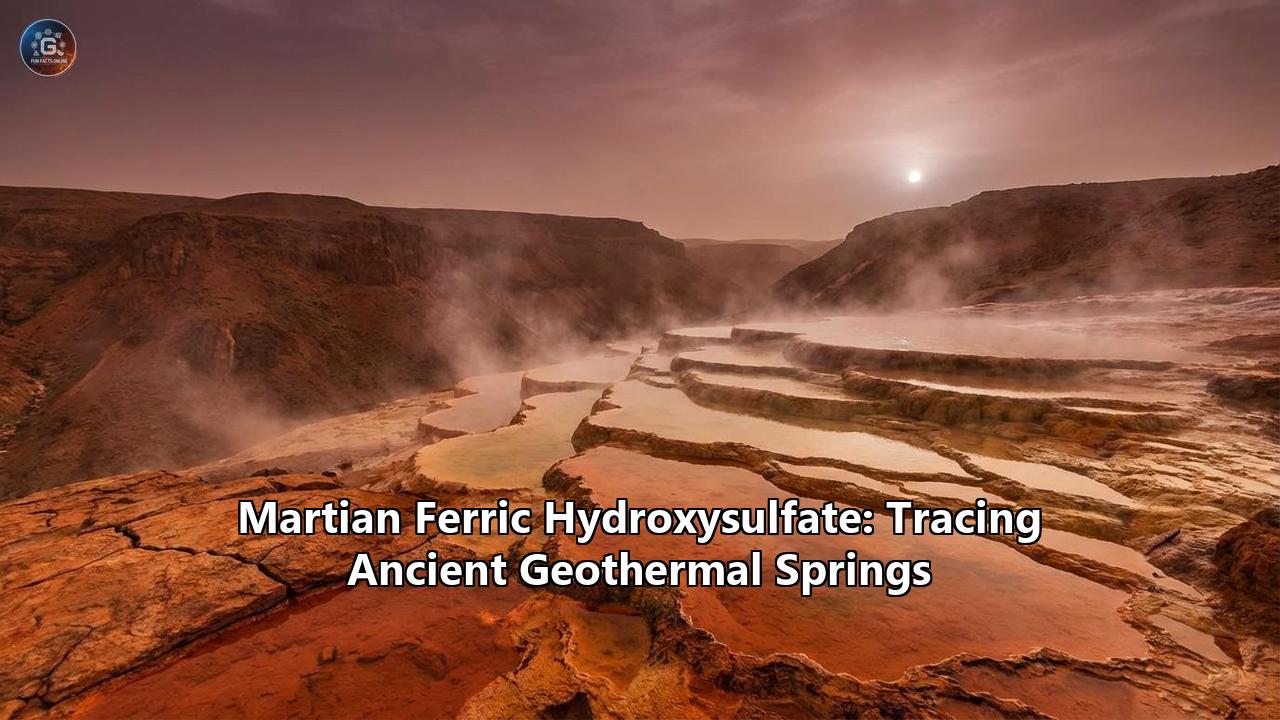
These highly localized deposits are the fossilized remains of Martian hydrothermal vents. The geothermal energy beneath Aram Chaos actively cooked the hydrated sulfates at temperatures exceeding 100°C, forcing the chemical transformation into ferric hydroxysulfate.
Juventae Chasma: Sub-Ice Volcanoes and Outburst Floods
A similar, yet distinct, narrative unfolded roughly 500 kilometers away at Juventae Chasma. Juventae is an enormous box canyon, roughly 250 kilometers long and 100 kilometers wide, that plunges 5 kilometers deep into the plains of Lunae Planum. It is physically separated from the main Valles Marineris system but shares its tectonic origins, having formed through extensional stresses related to the immense Tharsis volcanic bulge.
The floor of Juventae Chasma is a rugged alien landscape, featuring towering 2.5-kilometer-high mounds of light-toned interior layered deposits (ILDs) mostly composed of kieserite (a magnesium sulfate) and other hydrated minerals. Like Aram Chaos, Juventae is intimately linked to the catastrophic release of water; it acts as the source region for Maja Valles, a massive outflow channel extending northward.
Detailed topographic and geomorphological analyses from the Mars Global Surveyor (MGS) and the High-Resolution Imaging Science Experiment (HiRISE) suggest that Juventae Chasma was once filled with a massive glacier or an ice-covered lake. In this region, however, the heat source was not just deep-seated geothermal conduction, but active volcanism.
CRISM spectral mapping, overlaid on high-resolution topographic models, shows ferric hydroxysulfate sandwiched between distinct layers of unaltered basaltic ash and lava. This stratigraphy paints a vivid picture: active volcanic eruptions occurring directly beneath or adjacent to the ice. When the magma and hot ash breached the surface, they encountered sulfate-rich ice and water. The extreme heat from the lava flows flash-boiled the highly acidic, sulfurous brines, creating localized pockets of boiling water and steam.
This violent intersection of fire and ice provided the perfect crucible for forming ferric hydroxysulfate. The volcanic heating of the ambient hydrated ferrous sulfates in an oxygenated environment triggered the rapid phase change. The sub-ice eruptions also provided the thermal trigger that melted the glacier, leading to the ponding of water that eventually breached the canyon walls, resulting in the catastrophic megaripple-forming floods of Maja Valles.
Chronology of a Dynamic Planet
One of the most profound implications of identifying ferric hydroxysulfate at these sites is the timeline of its formation. For decades, the consensus view of Mars characterized the planet's geologic history in three broad strokes: the warm, wet Noachian (4.1 to 3.7 billion years ago), the transitional Hesperian (3.7 to 3.0 billion years ago), and the hyper-arid, geologically dead Amazonian (3.0 billion years ago to the present).
Most large-scale aqueous mineral deposits, such as the vast clay beds and initial sulfate evaporites, were thought to have formed during the Noachian and early Hesperian. However, crater-counting chronologies and stratigraphic relationships suggest that the thermal alteration events that created the ferric hydroxysulfate in Aram Chaos and Juventae Chasma occurred during the Amazonian period—less than 3 billion years ago.
"The presence of this mineral puts a lot more nuance on what was going on," Parente stated. "Parts of Mars have been chemically and thermally active more recently than we once believed". The survival of this mineral, which on Earth might be quickly altered by weathering or rainfall, is a testament to the hyper-arid deep freeze that followed these localized thermal events. Because Mars has been a dry desert for billions of years, the delicate ferric hydroxysulfate remained locked in a state of suspended animation, preserving a high-fidelity record of localized, high-temperature hydrothermal activity.
Terrestrial Analogs: Fumaroles and Extremophiles
To understand what these Martian environments might have looked like—and what they imply for the search for life—geologists frequently turn to terrestrial analogs. Earth is home to several extreme environments that closely mimic the geochemical conditions required to form ferric hydroxysulfate and related high-temperature sulfates.
At Lassen Volcanic National Park in Northern California, specifically the Sulphur Works region, scientists have conducted year-to-year studies of active fumaroles. These small steam vents, encrusted with elemental sulfur and surrounded by warm, acidic soil, act as natural laboratories for sulfate precipitation. Researchers have observed that depending on the moisture regime (annual snowfall and rain), the mineralogy around the fumaroles shifts dramatically. During wet, highly active hydrothermal periods, ferric sulfates like copiapite, coquimbite, and rhomboclase dominate the landscape. These minerals are structurally and chemically analogous to the ferric hydroxysulfate found on Mars, requiring similar acidic, high-redox potential environments.
Another striking analog is found in the Landmannalaugar region of Iceland, where thermal springs intermingle with cold glacial runoffs in a volcanic setting. Here, hydrothermal fluids actively precipitate iron oxides and oxyhydroxides like ferrihydrite, painting the landscape in vibrant orange-red pigments. The Icelandic springs mirror the proposed sub-ice volcanic mechanisms of Juventae Chasma, demonstrating how magma interacting with glacial meltwater drives the rapid formation of highly oxidized iron minerals.
Perhaps the most famous analog is Yellowstone National Park, where superheated, acidic waters bubble to the surface, dissolving surrounding rocks and precipitating massive terraces of silica and sulfate minerals. On Mars, the Spirit rover found direct evidence of such an environment at the Columbia Hills inside Gusev Crater. Spirit's wheels churned up bright white soils consisting of remarkably pure ferric sulfates and opaline silica. On Earth, opaline silica of this purity is almost exclusively formed in the roaring outflows of hydrothermal geysers and hot springs. The discovery of ferric hydroxysulfate by orbiters strongly corroborates the ground-truth data from Spirit, indicating that localized geothermal hotspots were not isolated flukes, but a recurring theme across the Martian surface.
Astrobiological Implications: Hunting for Life in the Hot Springs
The confirmation of recent, high-temperature geothermal activity on Mars acts as a profound catalyst in the field of astrobiology. Life, as we know it, requires three fundamental pillars: liquid water, essential chemical elements (carbon, hydrogen, nitrogen, oxygen, phosphorus, and sulfur), and a source of energy. While the surface of Mars is bathed in lethal ultraviolet and cosmic radiation and subject to sterilizing perchlorates, the subsurface hydrothermal systems indicated by ferric hydroxysulfate would have provided all three pillars in abundance.
In terrestrial hydrothermal systems, the sharp gradients in temperature and pH, along with the mixing of oxidized and reduced chemicals, provide a rich source of redox energy. Chemolithoautotrophic extremophiles—bacteria and archaea that "eat" inorganic rocks and minerals—thrive in these environments. They bypass the need for sunlight by harvesting the electron transfer between dissolved hydrogen, sulfur, and iron.
The transition from ferrous to ferric iron, the very process that created the ferric hydroxysulfate at Aram Chaos, is a prime energy-yielding reaction utilized by iron-oxidizing microbes on Earth (such as Acidithiobacillus ferrooxidans). If microbial life ever arose on Mars, it is highly probable that it would have retreated into the deep, warm, wet subsurface as the planet's atmosphere thinned and the surface froze.
Dr. Manuel Roda of Utrecht University, who modeled the collapse of Aram Chaos, highlighted the biological potential of these environments: “An exciting consequence is that rock-ice units are possibly still present in the subsurface. These never achieved the melting conditions, or melted only a lower thin layer... These lakes could provide a potentially favorable site for life, shielded from hazardous UV radiation at the surface”.
Furthermore, the minerals precipitated by these geothermal springs are excellent preserving agents. Hydrated silica and iron sulfates have an exceptional capacity to entomb and preserve organic molecules and microfossils. If extremophiles lived in the hot springs of Aram Chaos or Juventae Chasma, their biosignatures—lipid biomarkers, isotopic fractionations, or even mineralized cellular structures—might still be trapped within the crystalline lattice of the ferric hydroxysulfate and surrounding ILDs.
The Future of Martian Geochemical Exploration
The discovery of ferric hydroxysulfate is a testament to the symbiotic relationship between orbital observation, artificial intelligence, and terrestrial laboratory science. As we look toward the future of Mars exploration, these tools will become increasingly intertwined.
Currently, NASA's Perseverance rover is exploring Jezero Crater, a site chosen for its ancient deltaic deposits and rich concentrations of clays and carbonates. The same AI-driven mapping techniques developed by Mario Parente’s team to find ferric hydroxysulfate have already been deployed to map Jezero Crater with unprecedented clarity. By pinpointing the exact spatial distribution of hydrated silica and carbonates from orbit, the AI acts as a sophisticated scout, guiding the rover's SuperCam and SHERLOC instruments to the most scientifically valuable outcrops. Perseverance is actively drilling and caching these high-value rock samples, which are slated to be returned to Earth in the 2030s by the ambitious Mars Sample Return mission.
While Jezero Crater represents a pristine Noachian habitable environment (an ancient surface lake), the findings at Aram Chaos and Juventae Chasma compel planetary scientists to consider a different kind of target for future missions. The rugged, chaotic terrains and deep canyons of Valles Marineris have traditionally been considered too dangerous for rover landings due to their steep slopes, massive boulders, and unpredictable winds. However, the revelation that these regions harbor the remnants of Amazonian-era geothermal springs makes them some of the most compelling astrobiological targets in the solar system.
Advances in autonomous landing systems, such as the Terrain-Relative Navigation used by Perseverance, combined with next-generation mobility platforms like the Ingenuity helicopter's successors, may soon make these treacherous terrains accessible. A future mission targeted directly at the ferric hydroxysulfate outcrops of Aram Chaos could drill into the fossilized hydrothermal vents, directly sampling the stratigraphy that records the last gasps of Martian geothermal heat.
The identification of ferric hydroxysulfate is not the end of the 2.236-micron mystery; it is the beginning of a profound new line of inquiry. It demonstrates that Mars is not a simple, monolithic dead rock, but a planet with a complex, dynamic, and surprisingly recent geologic pulse. Hidden beneath the global veneer of oxidized dust lie the frozen monuments of ancient geysers, sub-ice volcanoes, and chaotic floods. By continuing to refine our orbital algorithms and pushing the boundaries of deep learning, we will undoubtedly uncover more geochemical ghosts, each one bringing us a step closer to answering the ultimate question: Did the hot springs of Mars ever harbor life?
Reference:
- https://www.iflscience.com/an-entirely-new-mineral-may-have-been-found-on-mars-solving-20-year-old-mystery-80391
- https://theanalyticalscientist.com/issues/2025/articles/october/spectral-mystery-on-mars-finally-solved
- https://en.wikipedia.org/wiki/Ferric_hydroxysulfate
- https://theanalyticalscientist.com/issues/2025/articles/october/spectral-mystery-on-mars-finally-solved
- https://ahed.nasa.gov/datasets/b425b97a4c6d28c04f87d5b49f36
- https://www.umass.edu/engineering/news/mario-parente-mars
- https://www.umass.edu/news/article/umass-researchers-help-id-new-mineral-mars-providing-insight-red-planets-potential
- https://www.usgs.gov/publications/possible-juventae-chasma-subice-volcanic-eruptions-and-maja-valles-ice-outburst-floods
- https://scitechdaily.com/a-mysterious-mineral-on-mars-may-rewrite-the-planets-geologic-history/
- https://www.sciencedaily.com/releases/2026/03/260309225228.htm
- https://pubs.geoscienceworld.org/books/book/1580/chapter/107352563/spectroscopic-and-geochemical-analyses-of
- https://meetingorganizer.copernicus.org/EPSC2024/session/51204
- https://astrobiology.com/2025/09/perseverance-rover-uncovers-clues-to-ancient-martian-chemistry.html
- https://www.computer.org/csdl/proceedings-article/cvprw/2022/873900b321/1G56tBK5CJG
- https://www.seti.org/news/a-unique-martian-mineral-offers-fresh-clues-about-planet-s-past/
- https://www.seti.org/news/a-unique-martian-mineral-offers-fresh-clues-about-planet-s-past/
- https://www.universetoday.com/articles/new-water-related-discovery-from-hibernating-spirit-rover
- https://themis.asu.edu/feature/50
- https://www.hou.usra.edu/meetings/tenthmars2024/pdf/3453.pdf
- https://scitechdaily.com/a-mysterious-mineral-on-mars-may-rewrite-the-planets-geologic-history/
- https://en.wikipedia.org/wiki/Aram_Chaos
- https://science.nasa.gov/photojournal/a-complex-geologic-history-of-aram-chaos/
- https://www.sci.news/space/science-aram-chaos-ancient-ice-lake-mars-01382.html
- https://www.uahirise.org/ESP_024398_1835
- https://en.wikipedia.org/wiki/Juventae_Chasma
- https://scispace.com/pdf/mineralogical-characterization-of-juventae-chasma-mars-3mrdob4sc0.pdf
- https://science.nasa.gov/photojournal/the-hills-in-juventae-chasma/
- https://www.eurekalert.org/news-releases/1099990
- https://www.hou.usra.edu/meetings/lpsc2026/pdf/1230.pdf
- https://www.ovid.com/journals/scie/abstract/10.1126/science.1155429~detection-of-silica-rich-deposits-on-mars?redirectionsource=fulltextview
- https://www.researchgate.net/publication/370499384_The_CRISM_investigation_in_Mars_orbit_Overview_history_and_delivered_data_products
- https://www.researchgate.net/figure/Geological-map-of-Juventae-chasma-modified-by-Catling-et-al-2006-The-five-geomorphic_fig4_316830197