
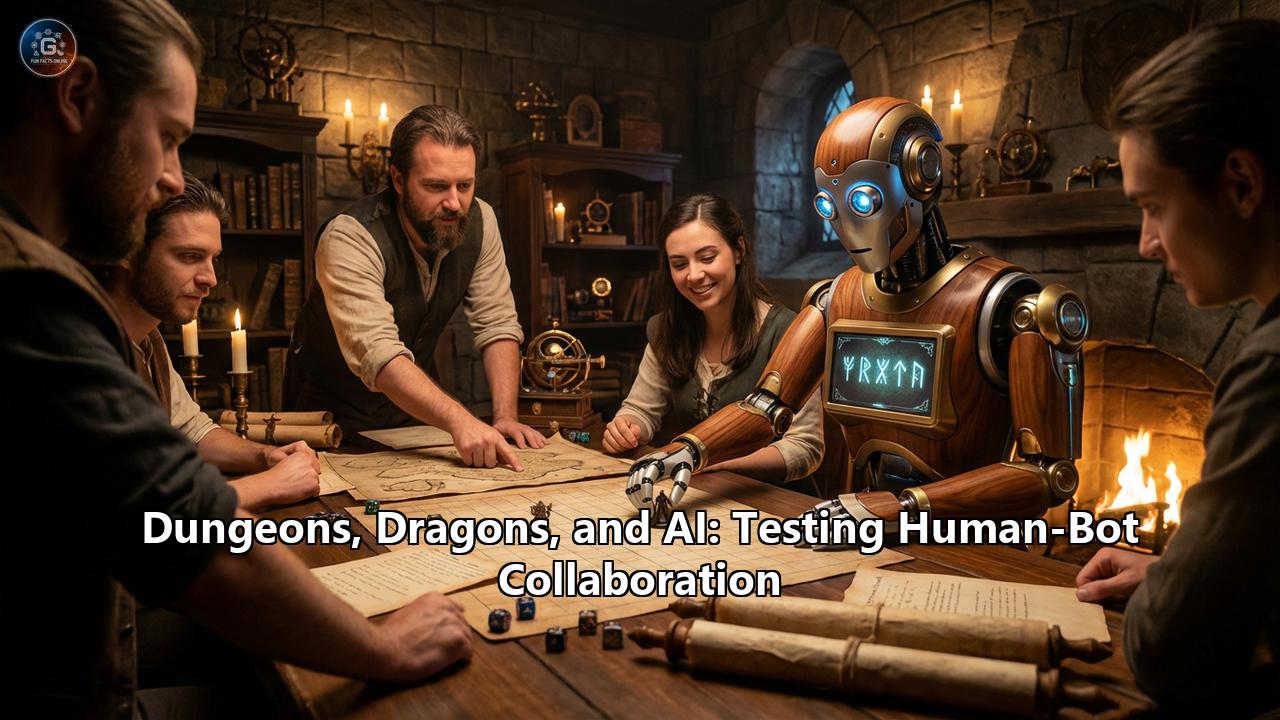
The dimly lit basement, smelling faintly of cheesy snacks and anxiety, has long been the sanctuary of the Dungeon Master. Behind the cardboard screen, a solitary figure juggles distinct personalities for six different goblins, tracks the hit points of a gelatinous cube, and desperately tries to remember the name of the tavern keeper they invented three sessions ago. This is the sacred tradition of Tabletop Roleplaying Games (TTRPGs): a messy, chaotic, deeply human collision of math and make-believe.
But in 2026, a new player has pulled up a chair. It doesn’t eat snacks, it doesn’t sleep, and it has read every rulebook in existence.
Artificial Intelligence has breached the dungeon. From Large Language Models (LLMs) that can generate infinite loot tables in seconds to image generators visualizing eldritch horrors that defy description, AI is reshaping the landscape of Dungeons & Dragons (D&D) and its peers. This is not just a technological upgrade; it is a cultural schism, a creative revolution, and an ethical battleground all rolled into one.
This comprehensive exploration delves into the friction and the flow of human-bot collaboration in TTRPGs. We will examine the tools transforming the hobby, the controversies tearing communities apart, and the ultimate question: Can a machine truly understand the "Rule of Cool"?
Part I: The Great Schism — Purists vs. Pragmatists
To understand the impact of AI on D&D, one must first understand the community it is entering. TTRPG players are, by nature, creators. They are writers, actors, tacticians, and artists. When AI tools began to proliferate in 2023 and 2024, the reaction was not a uniform embrace but a fractured response that defined the "Great Schism" of the hobby.
The Purist Defense
For the Purist, D&D is an escape from algorithms. In a world mediated by screens and predictive text, the tabletop is the last bastion of analog creativity. To bring an AI into this space is to pollute the water. The arguments here are deeply rooted in the philosophy of play:
- The "Soul" Argument: A roleplaying game is a conversation. When a human DM describes a weeping willow reflecting in a cursed lake, they are drawing on personal emotion, shared history, and intentionality. An AI describing the same tree is predicting the next statistically likely token. Purists argue that without intent, there is no art.
- The Labor Concern: This is the most volatile front. With major publishers like Wizards of the Coast (WotC) facing backlash for "polished" AI art in books like Bigby Presents: Glory of the Giants (2023), the community rallied to protect human artists. The 2025/2026 Ennie Awards’ decision to ban AI-generated content from submission was a landmark victory for this camp, drawing a hard line in the sand: If a human didn't make it, it's not a roleplaying product.
The Pragmatist’s Toolkit
Opposing the Purist is the Pragmatist—often the "Forever DM" who works a 40-hour job, has a family, and has exactly 45 minutes a week to prepare a four-hour session. For them, AI is not a replacement for creativity; it is a prosthetic for time.
- The Drudgery Killer: Generating names for 50 NPCs, populating a magic item shop, or statting out a custom monster is not "high art"—it’s administrative friction. Pragmatists use AI to clear this brush so they can focus on the plot.
- The Accessibility Bridge: For players with social anxiety, aphasia, or executive dysfunction, AI tools act as a scaffold, allowing them to participate in a hobby that requires immense cognitive load and social improvisation.
Part II: The DM’s New Toolkit — The Rise of the Co-Pilot
For those willing to bridge the divide, a new way of playing has emerged: The AI Co-Pilot. We are moving away from the fear of "The AI Dungeon Master" replacing humans and toward "The Augmented Dungeon Master."
1. The Lore Engine & The Context Window
In the early days of ChatGPT (2022-2023), AI was a forgetful assistant. You would tell it the villain’s name, and three turns later, it would hallucinate a new one. By 2026, the game changed with massive "context windows" (like those seen in Gemini 1.5 Pro and GPT-5 iterations).
- The Campaign Bible: DMs can now feed entire PDFs of their campaign setting, session notes, and house rules into an LLM. The AI acts as a searchable lore keeper.
Scenario: A player asks, "Hey, didn't we meet the Baron's cousin three months ago in that one fishing village?"
Old Way: The DM shuffles through four notebooks in a panic.
New Way: The DM types the question into their custom GPT. The AI replies: "Yes, you met Ser Alistair in the village of Oakhaven. He gave you a signet ring."
2. The Stat Block Smith
Balancing combat in D&D 5e (or its 2024 revision) is notoriously difficult. Challenge Ratings (CR) are vague. AI tools have become proficient at "Math-Hammering" encounters.
- Dynamic Adjustment: "I have a party of five level 7 characters, but they have overpowered magic items. Create a stat block for a 'Void-Touched Owlbear' that will challenge them without a Total Party Kill (TPK)."
- The AI understands action economy. It gives the Owlbear Legendary Actions (to balance the 5-vs-1 turn disparity) and creates a custom "Void Roar" ability that targets Intelligence saves, exploiting the party's likely weakness.
3. Visuals on a Budget (The Home Game Exemption)
While using AI art in published books is a pariah-level offense, the unspoken truth of 2026 is that home games are flooded with it.
- The VTT Revolution: Virtual Tabletops (VTTs) like FoundryVTT and Roll20 rely on tokens and battle maps. Previously, DMs simply stole art from Google Images (also legally dubious). Now, they generate it.
- Tools: Apps like Summon Worlds allow players to describe their character and get a token in seconds. This has led to a "visual inflation" in TTRPGs. Players now expect every goblin, sword, and potion to have a unique, high-fidelity image, putting pressure on DMs to curate vast libraries of assets.
Part III: The Silicon Dungeon Master — Can AI Run the Game?
If the Co-Pilot is the safe bet, the "AI Game Master" is the moonshot. Companies like Hidden Door, Quest Portal, and the developers behind Friends & Fables have been chasing the white whale: a fully autonomous, infinite, responsive Dungeon Master.
The "Franz" Experiment
Friends & Fables introduced "Franz," an AI Game Master designed to run 5e campaigns. In testing these systems, several patterns emerge that highlight the current state of Human-Bot collaboration.
Where it Works: The "Yes, And" MachineAI is the ultimate improviser in one specific sense: it never freezes.
- Player: "I want to ignore the dragon and instead open a bakery in the village."
- Human DM: (Stares in disbelief, sighs, rips up notes). "Okay... roll a... baking check?"
- AI DM: "The village of Ashwood is in desperate need of bread. You find a derelict mill. A local miller named Thad offers to sell it to you for 500 gold, but he warns of a ghost in the grain silo."
The AI seamlessly pivots. It has no "plot" to protect, so it allows for absolute player agency in a way humans struggle to.
Where it Fails: The Long-Term LogicThe "Dream Logic" problem persists. While context windows are larger, AI still struggles with narrative causality over long periods.
- The Betrayal: If an NPC betrays the party in Session 1, a human DM builds tension for ten sessions, dropping subtle clues until the reveal in Session 11.
- The AI: It might remember the betrayal, but it struggles to pace the tension. It will either reveal it instantly or forget the emotional weight of the act. It lacks "Theory of Mind"—it doesn't understand why the players would feel hurt, only that "betrayal" is a plot tag.
The Rise of Solo RPGs
The most successful domain for the AI DM is Solo Roleplaying. Tools like Hidden Door treat roleplaying not as a tactical simulation, but as collaborative fan-fiction.
- Hidden Door focuses on "vibes" and narrative tags rather than crunching numbers. It creates a safe, private sandbox where players can explore stories without the social anxiety of a group. For many, this is the "gateway drug" into TTRPGs.
Part IV: Technical Deep Dive — Under the Hood of the Hybrid Table
How does this actually work? For the tech-savvy DM, the integration of AI goes beyond a ChatGPT tab open in a browser. It involves APIs, RAG, and VTT modules.
Retrieval-Augmented Generation (RAG)
This is the secret sauce of 2026. A standard LLM knows "everything" about the internet but nothing about your homebrew world of "Zarathustra."
- How it works: You upload your world bible (PDFs, text files). When you prompt the AI, it doesn't just guess; it "retrieves" relevant chunks of your data first, then generates an answer.
- Application: "Generate a loot drop for the Crypt of Zog." The AI scans your notes, sees that Zog was a Fire Giant, and generates a "Flame-Wreathed Warhammer" rather than a generic sword.
FoundryVTT & The Module Ecosystem
FoundryVTT has become the playground for modders.
- Mass Edit & Procedural Gen: Modules like Baileywiki Mass Edit allow DMs to alter thousands of lights, walls, or tokens instantly. While not "Generative AI" in the LLM sense, these procedural tools are being linked with AI.
- The "Smart" NPC: Experimental modules are linking NPC tokens directly to LLM APIs. When a player types in chat to the shopkeeper, the text is sent to an API (like OpenAI or Anthropic), and the response is posted back in the character's voice, complete with checks against their inventory.
Part V: The Ethical Battlefield
No discussion of AI in D&D is complete without addressing the elephant in the room: Ethics. The tension between Hasbro (owner of WotC) and the community is palpable.
The "Wizards" Strategy
Wizards of the Coast is walking a tightrope.
- Public Face: "We love human artists." The backlash to the Glory of the Giants AI art scandal forced them to tighten contracts. They know that D&D's brand value is built on the "warmth" of human creativity.
- Private Ambition: Hasbro’s CEO has spoken openly about AI for "playful elements" and "internal efficiency." The fear is that WotC will eventually sell an "AI DM Subscription" on D&D Beyond, effectively trying to monetize the one person at the table who usually plays for free (the DM).
The Ennies & The Indie Resistance
The indie RPG scene has become the counter-culture. The Ennie Awards ban on AI content signals a market differentiation: "Human Made" is now a premium label.
- The "Soulless" Critique: Players report an "Uncanny Valley" effect with AI content. A dungeon description generated by AI might use perfect adjectives ("eldritch," "shadowy," "labyrinthine"), but it often feels hollow. It describes the surface of things, not the feeling.
- The Copyright Black Box: DMs are increasingly wary of entering their original homebrew lore into public AI models, fearing that their creative work will be absorbed into the training data of the very machine they are using.
Part VI: A Case Study — The Hybrid Session
Let’s look at what a "Maximalist Hybrid" session looks like in 2026, combining the best of human and machine.
The Setup:- DM: Sarah, a human.
- Platform: FoundryVTT + Discord.
- Assistants: A custom "Lore-Bot" GPT, Midjourney for on-the-fly visuals, and a specialized audio AI for voice modulation.
- The Hook: The players decide to go off-rails and investigate a sewer rumor Sarah hasn't prepped.
- The Pivot (AI Assist): Sarah types "Sewer encounter, level 5 party, theme: cult of the rat king" into her side panel. The AI spits out a map layout idea and a stat block for a "Rat King Chimera."
- The Visuals: While describing the smell of ozone and rot, Sarah generates an image of the Chimera on a second screen, drops it into the VTT, and reveals it to the players. The "Woah" factor is instant.
- The Roleplay (Human Only): The Rat King speaks. Sarah doesn't use AI here. She uses her own voice, improvising the King's desperate, mad logic based on the party's backstory. The AI provided the stats and the image, but Sarah provided the soul.
- The Rules Lawyer: A player tries to grapple the Chimera. "Can I grapple a Large creature if I'm Enlarge/Reduced?" Sarah asks the AI Rule-Bot. It cites the specific page number in the 2024 Player's Handbook. Ruling made in 10 seconds. Play continues.
This is the "Centaurs" model of chess applied to D&D: Human + AI beating Human alone or AI alone.
Part VII: The Future — 2027 and Beyond
Where do we go from here? The lines are blurring between Video Games and TTRPGs.
Sunderfolk and the Digital Table
Games like Sunderfolk (by Secret Door/Dreamhaven) represent the "Digital Tabletop." They use phones as controllers but maintain the social "couch co-op" feel. While not purely AI-driven, they build the infrastructure for it.
- The Living World: Future campaigns will likely feature "Living Worlds" where AI simulates the factions the players aren't interacting with. If the players ignore the Necromancer to go to the beach, the AI runs the Necromancer's conquest in the background, updating the world state dynamically for the next session.
The Death of the "Blank Page"
The era of the DM staring at a blank page is over. The barrier to entry for DMing has crumbled. The danger, however, is the "Homogenization of Imagination." If every DM uses the same base model to generate ideas, will every fantasy world start to feel like the same "average" of all fantasy tropes?
Conclusion: The Irreplaceable Spark
Dungeons & Dragons survived the Satanic Panic of the 80s, the video game boom of the 90s, and the MMO craze of the 2000s. It will survive the AI revolution of the 2020s.
The testing of Human-Bot collaboration reveals a fundamental truth: AI is a fantastic Stagehand, but a terrible Director.
It can build the set, sew the costumes, and handle the lighting cues (stat blocks, loot, rules). But it cannot read the room. It cannot look at the tired face of a player who had a bad week at work and decide to fudge a dice roll to give them a heroic moment. It cannot share the genuine, belly-aching laughter of a joke that only makes sense to the five people at that specific table.
In the end, we play D&D not to simulate a world, but to simulate connection. And until an AI can feel the adrenaline of a Natural 20, the Dungeon Master’s screen remains safe. The bots are welcome to help carry the books, but the humans are still telling the story.
Appendix: The Pragmatic DM's Guide to AI Tools (2026 Edition)
For those looking to dip a toe in without drowning in ethics or tech, here is the current "Gold Standard" toolset:
| Category | Tool Recommendation | Best Use Case |
| :--- | :--- | :--- |
| Brainstorming | ChatGPT / Claude (Paid) | "Give me 10 rumors for a port city." "Roast my villain's monologue." |
| Visuals | Midjourney / Adobe Firefly | Character tokens, scenic backdrops for VTTs. (Note: Firefly is often preferred for "ethical" training data claims). |
| Worldbuilding | LegendKeeper + API | Organizing massive lore bibles and keeping track of timelines. |
| VTT Integration | Quest Portal | A VTT built with AI assistants in mind, great for mobile-friendly play. |
| Rules Lookup | D&D Beyond (Official) | While WotC is slow, their official search remains the only "legal" way to get exact text from new books without hallucinations. |
Collaborate wisely. Roll for Initiative.*
Reference:
- https://www.reddit.com/r/FoundryVTT/comments/1i0pngp/the_7_essential_foundry_vtt_addon_modules_january/
- https://www.reddit.com/r/FoundryVTT/comments/1pl4d0w/the_top_5_must_have_foundry_modules_for_2026/
- https://screenrant.com/ennies-ai-ban-ttrpgs-good-dnd-op-ed/
- https://litrpgreads.com/blog/rpg/are-ai-art-and-rpg-tools-ethical-for-dnd-my-take-as-a-dm-in-2025
- https://skywork.ai/skypage/en/Hidden-Door-Game:-An-In-Depth-Guide-to-the-New-Frontier-of-AI-Narrative/1976816797406523392
- https://medium.com/@camauger/tabletop-rpgs-and-ai-no-algorithm-reads-the-room-7c281ed82d3f
- https://www.enworld.org/threads/embracing-ai-in-ttrpgs-enhancing-not-replacing-creativity.706793/
- https://www.youtube.com/watch?v=mbs_YN4eeEg
- https://www.reddit.com/r/Solo_Roleplaying/comments/1l5ky1r/ai_in_2025_yes_or_no_thoughts/
- https://www.reddit.com/r/dndai/comments/1j0ibk7/march_2025_dndai_request_rpg_ai_tools_showcase/
- https://fables.gg/
- https://litrpgreads.com/blog/rpg/rpg-ai-tools-every-dm-needs-for-running-better-campaigns-2025-update