
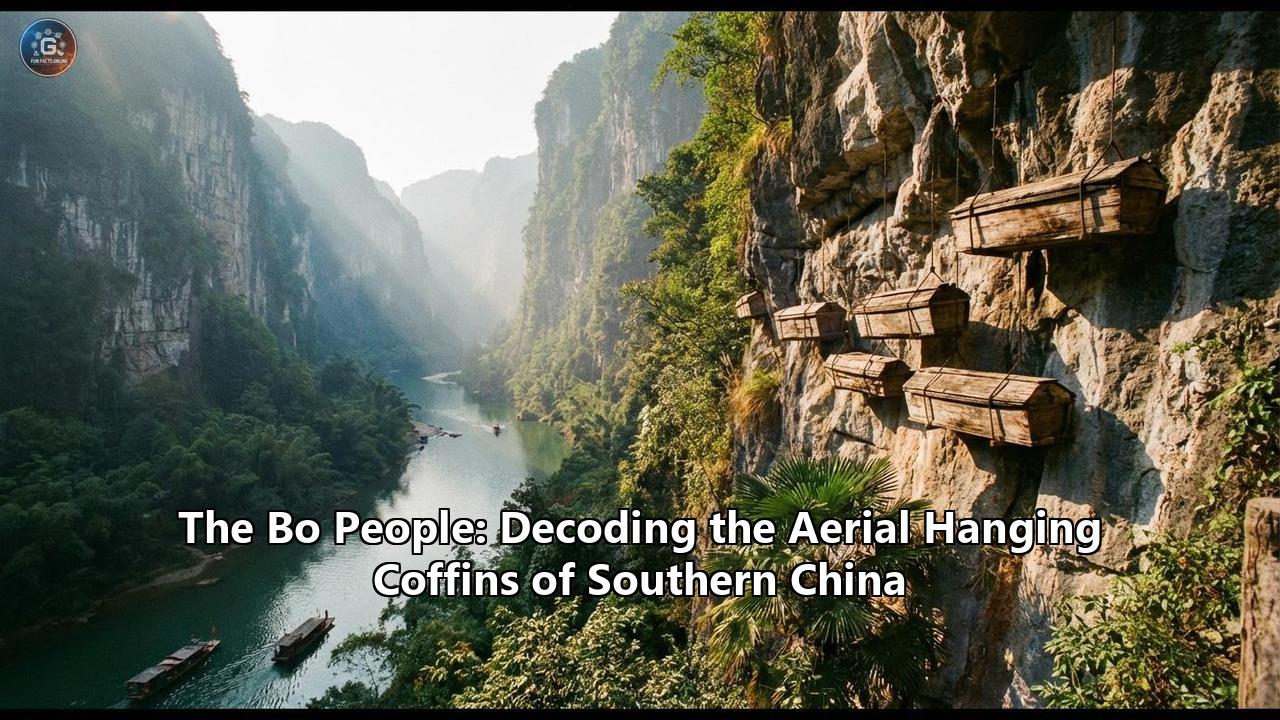
High above the winding rivers, dense bamboo forests, and emerald valleys of southwestern China, an ancient mystery hangs suspended in the mist. Clinging to the sheer, vertical limestone cliffs—sometimes hundreds of feet above the earth—are dozens of weathered wooden rectangles. These are not the remnants of ancient dwellings or watchtowers. They are tombs. Hewn from massive, single hardwood logs and wedged into the unforgiving rock face, these aerial monuments are the legendary hanging coffins of the Bo people.
For centuries, these gravity-defying graveyards have captivated the imaginations of explorers, historians, and locals alike. They represent one of the most fascinating and enigmatic funerary customs in human history. To the villagers who have lived in the shadows of these cliffs for generations, the architects of these tombs were mythical beings. Folklore remembers them as the "Sons of the Cliffs" and the "Subjugators of the Sky," with legends even suggesting they possessed the ability to fly.
But behind the myth lies a profoundly human story. The Bo people were a vibrant, prosperous civilization that thrived for thousands of years before being pushed to the brink of extinction by imperial conquests. For a long time, their sudden disappearance left a void in the historical record, turning the hanging coffins into a silent, unresolved puzzle. How did they hoist massive hardwood logs up sheer cliff faces? Why did they choose the sky over the earth for their eternal rest? And what truly happened to the people who built them?
Today, thanks to groundbreaking archaeological discoveries, modern genetic sequencing, and the tireless work of cultural preservationists, the silence of the hanging coffins is finally being broken. This is the comprehensive story of the Bo people: their rise, their tragic fall, the engineering marvels of their aerial tombs, and the 21st-century science that is finally bringing their descendants out of hiding.
The Sons of the Cliffs: Who Were the Bo People?
To understand the hanging coffins, one must first understand the people who placed them there. The Bo were a non-Han ethnic minority native to the rugged terrains of southern China, primarily spanning the modern-day provinces of Sichuan and Yunnan. Their roots in the region run astonishingly deep. Historical records and archaeological evidence suggest that the Bo culture developed over 3,000 years ago. They were a branch of the ancient Tai-Kadai-speaking populations who occupied vast stretches of southern China long before the Han ethnicity expanded its dominance southward.
The Bo were not isolated mountain dwellers; they were an active, formidable force in ancient Chinese geopolitics. As early as 1100 BC, the Bo people are recorded as having allied with the Western Zhou dynasty to overthrow the tyrannical Yin rulers at the end of the Shang Dynasty. They were described in sparse Chinese historical texts as a highly prosperous agrarian society, skilled in farming the fertile river valleys and renowned as accomplished horsemen and fierce warriors.
During the era leading up to the Ming Dynasty (1368–1644 CE), the Bo, like many ethnic minorities on the peripheries of the Chinese empire, were governed under the Tusi system. Under this arrangement, local tribal chieftains were granted a degree of regional autonomy by the imperial court, provided they recognized the central authority and paid regular tribute to the capital. This relative independence allowed the Bo to maintain their unique language, their vibrant daily life, and their spectacular, highly unorthodox religious and funerary customs.
However, their distinct way of life and their refusal to fully assimilate would eventually put them on a collision course with the expanding imperial ambitions of the Ming emperors—a conflict that would ultimately erase them from the map.
Defying Gravity: The Engineering Behind the Aerial Tombs
While the Bo people were known for their horsemanship and agriculture, it is their relationship with death that cemented their place in history. Unlike neighboring cultures that traditionally buried their dead in the earth or cremated them, the Bo looked upward.
The hanging coffins, known in Mandarin as xuanguan, are an astonishing feat of ancient engineering. The coffins themselves are massive. They were typically unpainted, rectangular or boat-shaped, and hollowed out from a single, durable hardwood tree trunk. Inside, the deceased was placed, often wrapped in several layers of clothing, alongside a few personal ornaments, copper plates representing the soul, and occasionally weapons or tools.
Once prepared, the true challenge began: elevating a coffin that could weigh hundreds of pounds up a sheer, 90-degree cliff face. The coffins are found at staggering heights, ranging from 30 feet (10 meters) to over 400 feet (130 meters) above the ground, often overlooking a rushing river or a deep gorge.
According to archaeological surveys, particularly in the Gongxian County of Sichuan where the largest concentration of Bo coffins remains, there are three primary methods the Bo used to secure the tombs:
- Cantilevered on Wooden Stakes: The most iconic and visually striking method. The Bo would drive thick wooden beams into natural cracks in the limestone, or chisel holes directly into the cliff face. The coffin would then be balanced delicately on these projecting stakes, suspended entirely in the open air.
- Natural Caves and Crevices: Coffins were hoisted into shallow, naturally occurring caves or horizontal fissures high up the cliff face, shielding them from rain and direct sunlight.
- Rock Projections: Coffins were carefully maneuvered onto narrow, naturally protruding rock ledges.
The question that has plagued architects and engineers since experts first formally surveyed the sites in 1941 is: How did they get them up there?
Without modern cranes or climbing gear, the Bo achieved the impossible. Several theories have been hotly debated among paleoanthropologists and folklorists. Some scholars suggest the Bo constructed massive, temporary earthen ramps at the base of the cliffs, dragging the coffins up before washing the dirt away. Others theorize the use of intricate bamboo scaffolding, built from the valley floor to the sky.
The most widely accepted theory today is a combination of top-down and bottom-up rope mechanics. It is believed the Bo may have lowered the heavy coffins from the top of the mountain using thick ropes made of braided bamboo or hemp, while workers scaled the cliffs from below, driving the wooden stakes into the rock to act as artificial climbing aids and eventual resting platforms. The sheer danger of this task cannot be overstated. It required immense communal effort, precise coordination, and an unshakeable belief in the importance of the ritual.
Bridging the Mortal and the Divine: The Spiritual Meaning
Why go to such extraordinary, perilous lengths to bury the dead? The answers lie in the intersection of practicality, filial piety, and a profound spiritual cosmology.
On a practical level, suspending a body hundreds of feet in the air protected it from the elements, as well as from scavengers, wild animals, and the desecration of rival tribes or grave robbers. The Bo believed that the physical preservation of the coffin was intimately tied to the spiritual well-being of the deceased.
Spiritually, the Bo viewed the sky as the realm of the divine and the earth as the realm of the mortal. By placing their ancestors high on the cliff faces, they were physically bridging the gap between the two worlds. Li Jing, a chronicler writing during the Yuan Dynasty (1279–1368 CE), provided a rare historical insight into the mindset of the cliff-burial practitioners: "Coffins set high are considered auspicious. The higher they are, the more propitious they are for the dead. And those whose coffins fell to the ground sooner were considered to be more fortunate".
Elevation equaled reverence. It has been suggested that the height at which a coffin was hung directly correlated to the deceased's social rank, with respected elders, chieftains, and great warriors claiming the highest and most precarious perches. Marco Polo, during his travels through Asia, briefly observed the rituals of the Bo, noting that "when deceased [they] had their bodies put in a box and taken to the mountains to be put in caves, or hung where others cannot reach".
The location also served a role in ancestral worship. In the Matangba and Sumawan valleys of Gongxian County, the sheer cliffs form a natural amphitheater. The Bo painted the limestone walls around the coffins with bright red murals—depicting horse riding, martial arts, dancing, and daily life—using pigments made from animal blood and red earth. From their lofty perches, the ancestors could look down upon their descendants like the stars and the moon, watching over the villages, blessing the crops, and ensuring the continued prosperity of the tribe.
Local folklore further highlights this belief. One enduring legend tells of the wealthy He family. An oracle told them, "If you hang your coffins on cliffs, braving the wind and rain, your descendants will grow more prosperous." The family complied, but when a violent storm blew their coffins down, their fortune was swept away with them. To the Bo, the cliff was not just a graveyard; it was the sacred umbilical cord connecting the past to the future.
The Shadows of the Ming Dynasty: Genocide and a Vanishing Culture
If the Bo people were so prosperous and spiritually resolute, why did they stop hanging their coffins, and why did they disappear from history? The answer is one of the darkest chapters in the history of southwestern China.
For centuries, the Bo enjoyed autonomy, but as the Ming Dynasty consolidated its power, the central government increasingly sought to tighten its grip on the frontier provinces. The imperial court began demanding higher tributes, enforcing heavy taxation, and imposing Han Chinese cultural and political structures over the indigenous tribes. The Bo, fiercely independent and proud, resisted.
By the middle-to-late Ming Dynasty, tensions boiled over into open rebellion. The Ming emperors responded with overwhelming, ruthless military force. In a series of brutal pacification campaigns culminating around 1573 AD, the imperial armies marched into Sichuan and Yunnan. The Bo, alongside other local tribes like the Duzhangman, were targeted not just for subjugation, but for extermination. The Ming forces initiated a genocidal campaign, massacring the Bo people, burning their villages, and destroying their agricultural infrastructure.
Faced with total annihilation, the surviving Bo had no choice but to flee. They abandoned their ancestral valleys, leaving their revered hanging coffins behind. To survive the imperial purges, the remnants of the Bo people went into deep hiding. They migrated to remote, inaccessible mountain regions, changed their surnames (taking on common local names like He or Fan), and deliberately integrated themselves into other ethnic minority groups, such as the Yi and the Miao.
In doing so, they saved their bloodlines but sacrificed their cultural identity. Their language went unspoken. Their rituals ceased. The creation of new hanging coffins stopped abruptly roughly 400 years ago. The Bo people seemingly vanished into the mists of history, leaving nothing behind but the silent, unpainted wooden boxes clinging to the cliffs above the Luxi and Yangtze rivers.
Secrets in the DNA: The 21st-Century Breakthrough
For over four centuries, the Bo people were considered effectively extinct. Modern locals living near the cliff sites claimed no connection to the ancient tomb builders. However, whispered oral histories and local idioms—such as the Sichuan saying, "Your family is from the Yi tribe, Fan family is from the Miao tribe, and He family is from the hanging on cliff tribe"—suggested that the blood of the Bo might still flow in the veins of the region's inhabitants.
It wasn't until the dawn of advanced genetic sequencing that the mystery was finally unraveled. In December 2025, a groundbreaking study published in the prestigious journal Nature Communications sent shockwaves through the archaeological and anthropological communities. A team of researchers, led by Dr. Zhang Xiaoming of the Kunming Institute of Zoology, successfully extracted and analyzed ancient DNA from 11 individuals interred in the hanging coffins, some dating back over 2,000 years.
The scientists compared these ancient genomes to the DNA of living populations in southwestern China. Their focus turned to the She De village in Qiubei County, Yunnan Province, where a small community of a few thousand people, officially categorized as part of the Yi ethnic group, maintained unique, distinct traditions (such as 'cave burials' where the spiritual essence of the dead is symbolically placed in ancestral caves).
The genetic results were unequivocal: The modern-day people of this community are the direct descendants of the ancient Bo people who built the hanging coffins.
"Approximately 600 years after the custom vanished from historical records, we found that the Bo people are the direct descendants of the Hanging Coffin custom's practitioners," the researchers wrote. Despite the genocidal persecution of the Ming Dynasty and centuries of forced assimilation, the genetic lineage of the "Sons of the Cliffs" had survived.
Furthermore, the DNA analysis unlocked the deeper origins of the Bo themselves. The genomes revealed that the ancient hanging-coffin builders shared deep genetic roots with Neolithic populations that lived on the southeastern coast of China between 4,000 and 4,500 years ago. Over millennia, these ancient peoples migrated westward and southward. The genetic footprint showed incredible diversity, indicating that the Bo were a dynamic, interactive society. Some individuals in the coffins possessed DNA linked to farmers from the Yellow River region in northern China, while others shared ancestry with people from the Mongolian Plateau, and even ancient Northeast Asian groups.
A Pan-Asian Phenomenon: Hanging Coffins Beyond the Bo
The 2025 DNA study also solved a broader regional mystery. Hanging coffins are not completely exclusive to the Bo people or to Sichuan province. Dozens of similar sites have been documented throughout Asia, forming a massive geographic arc of shared funerary customs.
To the east, in the Wuyi Mountains of Fujian province, archaeologists have found the oldest known hanging coffins in China, dating back an astonishing 3,400 years. In Jiangxi province, the Guyue people suspended coffins on the smooth cliff faces of Dragon-Tiger Mountain during the Warring States period, some 2,500 years ago.
The custom even transcends the borders of modern China. In northwestern Thailand, ancient "log coffins" crafted by hollowing out halved tree trunks have been found elevated on wooden supports within deep caves. The 2025 genetic study revealed remarkable DNA similarities between the ancient Thai log-coffin makers and the Chinese hanging-coffin builders, proving that the Bo were part of a vast, interconnected network of ancient Tai-Kadai-speaking peoples whose culture and beliefs permeated mainland Southeast Asia.
Further south, the tradition echoes through the Austronesian world. In the mountainous Toraja region of Sulawesi, Indonesia, the Torajan people practice liang tokek (literally "hanging burial"). They place distinctive, boat-shaped coffins known as erong beneath cliff overhangs, guarded by lifelike carved wooden effigies of the dead called tau-tau. In the Philippines, the Kankanaey people of Sagada in the Mountain Province continue a centuries-old tradition of suspending small wooden coffins from limestone cliffs. The Kankanaey carve their own coffins during their lifetimes and bury their distinguished leaders in a fetal position, believing that humans should leave the world in the exact same posture they entered it.
While separated by oceans, jungles, and thousands of years, these cultures share a profound, collective human impulse: to elevate their most revered ancestors above the mundane earth, pushing them as close to the heavens as mortal hands can reach.
Guardians of the Sky: Modern Conservation and the Future of the Aerial Tombs
Today, the remaining hanging coffins of the Bo people face an enemy far more relentless than the Ming Dynasty: time. Suspended in the open air, the ancient hardwood and wooden stakes are constantly battered by wind, torrential monsoon rains, and the natural erosion of the limestone cliffs.
By the early 1990s, surveys in Gongxian County documented 280 hanging coffins. However, within just a decade, nearly 20 of these priceless artifacts rotted away and plummeted into the valleys below. The urgent need to protect this fragile heritage has sparked a massive, state-sponsored conservation effort.
The Chinese government and local archaeological bodies have initiated several large-scale maintenance projects. The most significant efforts took place in 1974, 1985, and a massive overhaul in 2002. Led by experts like Cui Chen, curator of the Yibin Museum, conservationists employed modern technology to stabilize the cliffs. Teams of specialized workers rappelled down the sheer drops to grout cracks in the limestone rock, inject preservatives into the 400-year-old wooden stakes, and carefully clean and restore the coffins themselves.
During the 2002 restoration, which lasted over two months, workers successfully stabilized 43 hanging coffins and miraculously discovered 16 previously unknown tombs hidden deep within high-altitude crevices.
Beyond physical preservation, there is a cultural preservation underway. The sites at Matangba and Sumawan have been transformed into highly regulated, respectful archaeological parks. Tourists and scholars from around the globe now travel to the lush valleys of Sichuan to gaze up at the cliffs. They come not just to see a morbid curiosity, but to witness a testament to human ingenuity and spiritual devotion. The tourism brings economic vitalization to the region, ensuring that the local governments remain highly incentivized to protect the cliffs for future generations.
Conclusion: The Enduring Legacy of the Bo People
The story of the Bo people is a profound narrative of human resilience. They were a civilization that looked at impossible, sheer stone walls and saw a pathway to the heavens. They built monuments of staggering complexity, driven by a fierce love for their ancestors and an unyielding desire to protect them for eternity.
For centuries, it seemed that the cruelty of imperial politics had successfully erased the Bo from existence, reducing a vibrant, proud people to mere myths and ghost stories whispered by outsiders. The hanging coffins stood as silent, melancholic symbols of a lost genocide—a culture violently interrupted.
Yet, the cliffs never truly surrendered their secrets, and the bloodlines never truly broke. The wooden stakes held firm against the wind, and the DNA of the survivors quietly endured in the remote villages of Yunnan. Today, science and history have converged to vindicate the legends. The "Sons of the Cliffs" did not vanish into the ether; they adapted, they survived, and they are still here.
As the morning mist rolls through the gorges of the Yangtze River and parts to reveal the weathered wooden boxes jutting out from the limestone, they no longer represent just a mystery of the past. They stand as an enduring, gravity-defying monument to the indomitable spirit of the Bo people—a culture that, against all odds, managed to subjugate the sky and conquer time itself.
Reference:
- https://www.popularmechanics.com/science/archaeology/a69649788/china-hanging-coffins/
- https://pathsunwritten.com/china-hanging-coffins/
- https://owlcation.com/humanities/hanging-coffins-bo-people-ancient-china
- https://www.livescience.com/archaeology/ancient-hanging-coffin-people-in-china-finally-identified-and-their-descendants-still-live-there-today
- https://en.wikipedia.org/wiki/Hanging_coffins
- https://archiqoo.com/news/en/ancient+hanging+coffin+people+identified+as+ancestors+of+bo+people.php
- https://archaeology.org/news/2025/12/10/dna-analysis-confirms-oral-history-of-chinas-bo-people/
- http://www.freewheelingtwo.com/trips/2015-china/page-51
- https://sevenponds.com/cultural-perspectives/suspended-burials-in-china
- http://www.china.org.cn/english/culture/55407.htm
- https://medium.com/the-academic/subjugators-of-the-sky-ancient-dna-reveals-the-origins-of-chinas-hanging-coffin-tradition-0b74def8573b