
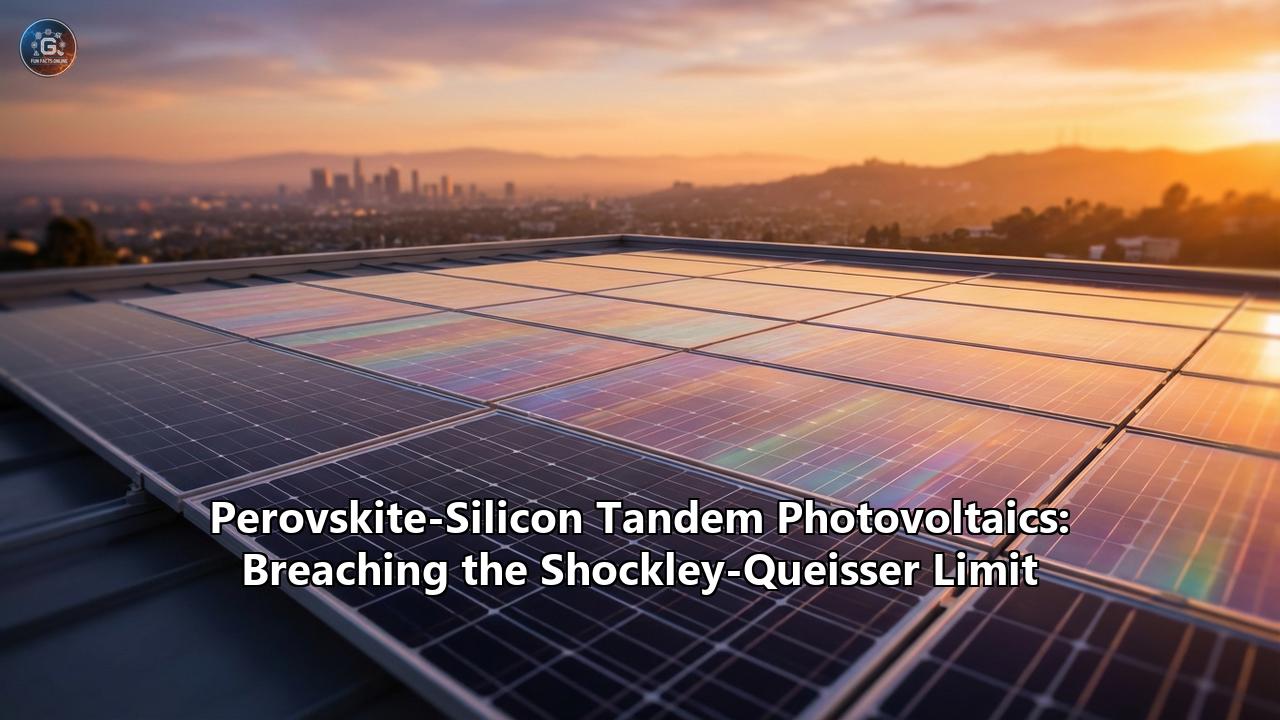
The year 2025 marked a definitive turning point in the history of photovoltaics. For decades, the solar industry has been governed by a single, ruthless equation: the Shockley-Queisser limit. This theoretical ceiling, calculated in 1961, dictated that a single-junction silicon solar cell could never convert more than roughly 33.7% of the sunlight hitting it into electricity, with practical industrial limits hovering closer to 29%. By the mid-2020s, with PERC and TOPCon technologies pushing effectively against this wall, the industry faced a crisis of stagnation.
Then came the breach. The commercial deployment of Perovskite-Silicon Tandem Photovoltaics has not just nudged the limit; it has shattered the ceiling, opening a pathway to efficiencies of 35%, 40%, and theoretically beyond. As of early 2026, we are no longer discussing if this technology will work, but how it is currently reshaping the global energy grid.
This article serves as a comprehensive technical dossier on the Perovskite-Silicon Tandem revolution. We will dissect the physics that allows these devices to cheat thermodynamic limits, explore the manufacturing breakthroughs that made them scalable, analyze the economic forces driving their adoption, and confront the environmental challenges that remain.
Part I: The Physics of the Breach
1.1 The Tyranny of Shockley-Queisser
To understand the magnitude of the tandem breakthrough, one must first appreciate the constraints of the single-junction cell. The Shockley-Queisser (SQ) limit is derived from the principle of detailed balance. It assumes a solar cell has a single p-n junction with a specific bandgap.
- Transmission Losses: Photons with energy lower than the bandgap (infrared light) pass through the cell unabsorbed. In silicon (bandgap ~1.12 eV), this accounts for a massive loss of potential energy.
- Thermalization Losses: Photons with energy significantly higher than the bandgap (blue and UV light) are absorbed, but the "excess" energy beyond the bandgap is instantly lost as heat (phonons) rather than useful current.
Silicon is an excellent compromise material, but it is fundamentally inefficient at handling the full solar spectrum. It wastes the high-energy blue photons and ignores the low-energy infrared ones.
1.2 The Tandem Solution: Spectral Splitting
Perovskite-Silicon Tandem cells bypass the SQ limit not by changing the laws of physics, but by changing the rules of the game. They utilize a "spectral splitting" architecture.
- The Top Cell (Perovskite): Perovskites are a family of materials with a crystal structure defined by the ABX3 formula. Crucially, their bandgap is tunable. In a tandem configuration, the top perovskite layer is engineered with a wide bandgap (typically ~1.68 eV to 1.80 eV). This layer greedily absorbs high-energy blue and green photons, converting them into electricity at a high voltage with minimal thermalization loss.
- The Bottom Cell (Silicon): The perovskite layer is transparent to lower-energy red and infrared light. These photons pass through to the bottom silicon cell, which absorbs them efficiently.
By stacking these two cells, the combined device acts as a "photon sieve," harvesting energy from each portion of the spectrum at its optimal voltage. The theoretical efficiency limit for this double-junction stack jumps from ~33.7% to over 45%.
1.3 Architecture: 2-Terminal (2T) vs. 4-Terminal (4T)
The industry has largely coalesced around the 2-Terminal (2T) monolithic architecture, though the debate was fierce.
- 4-Terminal (4T): Mechanically stacking two independent cells. While this avoids the need for "current matching" (allowing each cell to operate at its own maximum power point), it requires four wires, double the inverters, and extra glass, driving up the Balance of System (BOS) costs.
- 2-Terminal (2T): The perovskite is deposited directly onto the silicon wafer. The entire stack acts as a single device with one positive and one negative terminal. This is the "drop-in replacement" standard that has won the commercial race. However, it introduces a strict physics constraint: Current Matching. Since the cells are in series, the current flowing through the top cell must exactly match the bottom cell. If the perovskite generates less current than the silicon, it acts as a bottleneck, dragging down the performance of the entire stack.
Part II: The State of the Art (2025-2026)
2.1 The Record Breakers
The efficiency race has accelerated at a blistering pace.
- LONGi Green Energy Technology: In April 2025, LONGi stunned the world with a certified efficiency of 34.85% for a 2T perovskite-silicon tandem cell. This is not a theoretical number; it is a realized device verified by the US National Renewable Energy Laboratory (NREL).
- Qcells: Not to be outdone, Qcells reported a 28.6% efficiency on a full-area M10 commercial wafer, proving that high efficiency is not limited to fingernail-sized lab samples.
- Oxford PV: The UK-based pioneer began commercial shipments to US utility partners in late 2024. Their 72-cell commercial modules boast a module-level efficiency of 26.9%, significantly outperforming the best TOPCon modules (typically ~24-25%) available on the market.
2.2 Commercial Reality
The "lab-to-fab" gap, once the graveyard of solar innovation, has been bridged.
- South Korea's National Mandate: The South Korean Ministry of Economy and Finance designated Perovskite-Silicon Tandems as a "National Leading Project," allocating 33.6 billion won in 2026 alone to secure a 35% cell efficiency target by 2030.
- China's Gigafactories: Companies like GCL Perovskite and UtmoLight are operationalizing GW-scale lines. GCL’s 100MW pilot line has already supplied modules for a 1MW desert testbed in the Kubuqi Desert, proving the technology in harsh, real-world conditions.
Part III: Manufacturing the Future
Fabricating a tandem cell is exponentially more complex than a standard silicon cell. The primary challenge is coating a liquid onto a pyramid.
3.1 The Texture Problem
Standard silicon solar cells are textured with random pyramids (typically 3-10 micrometers high) to trap light. If you spin-coat a liquid perovskite solution onto these pyramids, gravity and surface tension cause the liquid to pool in the valleys and leave the peaks exposed. This causes "shunts"—short circuits that kill the cell.
3.2 Solutions in the Fab
Three primary manufacturing routes have emerged in 2025/2026 to solve the texture problem:
- Hybrid Evaporation/Solution (The "Scaffold" Method):
First, a porous scaffold of Lead Iodide (PbI2) and Cesium Iodide (CsI) is deposited via thermal evaporation (PVD). PVD is a line-of-sight process that coats the pyramids perfectly conformally, like snow on a mountain.
Second, an organic salt solution is sprayed or inkjet-printed into this porous scaffold, reacting to form the perovskite crystal in situ. This combines the uniformity of vacuum deposition with the speed of solution processing.
- Blade Coating with planarization:
Innovators have developed nitrogen-assisted blade coating techniques that effectively "fill in" the valleys of the silicon pyramids, creating a planarized perovskite surface on top. This requires precise control of ink viscosity and drying kinetics to prevent cracking.
- Vacuum-Based Deposition (All-Dry):
Companies like Von Ardenne are pushing for fully vacuum-based lines (PVD or CVD). While capital-intensive (high CAPEX), this avoids solvents entirely, solving toxicity and uniformity issues. It allows for perfect control of layer thickness on textured surfaces, crucial for the "current matching" required in 2T tandems.
3.3 The Move from PERC/TOPCon
A critical economic advantage for tandems is that they can be built on top of existing silicon tech.
- Heterojunction (HJT) is the ideal bottom cell because its top surface is TCO (Transparent Conductive Oxide), which is chemically compatible with perovskites.
- TOPCon Integration: Since TOPCon dominates the current market, major players like Trina Solar and JinkoSolar are developing "TOPCon-Tandem" routes. This involves modifying the front side of a standard TOPCon cell to accept the perovskite stack, potentially allowing legacy fabs to upgrade rather than becoming obsolete.
Part IV: The Stability Challenge
For years, the "Achilles' heel" of perovskites was their fragility. They degraded in moisture, broke down under UV light, and fell apart under heat. In 2026, the narrative has shifted from "instability" to "manageable degradation."
4.1 The IEC 61215 Breakthrough
The gold standard for solar reliability is the IEC 61215 protocol (Damp Heat, Thermal Cycling, Humidity Freeze).
- Qcells & GCL Success: In 2024 and 2025, both Qcells and GCL announced that their commercial tandem modules passed IEC 61215 damp heat tests (1000 hours at 85°C/85% humidity).
- KAUST's 1000-Hour Test: Researchers at KAUST demonstrated encapsulated cells that survived 1000 hours of damp heat with 95% efficiency retention, proving that proper packaging can completely neutralize the moisture threat.
4.2 Molecular Engineering
Stability is also being engineered at the atomic level.
- Cross-Linked SAMs: A major failure point was the hole transport layer (HTL). New "cross-linked" Self-Assembled Monolayers (SAMs), developed by groups like NUS, act like a molecular net. They bind the perovskite tightly to the silicon, preventing delamination and blocking ion migration even under high thermal stress.
- 2D/3D Passivation: Longi and others employ a thin layer of "2D perovskite" (a more stable, layered crystal structure) on top of the active "3D perovskite." This 2D layer acts as a shield, sealing surface defects and preventing moisture ingress.
Part V: Economics and LCOE
The ultimate arbiter of any energy technology is the Levelized Cost of Electricity (LCOE).
5.1 The Cost of Efficiency
While tandem modules are currently more expensive to manufacture (due to the extra layers and equipment), their high efficiency acts as a powerful lever on system costs.
- BOS Savings: A 30% efficient module generates 50% more power than a 20% module for the same footprint. This means you need 30% less land, 30% fewer racking systems, 30% less wiring, and 30% less labor for installation.
- LCOE Parity: Financial models for 2026 suggest that once tandem module production hits GW scale, the LCOE will drop 10-20% below standard silicon PV. The target is an LCOE of $0.02/kWh for utility-scale projects in sunny regions by 2030.
5.2 CAPEX Considerations
Upgrading a TOPCon line to a Tandem line is not cheap, but it is cheaper than building a greenfield factory. Estimates suggest that adding the "perovskite backend" to a silicon line increases CAPEX by roughly 30-40%, but the resulting product commands a significant price premium, improving the overall Internal Rate of Return (IRR) for manufacturers.
Part VI: The Lead Question & Sustainability
You cannot discuss perovskites without discussing Lead (Pb). The most efficient perovskites are lead-halides (APbX3).
6.1 The Toxicity Reality Check
Critics point to lead toxicity as a showstopper. However, a quantitative risk assessment reveals a different picture.
- Quantity: A perovskite layer is only ~500 nanometers thick. The total amount of lead in a square meter of perovskite panel is roughly 0.4 grams. By comparison, a standard lead-acid car battery contains nearly 10,000 grams of lead.
- Leaching vs. Total Content: Regulatory bodies like the EU (RoHS) and US EPA (RCRA) focus on leaching potential. If a panel breaks, does the lead dissolve into groundwater?
Ion-Exchange Resins: New recycling technologies use ion-exchange resins to recover >99.5% of the lead from end-of-life panels.
In-Situ Sequestration: Scientists have developed "lead-absorbing tapes" and encapsulation materials that chemically bind lead ions. If the panel breaks, these materials act like a sponge, trapping the lead before it can leach into the soil.
6.2 The Recycling Imperative
With the first commercial modules now in the field, the industry is preparing for the first wave of recycling in the 2040s. Closed-loop recycling processes are already being piloted, where the expensive FTO glass and the lead are recovered and reused. Given the scarcity of some materials (like Cesium or Indium in transparent electrodes), recycling will be an economic necessity, not just an environmental one.
Part VII: Outlook 2030
As we look toward 2030, the trajectory is clear. Silicon is not dying; it is evolving. The "Silicon Era" is transitioning into the "Tandem Era."
- Efficiency Targets: We expect to see commercial modules (not just lab cells) hitting 30% efficiency by 2027 and 33% by 2030.
- Market Share: Analysts predict tandems will capture significant market share in the premium residential and space-constrained commercial sectors first, before dominating the utility-scale market as production costs fall.
- Beyond 2T: While 2-Terminal tandems are the industrial winner today, research into 4-Terminal and even "Triple Junction" (Perovskite/Perovskite/Silicon) devices continues, promising efficiencies approaching 50% for specialized applications like aerospace and EVs.
The breach of the Shockley-Queisser limit is no longer a physics problem. It is an engineering reality. The Perovskite-Silicon Tandem cell has arrived, and with it, the promise of a solar future that is more efficient, more affordable, and more powerful than ever before.
Reference:
- https://www.kedglobal.com/energy/newsView/ked202505220008
- https://ect-journal.kz/index.php/ectj/article/download/1829/1021/3146
- https://www.longi.com/en/news/silicon-perovskite-tandem-solar-cells-new-world-efficiency/
- https://www.utilitydive.com/news/solar-tandem-perovskite-qcells-trinasolar-longi-cell-technology/748264/
- https://www.pv-magazine.com/2024/09/05/oxford-pv-starts-commercial-distribution-of-perovskite-solar-modules/
- https://ceramics.org/ceramic-tech-today/perovskite-solar-cells-progress-2025/
- https://www.pv-tech.org/pv-celltech-usa-takeaways-perovskite-manufacturing-bottlenecks-tariffs-dominate-discussions/
- https://www.anernstore.com/blogs/diy-solar-guides/pv-module-cost-trends-2030
- https://pmc.ncbi.nlm.nih.gov/articles/PMC9860350/
- https://par.nsf.gov/servlets/purl/10300268
- https://www.oxfordpv.com/
- https://www.anernstore.com/blogs/diy-solar-guides/perovskite-vs-silicon-lcoe-2030