
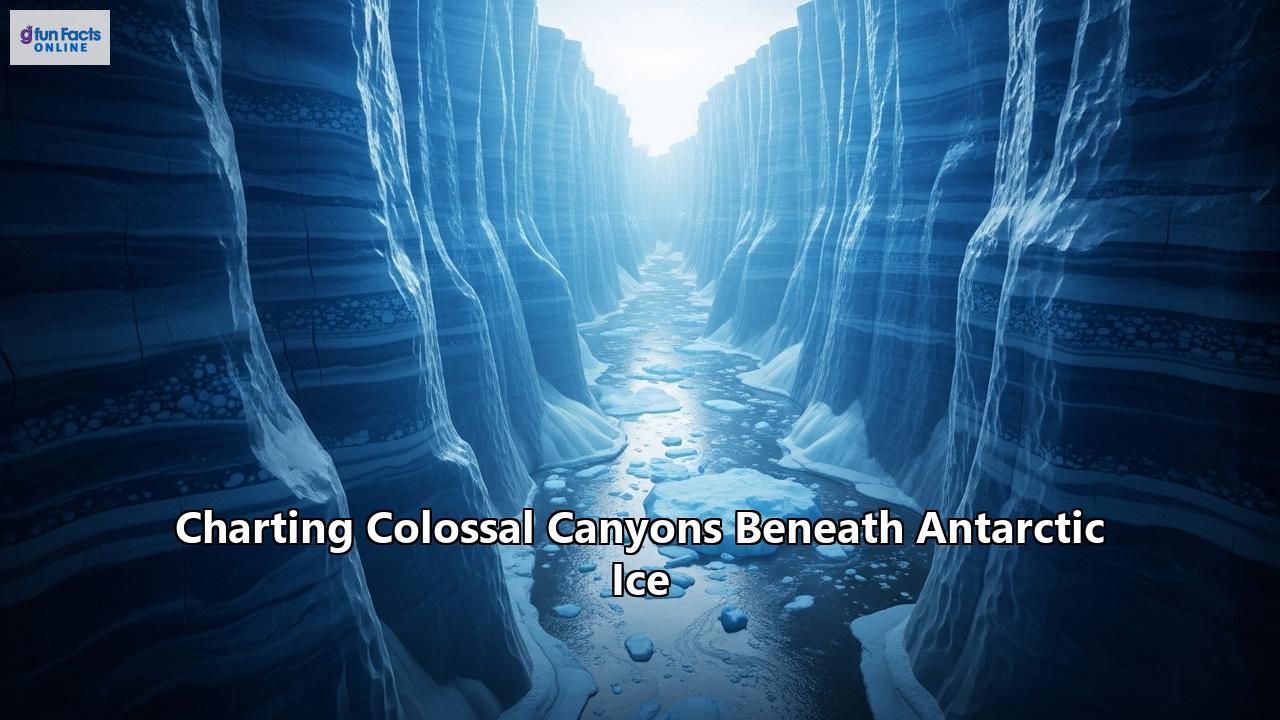
Beneath the colossal ice sheets of Antarctica, a hidden world of breathtaking scale and profound significance has been steadily emerging from the shadows. For centuries, our understanding of the southernmost continent was confined to its icy surface, a vast and seemingly uniform expanse of white. But in recent decades, a revolution in scientific exploration has peeled back this frozen veil, revealing a continent within a continent, a complex and dynamic landscape of towering mountains, sprawling basins, and, most astonishingly, colossal canyons that dwarf some of the most famous on Earth.
This is not a story of static, ancient relics, but of a dynamic world that is intimately connected to the stability of the Antarctic ice sheet and, by extension, the future of our planet's sea levels. These immense subglacial and submarine troughs, some plunging deeper than any terrestrial canyon, are not just geological curiosities; they are active players in the drama of climate change, acting as conduits for warm ocean water that can eat away at the ice from below, and as highways that can accelerate the flow of ice towards the sea.
The story of how we are charting these colossal canyons is a testament to human ingenuity, a saga of scientific discovery that has taken us from the heroic age of polar exploration to an era of high-tech remote sensing and deep-earth drilling. It is a journey into one of the last unexplored frontiers on Earth, a journey that is revealing not only the secrets of our planet's past but also crucial clues about its future. As we venture deeper into this hidden realm, we are not just mapping a new landscape; we are beginning to understand the powerful forces that shape our world and the delicate balance that governs our changing climate.
The Unveiling of a Hidden Continent: A New Age of Exploration
The history of Antarctic exploration is one of courage, endurance, and an insatiable curiosity about the unknown. The "heroic era" of the late 19th and early 20th centuries, defined by the legendary expeditions of Scott, Shackleton, and Amundsen, was a quest to conquer the surface of this formidable continent, to be the first to reach the geographic South Pole. These early pioneers faced unimaginable hardships, and their journeys laid the foundation for our initial understanding of Antarctica's geography and meteorology.
However, the world beneath the ice remained a complete mystery. For a long time, Antarctica was depicted on maps as a single, solid landmass, its true form concealed by an ice sheet several kilometers thick. The idea that a complex and varied topography lay hidden beneath this immense frozen dome was largely the realm of speculation.
The shift from surface exploration to probing the depths began in the mid-20th century, spurred on by technological advancements and a growing scientific interest in the nature of the ice sheet and the land it covered. The International Geophysical Year of 1957-58 marked a turning point, fostering a new era of international scientific collaboration in Antarctica. It was during this period that the first systematic attempts to measure the thickness of the ice sheet were made.
Early techniques were arduous. In the 1950s, scientists like Gordon Robin used seismic sounding to get the first glimpses of the bedrock. This involved drilling holes in the ice, detonating explosive charges, and measuring the time it took for the sound waves to travel to the bedrock and back. While groundbreaking, this method was slow and could only provide information for a limited number of points.
The true revolution in subglacial exploration came with the development of radio-echo sounding, or ice-penetrating radar, in the 1960s. This technology, which could be mounted on aircraft, allowed for the continuous profiling of the bedrock over vast distances. For the first time, scientists could "see" through the ice, and the results were stunning. These early airborne surveys revealed a world of mountains, valleys, and basins, a landscape far more complex than previously imagined.
It was during one of these pioneering flights in 1969 that the first evidence of a subglacial lake was discovered beneath the Soviet Vostok Station. This discovery opened up a whole new realm of scientific inquiry, suggesting that liquid water could exist in abundance beneath the ice sheet, a concept that would have profound implications for our understanding of glaciology, geology, and even biology.
The "heroic age" of reaching the South Pole had given way to a new heroic age of scientific discovery, a quest not just to stand on top of the world, but to understand what lay beneath. This new age of exploration continues to this day, with each new technological advance bringing the hidden continent of Antarctica into sharper focus.
The Tools of Discovery: Peering Through Kilometers of Ice
Mapping a continent buried under miles of moving ice is one of the greatest challenges in modern earth science. The inaccessibility of the subglacial environment means that scientists have had to develop a suite of ingenious remote-sensing technologies to peel back the layers and reveal the secrets hidden below. This technological arsenal, deployed from satellites, aircraft, and on the ground, has transformed our understanding of Antarctica's hidden landscape.
Ice-Penetrating Radar: The Workhorse of Subglacial Mapping
The most powerful and widely used tool for peering through the Antarctic ice is ice-penetrating radar (IPR), also known as radio-echo sounding (RES). This technique works on a simple principle: a radar instrument, typically mounted on an aircraft, transmits a radio wave down into the ice. This wave travels through the ice until it encounters a boundary with a different material, such as the bedrock, a layer of water, or even changes in the ice itself. At this boundary, some of the radio wave's energy is reflected back to the aircraft's receiver. By measuring the time it takes for the echo to return, and knowing the speed at which radio waves travel through ice, scientists can calculate the thickness of the ice with remarkable precision.
IPR is particularly effective in Antarctica because cold, pure ice is one of the most transparent materials to radio waves on Earth. This allows radar signals to penetrate several kilometers of ice, revealing not only the topography of the bedrock but also the internal layers of the ice sheet itself. These layers, which can be traced over vast distances, provide a historical record of snowfall and ice flow, helping scientists to understand how the ice sheet has evolved over time.
Over the past few decades, numerous international research campaigns have flown aircraft equipped with IPR systems back and forth across Antarctica, slowly but surely building up a picture of the world beneath the ice. The data collected from these surveys, often conducted in harsh and remote conditions, has been instrumental in the discovery of subglacial mountains, lakes, and the colossal canyons that are the focus of our story.
Satellites: A View from on High
While airborne radar provides detailed information along the flight path, satellites offer a broader, continent-wide perspective. Two key satellite technologies have been crucial for subglacial mapping: satellite altimetry and gravimetry.
Satellite altimetry uses radar or lasers to measure the height of the ice sheet's surface with incredible accuracy. While this may seem like a surface measurement, the topography of the ice sheet surface often contains subtle clues about the shape of the bedrock below. For example, a large subglacial mountain will cause a gentle rise in the ice surface, while a deep canyon can create a corresponding depression. By analyzing these subtle variations in surface elevation, scientists can infer the presence of large-scale subglacial features. Satellite gravimetry, on the other hand, measures minute variations in Earth's gravitational field. A satellite in orbit will be pulled slightly more strongly towards areas of higher mass and less strongly towards areas of lower mass. A massive mountain range hidden beneath the ice will exert a stronger gravitational pull than a deep canyon filled with less dense ice. By mapping these gravitational anomalies, scientists can effectively "weigh" different parts of the continent and deduce the underlying rock structure. This technique is particularly useful for identifying large-scale tectonic features and understanding the composition of the Earth's crust beneath the ice.Seismic Surveys: Listening for Echoes in the Ice
Similar to radar, seismic surveys use sound waves to probe the subglacial environment. Active seismic surveys involve creating a sound wave at the surface, either with a small explosion or a heavy vibrating plate, and then recording the echoes that bounce back from the bedrock and other subglacial features. While more logistically challenging to deploy than airborne radar, seismic surveys can provide very detailed information about the properties of the bedrock and can even penetrate through layers of sediment on the floor of subglacial lakes to reveal the deeper geology.
Passive seismic surveys, which listen for the natural seismic waves generated by earthquakes and icequakes, can also be used to infer the structure of the crust and upper mantle deep beneath the ice sheet, providing a broader geological context for the formation of subglacial features.
Putting It All Together: The Bedmap and BedMachine Projects
The vast amounts of data collected by these different technologies are brought together in ambitious international projects aimed at creating a unified map of the Antarctic bedrock. The Bedmap project, and its successor Bedmap2, compiled decades of measurements from a multitude of sources to create the most detailed map of Antarctica's subglacial landscape at the time.
More recently, the BedMachine Antarctica project has taken this a step further. Instead of just compiling existing data, BedMachine uses a sophisticated model that incorporates the principles of ice flow physics to fill in the gaps between survey lines. By knowing the speed and direction of the ice flow at the surface (measured by satellite), scientists can calculate the volume of ice passing through a given area and use this to infer the shape and depth of the underlying valley or canyon. This innovative approach has led to some of the most dramatic discoveries of recent years, including the identification of the deepest canyon on Earth.
Together, these technologies have provided us with an unprecedented view of the world beneath the ice, a world that is far more dynamic and influential than we ever imagined.
Gallery of Giants: Antarctica's Colossal Canyons
The application of these advanced mapping technologies has led to a series of stunning discoveries, revealing a subglacial landscape populated by canyons of truly colossal proportions. These are not isolated features but are part of a vast and interconnected system that plays a crucial role in the dynamics of the Antarctic ice sheet.
The Foundation Trough and the "Ice Highways" of the Interior
In 2018, an international team of scientists announced the discovery of a series of massive canyons hidden deep in the interior of Antarctica, near the South Pole. These troughs, named the Foundation Trough, the Patuxent Trough, and the Offset Rift Basin, are vast chasms that slice through the mountain ranges separating the massive East Antarctic Ice Sheet from the smaller, and more vulnerable, West Antarctic Ice Sheet.
The Foundation Trough is the largest of these, measuring over 350 kilometers long and 35 kilometers wide. These canyons act as "ice highways," funneling ice from the high-altitude interior of East Antarctica towards the coast. Their discovery was a surprise, as satellite data coverage is poor over the pole, and it was only through dedicated airborne radar surveys that their true scale was revealed. These features are significant because they provide a potential pathway for ice from the relatively stable East Antarctic Ice Sheet to flow into the less stable West, a process that could have significant implications for future sea-level rise.
The Denman Glacier Canyon: The Deepest Point on Land
One of the most breathtaking discoveries in recent years has been the identification of the world's deepest terrestrial canyon, hidden beneath the Denman Glacier in East Antarctica. In 2019, the BedMachine Antarctica project, using its innovative ice flow modeling techniques, revealed that the trough beneath the Denman Glacier plunges to an astonishing 3,500 meters (11,500 feet) below sea level. This is the deepest point on any continent, a chasm that is eight times deeper than the Dead Sea, the lowest exposed point on Earth.
The discovery of the Denman trough's true depth was a major breakthrough. Previous radar surveys had struggled to measure the bottom of the canyon because its walls are so steep that the radar signals would bounce off the sides, creating confusing echoes that obscured the true bottom. By incorporating ice flow data, scientists were able to calculate the immense volume of ice flowing through the glacier and deduce that the canyon must be incredibly deep to accommodate it.
The Denman Glacier and its underlying canyon are of particular concern to scientists because of a feature known as a retrograde bed slope. This means that the bedrock beneath the glacier slopes downwards as you move inland. This geometry is inherently unstable. As the glacier's grounding line – the point where it lifts off the bedrock and begins to float on the ocean – retreats inland, it exposes a thicker and thicker section of the glacier to the warming ocean waters, leading to a potential feedback loop of accelerated melting and retreat. The Denman Glacier holds enough ice to raise global sea levels by 1.5 meters (nearly 5 feet), making the stability of this deep canyon a critical area of research.
The Enigma of Princess Elizabeth Land: A Canyon System to Rival the Grand Canyon?
In one of the last unexplored regions of Antarctica, Princess Elizabeth Land, scientists have found evidence of what could be the largest canyon system on Earth. Analysis of satellite data in 2016 revealed a series of faint, linear features on the ice surface, hinting at a vast network of canyons and a massive subglacial lake hidden beneath.
Initial estimates suggest that this canyon system could be over 1,100 kilometers (685 miles) long and in places up to 1 kilometer (0.6 miles) deep. If confirmed by direct measurements, this would make it significantly longer than the Grand Canyon. The potential subglacial lake connected to this system is also thought to be enormous, covering an area of up to 1,250 square kilometers.
Like the discoveries in other parts of Antarctica, this find was made possible by looking for the subtle influence of the bedrock on the ice surface. The region is so remote and unexplored that it has been dubbed one of Antarctica's "Poles of Ignorance." Scientists are now working to confirm the existence and scale of this massive canyon system with airborne radar surveys. Understanding this vast, hidden landscape is crucial, as it will have a major impact on our models of ice flow and the overall stability of this sector of the East Antarctic Ice Sheet.
The Submarine Canyons: A Vast, Newly-Discovered Network
The colossal canyons are not just confined to the land beneath the ice. A recent study, using the most detailed map of the Southern Ocean seafloor to date, has revealed a vast network of 332 submarine canyons carved into the continental shelf around Antarctica. This is five times more than had been previously identified, and some of these underwater valleys plunge to depths of over 4,000 meters.
These submarine canyons are the primary conduits for the exchange of water between the deep ocean and the Antarctic coast. They play a crucial role in global ocean circulation by transporting cold, dense water formed on the continental shelf down into the abyss. However, they also act as a two-way street. These same canyons can channel warm, salty Circumpolar Deep Water from the open ocean up onto the continental shelf and towards the base of the floating ice shelves. This influx of warm water is a major driver of ice shelf melting from below, which can destabilize the glaciers that flow into them.
The study of these submarine canyons has also revealed a striking difference between East and West Antarctica. The canyons in the east are typically more complex and branching, suggesting a long history of formation under a relatively stable ice sheet. In the west, the canyons are shorter, steeper, and more V-shaped, indicative of more recent or episodic glacial activity. This provides important clues about the long-term history of the Antarctic ice sheet and its response to past climate changes.
The Architects of the Abyss: How Were These Canyons Formed?
The discovery of these colossal canyons raises a fascinating question: how did they get there? The processes that carved these immense features are complex and have likely involved a combination of geological forces acting over millions of years. Scientists are still piecing together the story, but several key architects have been identified.
The Legacy of Ancient Rivers and Tectonics
Some of these canyon systems may be incredibly ancient, predating the formation of the Antarctic ice sheet itself. Before Antarctica was covered in ice, it was a continent with rivers, valleys, and mountains, much like any other. It's possible that some of the canyon systems we see today are the remnants of ancient river networks that were carved into the landscape millions of years ago.
Tectonic forces have also played a crucial role in shaping the underlying structure of Antarctica. The continent is not a single, monolithic block of rock but is made up of different tectonic plates and crustal blocks that have moved and interacted over geological time. The Transantarctic Mountains, which separate East and West Antarctica, are a major tectonic feature, and the rifting that occurred between East and West Antarctica created deep basins that have influenced the flow of ice for millions of years. It is likely that many of the subglacial canyons follow pre-existing fault lines and tectonic weaknesses in the Earth's crust. The sheer scale and linear nature of the proposed canyon system in Princess Elizabeth Land, for example, strongly suggests a tectonic origin.The Unrelenting Power of Glacial Erosion
Once the Antarctic ice sheet began to form around 34 million years ago, a new and powerful erosional force was unleashed. Glaciers are incredibly effective at shaping the landscape, acting like giant bulldozers that can carve deep valleys and transport vast quantities of rock and sediment.
There are two main processes of glacial erosion: abrasion and plucking. Abrasion occurs as rock fragments embedded in the base of the glacier are dragged across the bedrock, grinding and polishing the surface. Plucking, or quarrying, happens when meltwater seeps into cracks in the bedrock, freezes, and expands, breaking off large blocks of rock that are then carried away by the flowing ice.
Over millions of years, these processes can carve deep, U-shaped valleys, which are a characteristic feature of glaciated landscapes. It is almost certain that glacial erosion has significantly modified and deepened any pre-existing river valleys and tectonic troughs, transforming them into the colossal canyons we see today. The fastest-flowing parts of the ice sheet, known as ice streams, are particularly effective at erosion, and many of the largest subglacial canyons are found beneath these rivers of ice.
The Role of Subglacial Meltwater and Turbidity Currents
While ice itself is a powerful erosive agent, water plays a crucial role in both subglacial and submarine environments. The immense pressure at the base of the ice sheet can cause melting even at temperatures below freezing, creating a network of subglacial lakes and rivers. This water acts as a lubricant, allowing the ice to slide more easily over the bedrock, but it can also be a powerful erosive force in its own right. When large volumes of subglacial water are channeled into narrow conduits, they can carve deep canyons into the underlying rock and sediment.
In the marine environment, a similar process involving turbidity currents is thought to be responsible for the formation of the large submarine canyons. Turbidity currents are fast-flowing, sediment-laden underwater avalanches. As glaciers and ice streams reach the coast, they deposit vast amounts of sediment on the continental shelf. This sediment can become unstable and slump, triggering a turbidity current that rushes down the continental slope at high speed. These currents are highly erosive and can carve deep canyons into the seafloor over long periods. The steep slopes and abundant glacial sediment around Antarctica create the perfect conditions for the formation of these powerful erosive flows.
The story of the formation of Antarctica's colossal canyons is therefore a complex one, involving a long history of tectonic activity, the shaping power of ancient rivers, the immense force of glacial erosion, and the persistent action of flowing water, both beneath the ice and in the deep ocean.
Canyons of Consequence: Guardians or Gateways of Ice Loss?
The discovery of Antarctica's vast network of subglacial and submarine canyons is more than just a matter of geological curiosity. These features have profound implications for the stability of the Antarctic ice sheet and its potential contribution to global sea-level rise. In an era of accelerating climate change, understanding the role of these canyons has become a matter of urgent scientific importance.
Conduits for Warm Ocean Water: The Achilles' Heel of the Ice Sheet
Perhaps the most significant role of these canyons, particularly the submarine ones, is their ability to act as conduits for warm ocean water. The Southern Ocean is not a uniformly cold body of water. Deep below the surface lies a layer of relatively warm and salty water known as Circumpolar Deep Water. Under normal circumstances, this warm water is kept away from the Antarctic coast by a front of colder, fresher water.
However, the submarine canyons that cut across the continental shelf can act as a direct pathway for this warm deep water to reach the base of Antarctica's floating ice shelves. This process is a major driver of basal melting, where the ice shelves are eroded from below. As the ice shelves thin, they lose their ability to buttress, or hold back, the glaciers that flow into them from the land. This can lead to an acceleration of ice flow from the interior of the continent into the ocean, directly contributing to sea-level rise.
The Denman Glacier, with its incredibly deep canyon, is a prime example of this vulnerability. The retrograde slope of the canyon means that as the glacier retreats, it opens up a wider and deeper pathway for warm ocean water to penetrate far inland, potentially triggering a rapid and irreversible collapse of the glacier.
Accelerating Ice Flow and the Threat of Sea-Level Rise
The topography of the land beneath the ice sheet is a critical factor in determining how fast the ice flows. The subglacial canyons act as natural channels, funneling the ice from the vast interior of the continent towards the coast. The smooth, often sediment-lined beds of these canyons can reduce friction, allowing the ice to slide more quickly.
Furthermore, the presence of subglacial water, which is often routed through these canyon systems, acts as a lubricant at the base of the ice, further accelerating its flow. Recent studies have shown that models that do not accurately account for the role of subglacial water can significantly underestimate the rate of ice loss. One study suggested that incorporating evolving subglacial water dynamics could triple the predicted amount of ice discharge from Antarctica.
The implications for global sea-level rise are stark. The Antarctic ice sheet contains enough water to raise global sea levels by around 58 meters. While a complete collapse is not considered likely in the near future, even a small increase in the rate of ice loss from key glaciers like Denman or Thwaites could have a significant impact on coastal communities around the world. The Denman Glacier alone holds the potential to raise sea levels by 1.5 meters.
Improving Climate Models with a More Accurate Subglacial Map
The discovery and detailed mapping of these colossal canyons are therefore crucial for improving the accuracy of the climate models that we use to predict future sea-level rise. For a long time, the lack of detailed knowledge about the subglacial landscape was a major source of uncertainty in these models. By incorporating the detailed topography of the bedrock, including the location and geometry of these massive canyons, scientists can create more realistic simulations of how the ice sheet will respond to a warming climate.
This more accurate picture allows scientists to identify which areas of the ice sheet are most vulnerable to collapse and to better understand the complex feedbacks between the ocean, the ice, and the underlying land. This knowledge is essential for policymakers and coastal communities as they plan for the impacts of climate change.
An Oasis in the Abyss? The Search for Life in Subglacial Realms
The discovery of liquid water beneath the Antarctic ice sheet has opened up one of the most exciting frontiers in modern science: the search for life in these extreme, isolated environments. The colossal canyons and the vast network of subglacial lakes and rivers they are part of are not just geological features; they may be home to unique ecosystems that have been cut off from the rest of the world for millions of years.
Subglacial Lakes as Hidden Habitats
There are now over 400 known subglacial lakes in Antarctica, ranging in size from small ponds to vast bodies of water like Lake Vostok, which is one of the largest lakes on Earth. These lakes are kept liquid by the immense pressure of the overlying ice, which lowers the freezing point of water, and by a small amount of geothermal heat from the Earth's interior.
For a long time, it was assumed that these dark, cold, high-pressure environments would be sterile. However, the discovery of thriving ecosystems at deep-sea hydrothermal vents, completely independent of sunlight, led scientists to reconsider the possibility of life beneath the ice.
The Discovery of Microbial Life
The first definitive evidence of life in a subglacial lake came in 2013, when a US research team, part of the WISSARD project, successfully drilled through 800 meters of ice into Lake Whillans in West Antarctica. The water samples they retrieved were teeming with microbial life, with almost 4,000 different species or groups of species identified.
This was a landmark discovery, proving that life could not only survive but thrive in the perpetual darkness and extreme cold of the subglacial environment. These are not just dormant microbes waiting for better conditions; they are part of a functioning ecosystem, with complex interactions and nutrient cycles.
Chemosynthesis: Life Without Light
Since there is no sunlight at the bottom of the Antarctic ice sheet, the organisms that live there cannot rely on photosynthesis for energy. Instead, they use a process called chemosynthesis. Chemosynthesis is the process of generating energy from chemical reactions, rather than from sunlight.
The microbes in Antarctica's subglacial lakes get their energy by "eating" rocks and minerals. The grinding of the glacier against the bedrock, a process known as comminution, exposes fresh mineral surfaces that can be used by these microorganisms. They can extract energy from the oxidation of minerals like pyrite (iron sulfide) and from compounds like ammonium and methane that are present in the water and sediments.
The discovery of these chemosynthetic ecosystems has profound implications. It suggests that life may be far more widespread on Earth than we previously thought, capable of colonizing even the most seemingly inhospitable environments.
Implications for Astrobiology and the Search for Extraterrestrial Life
The discovery of life in Antarctica's subglacial lakes has also energized the field of astrobiology, the study of the potential for life beyond Earth. The conditions in these lakes – liquid water beneath a thick ice shell, with energy derived from chemical reactions – are thought to be analogous to environments that may exist on other worlds in our solar system.
Icy moons like Jupiter's Europa and Saturn's Enceladus are believed to have vast liquid water oceans hidden beneath their frozen surfaces. If life can exist in the dark, cold depths of Antarctica's subglacial lakes, then it is plausible that similar life forms could exist in the subglacial oceans of these distant moons. The study of Antarctica's hidden ecosystems is therefore providing us with a valuable roadmap for how to search for life elsewhere in the cosmos.
The Future of Discovery: Charting the Remaining Unknowns
Despite the incredible progress of the last few decades, our exploration of Antarctica's subglacial world has only just begun. The vast majority of the continent's bedrock remains unmapped in high resolution, and only a handful of the more than 400 subglacial lakes have been directly sampled. The colossal canyons of Antarctica still hold many secrets, and a new generation of scientists and engineers is developing the tools and techniques to unlock them.
Planned Expeditions and Drilling Projects
The scientific community is actively planning new expeditions to explore these hidden realms. A major goal is to return to the enigmatic canyon system in Princess Elizabeth Land to confirm its existence and scale with comprehensive airborne radar surveys. This will require a major international effort, given the remoteness and logistical challenges of working in this region.
Drilling projects are also a key part of the future of subglacial exploration. Building on the success of the WISSARD project at Lake Whillans, there are ambitious plans to drill into other, more isolated subglacial lakes. One of the ultimate goals is to one day sample the waters of Lake Vostok, the largest and most isolated of Antarctica's subglacial lakes, which has been sealed off from the outside world for millions of years. Such a project presents immense technical and environmental challenges, as it is crucial to avoid contaminating this pristine environment with surface microbes.
The Development of New Autonomous Technologies
To overcome the challenges of exploring these remote and hazardous environments, scientists are developing a new generation of autonomous technologies. These include:
- Autonomous Underwater Vehicles (AUVs): These are robotic submarines that can be deployed through a borehole in the ice to explore the vast expanses of subglacial lakes. Equipped with sonars, cameras, and other sensors, they can create detailed maps of the lakebed and water column, and search for signs of life.
- Advanced Drilling Technology: Engineers are developing cleaner, more efficient, and more mobile drilling systems that can penetrate kilometers of ice with minimal environmental impact. These new drills will be essential for accessing a wider range of subglacial environments.
- Cryobots: These are robotic probes that are designed to melt their way through the ice, carrying a suite of scientific instruments. They could be used to explore the ice sheet and subglacial environment in a less invasive way than traditional drilling.
The Unanswered Questions and the Importance of Continued Exploration
The future of Antarctic subglacial research is filled with tantalizing questions. What other colossal canyons and mountain ranges lie hidden beneath the ice? How interconnected is the subglacial hydrological system, and how does it influence the stability of the ice sheet? What is the full extent and diversity of life in these hidden ecosystems, and what can it tell us about the evolution of life on Earth and the potential for life elsewhere?
Answering these questions is not just an academic exercise. The Antarctic ice sheet is a critical component of the Earth's climate system, and its response to global warming will have a profound impact on societies around the world. By charting the colossal canyons and exploring the hidden world beneath the ice, we are not only expanding the frontiers of human knowledge but also gaining the crucial insights we need to navigate the challenges of a changing planet.
Conclusion: A Hidden World, A Shared Future
The ongoing exploration of Antarctica's subglacial landscape is a story of discovery on a truly epic scale. The colossal canyons that have been unveiled in recent years have fundamentally changed our understanding of the white continent, revealing it to be a place of stunning geological complexity and dynamic change. These vast troughs, carved by ancient rivers and the relentless grinding of ice, are not just passive features of a frozen world; they are active participants in the climate system, shaping the flow of ice and water in ways that have global consequences.
The journey to map these hidden chasms is a triumph of modern science, a testament to the power of international collaboration and technological innovation. From the faint echoes of radar signals bouncing off bedrock kilometers below, to the subtle gravitational whispers detected by satellites in orbit, we are piecing together a picture of one of the last great unexplored regions of our planet.
Yet, this is a story that extends far beyond the realm of geology and glaciology. The discovery that these canyons can act as conduits for warm ocean water, accelerating the melting of the ice sheet from below, has brought a new urgency to our quest for knowledge. In an age of rising sea levels, understanding the vulnerabilities of the Antarctic ice sheet is not an academic luxury but a global necessity.
And in the deepest, darkest, and coldest corners of this hidden world, the discovery of life has opened up a new chapter in our understanding of biology and our place in the universe. The hardy microbes that thrive in the subglacial darkness, powered by chemical energy from the rocks beneath them, are a profound reminder of the tenacity of life and a tantalizing clue in our search for life beyond Earth.
The work of charting Antarctica's colossal canyons is far from over. Vast areas remain unmapped, and countless secrets are still locked away beneath the ice. But as we continue to probe this hidden world, we are not just drawing new lines on a map. We are gaining a deeper understanding of our planet's past, a clearer picture of its present, and a more informed view of our shared future. The story of Antarctica's colossal canyons is ultimately our story, a story of a fragile planet and our ongoing quest to understand it.
Reference:
- https://eos.org/research-spotlights/where-do-antarctic-submarine-canyons-get-their-marine-life
- https://journals.asm.org/doi/10.1128/aem.01956-14
- https://www.smithsonianmag.com/science-nature/thousands-microbe-species-live-buried-antarctic-lake-180952415/
- https://www.youtube.com/watch?v=SnUywlJ2N2U
- https://astrobiology.nasa.gov/news/life-in-the-extreme-surviving-beneath-a-glacier-part-ii/
- https://www.livescience.com/microbes-life-subglacial-lakes.html
- https://scar.org/~documents/policy/antarctic-treaty/atcm-xxx-and-cep-x-2007/atcm30-ip015?layout=default
- https://en.wikipedia.org/wiki/Subglacial_lake
- https://www.smithsonianmag.com/smart-news/first-signs-of-life-found-in-antarcticas-subglacial-lakes-8095757/
- https://www.innovations-report.com/agriculture-environment/earth-sciences/confirmed-800-meters-beneath-antarctic-ice-sheet-subglacial-lake-holds-viable-microbial-ecosystems/
- https://pubmed.ncbi.nlm.nih.gov/25085483/
- https://www.imperial.ac.uk/news/215153/lakes-isolated-beneath-antarctic-could-more/
- https://www.dri.edu/hidden-life-beneath-antarctic-ice-microbial-diversity-and-survival-strategies-revealed/
- https://www.sciencenews.org/article/lake-antarctica-ice-microbes-carbon
- https://www.researchgate.net/publication/253068510_Evidence_for_anoxic_conditions_in_subglacial_and_proglacial_environments
- https://www.youtube.com/watch?v=cc_HacJclTE
- https://www.youtube.com/watch?v=YLhKTks60NQ
- https://oceanexplorer.noaa.gov/edu/materials/chemosynthesis-fact-sheet.pdf
- https://pmc.ncbi.nlm.nih.gov/articles/PMC3960894/