
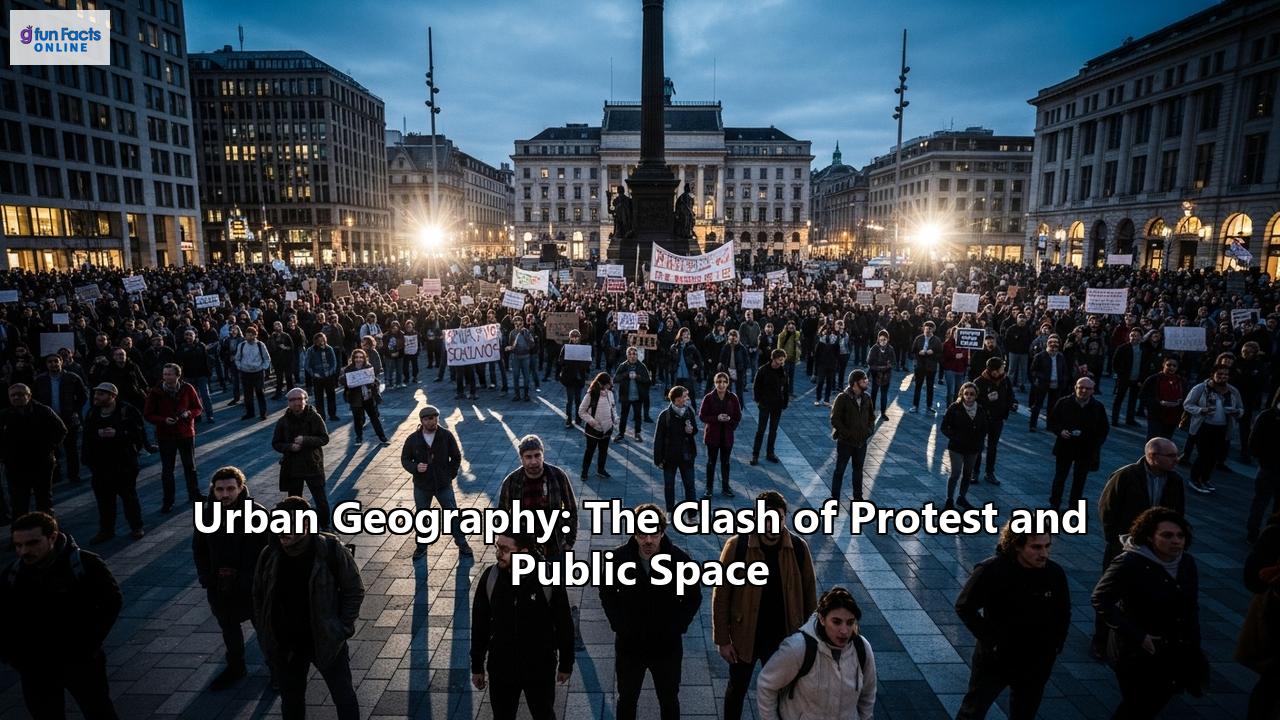
Urban Geography: The Clash of Protest and Public Space
The city square, the park, the boulevard – these are more than mere thoroughfares or recreational areas; they are the lifeblood of urban existence, the stages upon which the daily dramas of city life unfold. But beyond the mundane, these public spaces are also potent arenas of political expression, crucibles where dissent is forged and the future of societies is contested. From the impassioned cries for democracy in Cairo's Tahrir Square to the Occupy movement's encampments in the heart of global finance, public spaces are where the abstract ideals of justice and freedom take physical form. This article delves into the complex and often fraught relationship between protest and public space, exploring how the design of our cities can both enable and suppress the voices of its citizens.
The Intrinsic Link: Why Public Space is the Stage for Dissent
Public spaces are, by their very nature, political. They are the physical manifestation of the public sphere, the common ground where individuals from diverse backgrounds can converge, interact, and, crucially, make their voices heard. The visibility and accessibility of these spaces make them ideal platforms for social movements to garner attention and project their message to a wider audience. A protest in a city square, surrounded by the symbolic architecture of state power, carries a weight and a resonance that a demonstration in a remote location could never achieve.
The power of place in protest is not merely symbolic. The physical characteristics of urban spaces play a critical role in the dynamics of a demonstration. The size and layout of a square can determine the scale of a gathering, while the network of surrounding streets can facilitate the movement of protestors or, conversely, be used by authorities to contain and control them. The density of a city, for instance, was a key factor in the Arab Spring, with a large proportion of Cairo's population living within a short distance of Tahrir Square, enabling mass mobilization. Similarly, the labyrinthine streets of some urban neighborhoods can provide tactical advantages for protestors, offering routes for escape and opportunities for building barricades.
Theoretical Underpinnings: The Right to the City and Spatial Justice
The struggle for the right to use public space for protest is deeply rooted in broader theoretical concepts of urban life, most notably Henri Lefebvre's "right to the city." Lefebvre, a French sociologist and philosopher, argued that the right to the city is not simply a right of access to urban resources, but a collective right of all inhabitants to shape the urban environment in which they live. He saw the city as a site of constant struggle, where the dominant forces of capitalism and state control seek to impose a homogenous and commodified urban experience, while marginalized groups fight to reclaim and redefine urban space for their own purposes. Protests, in this context, are a powerful assertion of this right, a collective demand for a more democratic and inclusive urban life.
Closely related to the right to the city is the concept of "spatial justice," which examines the fair and equitable distribution of resources, opportunities, and power within a geographic area. Spatial injustice manifests in the urban landscape in myriad ways, from the "redlining" of neighborhoods that denies resources to certain communities to the privatization of public spaces that restricts access for those who do not fit a desired consumer profile. Protests that challenge these inequalities are, in essence, a demand for spatial justice, a call for a city where the benefits of urban life are shared by all, not just a privileged few.
A Global Tapestry of Protest: Case Studies in the Contestation of Public Space
The theoretical concepts of the right to the city and spatial justice are vividly illustrated in numerous protest movements that have erupted across the globe, each with its own unique relationship to the urban spaces it occupied.
The Arab Spring: Tahrir Square as a Revolutionary EpicenterThe 2011 Egyptian revolution, a pivotal moment in the Arab Spring, is inextricably linked to Tahrir Square in Cairo. For 18 days, the square was transformed from a bustling traffic hub into a vibrant, self-governing city within a city, a space of intense political debate, artistic expression, and collective action. The protestors' occupation of Tahrir Square was a direct challenge to the authoritarian regime of Hosni Mubarak, a powerful symbolic act of reclaiming a space that had long been under the tight control of the state. The sheer number of people who converged on the square, facilitated by its central location and the city's density, created a critical mass that was impossible for the regime to ignore. The events in Tahrir Square demonstrated to the world the immense power of public space as a catalyst for revolutionary change.
Occupy Wall Street: Contesting Privately Owned Public SpaceThe Occupy Wall Street movement, which began in 2011 in New York City's Zuccotti Park, brought to the forefront the issue of "privately owned public spaces" (POPS). These are spaces that, while open to the public, are owned and controlled by private corporations, often as a result of zoning concessions from the city. The choice of Zuccotti Park was both strategic and symbolic. Located in the heart of the financial district, it provided a direct physical challenge to the corporate power that the movement was protesting. The fact that it was a privately owned public space created a legal gray area that initially made it difficult for the city to evict the protestors. However, the eventual eviction of the Occupy encampment highlighted the precariousness of the right to protest in these increasingly common, quasi-public spaces, where the rights of property owners often supersede the rights of citizens to free speech and assembly.
Gezi Park Protests: Defending the Urban CommonsThe 2013 Gezi Park protests in Istanbul began as a small-scale environmental demonstration against a government plan to redevelop one of the city's last remaining green spaces into a shopping mall. The brutal police crackdown on the initial sit-in, however, transformed the protest into a nationwide uprising against the authoritarian government of Recep Tayyip Erdoğan. The struggle to save Gezi Park became a powerful symbol of the broader fight for the right to the city, for the right of citizens to have a say in the development of their urban environment. The protests highlighted the growing trend of neoliberal urban development, where public spaces are increasingly commercialized and privatized, with little regard for the needs and desires of the local community. The Gezi Park protests were a powerful reminder that public spaces are not just amenities, but essential components of a democratic and livable city, worth defending against the encroachment of private interests.
Black Lives Matter: Reclaiming Streets and Challenging SymbolsThe Black Lives Matter movement, which gained global prominence in the wake of the murder of George Floyd in 2020, has utilized public space in powerful and innovative ways to protest systemic racism and police brutality. Marches and demonstrations have taken over major thoroughfares and highways, disrupting the normal flow of commerce and daily life to draw attention to the urgent issue of racial injustice. The movement has also targeted public monuments and statues that celebrate figures with racist and colonialist legacies, arguing that these symbols perpetuate a narrative of white supremacy and have no place in a just and equitable society. The toppling of these statues is a powerful act of reclaiming public space and challenging the dominant historical narrative, a demand for a public realm that reflects the values and experiences of all its citizens, not just a select few. The painting of "Black Lives Matter" in giant letters on the streets of Washington D.C. and other cities was another potent example of using the urban landscape itself as a canvas for protest, a bold and visible assertion of Black humanity and the demand for justice.
The Architecture of Control: How Urban Design Can Suppress Dissent
Just as urban design can facilitate protest, it can also be used as a tool of control and suppression. Throughout history, those in power have consciously shaped the urban environment to maintain order and discourage dissent. The grand boulevards of 19th-century Paris, designed by Baron Haussmann, for example, were not only intended to beautify the city but also to make it easier for troops to quell popular uprisings. The wide, straight avenues prevented the construction of barricades and allowed for the rapid deployment of military forces.
In the contemporary city, the architecture of control is often more subtle but no less effective. The increasing privatization of public space, as seen in the case of Occupy Wall Street, is a key strategy for limiting the right to protest. Privately owned public spaces are often subject to a host of rules and regulations that prohibit activities deemed undesirable, including political demonstrations. The presence of private security forces in these spaces further reinforces this control, creating an environment where dissent is discouraged and often criminalized.
"Defensive architecture," also known as "hostile architecture," is another tactic used to control behavior in public spaces. This includes the use of spikes on ledges to prevent people from sitting or lying down, benches with armrests to deter sleeping, and the removal of public seating altogether. While often justified as measures to prevent loitering and anti-social behavior, these design features also have the effect of making public spaces less hospitable for all, and can be seen as a way of excluding those who do not fit the mold of the ideal consumer-citizen.
The Legal Labyrinth: Navigating the Right to Protest in Public Space
The right to protest in public spaces is enshrined in international law, including the International Covenant on Civil and Political Rights, which protects the rights to freedom of expression and peaceful assembly. However, these rights are not absolute and can be subject to restrictions in the interests of national security, public order, and the rights and freedoms of others. The interpretation and application of these restrictions vary widely from country to country, and even from city to city, creating a complex and often confusing legal landscape for protestors.
In many jurisdictions, protestors are required to obtain permits for marches and demonstrations, a process that can be used by authorities to control and limit the scope of protests. The criteria for granting or denying permits can be vague and open to political manipulation, giving authorities a powerful tool to suppress dissent. Even when protests are permitted, they are often subject to a host of "time, place, and manner" restrictions that can severely limit their impact. These can include restrictions on the location and duration of the protest, the use of sound amplification, and the size of banners and signs.
The legal framework governing protests in privately owned public spaces is even more complex and contested. As these spaces become more prevalent in our cities, the question of whether the First Amendment right to free speech extends to these quasi-public realms is a matter of ongoing legal debate. The courts have often sided with property owners, ruling that their right to control their property outweighs the rights of citizens to protest. This trend poses a significant threat to the future of protest in our cities, as more and more of our public life is conducted in spaces that are not truly public.
The Watchful Eye: Surveillance and the Chilling of Dissent
The rise of new surveillance technologies has added another layer of complexity to the clash between protest and public space. The proliferation of CCTV cameras, facial recognition software, and other forms of digital surveillance has transformed our cities into spaces of unprecedented monitoring. While often justified as measures to enhance public safety, these technologies can also be used to track and identify protestors, creating a "chilling effect" that can deter people from exercising their right to dissent.
The use of surveillance during protests raises serious concerns about privacy and the right to freedom of assembly. The knowledge that one is being watched can lead to self-censorship and a reluctance to participate in political activities that might be deemed controversial. The collection of data on protestors can also be used to create databases and watchlists, further eroding civil liberties and creating a climate of fear and intimidation. The challenge for democratic societies is to find a balance between the legitimate security concerns of the state and the fundamental right of citizens to protest without fear of reprisal.
Police Tactics and the Management of Protest
The policing of protests is a critical factor in determining whether a demonstration remains peaceful or escalates into violence. Police tactics can range from a "de-escalation-first" approach, which emphasizes communication and minimal intervention, to a more confrontational, "command and control" strategy that relies on the use of force and the tight control of public space.
A "graded response" is often seen as a best practice in protest policing, where the level of police intervention is proportionate to the level of threat posed by the demonstration. This approach might begin with officers in regular uniforms engaging with protestors, with riot-gear-equipped officers held in reserve in case of escalation. The goal is to avoid an overly militarized police presence, which can be perceived as provocative and can actually fuel the violence it is intended to prevent.
However, in many parts of the world, we are seeing an increased militarization of protest policing, with the deployment of armored vehicles, tear gas, rubber bullets, and other "less-lethal" weapons. This trend is often accompanied by a more aggressive approach to crowd control, including the use of "kettling" (where police encircle and trap a group of protestors) and pre-emptive arrests of protest leaders. These tactics not only pose a physical threat to protestors but also have a chilling effect on the right to dissent, creating an environment where people are afraid to take to the streets to voice their grievances.
The Digital Agora: Technology and the Future of Protest
The rise of the internet and social media has profoundly transformed the landscape of protest. Digital platforms have become powerful tools for organizing and mobilizing demonstrations, allowing activists to bypass traditional media outlets and communicate directly with a mass audience. Social media played a crucial role in the Arab Spring, for example, helping to spread information and coordinate protests across the region.
However, the role of technology in protest is not without its complexities. While social media can be a powerful tool for mobilization, it can also be used by authorities to monitor and surveil protestors. The digital traces that we leave online can be used to identify and track individuals, raising new challenges for privacy and security in the digital age.
Furthermore, the rise of "clicktivism" and online activism raises questions about the future of physical protest in public spaces. While online petitions and social media campaigns can be effective in raising awareness and generating support for a cause, they can also create a sense of passive engagement that can detract from the need for real-world action. The challenge for activists is to find ways to harness the power of digital technology to complement, rather than replace, the vital work of organizing and protesting in the physical realm. After all, there is a unique power and solidarity that comes from gathering together in a public space, a tangible sense of collective purpose that cannot be replicated online.
Art, Performance, and the Creative Reclaiming of Public Space
Protest is not always about marches and speeches. Art and performance have long been powerful tools for reclaiming and redefining public space, for challenging dominant narratives and imagining alternative futures. From the guerrilla art of Banksy to the theatrical interventions of groups like the Yes Men, creative activism can be a powerful way to engage the public and provoke dialogue about important social and political issues.
During the Black Lives Matter protests, for example, the transformation of the Robert E. Lee statue in Richmond, Virginia, into a vibrant and evolving work of public art was a powerful act of creative resistance. The statue, once a symbol of Confederate pride, was covered in graffiti and became the backdrop for photo shoots, dance parties, and other forms of artistic expression, a powerful testament to the community's reclaiming of a contested public space.
These creative interventions demonstrate that the clash between protest and public space is not just a struggle for physical territory, but also a battle over meaning and representation. By infusing public spaces with art, music, and performance, protestors can challenge the sterile and controlled environment of the neoliberal city and create fleeting moments of utopia, glimpses of a more just, vibrant, and democratic urban future.
Conclusion: The Enduring Importance of the Public Square
The relationship between protest and public space is a dynamic and ever-evolving one, shaped by the interplay of urban design, legal frameworks, technological advancements, and the creative tactics of both protestors and authorities. As our cities continue to grow and change, the struggle for the right to the city, for the right to a public realm that is truly public, will only become more urgent.
The increasing privatization and surveillance of our urban spaces pose a significant threat to the future of protest, but as history has shown time and again, the human desire for freedom and justice cannot be easily extinguished. From the ancient Greek agora to the modern city square, public space has always been, and will continue to be, the crucible of democracy, the place where citizens gather to challenge power, to demand change, and to shape the future of the world they inhabit. The clash of protest and public space is not just a feature of urban geography; it is the very engine of history, the force that drives us towards a more just and equitable world.
Reference:
- https://www.aclumich.org/en/news/threat-privatized-public-spaces-free-speech
- https://www.cambridge.org/core/journals/perspectives-on-politics/article/abs/privatization-and-protest-occupy-wall-street-occupy-toronto-and-the-occupation-of-public-space-in-a-democracy/ECF64C7D319E7958113BC0705614C36D
- https://www.researchgate.net/publication/372078816_Privatization_of_Public_Spaces_and_the_Right_to_the_City_in_the_United_States
- https://www.police1.com/police-products/less-lethal/articles/16-police-tactics-for-crowd-control-during-modern-demonstrations-j2MjoDM83soARucF/
- https://www.findlaw.com/civilrights/enforcing-your-civil-rights/protest-laws-by-state.html
- https://verfassungsblog.de/os3-eroding-protests-aus/
- http://prt.civicus.org/your-right-to-protest/
- https://phm.org.uk/blogposts/dangers-of-technological-surveillance-in-policing-public-protests/
- https://www.amnesty.org/en/what-we-do/freedom-of-expression/protest/
- https://constitutionalprotestguide.org/relevant-federal-and-state-laws/
- https://www.icnl.org/post/analysis/protesting-in-an-age-of-government-surveillance
- https://privacyinternational.org/learn/protest-surveillance
- https://amuedge.com/police-tactics-to-use-during-protests-and-riots-2/
- https://privacyinternational.org/examples/tracking-protest-surveillance
- https://en.wikipedia.org/wiki/Right_to_protest
- https://www.theguardian.com/cities/2015/aug/04/pops-privately-owned-public-space-cities-direct-action
- https://ccj.asu.edu/psi-lab/dealing-messy-democracy-guide-policing-protests
- https://www.aclu.org/know-your-rights/protesters-rights
- https://www.numberanalytics.com/blog/protest-policies-law
- https://www.britannica.com/topic/police/Methods-of-crowd-policing
- https://zencity.io/what-law-enforcement-can-learn-from-recent-protest-response-tactics/
- https://www.numberanalytics.com/blog/protest-and-the-law-a-guide
- https://www.article19.org/data/files/medialibrary/38581/Right_to_protest_principles_final.pdf
- https://northwesternlawreview.org/free-speech-and-public-space-after-occupy-wall-street/