
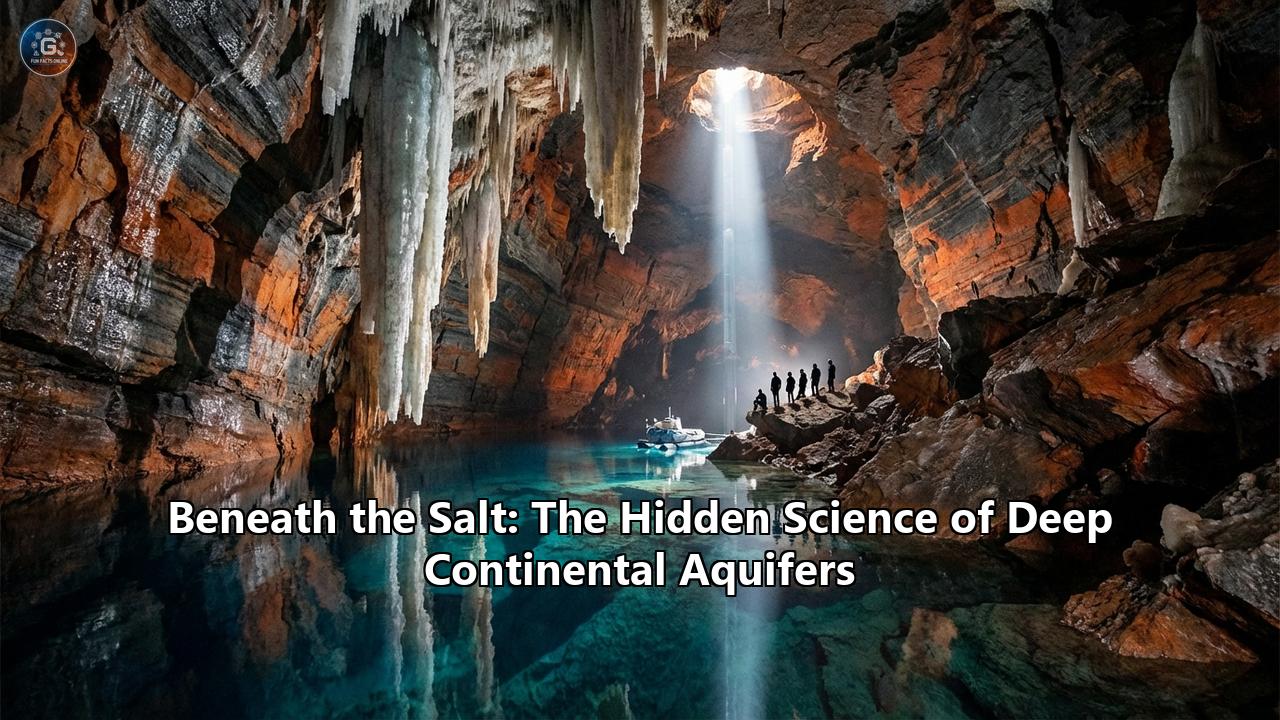
Beneath our feet, far deeper than the roots of the oldest forests and well below the deepest mines, lies a world as alien as the surface of Mars. It is a realm of crushing pressure, eternal darkness, and scorching heat, yet it is not dead. In the fractures of ancient granite and the pores of miles-deep sandstone, vast oceans of saline water have been trapped for millions, sometimes billions, of years. These are the deep continental aquifers, the Earth's hidden hydrosphere.
For centuries, human understanding of groundwater ended at the water table—the shallow, fresh reservoirs that feed our wells and springs. But in recent decades, a quiet revolution in geophysics, microbiology, and deep-earth engineering has revealed that the "water cycle" we learned in school is only the surface of the story. Beneath the salt, a second, slower, and vastly larger water cycle turns, hosting a biosphere of "zombie" microbes that live on geological time, holding the potential to solve our climate crisis, and fueling a new geopolitical race for critical minerals.
This is the hidden science of the deep continental subsurface.
Part I: The Geology of the Abyss
To understand deep aquifers, one must first discard the intuitive image of an underground lake. There are no sunless seas or hollow caverns echoing with the drip of water, save for rare limestone karst formations near the surface. True deep aquifers are rock—solid rock to the naked eye. They consist of microscopic pores between grains of sand in sedimentary basins, or hairline fractures in crystalline basement rock, filled with water that has nowhere to go.
The Scale of the Hidden Ocean
Recent estimates suggest that the volume of groundwater stored in the upper 10 kilometers of the Earth’s crust dwarfs the water found in all freshwater lakes and rivers combined. While the shallowest 2 kilometers contain the fresh water we rely on, the zone from 2 to 10 kilometers down holds an estimated volume of saline water that could cover the entire planet to a depth of several hundred meters.
These formations are often stratigraphically isolated. Over millions of years, layers of impermeable clay or shale—known as aquitards or seals—have been deposited on top of porous sandstone or limestone, trapping ancient oceans or meteoric water (rain and snow) that fell when dinosaurs walked the Earth.
Fossil Water: A Time Capsule
The water in these deep aquifers is "fossil water." It is not recharged by modern rain. In the Great Artesian Basin of Australia, water pulled from deep boreholes fell as rain 2 million years ago. In the deep mines of the Canadian Shield, geochemists have tasted water that has been isolated from the atmosphere for 1.5 to 2.6 billion years.
This ancient water is chemically distinct. It is a brine, often times saltier than the ocean. Over eons, the water has reacted with the surrounding rock, leaching minerals and becoming a complex chemical soup. It is rich in dissolved gases like hydrogen, methane, and helium, and heavy with metals—lithium, magnesium, and sometimes uranium. This chemistry is what makes these aquifers so valuable to industry, and so habitable to the strange life forms that call them home.
Part II: The Deep Hot Biosphere
In 1992, astrophysicist Thomas Gold published a controversial paper titled "The Deep Hot Biosphere," proposing that life did not just exist on the surface of the Earth, but permeated the crust to depths of several kilometers. He argued that the total mass of this subsurface life could rival the biomass of all surface life combined. While some of Gold’s theories (like the abiotic origin of all petroleum) remain fringe, his core prediction was spectacularly correct: the deep Earth is alive.
The Zombie Microbes
The organisms found in deep continental aquifers are not "extremophiles" in the traditional sense; they are the standard bearers of a different mode of existence. Cut off from the sun, they cannot rely on photosynthesis. Instead, they are chemolithotrophs—"rock eaters." They derive energy from inorganic chemical reactions, feeding on hydrogen released by the interaction of water and rock, or on sulfate and nitrate.
But life at 3 kilometers depth, under 300 atmospheres of pressure and 60°C (140°F) heat, is slow. In the nutrient-poor environment of deep granite fractures, microbes operate on metabolic timescales that are incomprehensible to surface biology. While an E. coli bacterium in a lab might divide every 20 minutes, deep subsurface microbes may divide once every hundred, or even thousand, years.
Biologists call this the "zombie" state. These cells spend most of their energy simply repairing the damage caused by heat and radiation, rather than growing. They sit in a state of suspended animation, waiting for a geological event—an earthquake or a shifting fracture—to bring a pulse of fresh nutrients.
*The Bold Traveler: Desulforudis audaxviator---
The poster child of the deep biosphere is Candidatus Desulforudis audaxviator. Discovered in 2008 in the fluid-filled fractures of the Mponeng gold mine in South Africa, 2.8 kilometers underground, this bacterium is a biological singularity.
In almost every other ecosystem on Earth, different species rely on each other to cycle nutrients. One makes waste, another eats it. D. audaxviator was found living entirely alone—a single-species ecosystem. Its genome contains everything it needs to survive independent of any other life form. It fixes its own nitrogen, fixes its own carbon, and fuels itself using hydrogen produced by the radioactive decay of uranium in the surrounding rock. It is literally powered by nuclear energy.
Its name, audaxviator, comes from Jules Verne’s Journey to the Center of the Earth: "Descende, audax viator, et terrestre centrum attinges" (Descend, bold traveler, and you will attain the center of the earth).
Biochemical Armor: Surviving the Crush
How do proteins and enzymes function under such crushing pressure? In surface organisms, high pressure forces water molecules into the interior of proteins, distorting their shape and stopping them from working. Deep biosphere adaptations include:
- Piezolytes: Small organic molecules that accumulate inside the cell to counteract external water pressure, stabilizing protein structures.
- Pressure-Resistant Enzymes: modified amino acid sequences that create more rigid protein cores, preventing them from being crushed or unfolded.
- Membrane Modification: Deep microbes alter the fatty acids in their cell membranes to keep them fluid. Under high pressure, normal membranes would turn into solid wax; these microbes introduce "kinks" in the molecular chains to keep them liquid and permeable.
Part III: Drilling into the Abyss
Accessing these deep realms is one of humanity's greatest engineering challenges. It requires technology that can withstand temperatures that melt rubber and pressures that crumple steel.
China’s "Shenditake 1" and the 10,000-Meter Quest
While the Space Race looked up, a new "Deep Earth" race is looking down. China has taken a distinct lead with projects like "Shenditake 1" in the Tarim Basin of Xinjiang. Launched in 2023 and continuing through 2025, this project aims to drill a borehole exceeding 10,000 meters (10 km) in depth.
The engineering hurdles are immense. At 10 km, the drill string—the steel pipe connecting the rig to the drill bit—weighs hundreds of tons. The sheer tensile stress threatens to snap the pipe under its own weight. Downhole temperatures exceed 200°C, rendering standard electronic sensors useless. The drilling mud—a critical fluid pumped down to cool the bit and carry up rock cuttings—must be chemically engineered to not boil or turn into a solid block of clay under the extreme conditions.
The goal of Shenditake 1 is twofold: scientific discovery of Earth’s Cretaceous history, and the strategic identification of ultra-deep oil and gas resources. But it also serves as a probe into the deep aquifers that lie beneath the desert, providing rare data on deep pore pressures and fluid chemistry.
The Challenge of Sampling
For microbiologists, drilling is a nightmare. The drilling mud used to lubricate the bit is teeming with surface bacteria. A single drop of contamination can ruin a sample of deep-biosphere water. To solve this, scientists use tracers—fluorescent dyes or distinctive chemical markers—added to the drilling mud. If the tracers show up in the water sample, they know it’s contaminated.
Advanced "downhole samplers" have also been developed. These are robotic tools that seal a sample of water and rock while it is still at the bottom of the hole, maintaining the in-situ pressure. If you brought a deep-sea fish to the surface, it would explode; deep-earth fluids do the same, degassing violently as they depressurize. Pressure-retaining samplers allow scientists to study the water exactly as it exists miles underground.
Part IV: The Lithium Rush and the "White Gold" of the Deep
The most immediate economic driver for deep aquifer exploration is not water, but what is dissolved in it: Lithium.
As the world transitions to electric vehicles (EVs), demand for lithium has skyrocketed. Traditional sources—hard rock mining in Australia and surface brine evaporation ponds in the "Lithium Triangle" of South America (Chile, Bolivia, Argentina)—are struggling to keep up. Deep saline aquifers offer a massive, untapped alternative.
Beyond the Salt Flats
Surface brines in the Atacama Desert rely on solar evaporation. Brine is pumped into massive ponds and left to sit for 18 months until the water evaporates, leaving lithium salts. It is slow, land-intensive, and consumes vast amounts of water in arid regions.
Deep continental aquifers, such as the Smackover Formation in Arkansas or the Leduc Formation in Alberta, Canada, contain lithium-rich brines deep underground. These are often ancient seabeds that were buried and concentrated over millions of years.
Direct Lithium Extraction (DLE)
The key technology unlocking these deep resources is Direct Lithium Extraction (DLE). Instead of evaporation ponds, DLE uses chemical filters—ion-exchange resins or adsorption beads—that act like a magnet specifically for lithium.
- Pump: Hot, lithium-rich brine is pumped from 3 km deep.
- Filter: The brine passes through a DLE unit. The lithium sticks to the beads; other salts (magnesium, calcium, sodium) pass through.
- Reinject: The lithium-stripped brine is injected back into the deep aquifer.
This process takes hours, not months. It has a smaller surface footprint and, crucially, it returns the water to the aquifer, maintaining reservoir pressure (though the long-term geochemical effects of reinjecting chemically altered brine are still being studied).
The Geopolitics of Brine
This has sparked a quiet geopolitical struggle. China, which dominates global lithium processing, is heavily investing in DLE technology and acquiring rights to brine resources in South America. Meanwhile, the U.S. and Canada are rushing to develop their own deep brine assets to secure a domestic supply chain for batteries. In 2024 and 2025, pilot plants in the southern United States began demonstrating that old oil wells could be repurposed to pump brine for lithium, turning fossil fuel infrastructure into green energy assets.
Part V: Carbon’s Final Resting Place
If deep aquifers can give us energy materials, they can also take away our waste. Carbon Capture and Storage (CCS) is the process of capturing CO2 from industrial sources and injecting it deep underground. While depleted oil fields are one option, deep saline aquifers offer vastly more capacity—enough to store centuries of human emissions.
The Physics of Storage
When CO2 is injected deeper than 800 meters, the pressure turns it into a "supercritical fluid." It has the density of a liquid but moves like a gas. In a saline aquifer, three trapping mechanisms work in sequence:
- Structural Trapping: The supercritical CO2 is lighter than the brine. It floats up until it hits the impermeable "cap rock" (the seal) and is physically held there, like a bubble under ice.
- Residual Trapping: As the CO2 plume migrates through the porous rock, tiny bubbles get stuck in the microscopic pores, snapping off from the main plume.
- Solubility & Mineral Trapping: Over centuries, the CO2 dissolves into the brine, making it heavy. The CO2-saturated water sinks to the bottom of the aquifer. Eventually, it reacts with the rock to form solid carbonate minerals (like limestone). The carbon effectively turns back into rock.
Sleipner and Gorgon: The proving grounds
The Sleipner project in the North Sea has been injecting CO2 into the Utsira saline aquifer since 1996. Seismic monitoring shows the CO2 plume spreading safely within the formation, proving the concept works. However, the Gorgon project in Australia highlights the risks. Intended to be the world's largest CCS project, it faced challenges with "pressure management." The aquifer rock was tighter (less porous) than expected, making it hard to inject CO2 without spiking the pressure to dangerous levels that could fracture the rock. They had to drill "water production" wells to pull brine out just to make room for the CO2—a costly and technically complex fix.
Part VI: A Solution to the Water Crisis?
As freshwater becomes scarce, eyes are turning to deep brackish aquifers as a source of drinking water.
The Cost of Salt
Desalination is usually associated with seawater. However, inland cities like El Paso, Texas, and Riyadh, Saudi Arabia, sit atop vast reservoirs of brackish deep groundwater. This water is less salty than the ocean but too salty to drink.
Desalinating brackish water is cheaper than seawater because the osmotic pressure is lower. Reverse Osmosis (RO) plants can turn this into potable water. The Kay Bailey Hutchison Desalination Plant in El Paso is the world's largest inland desalination plant, proving that deep aquifers can sustain major cities.
The Brine Problem
The catch is the waste. For every gallon of fresh water produced, an inland plant produces a gallon of concentrated, toxic brine. On the coast, this can be dispersed (controversially) into the ocean. Inland, there is nowhere for it to go. It must be injected into even deeper disposal wells, a practice that has been linked to induced seismicity—man-made earthquakes.
Part VII: Astrobiology on Earth
The study of deep continental aquifers has profound implications for the search for life beyond Earth.
- Mars: The surface of Mars is dry and irradiated, but evidence suggests vast aquifers may exist miles beneath the crust. If life ever evolved on Mars, it likely retreated into these deep, warm, chemolithotrophic refuges as the planet died. The "zombie" microbes of Earth are our best model for what Martian life might look like.
- Enceladus and Europa: The icy moons of Saturn and Jupiter harbor subsurface oceans. The interface between their rocky cores and the water is likely a hydrothermal environment similar to Earth’s deep aquifers.
The "Deep Hot Biosphere" theory also challenges the "Warm Little Pond" theory of life's origins. If the surface of the early Earth was bombarded by asteroids and sterilized by UV radiation, the deep subsurface offered a stable, protected nursery. It is possible that life did not migrate down, but migrated up. We may all be descendants of deep-earth rock eaters.
Conclusion: The Final Frontier is Down
We stand on a thin crust, floating over a deep, dark, and energetic world. Deep continental aquifers are not merely geological curiosities; they are central to the future of energy, water, and climate security. They offer lithium for our batteries, storage for our carbon, and potentially water for our cities.
But they also demand respect. We are piercing seals that have held for millions of years. We are injecting fluids, extracting brines, and altering pressures in a system we are only just beginning to map. The "zombie" biosphere has survived for eons in silence; as we wake it up, we must ensure that our rush for resources does not destroy the very environment that might hold the secret to the origin of life itself.
The exploration of the deep Earth is the great scientific adventure of the 21st century. The journey has just begun.
Reference:
- https://astrobiology.nasa.gov/news/life-without-the-sun/
- https://www.eurekalert.org/news-releases/792109
- https://www.energy-reporters.com/news/china-digs-toward-earths-core-massive-11000-meter-borehole-in-desert-hunts-ancient-secrets-and-fuels-fears-of-hidden-resource-grab/
- https://texaswaternewsroom.org/articles/desalinations_role.html
- https://repositories.lib.utexas.edu/server/api/core/bitstreams/38d91343-215e-4a6a-b3d4-5342d5255822/content
- https://www.theguardian.com/global-development/2025/sep/03/lithium-mining-bolivia-salt-flats-indigenous-environment-ecosystem