
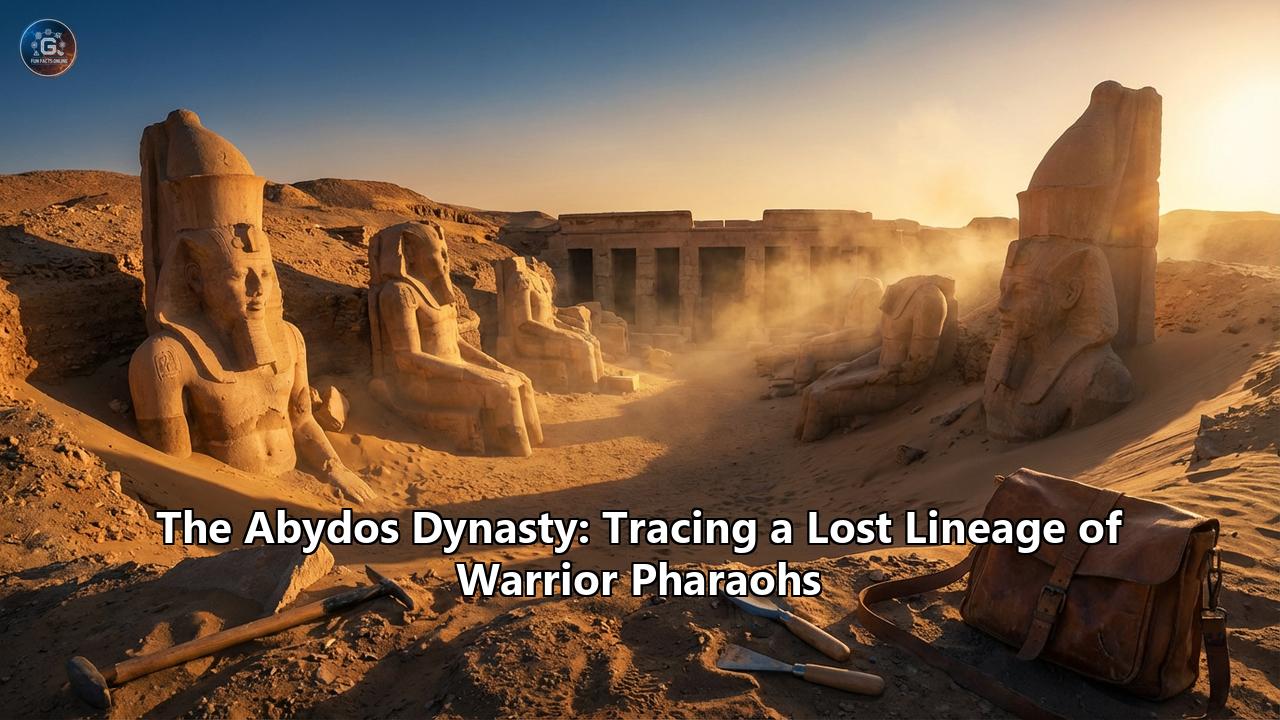
The sands of Egypt are often thought to be exhausted, their secrets laid bare by centuries of excavation. We know the pyramid builders of the Old Kingdom, the golden splendor of the New Kingdom, and the tragic end of the Ptolemies. Yet, history is not a solid monolith; it is fractured, filled with gaps where shadows linger. For decades, Egyptologists whispered of a "ghost dynasty"—a lineage of kings who ruled in the darkest days of the Second Intermediate Period, sandwiched between invaders in the north and rivals in the south. They were dismissed as a fiction, a misinterpretation of a few scattered hieroglyphs.
That was until the sand itself offered up a rebuttal. First in 2014, and again with earth-shattering confirmation in early 2025, the desert at the foot of the "Mountain of Anubis" in Abydos revealed the resting places of these forgotten kings. We now know them as the Abydos Dynasty. But they were not merely local administrators or petty chieftains clinging to power. The forensic evidence paints a far more visceral picture: they were warrior pharaohs, battered, scarred, and possibly the first royal horsemen in Egyptian history, fighting a desperate war for survival that would ultimately cost them their existence.
Part I: The Ghost in the King Lists
To understand the magnitude of the Abydos discoveries, one must first understand the chaos of the era they inhabited. The Second Intermediate Period (c. 1650–1550 BCE) was ancient Egypt’s nightmare. The central authority had collapsed. The Delta in the north had been overrun by the Hyksos—Semitic "Rulers of Foreign Lands" who brought with them strange gods and terrifying new weapons like the chariot. In the south, the Theban 16th and 17th Dynasties held a fragile line, claiming to be the true heirs of the pharaohs.
For a long time, historians believed this was a bipolar world: Hyksos vs. Thebes. But there were anomalies. The Turin King List, a ragged papyrus from the time of Ramesses II, listed names that fit nowhere. Stelae (stone slabs) found in Abydos bore royal cartouches—Wepwawetemsaf, Pantjeny, Snaaib—that appeared in no other records. In 1997, Egyptologist Kim Ryholt proposed a radical theory: a third power had existed. A short-lived, independent dynasty had risen in the sacred city of Abydos, acting as a buffer state between the warring north and south.
Many scholars scoffed. Why would a dynasty arise in Abydos, a religious center dedicated to Osiris, rather than a political capital? The idea remained a fringe theory until Dr. Josef Wegner and his team from the University of Pennsylvania began digging in a forgotten sector of the Abydos necropolis.
Part II: The Corpse in the Sand: The Discovery of Senebkay
In January 2014, Wegner’s team was investigating the mortuary complex of the Middle Kingdom pharaoh Senusret III. They found something odd: a 60-ton royal sarcophagus chamber made of red quartzite that had been ripped from its original location and crudely reused in a smaller, later tomb. It was a clear sign of a dynasty that was resource-poor but desperate to project legitimacy.
As they dug deeper, they found the remains of a man. He was not mummified in the grand style of Seti I or Rameses II; his tomb had been ravaged by ancient looters, his body pulled apart. But the bones told a story that gold masks never could.
Hieroglyphs on the tomb wall identified him as Woseribre Senebkay—"Strong is the Heart of Re." He was the first physical proof of the Abydos Dynasty. But the true shock came when osteologists examined his skeleton. Senebkay was a man of imposing height for his time, standing nearly 5'10". He died in his late 30s or early 40s, but he did not die peacefully.
Senebkay had been hacked to death.
His skull bore the distinct, brutal depressions of duck-billed battle axes—the signature weapon of the Hyksos era. He had taken blows to his knees and lower back, suggesting he was attacked from a lower angle, perhaps while he was mounted on a horse or in an elevated position, before being dragged down and finished off with a crushing blow to the head. This was no ceremonial ruler who sat safely in a palace; this was a king who fought on the front lines and paid the ultimate price.
Part III: The Horse Lords of Abydos
The injuries of Senebkay unlocked a revolutionary new understanding of Egyptian warfare. Traditionally, it was believed that the horse was introduced by the Hyksos and was used almost exclusively for chariots. The idea of Egyptians riding on horseback—cavalry—was thought to be a much later development.
However, the analysis of Senebkay’s pelvis and leg bones revealed tell-tale signs of "rider’s syndrome"—wear patterns caused by years of extensive horseback riding. And he was not alone. Excavations in the surrounding cemetery revealed other male skeletons with similar markers.
This paints a thrilling picture of the Abydos Dynasty. Lacking the immense wealth to build hundreds of chariots like their Hyksos enemies, these "scrappy" kings may have adapted by becoming master horsemen. Picture Senebkay not in a golden chariot, but mounted on an Egyptian steed, leading a rapid-strike force of cavalry across the desert sands to raid Hyksos supply lines or fend off Theban encroachments. They were the "Horse Lords" of the Nile, utilizing mobility and guerrilla tactics to hold their territory against superior numbers.
Part IV: The 2025 Revelation: The Nameless Giant
If 2014 put the Abydos Dynasty on the map, the discoveries of 2025 have rewritten its scale. In January 2025, the joint Egyptian-American mission returned to the "Mountain of Anubis." There, buried 23 feet beneath the sand, they struck limestone.
What they uncovered was not just another small tomb, but a royal complex of unexpected magnitude. Announced in March 2025, this new tomb features a limestone burial chamber capped with mudbrick vaults soaring 16 feet high. It is significantly larger than Senebkay’s tomb, implying a ruler of greater power, longer reign, or more resources.
Tragically, the specific name of this pharaoh has been lost to history. Ancient tomb robbers, likely hunting for gold amulets and precious oils, hacked away the plaster faces of the walls where the cartouches were painted. Yet, the iconography remains: vivid paintings of the goddesses Isis and Nephthys, spreading their wings to protect the deceased king.
The location of this "Nameless Giant" near Senebkay confirms that this area was a dedicated royal necropolis for the dynasty. It suggests a succession of warrior-kings who held this territory for perhaps 50 to 60 years. The sheer size of the 2025 tomb challenges the notion that the Abydos Dynasty was merely a fleeting "blip." At its height, this kingdom commanded enough labor and resource organization to construct monuments that, while not Pyramids, were impressive feats of engineering for a war-torn state.
Part V: Between Hammer and Anvil
Why did this dynasty exist? The answer lies in the geopolitics of the Second Intermediate Period. The Hyksos in the Delta (Avaris) were a commercial and military juggernaut. The Thebans in the south were the traditionalists, brooding and preparing for reconquest.
Abydos sat in the middle. It controlled the vital trade routes through the desert oases and, most importantly, it held the spiritual heart of Egypt. Abydos was the burial place of the first kings of Egypt and the center of the cult of Osiris. By holding Abydos, these local kings—likely a prominent local family who seized the moment of chaos—could claim a moral and religious legitimacy that even the powerful Hyksos could not touch.
They were a "buffer state," likely paying tribute to both sides to stay alive, or perhaps playing one against the other. The graffito of King Wepwawetemsaf found as far north as Beni Hasan suggests that at one point, their reach extended deep into Middle Egypt, challenging the Hyksos sphere of influence. This was a dynasty that refused to be small.
Part VI: The Shadow Kings
While Senebkay is the star, the other names of the dynasty are beginning to flesh out the narrative.
- Wepwawetemsaf: His name means "Wepwawet is his Protection." Wepwawet was the jackal-headed god of war and the "Opener of the Ways," a local deity of Abydos. Taking this name was a declaration of martial intent. He was a king of the battlefield.
- Pantjeny: Meaning "He of Thinis," referencing the ancient, almost mythical capital of Egypt's very first dynasty. This suggests an attempt to link their rule back to the dawn of Egyptian history.
- Snaaib: Known primarily from a stele that is crude in artistic style but grandiose in pretension, depicting him wearing the Khepresh (Blue War Crown).
The art of this period is often described as "provincial" or "crude." But look closer, and you see a raw, desperate energy. These stelae were not carved by master artisans in peaceful workshops; they were likely carved by soldiers or local craftsmen in a city under siege. They represent a refusal to vanish.
Conclusion: The Legacy of the Warrior Pharaohs
The Abydos Dynasty eventually vanished, likely absorbed by the rising power of Thebes as the 17th Dynasty began its war of liberation against the Hyksos. Senebkay may have fallen in one of these very battles—perhaps fighting the Hyksos, or perhaps fighting the Thebans who sought to unify the country.
For 3,600 years, they were forgotten. The scribes of the New Kingdom left them off the official lists, viewing them perhaps as illegitimate usurpers or inconvenient reminders of a fractured past. But the archaeology of 2014 and 2025 has vindicated them.
They were not merely names on a list. They were flesh and blood men who mounted horses when others rode chariots, who held the sacred ground of Abydos against overwhelming odds, and who died with axes in their hands. They remind us that history is not just the story of the victors—the Thutmoses and Ramesses—but also the story of those who held the line in the darkness, the lost lineage of warrior pharaohs who kept the heart of Egypt beating until the dawn could return.
Reference:
- https://popular-archaeology.com/article/discoveries-at-abydos/
- https://www.penn.museum/about/press-room/press-releases/penn-museum-and-egyptian-archaeologists-unearth-a-3-600-year-old-tomb-from-the-lost-abydos-dynasty
- https://anetoday.org/top-discoveries-2025/
- https://en.wikipedia.org/wiki/Hyksos
- https://thepenngazette.com/after-125-years-abydos-still-holds-secrets/
- https://archaeologymag.com/2025/03/unknown-egyptian-pharaohs-tomb-abydos/
- https://www.smithsonianmag.com/smart-news/archaeologists-discover-tomb-unknown-ancient-egyptian-pharaoh-180986292/
- https://www.livescience.com/archaeology/ancient-egyptians/not-enough-survives-to-read-the-kings-name-tomb-discovered-of-unknown-ancient-egyptian-pharaoh
- https://penntoday.upenn.edu/news/penn-museum-and-egyptian-archaeologists-unearth-3600-year-old-tomb-lost-abydos-dynasty