
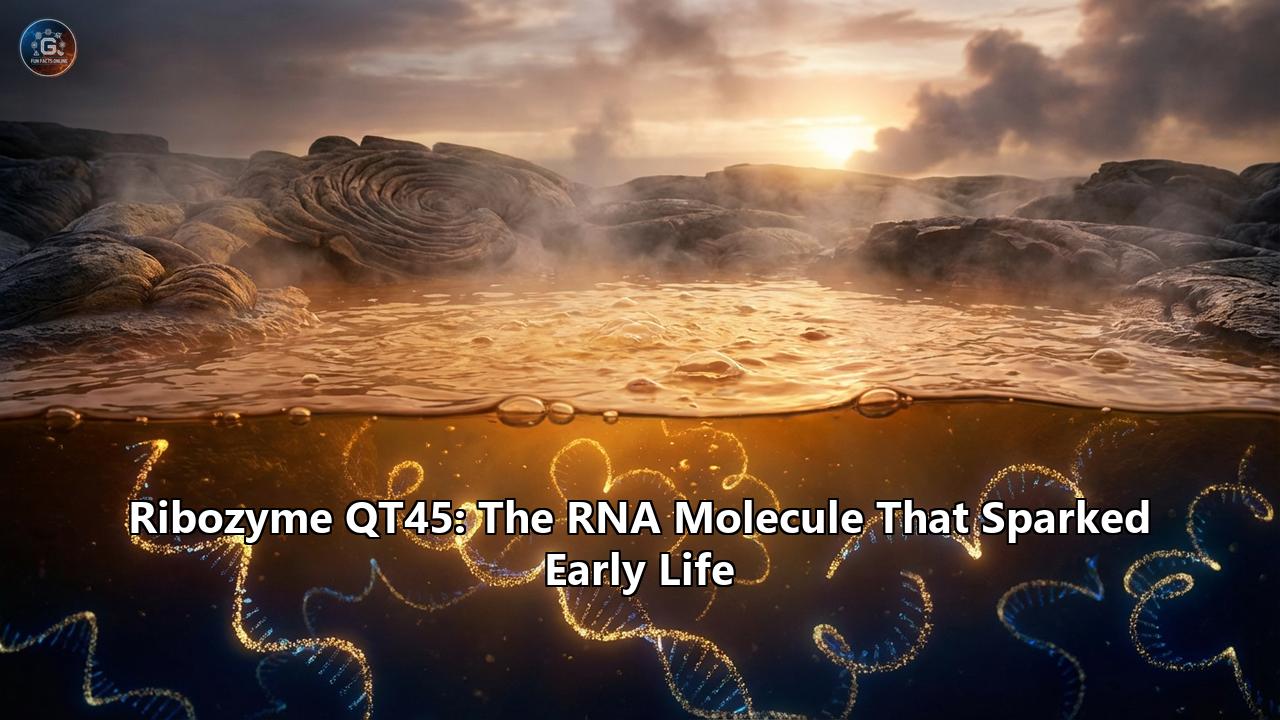
For decades, scientists peering into the origins of life have found themselves staring down the ultimate chicken-and-egg paradox. In modern biology, the division of labor at the cellular level is strictly defined: DNA holds the complex genetic blueprints, while proteins act as the heavy-lifting molecular machines that catalyze chemical reactions and build cellular structures. Yet, neither can function—or even exist—without the other. You need proteins to read and replicate DNA, but you need DNA to provide the instructions to build those proteins. So, billions of years ago in a lifeless, chemical-rich primordial puddle, which came first?
To resolve this paradox, biologists proposed an elegant solution known as the RNA World hypothesis. RNA, DNA’s versatile, single-stranded molecular cousin, possesses a unique evolutionary superpower: it can store genetic information just like DNA, but it can also fold itself into complex three-dimensional shapes to act as a catalyst, much like a protein. In this hypothetical era, roughly 4 billion years ago, RNA did it all. These dual-purpose catalytic RNA molecules, known as "ribozymes," acted as both the blueprint and the builder, theoretically kickstarting the earliest forms of life.
But the RNA World hypothesis has long harbored a massive, seemingly fatal flaw. Until recently, the only known RNA molecules capable of copying other RNA—a critical prerequisite for self-replication—were massive, intricate structures. Typically exceeding 150 nucleotides in length, these sprawling molecules were simply too complex to have spontaneously assembled in the chaotic, prebiotic chemistry of the early Earth. The statistical odds of such a colossal molecule forming by sheer chance in a primordial soup were vanishingly small, leaving scientists to wonder how life ever managed to bootstrap itself into existence. Life needed a simpler spark.
In a landmark discovery published in the journal Science in February 2026, researchers from the Medical Research Council (MRC) Laboratory of Molecular Biology (LMB) in Cambridge shattered this long-standing paradox. Led by investigator Edoardo Gianni and Philipp Holliger, the team unveiled a remarkable molecular machine that has fundamentally altered our understanding of abiogenesis. They named it QT45—short for "Quite Tiny 45".
At just 45 nucleotides long, QT45 is a fraction of the size of any previously known RNA polymerase ribozyme. Despite its diminutive stature, this tiny molecule possesses the astonishing ability to synthesize its own complementary strand and copy itself. This discovery not only bridges the daunting gap between simple chemistry and the first sparks of biological evolution, but it also paints a vivid, icy picture of how life might have emerged from the cosmos.
The Needle in a Trillion-Strand Haystack
To appreciate the magnitude of the QT45 discovery, one must understand the sheer mathematical improbability of finding it. The sequence space for RNA is astronomical. As Zachary Adam, a researcher at the University of Wisconsin-Madison, noted, "The number of 45-nucleotide-long RNA sequences alone is 'unimaginably large'". Finding one specific sequence that folds perfectly to act as a copying machine is a monumental feat of both luck and scientific persistence.
To find this needle in a haystack, the LMB team had to create a haystack of their own. They generated a vast pool of roughly one trillion unique, random RNA sequences. Unlike previous origins-of-life experiments that started with long, complex strands, the researchers deliberately focused on short sequences of 20, 30, or 40 nucleotides. Through a rigorous process of in vitro evolution—where molecules are selected for their ability to perform a specific task, mutated, and selected again—they forced the RNA into a molecular arms race.
After 11 gruelling rounds of mutation and selection, followed by 7 further rounds to optimize performance, the team isolated three small, unrelated RNA motifs capable of functioning as a polymerase. The undisputed winner among them was the 45-nucleotide ribozyme, QT45. To visualize their new discovery, the team used the AI tool AlphaFold3 to predict QT45's three-dimensional structure, though researchers are still working to map its exact physical shape in the laboratory.
Prebiotic Hacks: Ice, Triplets, and the Cryochemistry of Early Earth
QT45 does not function like the highly evolved, highly efficient polymerase enzymes found in modern human cells. Stripped of billions of years of evolutionary refinement, this ancient replicator relies on two specific "prebiotic hacks" to get the job done: sub-zero temperatures and "triplet" building blocks.
First, instead of reading and adding one single genetic letter at a time—which is notoriously difficult for short, primitive molecules because single nucleotides bind very weakly to a template—QT45 grabs its building blocks in chunks of three. These chunks, known as trinucleotide triphosphates or "triplets," bond much more securely to the RNA template. By utilizing triplets, QT45 bypasses one of the most critical chemical roadblocks that plague smaller ribozymes.
Second, QT45 thrives in the cold. The team discovered that the ribozyme functions optimally in conditions that mimic modern-day Iceland—specifically, mildly alkaline eutectic ice at temperatures around -7°C, where ice exists alongside hydrothermal activity. This frozen environment is crucial for several reasons. As water freezes into a solid lattice, it expels impurities, concentrating the RNA molecules and triplet substrates into microscopic pockets of liquid water between the ice crystals. This naturally occurring high concentration drives the chemical reactions forward without the need for cellular compartments. Furthermore, natural freeze-thaw cycles provide a crucial mechanical assist. In modern cells, specialized enzymes called helicases forcefully unzip the double-stranded DNA for copying. On the early Earth, the fluctuating temperatures of freeze-thaw cycles naturally separated the newly copied RNA strands, preventing them from sticking together dead in their tracks.
Closing the Loop: The Two Steps of Self-Replication
For an RNA molecule to be considered a true self-replicator, it must complete a two-step cycle. First, the ribozyme (acting as the positive strand) must use itself as a template to build a complementary negative strand. Second, it must use that newly minted negative strand as a template to rebuild the original positive ribozyme.
Before QT45, this full cycle had never been achieved by a molecule small enough to be prebiotically plausible. "This is, for the first time, a piece of RNA that can make itself and its encoding strand, and those are the two constituent reactions of self-replication," explained Philipp Holliger.
Operating in its frozen, mildly alkaline habitat for 72 days, QT45 synthesized its complementary strand from a random pool of triplets with an astonishing 94.1% per-nucleotide fidelity. It also successfully catalyzed the synthesis of its own positive strand, achieving yields of around 0.2%. While a 0.2% yield over two months might sound inefficient to a modern engineer, on a geological timescale, it is a roaring success. It represents the crossing of a threshold: the moment mere chemistry takes on the defining hallmark of biology—heredity.
Even more remarkably, QT45 demonstrated a profound level of versatility. It is not just a one-trick pony capable of only copying itself; it exhibits "promiscuity" across varied RNA substrates. The team challenged QT45 to copy increasingly structured RNA templates, including a well-known, biologically active molecule called the "Hammerhead" ribozyme. QT45 successfully navigated the complex 3D folds of the Hammerhead template and produced a functional copy. This capability proves that QT45 could have acted as a general-purpose replicator in a chemically diverse primordial soup, copying other functional molecules and sparking early evolutionary ecosystems.
The Crucible of Criticism: Intelligent Design vs. Chemical Reality
Any discovery touching the origins of life inevitably draws intense scrutiny, and QT45 is no exception. Skeptics, particularly proponents of Intelligent Design and organizations like the Atma Paradigm, have pointed out that QT45 is the product of highly controlled laboratory engineering. Critics like organic chemist James Tour and biomedical scientist Rob Stadler argue that the "spark of life" cannot be validated by an experiment that requires trillions of intelligently synthesized RNA strands, purified trinucleotide substrates, and perfectly calibrated temperature and pH cycles. To these critics, the requirement of 11 rounds of laboratory selection implies the necessity of an intelligent agent rather than a random natural occurrence. The Atma Paradigm further argues that there is an "inescapable gap between molecular machines and a living, purposeful agent," asserting that a molecule simply reacting to physical laws lacks true biological agency.
However, from the perspective of abiogenesis research, these laboratory conditions are an essential first step. The purpose of in vitro evolution is not to perfectly simulate a Hadean puddle on day one, but to map the boundaries of chemical possibility. By proving that a 45-nucleotide ribozyme can catalyze self-replication, the LMB team has permanently altered the theoretical landscape. Now that QT45 has proven the mechanics are possible, geochemists can begin looking for the natural, messy analogs of these controlled conditions—such as freeze-thaw cycles on the edges of glacial hydrothermal vents, or prebiotic chemical networks that naturally produce triplet substrates. As Glenn Wells from the MRC noted, the work is about "merging physics, chemistry and biology to understand the building blocks of life".
A Universe of Possibility: Astrobiological Implications
The implications of QT45 extend far beyond the history of our own planet. If the threshold for life's emergence requires an RNA molecule of only 45 nucleotides operating in eutectic ice, the likelihood of life spontaneously forming elsewhere in the universe increases exponentially.
Astrobiologists have long looked at the icy moons of our solar system—such as Jupiter’s Europa and Saturn’s Enceladus—as prime candidates for extraterrestrial life. These moons feature massive subsurface oceans locked beneath thick crusts of ice, with hydrothermal activity suspected at their cores. The discovery that RNA self-replication thrives in cold, icy, mildly alkaline environments perfectly mirrors the suspected conditions of these alien worlds. It raises the tantalizing possibility that the cold, dark depths of our solar system might not be barren, but rather incubating the same primitive chemical cycles that once birthed life on Earth.
The Dawn of Evolution
What makes QT45 truly breathtaking is not just what it is, but what it represents: the crossing of the rubicon from static chemistry to dynamic evolution. In the primordial world, once a molecule like QT45 began copying itself, it inevitably made mistakes. Because it operates with a 94.1% fidelity, roughly 6% of its genetic letters are copied incorrectly. In biology, these "mistakes" are mutations.
"The most exciting thing is, once the system begins to self-replicate, it should become self-optimising," says Holliger. Natural selection kicks in. A mutation might make the ribozyme fold slightly tighter, or bind its triplet substrates slightly faster. That faster variant outcompetes the slower ones, taking over the local microscopic water pocket. Slowly, relentlessly, the molecular engine upgrades itself.
The discovery of the QT45 ribozyme stands as a monumental triumph of modern synthetic biology. It rescues the RNA World hypothesis from its greatest paradox, proving that the chemical bridge between non-living matter and life is much shorter, and much more plausible, than we ever dared to dream. It suggests that the origin of life was not a singular, miraculous lightning strike of impossible complexity, but rather a quiet, microscopic inevitability—born in the ice, fueled by simple building blocks, and driven by the relentless, beautiful logic of chemistry.
Reference:
- https://www.zmescience.com/science/biology/the-quite-tiny-rna-molecule-that-could-answer-the-question-of-the-origin-of-life/
- https://pmc.ncbi.nlm.nih.gov/articles/PMC7618777/
- https://mrclmb.ac.uk/news-events/articles/bridging-the-gap-from-chemistry-to-life-discovery-of-a-tiny-rna-that-can-copy-itself/
- https://www.the-microbiologist.com/news/scientists-chemical-breakthrough-sheds-light-on-origins-of-life/8091.article
- https://blog.getrentacar.com/az/news/transporting-biochemical-material-cold-chain/
- https://www.academicjobs.com/research-publication-news/origins-of-life-breakthrough-mrc-lmb-qt45-rna-ribozyme-4464
- https://scienceandculture.com/2026/02/yet-another-demonstration-that-lifes-origin-required-an-intelligent-agent/
- https://atmaparadigm.com/the-qt45-ribozyme-why-molecular-replication-is-not-life/
- https://www.researchgate.net/publication/391677904_A_stepwise_emergence_of_evolution_in_the_RNA_world