
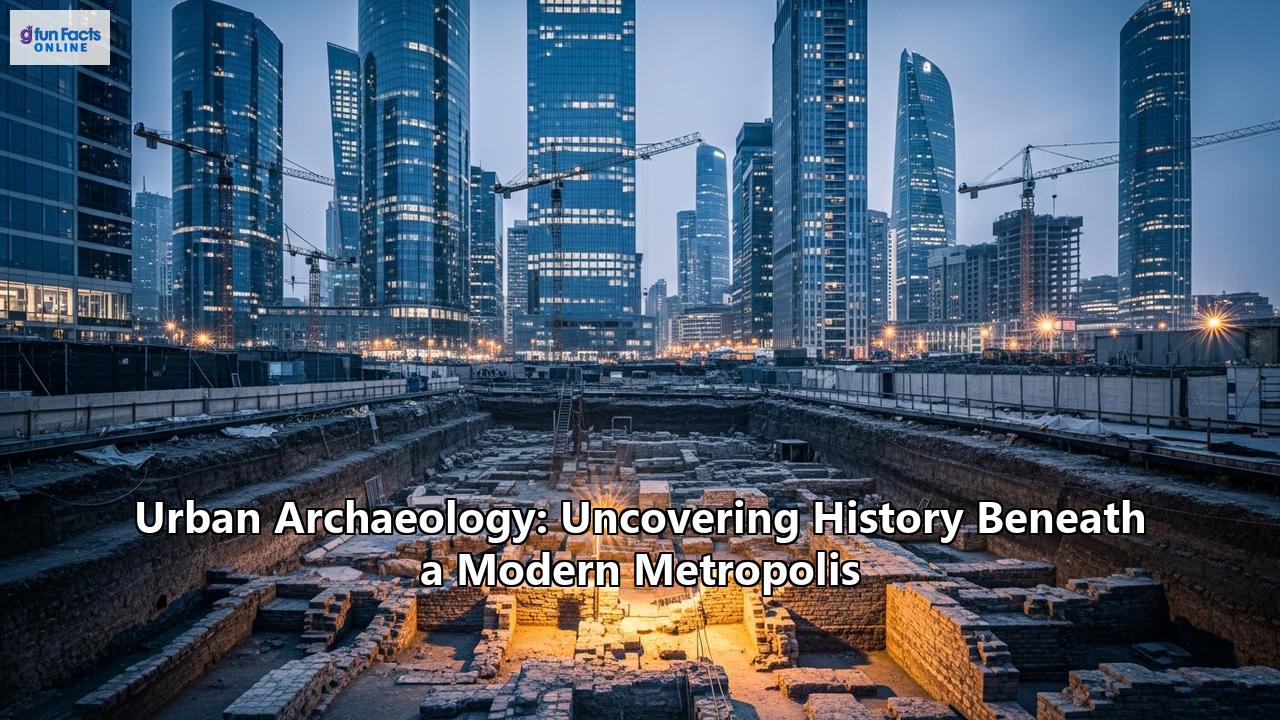
Beneath the Pavement, a Buried World: The Thrilling Pursuit of Urban Archaeology
The modern metropolis is a symphony of relentless motion—a vertical world of glass and steel, a horizontal blur of traffic and pedestrians. Its lifeblood is the constant hum of construction, the perpetual cycle of demolition and rebirth. Yet, beneath the familiar grid of streets and the foundations of towering skyscrapers lies a hidden dimension, a silent, layered world that holds the secrets of the city's own past. This is the realm of the urban archaeologist, a unique breed of historical detective tasked with uncovering the stories of forgotten generations, one square meter at a time, before they are erased forever.
Urban archaeology is the specialized sub-discipline of archaeology that focuses on the material past of our towns and cities. It is both archaeology in the city and of the city, studying not only the ancient sites that modern urbanism has entombed but also the very process of urbanization itself. From the remnants of a Roman wall found beneath a London bank to the vestiges of a colonial-era tavern unearthed during a New York subway extension, urban archaeology peels back the asphalt and concrete to reveal the rich, complex, and often surprising history that thrives just inches beneath our feet.
The Significance of a City's Scars
Why dig in a city, a place already so thoroughly documented in maps, photographs, and historical texts? The answer lies in what is left out of those records. History is often written by the powerful and the privileged, its narratives focused on grand events and prominent figures. Archaeology, however, tells the story of everyone else. It uncovers the lives of the illiterate, the marginalized, the working classes, and the immigrants whose daily existence shaped the city as profoundly as any mayor or merchant.
By sifting through the discarded remnants of their lives—the broken pottery, the animal bones from a family meal, the worn-out tools, the foundations of a humble workshop—archaeologists can reconstruct the social, economic, and even racial dynamics of past urban societies. They can trace the evolution of urban planning, understand the environmental impact of growing populations, and chart the spread of trade and disease. These material remains are the unbiased, unintentional archives of daily life, offering a more democratic and intimate glimpse into the past. In a very real sense, urban archaeology gives a voice to the voiceless, filling in the crucial gaps left in the written record.
Furthermore, in an age of rapid global development, urban archaeology plays a critical role in heritage preservation and the formation of modern identity. The discoveries made can foster a powerful connection between contemporary residents and their city's history, creating more meaningful and inclusive public spaces. It reminds us that the cities we inhabit today are not monolithic entities but are built upon a deep and diverse human legacy.
The Urban Gauntlet: Challenges Unique to City Digs
Excavating in a bustling metropolis is nothing like digging in a remote, open field. The urban archaeologist faces a unique and formidable set of challenges that demand ingenuity, precision, and immense patience.
The Labyrinth of Layers: Complex Stratigraphy
Cities are not built on clean slates. They are built on top of themselves, over and over again. For centuries, and in some cases millennia, inhabitants have leveled old structures, filled in pits with refuse, built new foundations, and laid down new roads. This constant cycle of destruction and construction creates what archaeologists call "deep stratigraphy"—a dense, complex, and often confusing vertical accumulation of layers, or "contexts." A single city block can contain a dizzying sequence of superimposed remains: a Victorian factory built over an 18th-century graveyard, which in turn cuts through the foundations of a medieval church that sits atop the remnants of a Roman villa. Deciphering this jumbled, three-dimensional puzzle is one of the greatest intellectual challenges of the field.
The Tyranny of Space and Time
Unlike rural excavations that can expand across wide areas, urban digs are almost always confined to the precise footprint of a new development. Whether it's a narrow trench for a new water pipe or the deep basement of a skyscraper, the excavation area is dictated by construction plans, not archaeological curiosity. This limited space means archaeologists can't always see the "big picture" at once and must work in constrained, often precarious conditions.
Compounding this is the immense pressure of time. Urban archaeology is frequently "rescue archaeology," also known as salvage or preventive archaeology. It is a race against the clock, an urgent effort to record and recover historical information before a site is destroyed by impending construction. Developers are working to tight deadlines and budgets, and archaeological work is often seen as a potential delay. This means excavations must be conducted with lightning speed, without sacrificing scientific rigor—a demanding balancing act that defines the profession.
Navigating the Modern Minefield
The challenges are not just historical. Archaeologists must contend with a dense web of modern subterranean infrastructure, from sewer lines and gas mains to fiber-optic cables and subway tunnels. Protecting these vital services while digging is paramount. Furthermore, the physical environment itself is hazardous, with risks from traffic, ground contamination, and the instability of adjacent buildings.
The Urban Archaeologist's Toolkit: Methodologies for a Modern Age
To overcome these immense challenges, urban archaeologists have developed a highly specialized set of methods and techniques that combine meticulous recording with cutting-edge technology.
Taming the Strata: Single Context Recording and the Harris Matrix
The revolution in urban archaeology came in the 1970s with the development of a systematic approach to recording, born out of the complex digs in cities like Winchester and London. The cornerstone of this approach is Single Context Recording. Instead of digging in arbitrary levels or focusing on large, multi-layered plans, archaeologists treat every single identifiable event—be it a layer of soil, the cut of a pit, a wall foundation, or a posthole—as a unique "context." Each context is given its own number, drawn on a separate plan, and described in detail on a dedicated "context sheet."
This mountain of individual records is then organized using the Harris Matrix, a schematic diagram developed by Dr. Edward Harris. The matrix forces the archaeologist to think about the physical and temporal relationships between each context. A context can only be above, below, or have no direct relationship to another. By diagramming these simple relationships, a complex sequence of events emerges, showing which pit cuts which layer, and which wall was built before which floor was laid. This system brings order to the chaos of urban stratigraphy, allowing for a logical deconstruction of the site's history, and has become the global standard for complex excavations.
Seeing the Unseen: Non-Invasive Technologies
Before a single spade breaks the ground, technology offers a glimpse of what lies beneath. Ground-Penetrating Radar (GPR) is particularly effective in urban settings, sending radio waves into the ground that bounce off buried objects, creating a subterranean map of potential walls, voids, or large features without any physical disturbance. This allows archaeologists to target their excavations more effectively and advise developers on the archaeological potential of a site early in the planning process. Other non-invasive techniques like magnetometry and electrical resistivity tomography can also help identify buried remains in different soil conditions.
The Digital Dig: From 3D Modeling to Big Data
Modern technology is also transforming how data is recorded and analyzed. Laser scanning and photogrammetry can create highly detailed, interactive 3D models of excavation trenches and artifacts. These digital replicas preserve the site with millimeter accuracy and allow for post-excavation analysis in a virtual environment.
Archaeological data from urban centers—including excavation records, historical maps, artifact databases, and environmental samples—can be integrated into Geographic Information Systems (GIS). These powerful mapping tools allow researchers to analyze spatial patterns across an entire city, revealing new insights into neighborhood development, industrial zones, and social boundaries that would be impossible to see from a single site.
Stories from the Stratosphere of Cities
The true magic of urban archaeology lies in the stories it uncovers. Around the world, excavations in major cities have dramatically reshaped our understanding of their history.
London, England: The construction of the Crossrail line, one of Europe's largest infrastructure projects, triggered one of the most extensive archaeological undertakings in British history. At the site of the new Liverpool Street station, archaeologists uncovered over 3,000 skeletons from the Bedlam burial ground, an overflow cemetery from the 16th and 17th centuries. Analysis of these remains provided a stunningly detailed look at the lives of Londoners during a period of immense social change, revealing evidence of diet, disease (including the plague), and physical hardship. In another part of the city, the discovery of a Roman-era temple dedicated to the god Mithras—the London Mithraeum—offered incredible insight into the religious lives of early Londoners and has since been painstakingly reconstructed for public viewing near its original location. New York City, USA: In 1991, during the construction of a federal office building in Lower Manhattan, a stunning discovery was made: the buried remains of the African Burial Ground. This cemetery, used during the 17th and 18th centuries, was the final resting place for an estimated 15,000 free and enslaved Africans. The rediscovery of this sacred site, which had been completely forgotten and built over, was a watershed moment. The archaeological investigation, driven by the impassioned advocacy of the African-descendant community, provided invaluable and harrowing information about the lives and deaths of the city's enslaved population, a history that had been largely erased from official narratives. Today, the site is a National Monument, a powerful example of archaeology's ability to reclaim and honor suppressed histories. Rome, Italy: In a city where antiquity is everywhere, urban archaeology continues to reveal new chapters of its unparalleled history. Excavations for Rome's new Metro C line have been a slow and painstaking process, but they have yielded breathtaking discoveries. Near the Colosseum, archaeologists unearthed the remains of an Imperial-era military barracks, complete with mosaic-floored rooms and a long hallway decorated with frescoes. At another station, they found the remnants of a 2nd-century commercial farm, including peach pits preserved for nearly 2,000 years. These finds offer a granular view of the everyday landscapes that existed just outside the monumental heart of the ancient capital. Mexico City, Mexico: The heart of modern Mexico City sits atop the ruins of the Aztec capital, Tenochtitlan. Ongoing excavations around the central Zócalo square continually bring this legacy to light. In recent years, archaeologists from the Templo Mayor project have uncovered the Huey Tzompantli, a terrifying and monumental rack of skulls that was described by Spanish conquistadors but had never been found. The discovery of this tower, containing the skulls of men, women, and children, has challenged previous understandings of Aztec ritual sacrifice and warfare, providing a direct and visceral link to the city's pre-Hispanic identity.The Uneasy Alliance: Development and Preservation
Urban archaeology exists in a delicate, often tense relationship with urban development. It is a field fundamentally driven by destruction, yet its goal is preservation—if not of the physical site, then of the knowledge it contains. This dynamic is managed through a framework of laws and regulations, often referred to as Cultural Resource Management (CRM) or Heritage Management.
In many countries, legislation requires developers to fund archaeological assessments before construction can begin. If significant remains are found, a plan must be made. This can range from a full-scale "preservation by record" excavation to, in cases of exceptional importance, altering construction plans to preserve the archaeology in situ (in place).
Successful projects demonstrate a collaborative approach. Archaeologists work with engineers and architects to integrate historical remains into new designs, creating unique public spaces. A Roman wall might be showcased in the lobby of an office building, or the foundations of a medieval house might be preserved beneath a glass floor in a new shopping center. This integration turns a potential conflict into an opportunity, enriching the urban environment and adding economic and cultural value to the new development.
The Future of the Past in Our Cities
The future of urban archaeology is inextricably linked to the future of our cities. As urban populations continue to grow and development intensifies, the threats to our buried heritage will only increase. Yet, our capacity to explore and understand it is also advancing rapidly.
The field will see greater use of artificial intelligence to analyze the vast datasets generated by modern excavations. Predictive modeling, using historical and geological data, will help identify areas of high archaeological potential before development is even proposed, allowing for better long-term planning.
Moreover, there is a growing emphasis on public archaeology and community engagement. Instead of being a closed-door academic pursuit, archaeology is becoming more collaborative, involving local residents in the process of discovery and interpretation. Digital tools, from virtual reality reconstructions of ancient cityscapes to online artifact databases, are making the findings more accessible and engaging for a global audience.
The modern metropolis may seem like a world away from the ancient past, but urban archaeology reveals that the two are in constant dialogue. The city is a living museum, a palimpsest where stories from countless generations are written on top of one another. The urban archaeologist is its curator, its interpreter, and its guardian. They work in the trenches of the present to salvage the stories of the past, ensuring that as our cities build ever higher into the sky, they do not forget the deep and complex foundations from which they came.
Reference:
- https://mappingancientathens.org/en/rescue-excavations/
- https://www.titaniumexcavation.com/excavation-in-urban-areas-how-to-manage-space-and-safety/
- https://anthroholic.com/harris-matrix
- https://student-journals.ucl.ac.uk/pia/article/id/482/
- https://www.parks.ca.gov/?page_id=24062
- https://research.uniroma1.it/urban-archaeology-and-excavation-multi-layered-site-centre-ancient-rome-stratigraphy-architecture
- https://student-journals.ucl.ac.uk/pia/article/id/482/print/
- https://en.wikipedia.org/wiki/Rescue_archaeology
- https://www.archaeologyexpert.co.uk/rescuearchaeology.html
- https://phoebe-project.conted.ox.ac.uk/www.archeox.net/fact-sheets/excavation/rescue-excavation.html
- https://ngsba.org/contract-archaeology/
- https://www.titaniumexcavation.com/excavation-in-tight-spaces-strategies-for-success/
- https://en.wikipedia.org/wiki/Harris_matrix
- https://en.wikipedia.org/wiki/Single_context_recording
- https://research.reading.ac.uk/silchester/lets-dig/
- https://www.bajr.org/single-context-recording/
- https://www.thoughtco.com/harris-matrix-archaeological-tool-171240
- https://intarch.ac.uk/journal/issue55/8/full-text.html
- https://www.researchgate.net/publication/343342535_Geological_Challenges_of_Archaeological_Prospecting_The_Northern_Peloponnese_as_a_Type_Location_of_Populated_Syn-Rift_Settings
- https://student-journals.ucl.ac.uk/pia/article/482/galley/642/view/