
I. The Silent Rhythm of the Biosphere
To the naked eye, a cornfield in mid-July appears static, a green ocean swaying gently in the wind. But beneath this placid surface, a frantic, microscopic machinery is at work. On the underside of every leaf, millions of tiny mouths are opening and closing in a silent, rhythmic chorus. These are stomata—microscopic valves that serve as the gatekeepers of the terrestrial biosphere. They are the lungs of the planet, the primary conduit through which carbon dioxide enters the food web and oxygen exits to fuel animal life.
For centuries, these pores have held a secret. We knew they opened to let carbon in for photosynthesis, and we knew they closed to prevent the plant from drying out. But the precise choreography of this dance—how quickly they react to a passing cloud, a sudden gust of dry wind, or a spike in temperature—remained largely a mystery. We could either look at them through a microscope in an unnatural state, or measure their gas exchange without seeing them. We could not do both.
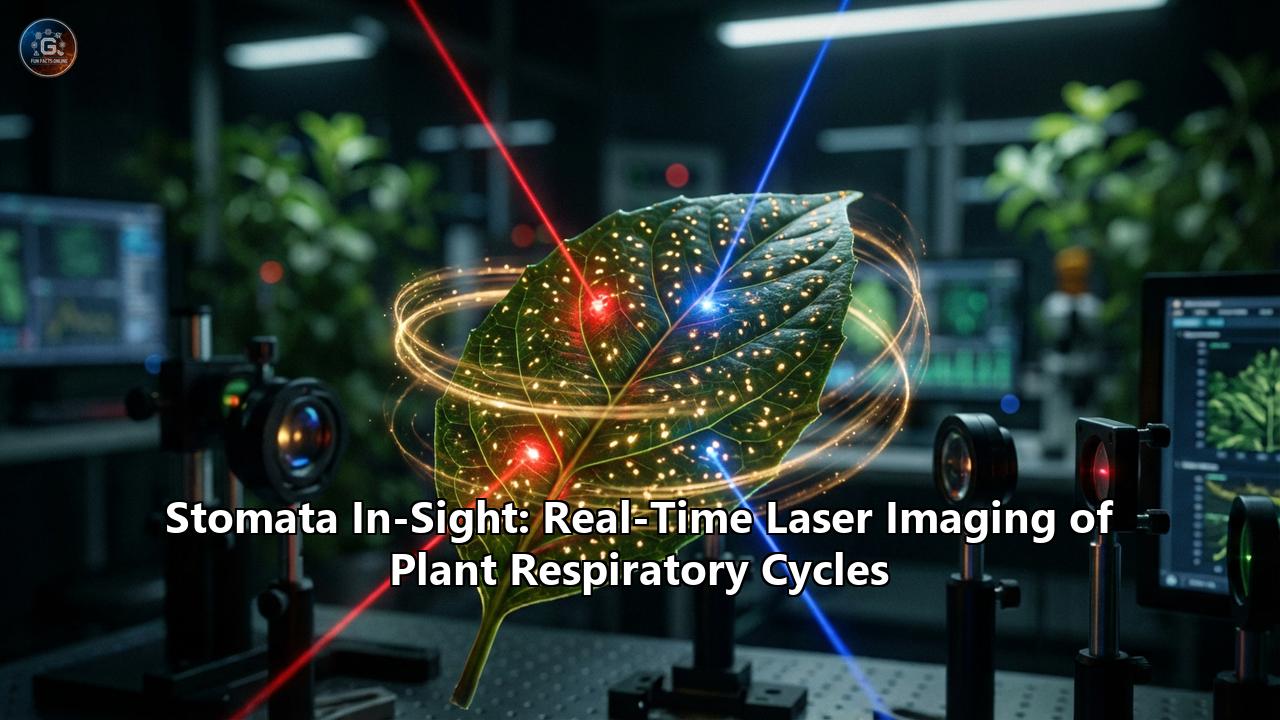
That era of compromise has ended. A new technological breakthrough, christened "Stomata In-Sight" by researchers at the University of Illinois Urbana-Champaign, has shattered the optical barrier. By fusing high-resolution laser scanning confocal microscopy with real-time gas exchange sensors and environmental controls, scientists can now watch plants breathe in real-time. This window into the plant’s respiratory cycle is not just a triumph of imaging; it is a critical key to unlocking crop resilience in a warming, drying world.
II. The Turgor Compromise: Anatomy of a Stoma
To understand the magnitude of this technological leap, one must first appreciate the biological paradox that plants face every day. Plants are stationary organisms living in a hostile environment. To grow, they must acquire carbon dioxide ($CO_2$) from the atmosphere. However, the wet interior of a leaf is a stark contrast to the often dry air outside. Opening a door to let $CO_2$ in inevitably lets water vapor out—a process known as transpiration.
This is the "transpiration compromise." A plant that keeps its stomata open too long will starve of water and wilt; a plant that keeps them closed too long will starve of carbon and stop growing. Evolution’s answer to this dilemma is the stoma (Greek for "mouth"), a pore bordered by two kidney-bean-shaped guard cells.
The mechanics of these guard cells are a marvel of hydraulics. When the plant wants to open the pore, it pumps potassium ions and other solutes into the guard cells. Water follows by osmosis, swelling the cells. Because the inner walls of the guard cells are thicker and stiffer than the outer walls, the swelling causes them to bow outward, creating an opening—the stomatal aperture. When the plant needs to conserve water, it pumps the ions out, the water follows, the cells deflate, and the pore snaps shut.
This system is incredibly dynamic. Stomata respond to light (opening at dawn), darkness (closing at night), $CO_2$ concentration, humidity, and drought stress. Yet, until now, our understanding of this dynamic was piecemeal. We had static images of open or closed pores, or we had graphs showing gas levels changing. We lacked the "movie" that connected the physical movement of the guard cells directly to the efficiency of the gas exchange.
III. The Blind Spot: A History of Imperfect Observation
The history of stomatal research is a history of clever workarounds. In the early days, botanists would paint leaves with clear nail polish or silicone to create a hardened impression. They would then peel off this "dental mold" and look at it under a microscope to count how many pores were open. While effective for counting density, this method was a static snapshot. It told us nothing about speed or reaction time.
Later, standard optical microscopy allowed for viewing live tissue, but it came with a fatal flaw: the Heisenberg uncertainty principle of biology. To look at a leaf under a high-power microscope, you often had to cut it, mount it on a slide, and blast it with bright light. These actions stressed the plant, causing the stomata to close or behave erratically. Furthermore, you couldn't control the atmosphere on a microscope slide. You couldn't simulate a hot, dry Kansas afternoon or a humid tropical morning.
Conversely, plant physiologists developed "gas exchange analyzers"—sophisticated clamps that attach to a leaf and measure the air going in and out. These machines provided excellent data on photosynthesis rates and water loss (stomatal conductance). But they were "black boxes." A sensor might show that water loss decreased by 20%, but it couldn't tell you why. Did all the stomata close slightly? Did half of them close completely while the other half stayed open? This patchy behavior, known as "stomatal heterogeneity," was invisible to the sensors.
The scientific community was left with a choice: see the structure without the function, or measure the function without the structure. "Stomata In-Sight" was born from the refusal to choose.
IV. Enter Stomata In-Sight: The Technological Trinity
The "Stomata In-Sight" system is not a single invention but a masterful integration of three distinct technologies, achieved by a team at the University of Illinois Urbana-Champaign. It is a "bionic" setup that merges optics, sensing, and environmental simulation.
1. Laser Scanning Confocal Microscopy (LSCM)
The visual core of the system is a laser scanning confocal microscope. Unlike a standard microscope that captures a blurry image of a thick object, a confocal microscope uses a focused laser beam and a pinhole aperture to eliminate out-of-focus light. It optically "slices" the leaf, building a crisp, three-dimensional image of the living guard cells.
Critically, this laser imaging is non-invasive. It allows researchers to look into the leaf tissue of a living, intact plant without slicing or staining it. The system uses specific wavelengths to excite the natural fluorescence of chlorophyll or specific dyes, making the guard cells glow against the dark background, providing high-contrast video of their swelling and shrinking.
2. Leaf Gas Exchange Sensing
While the laser watches the cells, the leaf is enclosed in a specialized chamber connected to high-precision gas analyzers. These sensors detect minute changes in $CO_2$ and water vapor concentrations.
The innovation here is the miniaturization and integration. Standard gas exchange chambers are bulky and opaque. The UIUC team engineered a chamber with an optical window transparent enough for the laser to shoot through, yet sealed tightly enough to measure gas flux with parts-per-million accuracy. This means that at the exact second the laser records a guard cell shrinking by 2 microns, the sensor records the corresponding drop in water transpiration.
3. Environmental Control
The final pillar is the ability to play god with the weather. The chamber is equipped with controls for light intensity, temperature, humidity, and $CO_2$ concentration. Researchers can program the system to mimic a cloud passing over the sun (a sudden drop in light) or a heatwave (a spike in temperature).
This "dynamic benchmarking" is what makes the system revolutionary. It allows scientists to test the reflexes of the plant. How fast can a corn plant close its stomata when the air suddenly dries out? Does it take 5 minutes or 20? In a world of rapidly changing climates, that reaction speed—the "kinetic response"—is the difference between life and death.
V. The Breakthrough: Watching the Breath
When the researchers turned on "Stomata In-Sight," they saw the respiratory dance in unprecedented detail. One of the primary subjects of the initial study was maize (corn), a crop vital to global food security.
The system revealed that stomatal movement is not a simple on-off switch. It is a complex, hydraulic oscillation. The imaging captured "stomatal patches"—clusters of pores that would open and close in unison, sometimes behaving differently than their neighbors just millimeters away. This patchiness had long been theorized to explain erratic gas exchange data, but it had never been visually correlated with real-time flux data before.
The system also quantified the "lag time." When light hits a leaf, photosynthesis begins almost immediately, demanding $CO_2$. However, the mechanical process of inflating the guard cells with water takes time. The laser imaging showed that in some maize varieties, the stomata were sluggish, taking several minutes to fully open. During this lag, the plant was missing out on potential growth. Conversely, when the light was turned off, some stomata were slow to close, leaking precious water into the dark night for no gain.
This sluggishness is a major inefficiency. By identifying the specific genetic lines of corn that have "snappier," more responsive stomata, breeders can now target genes that control the speed of ion transport channels. "Stomata In-Sight" provides the visual metric needed to screen for these high-performance plants.
VI. Beyond the Single Pore: The Physics of Laser Imaging
While "Stomata In-Sight" relies on confocal microscopy, it sits within a broader family of laser-based plant diagnostics that are maturing alongside it. Understanding these related technologies highlights why the UIUC breakthrough is so specific and necessary.
Biospeckle Laser Imaging (BSL):Another technique, known as biospeckle, involves shining a laser on a leaf and analyzing the "speckle pattern" caused by the scattering of light. As the cellular machinery moves (cytoplasm streaming, organelle movement), the speckle pattern changes. If the leaf is active and healthy, the speckle boils and shifts rapidly. If the leaf is stressed or dying, the speckle slows down.
While biospeckle is excellent for detecting general stress or bruising in fruit, it lacks the resolution to resolve individual guard cells. It tells you that activity is changing, but not what mechanism is changing. "Stomata In-Sight" provides the structural resolution that biospeckle lacks.
Laser Speckle Contrast Imaging (LSCI):Often used in neuroscience to map blood flow, LSCI has recently been adapted for plants to map sap flow and water distribution. It can show how water moves through the veins of a leaf in real-time. Combining LSCI with "Stomata In-Sight" could be the next frontier—watching the water arrive at the guard cell via LSCI, and then watching the guard cell open via confocal microscopy.
VII. The Agricultural Revolution: Breeding for the Future
The immediate application of "Stomata In-Sight" is in the field of crop genetics and phenotyping. We are currently facing a "yield plateau" in major crops like wheat, rice, and corn. Traditional breeding has maximized the size of the grain and the architecture of the plant. The next gains must come from physiological efficiency—making the plant a better machine.
1. Water-Use Efficiency (WUE):Agriculture consumes 70% of the world's fresh water. As aquifers deplete and droughts become more frequent, we need "more crop per drop."
Using "Stomata In-Sight," breeders can identify plants that close their stomata faster when a cloud passes. A plant that is slow to close during a 10-minute cloudy period is wasting water. Over a growing season, those wasted minutes add up to gallons of lost water. A "smart" plant with responsive stomata preserves that water in the soil for when it’s really needed.
2. Breaking the Productivity Barrier:Photosynthesis is limited by how fast $CO_2$ can get to the chloroplasts. This is often dictated by the size and number of stomata. However, simply adding more mouths leads to dehydration. The ideal plant has stomata that can open extremely wide when water is plentiful to maximize intake, but snap shut instantly when stress hits. The UIUC system allows researchers to measure this "dynamic range." They can hunt for genetic mutants that have high maximal aperture but low lag time.
3. Heat Stress Resilience:As global temperatures rise, plants face "vapor pressure deficit" (VPD)—essentially, the air becomes a vacuum sucking water out of the leaf. "Stomata In-Sight" allows scientists to simulate high VPD conditions in the chamber and watch how the guard cells physically structural integrity holds up. Do they collapse? Do they flutter? Understanding the failure modes of stomata under heat stress will help bioengineer heat-proof crops.
VIII. Implications for Climate Science
The impact of this technology extends beyond the farm to the climate models that predict our planet's future.
Global Climate Models (GCMs) rely on mathematical formulas to estimate how much carbon the world's forests and crops absorb. Currently, these models use simplified assumptions about stomatal behavior. They often treat the canopy as a "big leaf" with average properties.
However, "Stomata In-Sight" has revealed that stomatal behavior is far more complex and heterogeneous than previously thought. If our models assume plants stop losing water instantly when the sun goes down, but the reality is a 30-minute lag, then our calculations of global water cycles are off by gigatons.
By providing precise, kinetic data on how different species breathe, this technology can refine the "Land Surface Models" used by the IPCC (Intergovernmental Panel on Climate Change). Better data on plant respiration leads to better predictions of atmospheric humidity, rainfall patterns, and carbon sequestration rates. We may discover that certain forests are less efficient carbon sinks than we hoped, or that specific agricultural regions are releasing more water vapor than predicted.
IX. Future Horizons: AI and Autonomous Phenotyping
The data generated by "Stomata In-Sight" is massive. A single experiment generates terabytes of 3D video and gas flux logs. This is where Artificial Intelligence (AI) enters the equation.
The UIUC team utilizes machine learning algorithms to process the confocal images. The AI is trained to recognize a stoma, measure its aperture, calculate its area, and track it over time, automatically across thousands of frames. This automation removes the bottleneck of human analysis.
Looking forward, we can envision a future where this technology moves from the lab to the field. While confocal microscopes are currently large, the miniaturization of optics (photonics on a chip) is advancing rapidly. We may soon see "field-deployable" laser imagers—robots that roam the cornfields, clamping onto leaves and checking the respiratory health of the crop in real-time.
Furthermore, this tool opens the door for "synthetic biology" in plants. If we fully understand the mechanical limits of the guard cell, we might be able to engineer entirely new types of stomata—perhaps ones that are triggered by specific light wavelengths (optogenetics) or that default to a closed state to ensure extreme drought survival.
X. Conclusion: The Breathing Planet Revealed
"Stomata In-Sight" is more than just a new instrument; it is a conceptual bridge. It bridges the gap between the microscopic world of cellular biology and the macroscopic world of atmospheric science. It connects the swelling of a single cell to the hydrology of a continent.
For the first time, we are not just observing the aftermath of plant respiration; we are watching the process unfold. We are seeing the hesitation, the reaction, and the resilience of the green world. As humanity faces the dual challenges of feeding a growing population and stabilizing a volatile climate, this laser-focused insight into the breath of plants may prove to be one of our most vital tools. The "mouths" of the plants are speaking to us, and finally, we have the technology to listen.
Reference:
- https://optics.org/news/17/1/8
- https://www.eurekalert.org/news-releases/1111558
- https://www.techexplorist.com/real-time-imaging-captures-how-plants-breathe/101788/
- https://www.sciencedaily.com/releases/2026/01/260106224625.htm
- https://news.ssbcrack.com/new-tool-stomata-in-sight-allows-real-time-observation-of-plant-gas-exchange/
- https://pmc.ncbi.nlm.nih.gov/articles/PMC8553064/