
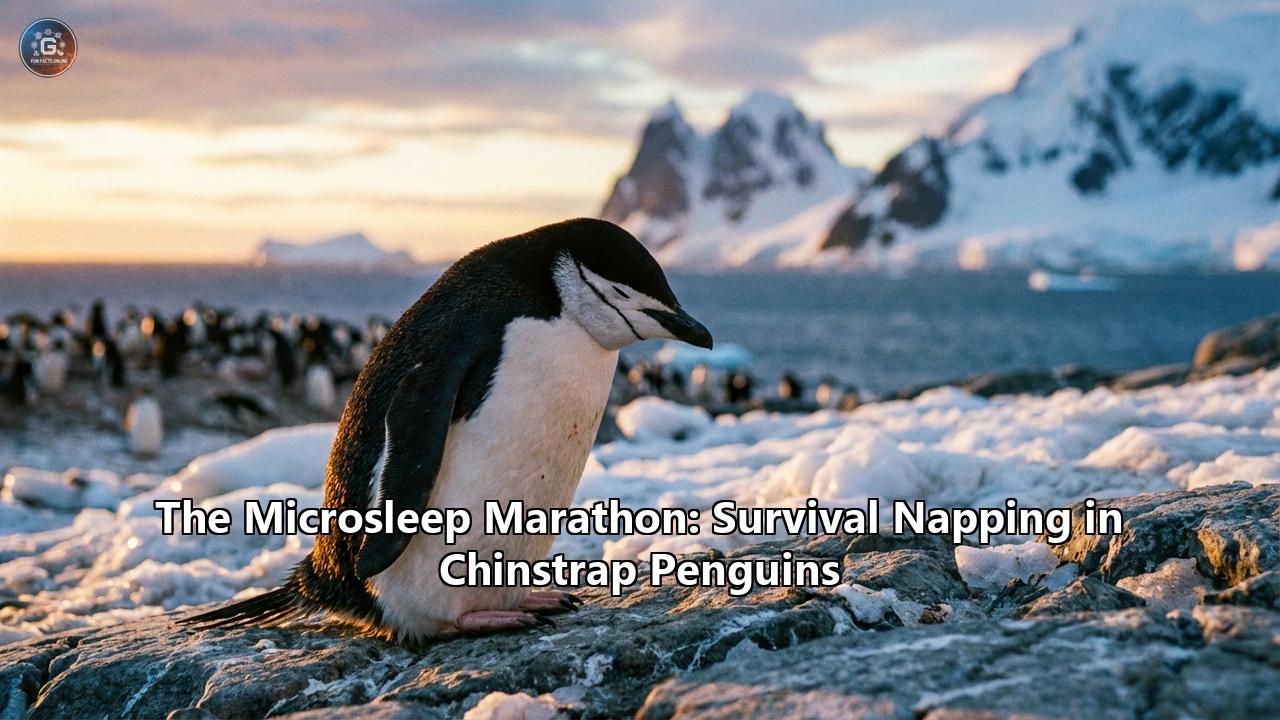
In the bleak, wind-scoured amphitheater of a King George Island colony, silence is an extinct concept. The air, thick with the acrid sting of ammonia and the brine of the Southern Ocean, vibrates with a cacophony that rivals a packed football stadium. Here, thousands of tuxedoed figures stand shoulder-to-shoulder on nests of volcanic pebbles, engaged in a high-stakes biological gamble. To the casual observer, they appear to be blinking—slow, heavy-lidded blinks that punctuate their vigilant stares. But they are not just blinking. They are sleeping.
For the Chinstrap penguin (Pygoscelis antarcticus), sleep is not a nightly retreat into eight hours of oblivion. It is a fragmented, desperate, and evolutionary masterpiece of survival. It is a microsleep marathon.
Recent scientific revelations have upended our understanding of vertebrate rest, revealing that these Antarctic sentinels survive on naps that last, on average, just four seconds. By repeating this fleeting shutdown over 10,000 times a day, they accumulate more than 11 hours of sleep without ever truly letting their guard down. It is a strategy born of necessity, forged in an environment where a moment of inattention can mean the loss of an egg to a skua or a precious pebble to a thieving neighbor. This is the story of the most fragmented sleeper on Earth, and what their bizarre habits tell us about the biological imperative of rest.
Part I: The Discovery of the Four-Second Nap
For decades, polar biologists and sleep researchers assumed that the behavior of nesting penguins—often seen nodding off and snapping awake—was simply "drowsiness." It was viewed as a transition state, a purgatory between the waking world and true, restorative sleep. It wasn't until late 2023, with the publication of a landmark study in the journal Science, that the true nature of their behavior was quantified.
A team led by Paul-Antoine Libourel of the Lyon Neuroscience Research Center and Won Young Lee of the Korea Polar Research Institute traveled to King George Island, a rugged outpost in the South Shetland Islands. Their mission was to look inside the brains of breeding Chinstrap penguins. The logistical challenges were immense. To measure sleep in the wild, the team had to outfit 14 penguins with portable data loggers. These devices, glued temporarily to the birds' dorsal feathers, were wired to electrodes implanted under the skin of the skull to record electroencephalogram (EEG) activity—brain waves. They also measured muscle tone, body movement, and location via GPS.
The data that came back was staggering. The researchers found that while the penguins were at sea foraging, they barely slept at all. But once they returned to land to incubate their eggs, they entered a state of "somnolent vigilance." The EEG readings showed the unmistakable slow-wave patterns of deep sleep, but they occurred in bursts so short they defied conventional classification.
The Numbers of Survival:- Average Nap Duration: 3.91 seconds.
- Frequency: More than 600 times per hour.
- Daily Total: Over 10,000 microsleeps.
- Cumulative Rest: Approximately 11 hours per day.
This discovery was a paradigm shift. In human sleep science, "microsleeps" are considered a failure of the system—a dangerous symptom of sleep deprivation that leads to car accidents and cognitive errors. For the Chinstrap penguin, however, microsleep is not a bug; it is a feature. It is the primary operating system. The study showed that despite never getting more than a few seconds of continuous shut-eye, the penguins were able to successfully raise their chicks and function at a high biological level. They had effectively hacked the sleep process, stripping it down to its absolute minimum viable unit and distributing it across the entire 24-hour cycle.
Part II: The Crucible of the Colony
To understand why an animal would evolve to sleep in four-second bursts, one must understand the environment of a Chinstrap penguin colony. King George Island is not a peaceful snow globe. It is a chaotic, overcrowded, and hyper-aggressive metropolis.
The Landscape of Noise and SmellA Chinstrap colony is an assault on the senses. Early Antarctic explorers, from the crew of Captain Cook’s voyages to the sealers of the 19th century, often smelled the colonies before they saw them. The guano, stained pink from a diet rich in krill, coats the rocky slopes and creates a pervasive stench of ammonia and rotting fish. But it is the noise that is most overwhelming. The Chinstrap is nicknamed the "Stonecracker" penguin, not because it breaks rocks, but because its shrill, piercing screech is said to be loud enough to crack stones.
In this din, thousands of breeding pairs stake out territory. Nests are simple scrapes in the ground, built up with pebbles to keep eggs out of the meltwater. Pebbles are the currency of the colony, and inflation is rampant. A penguin that turns its back for a minute may find its nest dismantled by a neighbor. This creates a pressure cooker of social tension. Aggression is constant. Neighbors bicker, peck, and slap each other with flippers stiffened into truncheons.
The Predators from the SkyIf the neighbors weren't bad enough, the sky is full of monsters. The Brown Skua (Stercorarius antarcticus) is a predatory seabird with the intelligence of a crow and the rapaciousness of a raptor. They patrol the air currents above the colony, watching for an unattended egg or a weak chick. A sleeping parent is a negligent parent, and negligence results in death.
This is the central conflict of the Chinstrap penguin’s life: the biological need for sleep versus the ecological need for vigilance. If they sleep too deeply, they lose their offspring. If they don't sleep at all, they collapse from exhaustion.
The microsleep strategy is the evolutionary solution. by closing their eyes for only seconds at a time, a parent is never "offline" for long enough for a skua to launch a successful raid or a neighbor to steal a stone. They exist in a state of oscillating consciousness, constantly refreshing their brain while keeping their radar active.
Part III: The Neuroscience of the Half-Asleep Brain
How is this physiologically possible? If a human tried to survive on four-second naps, they would suffer from severe cognitive decline, hallucinations, and eventual organ failure. The Chinstrap penguin, however, utilizes a sleep mechanism that is ancient, complex, and shared with a few other elite biological performers: Unihemispheric Slow-Wave Sleep (USWS).
Sleeping with One Eye OpenThe EEG data from the Libourel study revealed that Chinstraps can engage in both bihemispheric sleep (where both sides of the brain sleep) and unihemispheric sleep (where only one side sleeps). When sleeping unihemispherically, one eye remains open, connected to the awake hemisphere of the brain.
This ability is a convergent evolutionary trait found in several aquatic mammals (like dolphins and fur seals) and birds (like frigatebirds and mallard ducks).
- The Group Edge Effect: In mallard ducks, individuals on the edge of a flock sleep with the eye facing away from the group open, keeping watch for predators, while the "inner" eye closes. The hemisphere controlling the open eye stays awake.
- The Frigatebird: These masters of flight can stay airborne for months. Research has shown they sleep while flying, often using unihemispheric sleep to maintain aerodynamic control, grabbing mere minutes of rest during thermal gliding.
For the Chinstrap penguin, the ability to switch between unihemispheric and bihemispheric sleep is crucial. The study found that while they do sleep with both brains occasionally, a significant portion of their rest is asymmetric. This suggests that even during their "naps," they are processing visual information. They are resting their processing centers in turns, like a computer rebooting its cores one by one rather than shutting down the whole system.
The Synaptic Homeostasis HypothesisThe Chinstrap study challenges a major theory in neuroscience known as the Synaptic Homeostasis Hypothesis (SHY). This hypothesis proposes that the function of sleep is to "downscale" the synaptic connections that are strengthened during wakefulness. Essentially, learning and being awake saturate the brain's circuits; sleep is the maintenance crew that prunes these connections to save energy and space for the next day's learning.
Conventionally, it was believed that this process required consolidated periods of slow-wave sleep—long, uninterrupted cycles. The Chinstrap penguin proves that this is not strictly true. Their brains appear capable of performing this synaptic maintenance in micro-bursts. The benefits of sleep, it seems, can accrue incrementally. If you save a document every 4 seconds, you never lose your work. Similarly, if the penguin restores its synapses every 4 seconds, it never hits the crash point of exhaustion.
Part IV: A Day in the Life of a Stonecracker
To visualize this existence, imagine standing on the black volcanic sands of King George Island in mid-December. It is the height of the austral summer. The sun dips towards the horizon but never truly sets, casting a perpetual twilight that bathes the glaciers in bruised purples and golds.
The Shift ChangeOn the beach, a male Chinstrap penguin emerges from the surf. He has been at sea for 24 hours, diving to depths of 70 meters in freezing waters to hunt Antarctic krill. He is exhausted, his belly full of semi-digested crustaceans to regurgitate for his chicks. He waddles up the steep, snowy slope, using his claws to grip the ice—a mountaineer in a dinner jacket.
He reaches his nest, a small crater of stones halfway up a ridge. His mate is there, caked in mud and guano, sitting on two grey, fuzzy chicks. She has not eaten in a day. She has been microsleeping since he left.
The greeting is raucous. They engage in an "ecstatic display," facing each other, pointing their bills to the sky, and pumping their flippers while screaming. This ritual is vital; it reinforces the pair bond and allows them to recognize each other in the deafening crowd.
The WatchThe female departs for the sea, and the male takes his post. He settles over the chicks, tucking them into his brood patch—a featherless area of highly vascularized skin that transfers body heat. Now, his marathon begins.
He stands. His eyelids droop.
- Second 1: Eyes close. Brain waves slow.
- Second 2: Slow-wave sleep deepens.
- Second 3: A neighbor squawks.
- Second 4: Eyes snap open.
He scans the immediate vicinity. The neighbor is just preening. No skuas overhead.
- Second 5: Eyes close.
- Second 6: Sleep returns.
This cycle repeats. Over and over. For twenty-four hours. He will nap while standing. He will nap while lying down. He will nap while snow accumulates on his back. If a skua dives, he will react instantly, lunging with his beak. If a neighbor tries to pilfer a stone, he will slap them away. He is a biological metronome, ticking between worlds.
The Foraging TripWhen his mate returns, he will head back to sea. Here, the dynamic changes. The study found that while at sea, penguins barely sleep. They are "at work." They must constantly dive, evade leopard seals—their primary aquatic predator—and navigate shifting ice. They might catch a few minutes of rest floating on the surface, but the ocean is too dangerous for the 11-hour microsleep luxury. The colony, despite its chaos, is the only place safe enough to sleep, even if that sleep is shattered into thousands of fragments.
Part V: The Chinstrap Profile
While their sleep habits are currently their most famous trait, Pygoscelis antarcticus is a fascinating creature in its own right.
Physical DescriptionStanding about 70 to 76 cm (28-30 inches) tall and weighing 3 to 5 kg (7-11 lbs), they are medium-sized penguins. Their defining feature is the thin, curved line of black feathers running under their chin, giving them the appearance of wearing a black helmet strapped on tight. Their eyes are reddish-brown, giving them a somewhat intense, penetrating stare that matches their aggressive personality.
Diet and HuntingChinstraps are krill specialists. While they will eat small fish, Antarctic krill makes up 95-99% of their diet in many regions. This specialization makes them incredibly efficient hunters but also vulnerable. They can swim up to 80 km (50 miles) offshore to find food. Unlike the Adélie penguin, which prefers the pack ice, Chinstraps prefer open water, often breeding on ice-free rocky slopes.
Breeding Cycle- November: Arrival at colonies. Nests are built or repaired. Aggression is at its peak.
- Late Nov/Dec: Two eggs are laid. Incubation takes about 37 days, with parents swapping shifts every few days.
- Jan/Feb: Eggs hatch. Chicks grow rapidly, demanding huge amounts of food. This is the period of highest sleep pressure for parents.
- March: Chicks "fledge" (get their waterproof feathers) and head to sea. Adults molt and then follow.
Part VI: The Ghost of Captain Cook and the Future of the Ice
The Chinstrap penguin was first scientifically described by Johann Reinhold Forster, a naturalist on Captain James Cook’s second voyage in 1772. Forster, and the explorers who followed, saw these birds as symbols of the remote, untouchable Antarctic. But today, the Chinstrap is a sentinel for a changing world.
The Climate ThreatWhile the microsleep strategy protects them from skuas, it cannot protect them from a warming ocean. The Antarctic Peninsula is one of the fastest-warming places on Earth.
- Krill Decline: Warmer water and reduced sea ice cover are decimating krill populations. Less krill means penguins must swim farther and dive deeper to find food.
- The Sleep Tax: If a parent has to spend more time foraging, they spend less time at the nest. This disrupts the intricate shift system. A parent delayed at sea leaves their partner starving on the nest. A starving partner may abandon the eggs to save themselves.
- Population Crash: Surveys on Elephant Island and other strongholds have shown dramatic population declines—up to 50-75% in some colonies over the last 50 years.
The microsleep strategy is highly efficient, but it operates on a razor-thin margin. It relies on the ability to return to the nest regularly. If the food moves too far away, the system collapses.
Part VII: Implications for Human Science
Why does this matter to us, the monolithic sleepers?
- Treating Sleep Disorders: Understanding how penguin brains prevent the toxic buildup of metabolic waste during fragmented sleep could unlock new treatments for human sleep disorders. If we can identify the specific proteins or neural pathways that allow "incremental restoration," we might be able to help people with chronic insomnia or sleep apnea.
- The Limits of Consciousness: The Chinstrap study blurs the line between awake and asleep. It suggests that consciousness is not a binary switch but a dimmer. Humans experience microsleeps as "lapses," but perhaps, with training or technological augmentation, the human brain could access similar states. (Though, for now, please don't try this while driving).
- The Nature of Intelligence: These birds navigate complex social hierarchies, navigate the open ocean, and raise young, all while never sleeping more than 4 seconds at a time. It challenges our assumption that "higher" cognitive function requires long blocks of rest.
Conclusion: The Ultimate vigil
The Chinstrap penguin is a testament to nature's refusal to accept "impossible" as an answer. Faced with a freezing, predator-filled, resource-constrained environment, evolution did not give them a weapon or a shield; it gave them a new way to exist.
They are the sleepless watchers of the south. As you read this sentence, a Chinstrap penguin on King George Island has just fallen asleep. And now, it is awake again. In that blink of an eye, it has stolen a moment of life, one micro-second at a time, defying the odds in the harshest place on Earth. Their marathon continues, a silent, blinking vigil at the bottom of the world.
Reference:
- https://www.youtube.com/watch?v=QdUHy6Y029o
- https://www.secretatlas.com/handbook/wildlife-and-nature-guides/antarctic/chinstrap-penguin
- https://www.polartours.com/animals/chinstrap-penguin
- https://www.quora.com/What-are-some-interesting-facts-about-the-Chinstrap-penguin
- https://seahistory.org/sea-history-for-kids/chinstrap-penguin/
- https://www.researchgate.net/publication/264742119_New_Antecedents_on_the_Discovery_of_the_South_Shetland_Islands_the_Journal_of_Midshipman_Charles_W_Poynter_1819-1820
- https://bookshapers.co.uk/podcast/the-sign-of-the-penguins/
- https://www.youtube.com/watch?v=RREki5qqw-E