
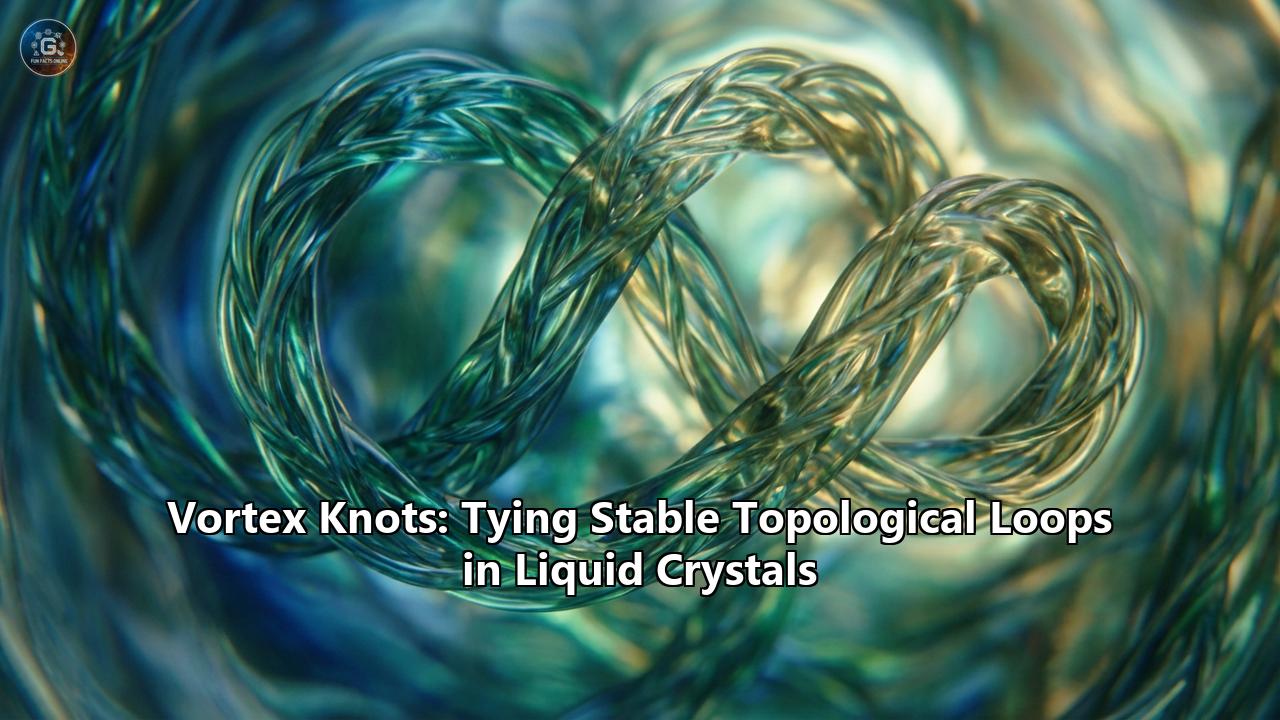
These are not the knots of shoelaces or rope, which rely on friction to hold their form. These are vortex knots—loops of singularity and orientation that are held together by the iron laws of topology. They are the realization of a 19th-century scientific dream, a ghost of a theory that once tried to explain the entire universe, now reborn in the laboratory to power the technologies of tomorrow.
This article dives deep into the science of these "heliknotons," exploring how they are made, why they are virtually indestructible, and how they might rewrite the future of photonics, soft robotics, and data storage.
Part I: The Ghost of Lord Kelvin and the Vortex Atom
To understand why a knot in a liquid crystal is such a monumental achievement, we must travel back to Victorian Scotland. In 1867, the great physicist William Thomson (later Lord Kelvin) watched a demonstration by his colleague P.G. Tait. Tait had created smoke rings—vortices of air—that traveled across the room, bouncing off one another with a peculiar, elastic resilience.
Inspired, Kelvin proposed a radical theory: What if atoms are not solid balls, but knotted vortices in the ether?
He theorized that the periodic table of elements was actually a table of knots. A hydrogen atom might be a simple unknotted loop; oxygen might be a figure-eight knot; carbon, a trefoil. If the ether was a perfect, frictionless fluid, these knots would be stable forever—unable to untie themselves because the fluid lines could not pass through one another. It was a beautiful, geometric theory of matter.
It was also wrong. The ether didn't exist, and atoms turned out to be quantum mechanical clouds of probability, not knots of fluid. Kelvin’s theory was discarded, becoming a historical curiosity.
But the mathematics developed to study these knots survived, birthing the field of topology. And now, 150 years later, Kelvin’s dream has been resurrected—not in the vacuum of space, but in the vials of soft matter physics labs. In chiral liquid crystals, researchers have finally found the medium where Kelvin’s vortex knots can exist, stable and robust, behaving exactly like the "atoms" he once imagined.
Part II: The Canvas—What is a Chiral Liquid Crystal?
Liquid crystals (LCs) are the state of matter that occupies the grey zone between a flowing liquid and a crystalline solid. They flow like oil, but their constituent molecules are shaped like rods or discs, and they like to point in the same direction. This direction is mathematically described by a vector field called the director field ($\mathbf{n}$).
The material used to tie vortex knots is a special variety: Chiral Nematic Liquid Crystal.
The Twist of Chirality
In a standard nematic liquid crystal, the rod-like molecules line up parallel to each other. But if you dope this material with a "chiral" agent—a molecule with a handedness, like a screw or a helix—the entire structure begins to twist. The director field doesn't just point in one direction; it rotates in a helical spiral as you move through the material.
This natural tendency to twist is the secret ingredient. It provides a "background field" that wants to form helices. When you disrupt this field—say, with a laser or an electric jolt—the system tries to heal the disruption while satisfying two competing urges:
- Elasticity: The molecules want to be parallel (or twist at a constant rate).
- Topology: The disruption might be "twisted" in such a complex way that it cannot smooth itself out without tearing the field.
When these two forces balance, you get a Topological Soliton.
Part III: The Heliknoton—A Knot in the Field
The specific type of knot that has captured the scientific world's attention is called the Heliknoton.
Discovered and characterized by teams led by researchers like Ivan Smalyukh at the University of Colorado Boulder, the heliknoton is a topological marvel. It is not a knot of material (the molecules themselves don't form a long rope), but a knot in the orientation of the molecules.
The Geometry of the Knot
Imagine the director field as a forest of arrows. In a heliknoton, there are specific lines where the arrows do something distinct.
- The Vortex Core: There are singular lines where the orientation of the molecules becomes undefined or twists abruptly.
- The Preimage: This is a more subtle topological concept. If you pick a specific direction (say, "North") and trace all the points in the liquid crystal where the molecules point exactly North, those points form closed loops.
In a heliknoton, these loops are linked and knotted. The very fabric of the molecular alignment is tied in a trefoil knot, a figure-eight knot, or even more complex distinct topologies.
Unlike a shoelace, which can be untied if you pull the ends, a heliknoton has no ends. It is a closed loop embedded in a 3D medium. To "untie" it, you would have to forcefully rip the liquid crystal order apart, overcoming a massive energy barrier. This gives the heliknoton Topological Protection. It is stable not because it is frozen, but because mathematics forbids it from decaying.
Part IV: How to Tie a Microscopic Knot
You cannot reach into a microscope with tiny tweezers and tie these knots by hand. Instead, physicists use the self-assembling properties of the material, coaxed by high-tech tools.
1. The Laser Tweezer Method
Focused laser beams can exert force on matter—a technique known as optical trapping. By using a laser beam that itself has a topological structure (a "vortex beam" of light, which twists like a corkscrew), researchers can "write" a knot into the liquid crystal. The light grabs the molecules and twists them into the knotted configuration. When the laser is turned off, the knot remains, frozen in place by the material's elasticity.
2. The Electric Shock (Quench)
Another method involves applying a sudden electric field to a heated liquid crystal. As the material cools and the field is removed, the molecules frantically try to reorient themselves. In this chaotic transition, "topological defects" nucleate spontaneously. While many of these defects annihilate each other, some get tangled up in the helical background, forming stable heliknotons. It is a form of controlled chaos—shaking the box until a perfect knot falls out.
3. The Role of Confinement
Physicists often sandwich the liquid crystal between two glass plates with a gap of only a few microns. This confinement forces the knot to flatten slightly or interact with the boundaries, which can actually enhance stability. The ratio of the sample thickness to the "pitch" (the tightness of the natural helix) is a critical parameter. Tune it wrong, and the knot unties; tune it right, and the knot lives forever.
Part V: Why They Are "Stable" and "Protected"
The term "Topological Protection" is thrown around often in modern physics, but what does it actually mean for a vortex knot?
Imagine wrapping a rubber band around a coffee mug handle. You cannot remove the rubber band without cutting it or breaking the handle. The state of "being linked" is topologically protected.
In the liquid crystal:
- The "rubber band" is the vortex loop.
- The "coffee mug" is the entire 3D space of the sample, constrained by the boundary conditions of the director field.
Because the liquid crystal is chiral (it has a handedness), it hates to be uniform. It wants to twist. The heliknoton represents a local minimum of energy—a comfortable armchair in the energy landscape. To transform a heliknoton back into a uniform field (the unknot), the system would have to pass through a high-energy state where the continuous field is "torn." Thermal fluctuations (Brownian motion) are not strong enough to push the system over this hill.
Consequently, heliknotons behave like particles. They drift around, bounce off each other, and even self-assemble into crystal lattices. You can have a "crystal of knots"—a meta-material where the "atoms" are not protons and neutrons, but pure loops of topology.
Part VI: Applications—The Future of Knotted Matter
Why does this matter outside of pure theory? Because heliknotons are tunable, reconfigurable, and optical.
1. The Ultimate Reconfigurable Display
Liquid crystals are the basis of LCD screens. Current LCDs work by switching pixels on or off. Heliknotons offer a new paradigm: pixels that are 3D objects with complex optical properties. Because the knot has a specific geometry, it interacts with light in unique ways, bending and twisting it. A display made of heliknotons could steer light in 3D, creating true holographic displays or advanced privacy screens that look different from every angle.
2. Soft Robotics and Artificial Muscles
Heliknotons are sensitive to electric fields. When you apply a voltage, the knot can shrink, expand, or move. This "giant electrostriction" means a material filled with these knots can change its shape or size dramatically with a simple electrical signal. This is the holy grail for soft robotics: a material that acts like an artificial muscle, contracting on command without mechanical motors.
3. High-Density 3D Data Storage
In a magnetic hard drive, a bit is a 2D patch of magnetic orientation (0 or 1). A heliknoton is a 3D structure that can exist in different topological states (trefoil, cinquefoil, etc.). Theoretically, you could encode data not just in the presence of a knot, but in the type of knot.
- Unknot = 0
- Trefoil = 1
- Figure-Eight = 2
- Linked Rings = 3
This would allow for "topological memory" that is robust against magnetic interference or thermal degradation, potentially vastly increasing data density.
4. Photonic Circuitry
Light struggles to navigate tight corners without scattering. However, light traveling through a material patterned with heliknotons can be guided by the refractive index variations of the knots. These knots could act as waveguides, splitters, or resonators in optical computers, moving photons around with the same precision that silicon chips move electrons.
Part VII: Beyond the Lab—Cosmology and Quantum Fluids
The study of vortex knots in liquid crystals is also a window into the deepest mysteries of the universe.
The mathematics describing heliknotons (homotopy theory) is the exact same mathematics used to describe:
- Cosmic Strings: Hypothetical topological defects that may have formed in the early universe, shortly after the Big Bang.
- Skyrmions in Nuclear Physics: Models of how subatomic particles like protons and neutrons maintain their stability.
- Superfluids and Superconductors: Quantum fluids where quantized vortices determine the material's behavior.
By watching a heliknoton merge or split in a microscope slide, physicists are effectively running a simulation of the early universe or the interior of a neutron star. It is a "tabletop cosmology" experiment. Recent observations of "dischiralation"—a newly coined term for lines where chirality is broken—may provide analogies for how fundamental symmetries were broken in the infant cosmos.
Conclusion: The New Knot Theory
For centuries, knots were static things—tied in rope, drawn on paper, or carved in stone. Today, we are witnessing the birth of dynamic knot theory. We are moving from the passive observation of knots to the active engineering of knotted matter.
Vortex knots in liquid crystals are a triumph of modern condensed matter physics. They prove that with the right combination of geometry (topology) and energy (chirality), we can sculpt the fundamental fields of nature into stable, complex, and functional shapes.
Lord Kelvin was wrong about atoms, but he was right about the beauty of the knot. It turns out that if you want to tie a knot in reality, you don't need ether—you just need a little bit of liquid crystal and a twist of light.
Reference:
- https://physicsworld.com/a/3d-knots-appear-in-liquid-crystals/
- https://www.researchgate.net/figure/Examples-of-exotic-magnetic-states-with-hopfion-rings-and-skyrmion-strings-Over-focus-and_fig5_375831930
- https://scitechdaily.com/viking-knots-linked-with-quantum-vortices-a-vortex-structure-that-is-impervious-to-decay/
- https://www.frontiersin.org/journals/physics/articles/10.3389/fphy.2023.1201018/full