
For centuries, the sweeping, wind-scoured expanses of the Eurasian Steppe have been romanticized as an endless ocean of grass—a harsh, unforgiving domain where only the hardiest of mobile herders and horseback nomads could survive. Traditional historical narratives have long painted these ancient populations as transient, shifting seasonally with their flocks, leaving behind only scattered campsites, modest burial mounds, and the ephemeral footprints of a life lived perpetually on the move. Urbanization, monumental architecture, and industrial-scale manufacturing were supposedly the exclusive domains of the settled agrarian societies in Mesopotamia, Egypt, and the Indus Valley.
However, beneath the arid soil of northeastern Kazakhstan, a 3,500-year-old secret has been waiting to shatter these deeply entrenched assumptions.
The revelation of Semiyarka—a colossal Late Bronze Age settlement that thrived around 1600 BCE—has upended everything archaeologists thought they knew about prehistoric steppe societies. Nicknamed the "City of Seven Ravines" due to its dramatic, commanding position above a network of plunging valleys, this sprawling proto-city is not merely a collection of temporary yurts. It was a meticulously planned, 140-hectare (roughly 350-acre) urban metropolis. More astonishingly, it functioned as a highly organized, full-scale industrial hub dedicated to the elusive and complex production of tin-bronze—the defining, transformative metal of the ancient world.
The discovery of Semiyarka forces a profound rewriting of human history, proving unequivocally that so-called "mobile" communities were entirely capable of engineering, building, and sustaining massive permanent settlements centered on industrial production.
The journey to uncovering the City of Seven Ravines is as fascinating as the site itself. The earliest visual evidence of Semiyarka actually dates back to the Cold War. The distinct, geometric outlines of the ancient city’s earthworks first appeared in classified aerial photographs taken by a Soviet-era mission, and later in imagery captured by the American Corona spy satellite mission KH4B in April 1972. For decades, these striking rectangular anomalies hidden in the landscape remained an enigma, undisturbed and uninvestigated.
It wasn't until the early 2000s that archaeologists from Toraighyrov University, notably Dr. Viktor Merz, physically identified the site on a promontory overlooking the Irtysh River in the Beskaragai district of Kazakhstan’s Abai Region. At the time, researchers estimated the settlement to be a relatively modest 40 hectares (100 acres). However, the sheer remoteness of the site, coupled with a lack of substantial funding, personnel, and modern equipment, stymied further exploration. For nearly two decades, the true scale of Semiyarka lay dormant.
The breakthrough arrived in 2018 when an international team of archaeologists from University College London (UCL), Durham University, and Toraighyrov University secured joint UK and Kazakh grants to initiate a comprehensive survey. Led by Dr. Miljana Radivojević, an associate professor in archaeological science at UCL, the team deployed cutting-edge drone mapping, systematic surface collection, and extensive geophysical prospection.
The results of this survey, published in the prestigious journal Antiquity in November 2025, sent shockwaves through the archaeological community. The data revealed that Semiyarka was nearly four times larger than originally believed, spanning an immense 346 acres (140 hectares). To put this into perspective, Semiyarka was more than four times the size of contemporaneous villages in the region, establishing it as the undisputed "urban hub" of the northern Kazakh steppes.
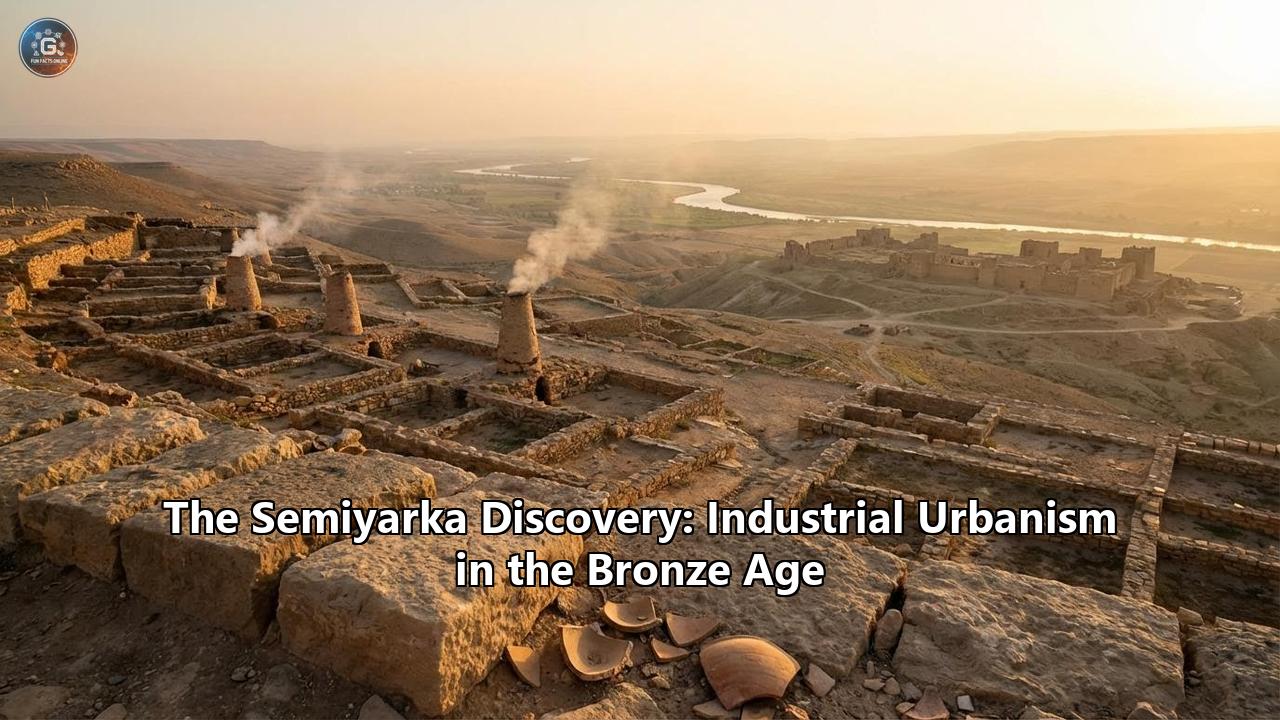
Walking the grounds of Semiyarka during its zenith in the 16th century BCE would have been a breathtaking experience. The settlement was an early masterpiece of urban planning. Utilizing drones and geophysical equipment, researchers mapped out multi-row rectilinear earthworks that define the city's boundaries. These earthen mounds, which still rise several feet above the surrounding plains, outline straight, evenly planned quarters that appear to have been constructed simultaneously, indicating a unified, centralized construction plan.
Archaeologists identified the remnants of at least 20 distinct household complexes within the city. These were not fragile, temporary tents; they were robust, multi-room homes, built from durable materials and possibly fortified to protect the inhabitants and their valuable resources.
At the very heart of the settlement, where the two primary rows of structures meet, lies the city's most awe-inspiring architectural feature: a central monumental building. Oriented almost perfectly along an east-west axis, this massive structure is twice the size of the surrounding domestic dwellings. While its exact function remains an enticing mystery pending deeper excavation, its scale and prominent location strongly suggest it was a communal epicenter—likely serving as a seat of governance, a site for complex religious rituals, or an administrative headquarters to manage the city's vast industrial output.
What truly elevates Semiyarka from a fascinating ancient settlement to a site of global historical importance is what lies on its southeastern edge. Here, researchers uncovered a sprawling, highly organized industrial zone.
To understand the significance of this, one must understand the economics of the Bronze Age. Bronze is an alloy, typically made by smelting copper with a small percentage of tin. While copper deposits are relatively common, tin is incredibly rare and inhomogeneously distributed across the Earth's crust. Securing tin was the ultimate geopolitical imperative of the 2nd millennium BCE; it was the "silicon" of the ancient world, required to forge the hardest tools, the most lethal weapons, and the most prestigious status symbols.
For decades, archaeologists have found hundreds of thousands of tin-bronze artifacts scattered across the Eurasian Steppe, yet the actual manufacturing sites—the factories where this metal was smelted and cast—remained practically invisible. Prior to the Semiyarka survey, there was only one published site of tin-bronze production in the entire vast region: the Late Bronze Age Askaraly mine.
Semiyarka is the elusive missing link. Surface collections and geophysical data in the city's industrial sector revealed a treasure trove of metallurgical debris: numerous crucibles used to melt the super-heated metal, vast quantities of slag (the stony waste matter separated from metals during the smelting of ore), and finished tin-bronze artifacts, including a masterfully crafted bronze axe.
This was not a minor, ad-hoc workshop operated by a lone blacksmith. It was a full-scale industrial complex. The presence of such a massive metallurgical zone proves that the inhabitants of Semiyarka were operating controlled, complex production systems. They were master metallurgists who had transitioned from subsistence survival to specialized, industrial-level manufacturing.
The raw materials fueling this Bronze Age forge did not magically appear on the steppe. Semiyarka’s location was a masterstroke of strategic geographic positioning. The city was situated within a viable distance of the Altai Mountains, located near the modern borders of Kazakhstan, Russia, Mongolia, and China. The Altai range is famously rich in copper and tin deposits.
By establishing their metropolis on a promontory above the Irtysh River, the rulers of Semiyarka effectively controlled a critical superhighway of the ancient world. The river provided a reliable route for transporting heavy loads of raw ore down from the mountains and into the city's fiery crucibles. Once transformed into gleaming axes, weapons, and ornaments, these finished goods could be distributed outward along the river valley and across the steppes.
Semiyarka was perfectly positioned to act as a crucial node in a vast, prehistoric trade network. Kazakhstan, during this era, was effectively the forge of Eurasia. Metal products produced in this region have been found as far afield as Eastern Europe and the borders of China. Semiyarka likely served as a major center of exchange, facilitating the flow of technology, goods, and cultural ideas between Central Asia and the rest of the continent.
Who were the brilliant engineers, metallurgists, and traders who built the City of Seven Ravines? The material culture recovered from the site provides a compelling window into their lives.
Researchers collected fragments representing at least 114 ceramic vessels. A staggering 85% of these pottery sherds belong to the Alekseevka-Sargary culture (a Late Bronze Age tradition dating roughly 1500–1100 BCE), while a smaller percentage belongs to the Cherkaskul culture (1600–1250 BCE). Both of these groups are considered sub-divisions or closely related descendants of the broader Andronovo cultural horizon.
The Andronovo culture (c. 2000–1150 BCE) was a massive family of societies that stretched from the southern Urals to the upper Yenisei River in Siberia. Known for their fierce horse-riding warriors, chariot technology, and complex burial traditions in rectangular stone "cists," the Andronovo people were also some of the ancient world's most capable metalworkers. Within their society, metallurgy was not viewed merely as a trade; it was a sacred art. Miners and blacksmiths held exalted social status, their labor intimately connected to the mastery of fire and the spiritual world.
The blending of Alekseevka-Sargary and Cherkaskul pottery at Semiyarka is highly significant. It suggests that the city was a cosmopolitan melting pot. The Cherkaskul culture originated in western Siberia, indicating that Semiyarka facilitated active interaction and integration with groups from distant northern forests. The absence of later Begazy-Dandybaev ceramics further solidifies the city's origins in the 16th century BCE, predating subsequent cultural shifts.
The inhabitants of Semiyarka likely practiced a highly sophisticated hybrid lifestyle. While they maintained elements of mobile pastoralism—herding cattle, sheep, and horses across the steppes—they simultaneously anchored themselves to this massive urban and industrial center. They were herder-miners, combining the mobility necessary to exploit the vast grasslands with the settled permanence required to run complex metallurgical operations.
For centuries, the lens through which we viewed the ancient world was heavily biased toward the agrarian civilizations of the Middle East and the Mediterranean. The Eurasian Steppe was relegated to the margins of history—viewed merely as a conduit for migrations or a breeding ground for nomadic conquerors.
The Semiyarka discovery irreversibly shatters this outdated paradigm. As Dr. Radivojević noted upon the publication of the findings, the site "changes the way we think about steppe societies". It proves that the dichotomy between the "civilized, settled" urbanite and the "barbaric, roaming" nomad is a false one. The communities of the Kazakh Steppe were capable of envisioning, planning, and building sophisticated, permanent settlements that rivaled the complexity of early cities in the conventionally recognized cradles of civilization.
Semiyarka was a nexus of power, an industrial juggernaut, and a triumph of Bronze Age urban planning. As archaeologists prepare to transition from surface surveys to deep excavations, the City of Seven Ravines will undoubtedly yield even more secrets. The crucibles have long cooled, and the earthen mounds are now blanketed by the quiet grass of the Abai Region, but the legacy of Semiyarka continues to burn brightly, illuminating a lost chapter of human ingenuity on the ancient steppes.
Reference:
- https://antiquity.ac.uk/news/2025/city-seven-ravines-bronze-age-metropolis-unearthed-eurasian-steppe
- https://thedebrief.org/archaeologists-uncover-a-massive-bronze-age-proto-city-in-kazakhstan-that-rewrites-steppe-history/
- https://www.discovermagazine.com/ancient-steppe-settlement-hides-evidence-of-industrial-level-bronze-production-3-500-years-ago-48275
- https://www.smithsonianmag.com/smart-news/archaeologists-find-evidence-of-a-bronze-age-city-in-kazakhstan-180987747/
- https://www.livescience.com/archaeology/sophisticated-bronze-age-city-unearthed-in-kazakhstan-transforms-our-understanding-of-steppe-societies
- https://news.artnet.com/art-world/semiyarka-kazakhstan-archaeology-bronze-age-city-2715955
- https://www.researchgate.net/publication/397707056_A_major_city_of_the_Kazakh_Steppe_Investigating_Semiyarka's_Bronze_Age_legacy
- https://en.wikipedia.org/wiki/Semiyarka
- https://astanatimes.com/2025/11/semiyarka-uncovers-lost-industrial-power-of-kazakh-steppe/
- https://www.sciencedaily.com/releases/2025/12/251205054731.htm
- https://www.vorderas-archaeologie.uni-muenchen.de/personen/wiss_mitarbeiter/kaniuth/publikationen/berger-et-al-2023a_feart-11.pdf
- https://www.frontiersin.org/journals/earth-science/articles/10.3389/feart.2023.1224873/full
- https://astanatimes.com/2024/10/bronze-age-kazakhstan-was-center-of-metallurgy-archeologist-says/
- https://en.wikipedia.org/wiki/Semiyarka
- https://en.wikipedia.org/wiki/Andronovo_culture
- https://www.ancient-origins.net/human-origins-science/andronovo-culture-0015913
- https://en.wikipedia.org/wiki/Cherkaskul_culture
- https://www.bergbaumuseum.de/fileadmin/forschung/zeitschriften/metalla/20.2/metalla-20-2-animal-herder-miners-of-the-andronovo-culture-oezyarkent.pdf