
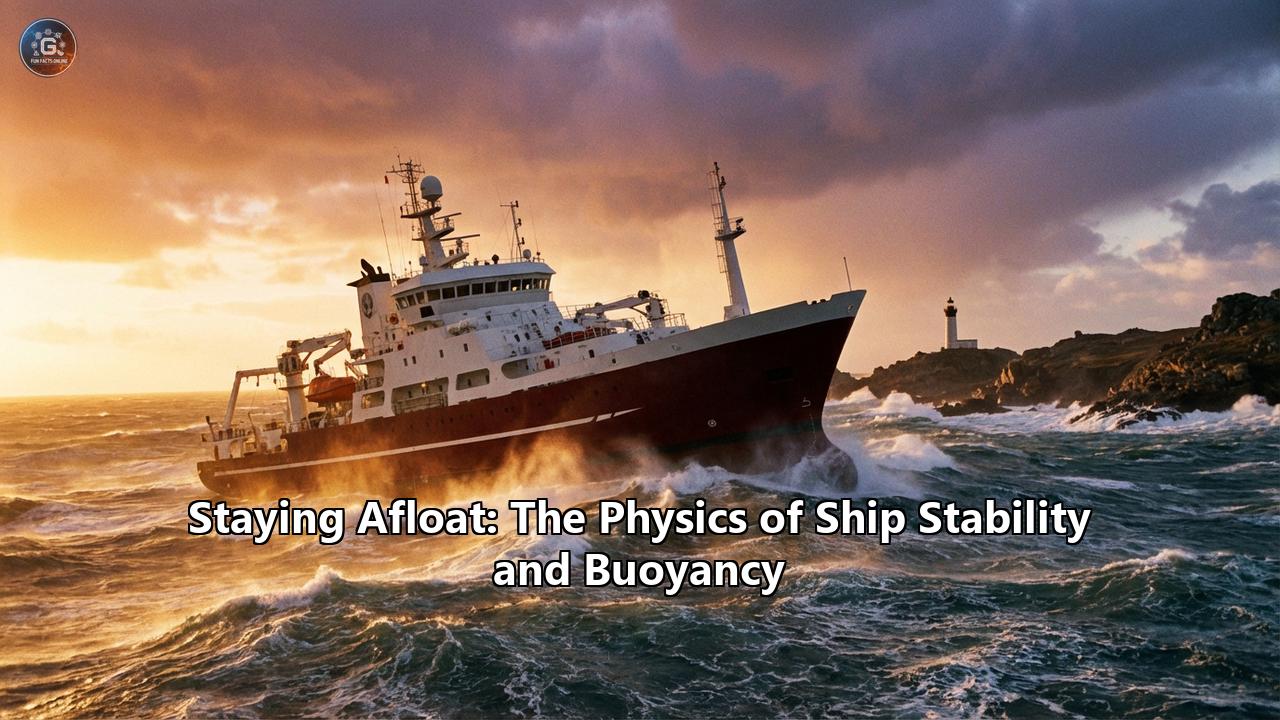
The ocean is a chaotic, relentless force. It is a dynamic environment where millions of tons of steel are expected not just to float, but to remain upright against wind, waves, and the shifting weights of cargo and passengers. The fact that a cruise ship like the Icon of the Seas—20 decks high and looking top-heavy enough to topple in a breeze—can cut through a hurricane with wine glasses barely trembling on dinner tables is not magic. It is a triumph of physics, engineering, and centuries of hard-learned lessons written in blood and saltwater.
This is the story of that invisible battle between gravity and buoyancy. It is a deep dive into the mathematics of survival, the engineering of comfort, and the tragic history of what happens when we get it wrong.
Part I: The Invisible War – The Physics of Floating
To understand how a ship stays upright, we must first understand why it floats. It begins with a principle discovered in a bathtub more than 2,000 years ago.
Archimedes and the displacing of worldsArchimedes’ Principle is the bedrock of naval architecture. It states that an object immersed in a fluid is buoyed up by a force equal to the weight of the fluid it displaces. A ship weighing 100,000 tons must displace 100,000 tons of water to float. If it displaces less, it sinks. This is why steel, which is far denser than water, can float; the hull is shaped to enclose a massive volume of air, making the average density of the ship less than that of the ocean.
But floating is the easy part. A log floats, but it rolls freely. A ship must float upright. This requirement introduces us to the three most critical points in naval architecture, a trinity of letters that every deck officer memorizes: K, B, G, and M.
- K (Keel): The baseline reference point at the very bottom of the ship.
- B (Center of Buoyancy): The geometric center of the underwater hull volume. This is where the upward force of the water acts. You can imagine the ocean pushing up on the ship through this single point.
- G (Center of Gravity): The geometric center of all weights on the ship—the steel, the cargo, the fuel, the passengers, the engines. Gravity pulls the ship down through this single point.
- M (Metacenter): The theoretical point that determines stability. When a ship heels (tilts), the shape of the underwater hull changes. The Center of Buoyancy (B) shifts toward the lower side. If you draw a vertical line up from the new position of B, it intersects the ship's centerline at point M.
The relationship between the Center of Gravity (G) and the Metacenter (M) is the single most important factor in a ship's initial stability. The distance between them is called the Metacentric Height (GM).
- Stable Equilibrium (Positive GM): If M is above G, the ship is stable. When wind pushes the ship over, the upward force of buoyancy (at B) moves outboard of the downward force of gravity (at G). This creates a "righting lever" (GZ) that twists the ship back upright.
- Unstable Equilibrium (Negative GM): If G is above M, the ship is unstable. When it heels, the force of gravity pulls the high side down further, and the force of buoyancy pushes the low side up, flipping the vessel. This is often the cause of capsizing.
- Neutral Equilibrium (Zero GM): If G and M are at the same point, the ship has no tendency to right itself or capsize. If you push it to 10 degrees, it stays at 10 degrees. This is affectionately known as a "floppy" ship.
The magnitude of the GM determines the ship’s personality.
- A "Stiff" Ship (Large GM): Has a low center of gravity. It is very stable and resists heeling. However, when it does roll, it snaps back to upright violently. This is great for safety but terrible for comfort. On a stiff ship, you might not capsize, but you might break a leg or get violently seasick due to the rapid, jerky motion.
- A "Tender" Ship (Small GM): Has a higher center of gravity. It rolls slowly and deeply. It feels lazy in the water. While comfortable for passengers (because the accelerations are lower), a tender ship is closer to the danger zone. If the GM gets too small, a strong wind or a sharp turn could push it past the point of no return.
Part II: The Enemies of Stability
Even a perfectly designed ship faces dynamic threats that can destroy its stability in seconds.
The Free Surface Effect: The Silent KillerLiquids on a ship—fuel, freshwater, ballast—are rarely frozen in place. They slosh. This sloshing is called the Free Surface Effect (FSE), and it is a stability nightmare.
Imagine a wide, shallow tank half-full of water. As the ship heels to the right, all that water rushes to the right side of the tank. This shift in weight moves the ship's overall Center of Gravity (G) toward the heel, reducing the righting lever. Effectively, FSE makes the ship "feel" like its center of gravity is higher than it actually is.
This effect is proportional to the cube of the tank's width. A tank that is twice as wide is eight times more dangerous. This is why ship designers use longitudinal bulkheads to divide wide tanks into narrower ones, breaking the sloshing momentum.
The Angle of LollIf a ship has a negative GM (unstable upright), it won't necessarily capsize immediately. It might flop over to an angle—say, 15 degrees—where the hull shape changes enough that the Center of Buoyancy moves far enough out to finally create a positive righting arm. The ship then hangs there, listing at 15 degrees. This is the Angle of Loll.
It is a terrifying condition. If a captain sees their ship listing, their instinct might be to fill a ballast tank on the high side to correct it. But if the ship is loll—unstable—adding weight high up might reduce stability further, causing the ship to violently flop to the other side and capsize. The correct procedure is often to fill tanks on the low side first to lower G, a counter-intuitive move that requires nerves of steel.
Parametric RollingThis is a modern phenomenon, particularly dangerous for container ships with flared bows. It occurs when the ship's length matches the wavelength of the sea.
As a wave crest passes amidships, the ship's waterplane area (the slice of the ship at the waterline) decreases because the bow and stern are hanging in the air. This reduces stability (lowers M). When the wave trough is amidships, the bow and stern dig in, the waterplane area increases, and stability spikes (raises M).
If this cycle of stability rising and falling matches the ship's natural roll period, it creates a resonance. Like a child pumping a swing, the roll gets bigger with every wave. A ship can go from calm to rolling 40 degrees in just a few cycles, snapping container lashings and sending cargo overboard.
Part III: The Price of Ignorance – Historical Case Studies
The rules of stability were not derived in a classroom; they were written in the wake of disasters.
*1. The Vasa (1628): The King’s Vanity
The Vasa was the most powerful warship of her time, a floating fortress meant to project Swedish dominance. She carried 64 bronze cannons. But she was doomed before she launched.
King Gustavus Adolphus constantly changed the requirements, demanding more guns and a second gun deck. The shipwrights, afraid to defy the king, built a superstructure that was too tall and heavy for the hull's width.
Before sailing, the captain performed a stability test: he had 30 men run back and forth across the deck. The ship rolled so violently the test was stopped to prevent her from capsizing at the dock. They sailed anyway.
Less than a mile into her maiden voyage, a light breeze caught her sails. She heeled over. The lower gun ports, which had been left open to fire a salute, dipped below the waterline. Water rushed in, and the Vasa sank in minutes, taking 30 lives and the nation's pride with her.
Lesson: Form Stability. The hull must be wide enough to support the weight above it. Also, the danger of "mission creep" in design.
2. The SS Eastland (1915): The Tragedy of Good Intentions
In 1912, the Titanic sank, partly due to a lack of lifeboats. In response, the U.S. government passed the Seaman’s Act, requiring lifeboats for all passengers.
The SS Eastland, a Great Lakes steamer known for being tender, was retrofitted with heavy lifeboats on her upper decks to comply with the new law. On July 24, 1915, while tied to a dock in the Chicago River, she began boarding passengers for a company picnic. The extra weight of the lifeboats, combined with a crowd of 2,500 people moving to one side to wave at a passing boat, raised the center of gravity critically high.
The ship rolled over at the dock. 844 people died—more passengers than on the Titanic—trapped inside the hull or crushed by furniture.
Lesson: Modifications Matter. You cannot simply add safety gear without recalculating the stability. The cure for one risk (drowning at sea) became the cause of another (capsizing at dock).
3. The Herald of Free Enterprise (1987): The Open Deck
Ro-Ro (Roll-on/Roll-off) ferries have large, open vehicle decks. These decks must remain free of bulkheads to allow cars to park, which makes them vulnerable to the Free Surface Effect.
The Herald left Zeebrugge, Belgium, with her bow doors open due to crew negligence. As the ship accelerated, the bow wave washed over the deck and into the open doors. Thousands of tons of water flooded the vehicle deck.
Because there were no dividers, the water surged to one side. The ship turned over in 90 seconds. 193 people died.
Lesson: The Stockholm Agreement. This disaster led to new regulations requiring Ro-Ro ferries to be able to survive with water on deck (a specific depth of water). It also led to the installation of "hem-cyclic" flaps and better door indicators on the bridge.
4. The Cougar Ace (2006): The Ballast Exchange
The Cougar Ace was a massive car carrier transporting 4,700 Mazdas. To prevent invasive species transfer, ships are required to exchange ballast water in the open ocean.
The crew began draining the ballast tanks to refill them with fresh ocean water. However, they drained the starboard tanks while the port tanks were also slack. This created a massive synchronized Free Surface Effect and raised the center of gravity simultaneously.
The ship instantly heeled 60 degrees. She didn't sink, but she floated on her side for weeks. The salvage team had to board a ship that was essentially a vertical cliff face to pump water and right her.
Lesson: Operational Sequence. Modern loading computers now simulate ballast exchange steps to ensure the ship never passes through an unstable condition during the process.
Part IV: Engineering the Solution – How We Tame the Roll
Naval architects have developed an arsenal of technologies to keep ships upright and comfortable.
1. Bilge Keels: The Passive DefenderIf you look at the underwater hull of almost any ship, you will see long metal fins running longitudinally along the "turn of the bilge" (the curved part where the bottom meets the side). These are bilge keels.
They are simple, cheap, and effective. As the ship rolls, the flat surface of the keel drags against the water, creating turbulence and resistance. They don't stop the roll, but they dampen it, reducing the number of swings a ship takes to settle down. They are most effective when the ship is not moving or moving slowly.
2. Anti-Roll Tanks (ART): Fighting Water with WaterIt seems counter-intuitive to put a sloshing tank of water on a ship to stop it from rocking, but that is exactly what a Passive Anti-Roll Tank does.
These are U-shaped tanks running across the ship. They are "tuned" so that the water flows from side to side out of phase with the ship’s roll.
When the ship rolls to port, the water in the tank is still rushing to starboard (uphill). The weight of the water on the high side pushes the ship back down, dampening the roll.
Active Anti-Roll Tanks use pumps or air blowers to force the water to the correct side, making them effective even if the ship's roll period changes. 3. Active Fin Stabilizers: Underwater WingsThese are the gold standard for cruise ships and warships. They are movable metal wings that extend out from the hull below the waterline.
They work like the ailerons on an airplane. If the ship rolls to starboard, the starboard fin tilts up (creating lift) and the port fin tilts down (creating downforce). This torque actively fights the roll.
Modern fins are gyro-controlled and can reduce roll by 90%. Some are "retractable" (folding into the hull to save fuel/space) and some are "zero-speed" capable.
- The Zero-Speed Challenge: Traditional fins need water flowing over them to work (lift = speed). To stabilize a yacht at anchor, "Zero-Speed" fins are designed to flap like fish fins, paddling the water to generate force even when the ship is stationary.
For smaller yachts and some research vessels, giant gyroscopes are used. A heavy flywheel spins at high speed (thousands of RPM) inside a vacuum sphere.
When the ship tries to roll, the gyroscope precesses (tilts) fore-and-aft. Hydraulic cylinders fight this precession. By resisting the gyro's tilt, the gyro exerts a massive torque back on the ship's hull, locking it in place.
Advantage: No external fins (no drag), works perfectly at anchor.
Disadvantage: Heavy, expensive, and consumes power.
5. Magnus Effect RotorsThis is a newer technology. Instead of a fin, a spinning cylinder extends from the hull. As water flows past the spinning cylinder, it creates lift (the Magnus Effect—the same physics that makes a curveball curve).
These generate massive lift at low speeds, making them excellent for stabilizing ships that move slowly, like research vessels or luxury yachts loitering off the coast.
Part V: Modern Titans – How the Icon of the Seas Stays Upright
When people see the Icon of the Seas, a 250,000-gross-ton behemoth, they often ask: "How does it not tip over?" It looks like a skyscraper on a barge.
The answer lies in density distribution and beam width.
1. The Iceberg PrincipleWhile the superstructure of a cruise ship is huge, it is mostly air. The cabins, the dining halls, the theaters—they are vast open spaces. The structure itself is often made of thinner steel or aluminum in the upper decks to save weight.
In contrast, the bottom of the ship is dense. It holds the massive diesel-electric engines (thousands of tons), the generators, the fuel tanks, the fresh water supply, and the waste treatment systems.
This keeps the Center of Gravity (G) surprisingly low.
2. Extreme BeamThe Icon of the Seas is incredibly wide (roughly 65 meters / 213 feet). Stability (GM) is heavily influenced by the "Moment of Inertia" of the waterplane area, which is proportional to the cube of the beam.
A ship that is 10% wider is roughly 33% more stable. By building wide, cruise ships gain immense initial stability.
3. The "Duck Walk"Modern cruise ships use "azipods"—propellers on rotating pods—instead of rudders. This eliminates the need for a long, skinny hull form for steering. It allows the hull to be boxier and flatter, maximizing the buoyancy distribution at the edges of the ship, which is where it matters most for stability.
Part VI: The Human Element – ISO 2631-1 and the Science of Vomit
Stability isn't just about survival; it's about not ruining the buffet.
Naval architects use ISO 2631-1, a standard that quantifies human exposure to vibration and motion.
The human ear's vestibular system is particularly sensitive to vertical accelerations in the frequency range of 0.1 to 0.5 Hz (a cycle every 2 to 10 seconds).
- Motion Sickness Incidence (MSI): This is a calculated percentage of how many passengers will vomit after 2 hours of exposure to a certain motion.
- The Comfort Paradox: To make a ship safe (hard to capsize), you want a large GM (stiff). But a stiff ship snaps back quickly, creating high accelerations that trigger high MSI.
To solve this, designers aim for a "tender" ship (low accelerations) and use active stabilizers to prevent the roll angles from getting dangerous. It is a delicate balance between safety and nausea.
Part VII: Operational Reality – The Chief Officer's Burden
On the bridge of every modern cargo ship, there is a computer that runs the show: the Loadicator (often NAPA software).
Before a single container is loaded, the Chief Officer inputs the cargo plan into this Type 4 Loading Computer.
The software uses a 3D model of the ship to calculate:
- Draft and Trim: How deep will she sit?
- Intact Stability: Is the GM positive? Is the area under the GZ curve sufficient (meeting SOLAS regulations)?
- Shear Force and Bending Moment: Will the weight of the cargo snap the hull in half?
- Damage Stability: If we hit an iceberg and compartments 3 and 4 flood, will we survive?
Despite all the lasers and computers, the ultimate check is still manual. In port, the officer goes down to the waterline on a small boat or a rope ladder. They visually read the draft marks painted on the hull. They take a sample of the harbor water to measure its density (salt water provides more buoyancy than brackish water). They calculate the ship's displacement by hand to verify the computer's numbers. It is a ritual of seamanship that connects the digital age to the days of sail.
Part VIII: The Future – The Autonomous Captain
The future of stability is algorithmic.
Companies are developing "Digital Captains" and "Variable Stability Systems".
- AI Routing: Autonomous ships will use Lidar and wave radar to map the sea state miles ahead. The AI will adjust the ship's course and speed to avoid parametric rolling resonance before it even starts.
- Auto-Ballasting: Instead of a crew manually opening valves, an AI will dynamically pump ballast water between tanks in real-time to counteract wind gusts or crane movements during loading.
- Safe Return to Port (SRtP): This is a regulation already in place for passenger ships. It demands that ships have redundant propulsion and steering systems so that even after a fire or flooding, the ship acts as its own lifeboat, limping to safety rather than relying on evacuation.
Conclusion
A ship is a bubble of air and steel suspended between two fluids—the water below and the wind above. Its survival depends on the center of buoyancy always outmaneuvering the center of gravity.
From the wooden ribs of the Vasa to the computerized fins of the Icon of the Seas*, the history of ship stability is a history of humanity trying to impose order on chaos. We have learned that you cannot cheat physics. You can only negotiate with it, using geometry, mass, and the eternal vigilance of the men and women who watch the inclinometer, waiting for the sea to make its move.
Reference:
- https://www.classnk.or.jp/hp/pdf/info_service/iacs_ur_and_ui/ur-m46-rev.4-aug-2024-ul.pdf
- https://assets.publishing.service.gov.uk/media/5a75a9e6e5274a436829902c/con1_2a_ap3_1-2.pdf
- https://www.napa.fi/visions-on-autonomous-ship-stability-management/
- https://yadda.icm.edu.pl/baztech/element/bwmeta1.element.baztech-ff539f05-3223-4af0-8246-e85ac5bea540/c/Stockholm_Transnav_2_2021.pdf
- https://www.imorules.com/GUID-5A600BFB-05C0-4CA7-A16B-F9FD101E4FAC.html
- https://www.napa.fi/software-and-services/ship-operations/napa-loading-computer/
- https://www.unoks.com/en/blog/technology-and-innovation/autonomous-ships-the-future-of-maritime-transport
- http://www.shipstab.org/files/Proceedings/ISSW/ISSW_2011_Washington_USA/Session_01_Early%20_Stage_Design/01_4_Shigunov_et_al.pdf
- https://www.napa.fi/complete-guide-to-type-4-requirements-and-srtp-for-passenger-ships/
- https://www.brookesbell.com/news-and-knowledge/article/safe-return-to-port-regulations-154962/
- https://grokipedia.com/page/safe_return_to_port_requirement