
The universe is governed by profound mathematical symmetries, a reality that continually surprises physicists when identical equations emerge in entirely unrelated fields. For decades, the study of how electrons zip through advanced carbon structures and the study of how magnetic ripples propagate through metallic films have existed as isolated domains within condensed matter physics. However, an astonishing discovery has recently bridged this divide, proving that the architecture of space and symmetry can override the fundamental differences between the particles that inhabit them.
In March 2026, a team of engineers at the University of Illinois Urbana-Champaign’s (UIUC) Grainger College of Engineering unveiled a paradigm-shifting breakthrough: by meticulously sculpting a two-dimensional magnetic film, they forced magnetic spin waves to obey the precise mathematical equations that govern electrons in graphene. Published in the prestigious journal Physical Review X, this discovery by materials science graduate student Bobby Kaman and Professor Axel Hoffmann demonstrates that synthetic magnonic crystals can act as magnetic analogues to graphene.
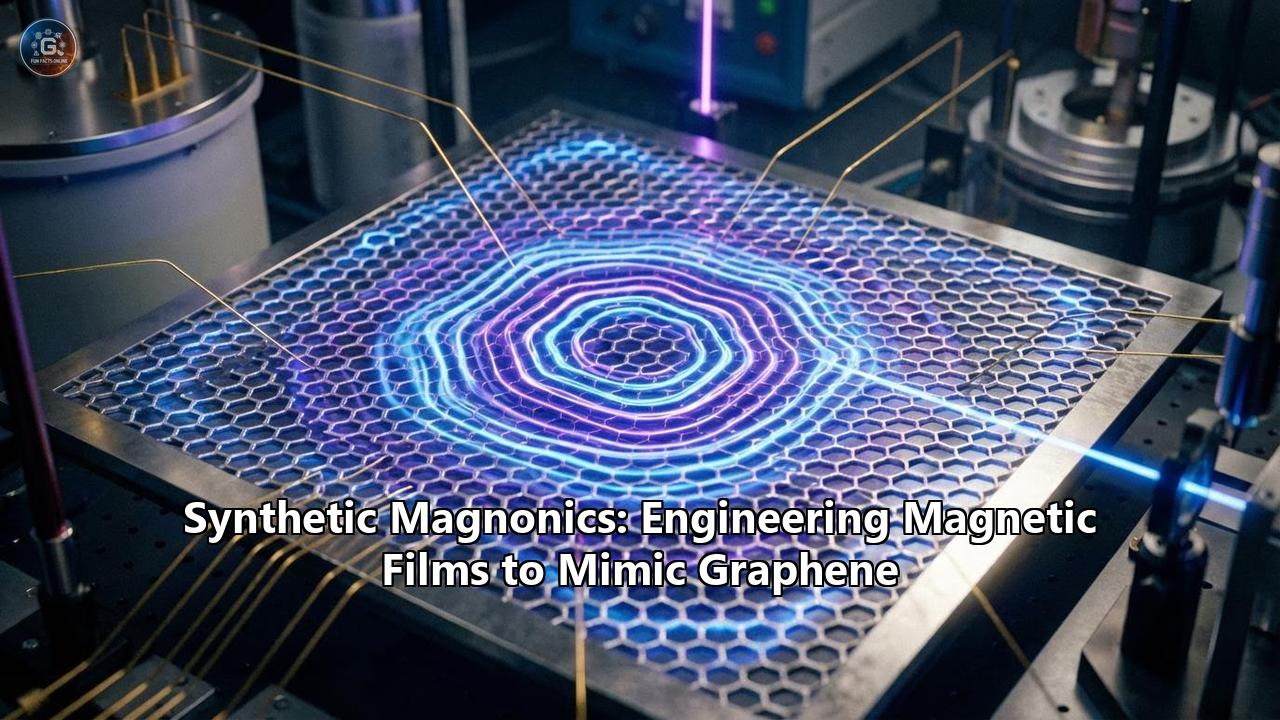
This revelation is far more than a theoretical curiosity. It is the dawn of "synthetic magnonics"—a design philosophy where the physical geometry of a material is manipulated to conjure exotic quantum and classical behaviors on demand. By patterning a thin magnetic film with a hexagonal array of microscopic holes, the researchers did not just replicate graphene’s iconic Dirac cones; they unlocked a staggering landscape of nine distinct energy bands, featuring massless magnetic waves, localized flat bands, and topological states.
To truly grasp the magnitude of this breakthrough—and its imminent impact on everything from micrometer-scale microwave circulators to low-power quantum computing—we must take a deep dive into the disparate worlds of graphene, magnonics, and the metamaterial engineering that finally brought them together.
The Standard Bearer: Graphene and the Dirac Fermion
To understand why making a magnet "act like graphene" is such a coveted goal, one must first understand the magic of graphene itself. Isolated in 2004, graphene is a single layer of carbon atoms arranged in a 2D honeycomb (hexagonal) lattice. This specific geometric arrangement is the absolute key to its legendary properties.
In conventional conductors like copper, electrons act as classical particles with mass, bouncing around the atomic lattice and losing energy as heat—a phenomenon known as Joule heating. Their relationship between energy and momentum (known as the dispersion relation) is parabolic. However, when electrons are confined to the honeycomb lattice of graphene, the quantum mechanical interactions between the overlapping carbon orbitals radically alter their behavior.
The conduction and valence bands of graphene meet at six points in the material's momentum space, known as the Brillouin zone. At these specific intersections, called Dirac points, the energy-momentum relationship ceases to be parabolic and instead becomes perfectly linear. Mathematically, the electrons shed their effective mass, behaving as relativistic particles moving at a constant speed, a fraction of the speed of light. These massless charge carriers are called Dirac fermions. Because they lack mass, they do not scatter in the traditional sense, allowing them to flow with extraordinarily high mobility.
For nearly two decades, physicists have viewed this linear dispersion—the Dirac cone—as a holy grail of condensed matter physics. It allows for ultra-fast electronics, ballistic transport, and access to exotic topological quantum states. But graphene has one critical limitation: it is fundamentally non-magnetic. Carbon atoms do not possess an intrinsic magnetic moment. Therefore, if one wishes to harness the bizarre, relativistic physics of the honeycomb lattice for spin-based technologies (spintronics), pure graphene falls short.
Enter Magnonics: The Symphony of Spins
While electronics relies on the flow of charge, a parallel discipline known as spintronics seeks to process information using the electron’s intrinsic angular momentum, or "spin." Magnonics is a highly specialized, rapidly growing subfield of spintronics that deals not with the movement of the electrons themselves, but with the collective wave-like excitations of their spins.
Imagine a stadium of people holding hands. If one person stands up and sits down, they pull on their neighbors, causing them to stand and sit in a cascading sequence. The people (the electrons) do not move from their assigned seats, but a "wave" of energy travels around the stadium. In a magnetic material, the atoms are locked in a rigid crystal lattice, and their magnetic moments (spins) are aligned by a quantum mechanical force known as the exchange interaction. If you perturb one spin—perhaps by hitting it with a laser pulse or a microwave frequency—it begins to precess like a wobbling top. Because it is magnetically coupled to its neighbors, this wobble is passed down the line.
This propagating ripple of magnetic disturbance is called a spin wave. When we apply the rules of quantum mechanics to this wave, it is quantized into discrete packets of energy called "magnons," much in the same way light waves are quantized into photons.
Magnonics offers a tantalizing future for technology. Because magnons transport information through the collective wobbling of localized spins rather than the physical translation of electrons, they do not suffer from electrical resistance. They generate zero Ohmic loss (no Joule heating), operating entirely without the thermal waste that plagues modern silicon chips. Furthermore, spin waves naturally operate at frequencies ranging from gigahertz (GHz) to terahertz (THz), making them ideal for the next generation of ultra-fast communication and computing.
However, there has always been a catch. Controlling these waves in continuous magnetic films is notoriously difficult. To guide, shape, and manipulate spin waves, scientists have turned to "magnonic crystals"—artificial structures, or metamaterials, featuring periodic variations in their magnetic properties. Much like how photonic crystals control light through periodic dielectric structures, magnonic crystals carve out allowed and forbidden frequency zones (bandgaps) for spin waves.
The Convergence: Carving the Honeycomb
The conceptual leap made by Kaman and Hoffmann was born from the principles of metamaterials: the idea that structure dictates function. If graphene owes its miraculous electron behavior strictly to its hexagonal honeycomb geometry, what would happen if that exact geometry was artificially imposed on a continuous magnetic film?
“Graphene is unique because its conduction electrons organize into massless waves, so I was curious if altering the physical geometry of a magnonic material to look like graphene would make it act like graphene,” noted Kaman.
To test this bold hypothesis, the UIUC team utilized advanced micromagnetic simulations and modeling. They started with the mathematical framework of a thin magnetic film. Then, they theoretically punched a series of microscopic holes (anti-dots) into the film, arranging these voids in a perfect hexagonal pattern. In this synthetic lattice, the regions of magnetic material left behind form a continuous honeycomb network, mirroring the bonds between carbon atoms in graphene.
When the researchers mapped out the energy and momentum of the spin waves propagating through this engineered terrain, they found that the Landau-Lifshitz-Gilbert (LLG) equations—the classical laws governing magnetic spin dynamics—yielded solutions that were mathematically indistinguishable from the tight-binding Hamiltonian equations that describe electrons in graphene. The two phenomena, long assumed to be distinct, were suddenly speaking the exact same mathematical language.
The Nine Bands of Magnonic Complexity
The researchers hypothesized they might find a handful of similarities. What they discovered, however, was an analogy "much deeper and richer" than anyone expected.
In a traditional electronic system like graphene, researchers primarily concern themselves with a few dominant energy bands near the Fermi level (the highest occupied energy state). But in this synthetic magnonic crystal, the intricate geometry of the periodic holes forced the spin waves to reorganize into an incredibly complex spectrum. The UIUC team identified a staggering nine distinct energy bands. This meant the material could simultaneously support several entirely different classifications of physical behavior.
1. Massless Dirac Magnons:Just as graphene hosts massless Dirac fermions, the magnonic crystal hosted massless spin waves at the center of the Brillouin zone. This linear dispersion relation means the energy of the magnon scales directly and linearly with its momentum, a hallmark of relativistic physics. These Dirac-like magnons mimic graphene's linear dispersion, meaning they travel at a constant group velocity regardless of their energy. In a practical sense, this translates to predictable, highly efficient spin wave transport across the material without the dispersive spreading that normally degrades wave packets.
2. Low-Dispersion Flat Bands:Among the nine bands were states characterized by "low dispersion," often referred to as flat bands. In condensed matter physics, a flat energy band means that the wave’s energy does not change with momentum. Because group velocity is the derivative of energy with respect to momentum, a flat band implies a velocity of zero. In other words, these are highly localized states. The spin waves essentially become trapped by the geometry of the hexagonal holes, circulating endlessly around the microscopic voids without propagating forward. Flat bands are currently a subject of intense scientific interest because they facilitate strong correlations; when particles (or quasiparticles) stop moving, their interactions with one another become the dominant force, often leading to emergent phenomena like magnonic Bose-Einstein Condensates or artificial spin ice behaviors.
3. Topological Effects Across Bands:Perhaps the most exciting discovery was the presence of topologically nontrivial bands. Topology is a branch of mathematics concerned with properties that are preserved through continuous deformations (like how a coffee mug is topologically equivalent to a donut because both have one hole). In physics, topologically nontrivial energy bands give rise to "edge states"—pathways along the boundary of a material where waves can travel in only one direction.
Because these topological edge states are mathematically protected by the geometry of the bulk material, they are entirely immune to backscattering. If a topological magnon encounters a defect, a missing atom, or a sharp corner in the synthetic lattice, it doesn't bounce back or dissipate as heat. It simply flows perfectly around the obstacle. This property is highly coveted for information processing, as it promises perfectly robust, loss-free spin wave transport in practical, imperfect nanoscale devices.
The Universal Math: Fermions vs. Bosons
To appreciate the sheer beauty of this UIUC breakthrough, one must consider the fundamental nature of the particles involved.
Electrons are fermions. They obey the Pauli Exclusion Principle, meaning no two electrons can occupy the exact same quantum state simultaneously. This forces electrons in graphene to stack up in energy levels, filling the bands up to the Fermi energy.
Magnons, conversely, are bosons. They are entirely exempt from the Pauli Exclusion Principle. You can pack an infinite number of magnons into the exact same quantum state. This allows magnons to undergo Bose-Einstein Condensation (BEC), where a macroscopic number of quasiparticles fall into the ground state and begin to act as a single, coherent quantum entity.
Despite this profound difference—fermions obeying Fermi-Dirac statistics and bosons obeying Bose-Einstein statistics—the geometric constraints of the honeycomb lattice override their internal nature. The mathematical framework determining their propagation through space is universal. The exchange interaction coupling the magnetic spins acts as a perfect mathematical analog to the quantum tunneling (hopping parameter) of electrons between carbon atoms in graphene.
Natural vs. Synthetic: The Engineering Advantage
It is worth noting that nature has its own versions of magnonic graphene. In recent years, scientists have discovered two-dimensional van der Waals ferromagnets—crystalline materials that can be peeled down to a single atomic layer, much like graphene. Materials such as Chromium Triiodide (CrI3), Chromium Tribromide (CrBr3), and Chromium Silicon Telluride (CrSiTe3) feature intrinsic honeycomb arrangements of magnetic atoms.
Through complex experiments utilizing Inelastic Neutron Scattering and Brillouin Light Scattering (BLS), physicists have indeed observed natural Dirac magnons in these materials. In intrinsic honeycomb ferromagnets, a subtle quantum mechanical force called the Dzyaloshinskii-Moriya (DM) interaction—which arises from broken inversion symmetry and spin-orbit coupling—can even open up a topological gap at the Dirac points, granting them topological properties.
However, these natural materials have severe limitations for everyday technology. For one, their ferromagnetism is incredibly fragile. CrI3, for example, only remains magnetic at cryogenic temperatures below 61 Kelvin (-212°C). For another, researchers are stuck with whatever lattice parameters and interaction strengths nature provides.
This is exactly why Kaman and Hoffmann's synthetic magnonic crystals are so revolutionary. By moving from natural crystals to metamaterials, engineers reclaim absolute control.
Because the "lattice" in synthetic magnonics is defined by physical holes etched into a film using modern nanolithography, engineers can dictate the pitch, size, and spacing of the honeycomb structure to micrometer or nanometer precision. Furthermore, they can carve these patterns into robust, room-temperature magnetic materials like Permalloy (a nickel-iron alloy) or Yttrium Iron Garnet (YIG). The UIUC research provides a clear roadmap for transitioning from empirical, trial-and-error observations of magnetic materials into a new era of rational, predictive metamaterial design.
Technological Implications: Shrinking the Wireless World
While mapping a fundamental physics model to an engineered spin system is a triumph of basic science, Professor Hoffmann was quick to emphasize the immense technological applications of this work. The most immediate impact of this discovery lies in the realm of radiofrequency (RF) and microwave engineering.
Modern cellular communication, radar systems, and the impending 6G wireless networks heavily rely on a device called a microwave circulator. A circulator is a non-reciprocal multi-port component. Its job is to route microwave signals in a single circular direction—for instance, allowing a signal to flow from a transmitter to an antenna, and from the antenna to a receiver, but strictly blocking the transmitter's powerful output from flowing backward and destroying the sensitive receiver.
Non-reciprocity is notoriously difficult to achieve. Traditional electrical components (like resistors and capacitors) are reciprocal; electricity flows through them the same way in either direction. To achieve non-reciprocity in microwave circulators, engineers currently use bulky, centimeter-sized chunks of magnetic ferrite materials placed inside strong external permanent magnets. These devices are heavy, expensive, and utterly incompatible with the microscopic dimensions of modern integrated circuits. As mobile phones and wireless arrays pack more antennas into tighter spaces, the massive size of traditional circulators has become a severe bottleneck.
Synthetic magnonic crystals, particularly those engineered with topological, single-direction edge states based on this graphene analogy, could solve this problem overnight. Because the topological magnon bands in these engineered honeycomb films naturally restrict waves to travel in only one direction along their edges, they act as intrinsic, microscopic circulators. This magnonic platform could enable microwave circulators to be successfully miniaturized down to the micrometer scale—a staggering reduction in size that could revolutionize the architecture of smartphones, quantum computers, and phased-array radar systems.
Furthermore, this topological protection means the micrometer-scale circulators would be robust against manufacturing defects. If the lithography process accidentally leaves a jagged edge on one of the hexagonal holes, the spin wave will not scatter; the topological mathematics mathematically force it to circumnavigate the defect and continue on its designated path.
Magnonic Logic and the Quantum Frontier
Beyond telecommunications, synthetic magnonic graphene opens new frontiers in computing. The tech industry is rapidly approaching the thermal limits of traditional CMOS transistors. As we pack billions of transistors into microscopic silicon real estate, the Joule heating produced by migrating electrons becomes overwhelming.
Magnonic logic gates represent a low-power alternative. By utilizing the interference of spin waves (where two wave crests meet to form a larger crest representing a '1', or a crest and a trough cancel out to represent a '0'), one can perform complex logical operations without moving a single electron. The massless Dirac magnons identified in the UIUC study are perfect candidates for transporting these logic signals across a chip at high, constant velocities without signal degradation.
Meanwhile, the flat bands identified in the nine-band energy spectrum hold incredible promise for quantum computing and fundamental physics. When spin waves are trapped in these zero-dispersion localized states, their interactions multiply. In a quantum context, this creates the perfect environment to study many-body bosonic phenomena. Researchers could theoretically use these flat bands to engineer highly correlated states of matter, utilizing the synthetic magnonic platform as a macro-scale quantum simulator to model behaviors that are too complex for traditional supercomputers to calculate.
Engineering the Future: The Road Ahead
Translating the intricate mathematics of Physical Review X into commercial consumer devices will require navigating several engineering hurdles. While magnons do not suffer from electrical resistance, they do experience a different type of decay known as magnetic damping. As the spins wobble, they gradually transfer their energy back into the atomic lattice (phonons), causing the wave to die out over a specific distance (the spin wave diffusion length).
To make magnonic circuitry viable, engineers must fabricate these synthetic honeycomb lattices out of materials with ultra-low Gilbert damping constants. Yttrium Iron Garnet (YIG) is the current gold standard, capable of sustaining spin waves for millimeters—an eternity on the scale of microchips. Integrating YIG-based magnonic crystals with existing silicon-based CMOS electronics remains a high-priority challenge for materials scientists.
Additionally, the ability to dynamically tune the magnetic state of the film opens up a realm of reconfigurable electronics. Unlike the physical lattice of graphene, which is permanently set in stone once grown, the properties of a magnonic crystal can be actively modified in real-time by applying external magnetic fields or electrical currents. This means the dispersion relations, the bandgaps, and the topological states of the synthetic magnonic graphene could be switched on and off, creating a dynamic, programmable metamaterial that adapts on the fly to changing processing needs.
Conclusion: A New Lens on the Universe
The revelation that a thin sheet of magnetic metal patterned with microscopic holes operates via the identical mathematical rules as graphene is a testament to the elegant unity of physical laws. By successfully forcing spins to dance to the tune of Dirac fermions, Kaman and Hoffmann have successfully demolished the invisible wall that once separated 2D electronic materials from 2D magnetic systems.
Through the lens of synthetic magnonics, we are no longer limited by the materials the Earth provides. We can now draft the mathematical properties we desire—whether that is massless wave propagation, flat-band localization, or defect-immune topological transport—and physically sculpt those properties into reality.
As humanity inches closer to the limits of conventional electronics, the universe has graciously revealed a backdoor. Through the engineered honeycomb lattices of magnetic films, the future of low-power computing, advanced wireless telecommunication, and topological wave dynamics shines brighter than ever, all driven by the massless, whispering waves of microscopic spins.
Reference:
- https://www.sciencedaily.com/releases/2026/03/260307213230.htm
- https://www.stardrive.org/index.php/sd-science-news/73370-engineered-magnetic-films-follow-graphenes-equations-for-massless-electron-waves
- https://matse.illinois.edu/news/81233
- https://advancedcarbonscouncil.org/blogpost/2151389/517907/Engineers-Create-Unusual-Magnetic-Material-That-Behaves-Like-Graphene
- https://bioengineer.org/how-to-make-magnets-behave-like-graphene-a-scientific-breakthrough/
- https://www.academicjobs.com/research-publication-news/magnets-mimic-graphene-new-research-or-academicjobs-8761
- https://pmc.ncbi.nlm.nih.gov/articles/PMC11194793/
- https://pubs.acs.org/doi/10.1021/acs.nanolett.5c06192
- https://scitechdaily.com/engineers-create-unusual-magnetic-material-that-behaves-like-graphene/
- https://arxiv.org/pdf/2602.19935
- https://www.researchgate.net/publication/363528445_Thermal_Evolution_of_Dirac_Magnons_in_the_Honeycomb_Ferromagnet_CrBr_3
- https://arxiv.org/html/2602.19935v1
- https://www.reddit.com/r/materials/comments/1ryjiu4/new_magnonic_crystal_engineered_by_researchers_at/