
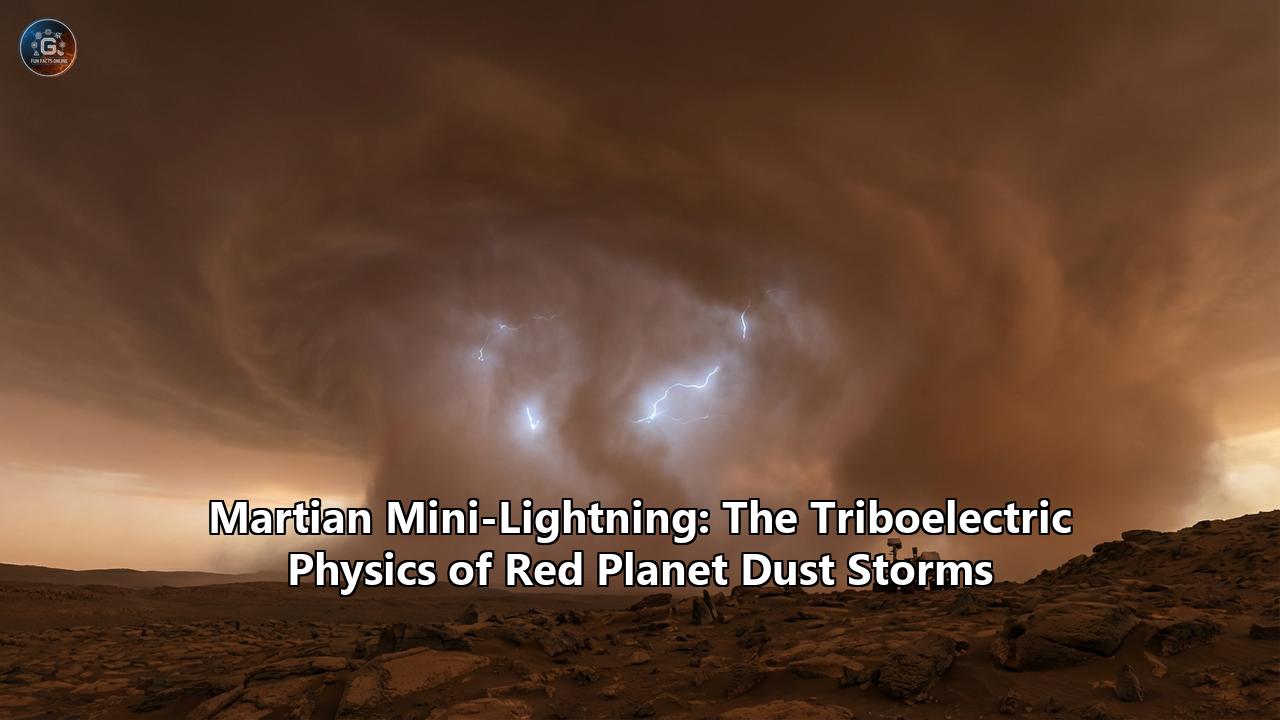
For decades, planetary scientists have stared at the swirling chaos of Martian dust storms and wondered: Is there lightning in there? On Earth, volcanic ash plumes and desert sandstorms crackle with static electricity, sometimes generating jagged bolts of lightning that rival supercell thunderstorms. But on Mars, the question remained a tantalizing mystery. The physics suggested it should be there, but orbiters saw no flashes, and landers heard no thunder.
That silence has finally been broken.
In late 2025, a definitive study published in Nature confirmed what theoreticians had long suspected: Mars is an electrically active world. But it is not the world of thundering tempests we know on Earth. Instead, it is a planet of "mini-lightning"—an alien form of electrical discharge governed by the unique laws of the Red Planet’s thin, carbon-dioxide atmosphere. This discovery changes everything from our understanding of Martian chemistry and the hunt for life to the safety protocols for the first human explorers.
Part I: The Sound of a Spark
The breakthrough did not come from a camera, but from a microphone. NASA’s Perseverance rover, parked in the Jezero Crater, carries the SuperCam instrument, which includes a high-frequency microphone originally designed to listen to the "snap" of rocks being vaporized by the rover's laser.
But the microphone hears more than just laser blasts. It listens to the wind.
For years, the audio data was a wash of background hisses and the low rumble of gusts. However, a team of researchers from the University of Toulouse and the CNRS (French National Center for Scientific Research) began to notice anomalies in the data collected during dust devils—whirlwinds of dust that scour the crater floor. Embedded within the wind noise were distinctive, sharp "cracks" and "pops."
These were not mechanical glitches. They were the acoustic signatures of triboelectric discharges.
Over a period of two Martian years, the team isolated 55 distinct electrical events. These weren't the booming peals of thunder associated with kilometers-long lightning bolts. They were small, snappy discharges, likely only a few centimeters long. To a human standing there, it might sound like the crackle of a sweater being pulled off in dry winter air, or the snapping of static against a doorknob—but magnified by the alien acoustics of the Martian atmosphere.
This auditory evidence provided the "smoking gun" that visual searches had missed for 50 years. Mars was sparking, but it was doing so on its own, subtle terms.
Part II: The Physics of Alien Static
To understand why Martian lightning is "mini," we must delve into the physics of triboelectricity and Paschen’s Law.
The Triboelectric Effect
The engine driving this electrical activity is friction. When dust grains collide—as they do constantly in the chaotic turbulence of a dust devil or a global storm—they exchange electrons. This is the triboelectric effect, the same phenomenon that allows you to shock yourself on a doorknob after walking across a carpet.
On Mars, the dust is incredibly fine and dry (far drier than any desert on Earth). As these grains tumble and strike one another, they sort themselves by charge. Typically, smaller grains tend to acquire a negative charge, while larger grains become positive. The wind acts as a centrifuge, lifting the lighter, negatively charged particles high into the air while the heavier, positively charged grains stay near the ground.
This separation creates a massive electric field—a planetary-scale capacitor with the ground as the positive terminal and the dust cloud as the negative terminal.
Paschen’s Law and the "Mini" Discharge
On Earth, the atmosphere is thick and insulating. It takes a tremendous voltage—roughly 3 million volts per meter—to rip electrons off air molecules and create a conductive channel for lightning. This allows charge to build up to localized extremes until it releases in a massive, blinding gigajoule bolt.
Mars is different. Its atmospheric pressure is less than 1% of Earth's.
This is where Paschen’s Law comes into play. Friedrich Paschen discovered in 1889 that the voltage required to spark a gap in a gas depends on the pressure of that gas.
- High Pressure (Earth): Air molecules are packed tight. Electrons smash into them frequently, losing energy, so you need a huge electric field to accelerate them enough to ionize the gas. Result: Rare but massive lightning.
- Low Pressure (Mars): The air is thin. Electrons can accelerate for longer distances between collisions, gaining enough speed to knock other electrons loose and start an avalanche (a spark) much more easily.
Because the Martian atmosphere is so thin, it is a poor insulator. It breaks down and conducts electricity at a much lower voltage—about 25,000 volts per meter, compared to Earth's 3,000,000.
This "weak" atmosphere means the charge can never build up enough to create a giant, Earth-style lightning bolt. As soon as the electric field gets even moderately strong, the atmosphere gives way, and snap—a small discharge occurs. The energy is released in thousands of tiny, centimeter-scale sparks rather than one giant bolt.
Mars doesn't store its anger; it releases it in a constant, low-level crackle.
Part III: The Invisible Storm (Why We Didn't See It)
For decades, orbiters and landers looked for flashes. They saw nothing. We now know why.
- Low Luminosity: The energy contained in these "mini-lightning" sparks is low—millijoules to joules, rather than gigajoules. They simply aren't bright enough to be seen from orbit against the glare of the sunlit planet, and even at night, they would be incredibly faint.
- Attenuation: Martian dust is red because of iron oxide (rust), which is opaque. A dust storm is effectively a wall of rust. Any faint light produced by a spark deep inside a storm would be absorbed by the dust cloud almost instantly.
- Glow Discharge: Physics suggests that many of these discharges might not even be sparks. Instead, they might take the form of a Townsend dark discharge or a glow discharge. Imagine the faint, diffuse purple glow of a neon sign rather than the sharp arc of a welding torch. A dust devil on Mars might not flash; it might simply glow faintly in the ultraviolet or blue spectrum, invisible to the human eye and standard rover cameras.
Part IV: The Planetary Chemical Reactor
The most profound implication of this discovery is not about weather, but about chemistry and life.
The Martian surface is hostile. It is covered in perchlorates—toxic, highly oxidized salts—and lacks organic molecules even in places where we expect to find them. The confirmed presence of triboelectric discharges solves this chemical puzzle.
The Electro-Chemical Cycle
Every spark is a microscopic chemical factory. When an electrical discharge rips through the CO2-rich atmosphere, it splits molecules apart, creating energetic fragments called free radicals and ions.
- CO2 splits into CO and Oxygen radicals.
- Trace water vapor splits into Hydroxyl (OH) radicals.
These radicals are aggressively reactive. When they bombard the dust grains, they initiate an electrochemical cycle that transforms relatively harmless chloride salts (like table salt) into perchlorates (ClO4-) and chlorates.
The "Hydrogen Peroxide" Scrub
The models validated by the Perseverance data suggest that these discharges produce significant amounts of hydrogen peroxide (H2O2).
Effectively, a Martian dust storm acts like a giant sterilization chamber. The wind kicks up dust, the dust generates static, the static creates sparks, and the sparks manufacture hydrogen peroxide. This bleach-like chemical rains down on the soil, actively destroying any organic matter lying on the surface.
This explains why the Viking landers in the 1970s found no organics and puzzling soil chemistry. It wasn't just that life wasn't there; it was that the planet's weather system was actively bleaching the surface, scrubbing away the chemical fingerprints of potential biological history.
The Methane Mystery
This also offers a solution to the "Methane Mystery." Methane has been detected on Mars in plumes that disappear far faster than UV radiation alone can explain. If dust devils are mobile electric zappers, they could be breaking down methane molecules rapidly, scrubbing the gas from the atmosphere before it can accumulate.
Part V: Hazards for Human Exploration
The confirmation of Martian electricity forces a redesign of future human missions.
1. The Spacesuit ShockAn astronaut walking on Mars will be a triboelectric generator. The dry, dusty environment is the ultimate static-building scenario. If an astronaut touches a rover, an airlock, or a scientific instrument, the resulting discharge could be far more than a nuisance. With electronics optimized for low power, a static shock could fry critical life-support sensors or navigation computers. All future Mars suits and habitats must be grounded and shielded with conductive materials to bleed off charge continuously.
2. Radio InterferenceThe 55 events recorded by Perseverance were detected not just acoustically, but as electromagnetic interference. A global dust storm—which can encircle the entire planet for months—would be a source of constant, wide-band radio noise. This "static" could degrade communications between surface crews and orbiters, potentially isolating explorers during the most dangerous weather events.
3. Dust AdhesionElectrically charged dust is sticky. It clings to solar panels, camera lenses, and viewports with a tenacity that mechanical wipers cannot easily fix. (This is likely what killed the Opportunity rover and the InSight lander). Knowing that this charging is active and continuous means engineers must develop electrostatic repulsion systems—essentially "force fields" that use electric charges to repel dust from solar arrays—rather than relying on wind to blow it off.
Conclusion: The Electric Horizon
Mars is often described as a dead world—geologically frozen and atmospherically thin. But the discovery of triboelectric mini-lightning paints a different picture. It is a world where the very soil crackles with energy, where the wind manufactures bleach, and where the weather is an invisible electric storm.
As we prepare to send humans to the Red Planet, we must respect this invisible force. The beauty of Mars is not just in its rusty canyons and blue sunsets, but in the physics of the unseen—the centimeter-long sparks that have been quietly shaping the chemistry of the planet for billions of years, waiting for us to finally listen.
Reference:
- https://watchers.news/epicenter/electric-discharges-on-mars-reshape-understanding-of-its-thin-atmosphere/
- https://en.meteorologiaenred.com/The-electrical-activity-in-the-atmosphere-of-Mars-that-has-been-discovered-and-why-it-matters.html
- https://www.sciencenews.org/article/martian-mini-lightning-listen-nasa
- https://bioengineer.org/triboelectric-discharges-detected-in-martian-dust-storms/
- https://ntrs.nasa.gov/api/citations/20190028297/downloads/20190028297.pdf
- https://www.futurity.org/mars-dust-storms-perchlorate-1898402-2/
- https://source.washu.edu/2018/10/electricity-in-martian-dust-storms-helps-to-form-perchlorates/
- https://web.lmd.jussieu.fr/~slebonnois/pub/REF/2004Icar..170..424E.pdf
- https://www.hou.usra.edu/meetings/marsdust2017/pdf/6012.pdf