
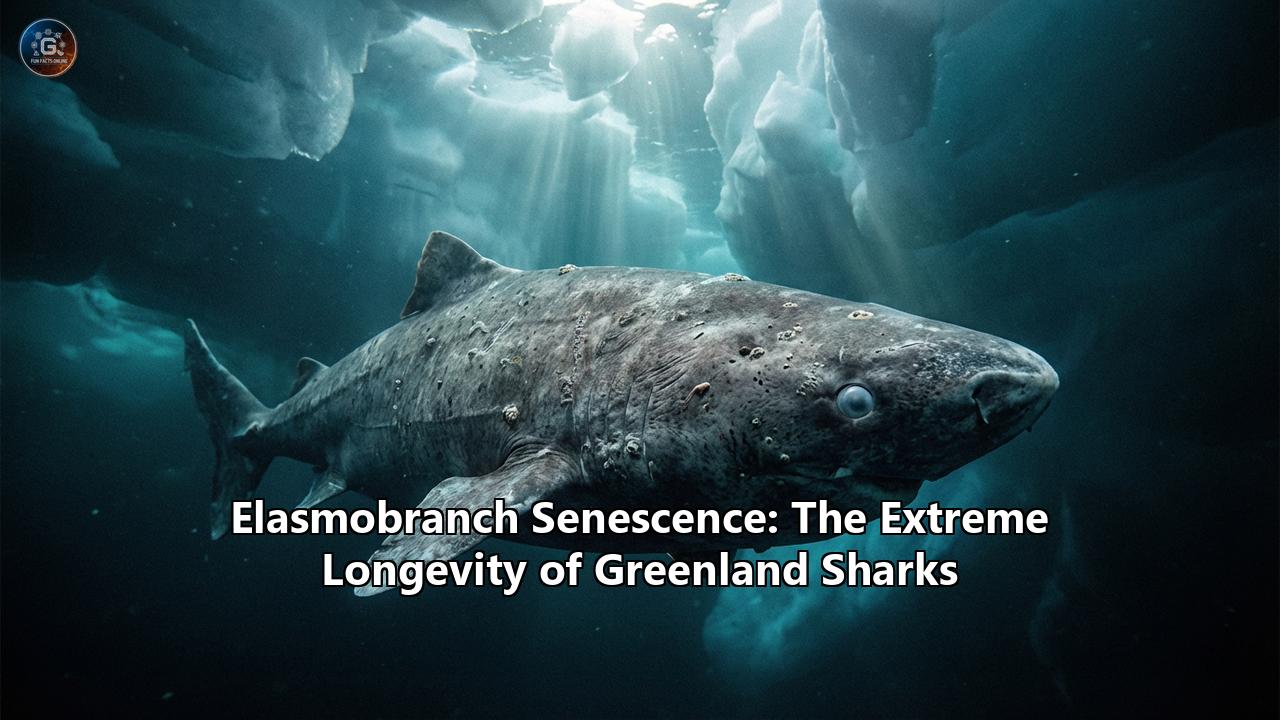
In the freezing, abyssal depths of the Arctic and North Atlantic Oceans, a silent leviathan drifts through the dark. Moving at a sluggish pace of less than one mile per hour, this creature might seem unremarkable at first glance—a mottled, grey, barrel-shaped scavenger roaming the seafloor. Yet, hidden within its biology is one of the most astonishing secrets of the natural world. If you were to encounter a fully grown female today, there is a distinct biological possibility that she was born around the time William Shakespeare was drafting Hamlet, or when Galileo Galilei first pointed his telescope at the night sky.
This is the Greenland shark (Somniosus microcephalus), a deep-sea predator and the longest-living vertebrate known to science. With a lifespan conservatively estimated at 272 years, and potentially exceeding 500 years, this enigmatic elasmobranch has shattered our understanding of aging, senescence, and the biological limits of vertebrate life.
For decades, the Greenland shark was an elusive ghost of the polar seas, a species categorized as "Data Deficient" and largely ignored by mainstream marine biology. Today, however, it stands at the forefront of genetic and physiological research. By studying the extreme longevity of the Greenland shark, scientists are decoding the mechanisms of "negligible senescence"—the phenomenon where an organism shows virtually no signs of biological aging over time.
The Ghost of the Arctic: Anatomy and Ecology
To understand how the Greenland shark defies time, one must first understand its extreme lifestyle. Belonging to the family Somniosidae, commonly known as "sleeper sharks," the Greenland shark is a colossal fish. Adults routinely reach lengths of 4 to 5 meters (13 to 16 feet), with the largest confirmed specimens stretching over 6 meters (21 feet) and weighing more than 1,000 kilograms (2,200 pounds).
Despite their massive size, these sharks live life in the absolute slow lane. They inhabit waters ranging from just below freezing (-1.1°C) to 7.4°C, plunging to depths exceeding 1,800 meters (5,900 feet). Their environment is characterized by crushing pressure and total darkness. Consequently, their metabolism and physical movements have adapted to conserve as much energy as possible. They exhibit the lowest swim speed and tail-beat frequency for their size of any fish species, cruising at a mere 0.34 meters per second.
Their physical appearance reflects their ancient, deep-sea existence. They possess cylindrical bodies covered in highly specialized dermal denticles—tooth-like scales that reduce hydrodynamic drag and allow them to glide silently through the water column. However, one of their most striking features is a parasitic affliction. The eyes of the vast majority of adult Greenland sharks harbor a bioluminescent copepod crustacean called Ommatokoita elongata, which attaches to the shark's cornea. This parasite eventually renders the shark partially or completely blind. Yet, in the pitch-black depths of the Arctic, sight is a secondary sense. The shark relies heavily on an incredibly acute sense of smell to navigate and locate prey.
As apex predators and opportunistic scavengers, Greenland sharks boast a highly varied diet. Despite their sluggish cruising speeds, their stomachs have yielded the remains of remarkably fast prey, including seals, fish like cod and halibut, squid, and even the occasional remains of reindeer, moose, and polar bears. Scientists theorize that they may ambush seals while the mammals are sleeping in the water, utilizing a specialized buccal cavity to generate immense suction, pulling prey directly into their jaws without the need for a high-speed chase.
Cracking the Time Capsule: The Eye Lens Radiocarbon Breakthrough
For a long time, the true age of the Greenland shark was an unsolved mystery. In fisheries science, the age of most teleost (bony) fish is determined by examining otoliths—tiny ear bones that accumulate annual calcified growth rings, much like the rings of a tree. However, elasmobranchs (sharks, rays, and skates) possess cartilaginous skeletons and lack otoliths entirely. For other shark species, such as the Great White or the Porbeagle, biologists can sometimes count growth bands in the calcified cartilage of their vertebrae or dorsal fin spines. The Greenland shark, however, possesses soft, uncalcified vertebrae that yield no such clues.
The only indicator of their potential longevity was their incredibly slow growth rate. Tagging-and-recapture studies from the mid-20th century revealed that these giants grow at a microscopic rate of just 0.5 to 1 centimeter per year. If a shark measures 5 meters long and grows less than a centimeter annually, the mathematical implications are staggering.
The definitive breakthrough arrived in August 2016, when a team of researchers led by marine biologist Julius Nielsen published a landmark study in the journal Science. Unable to rely on bones, the team turned to an unlikely biological archive: the shark's eye.
In vertebrates, the nucleus of the eye lens is composed of metabolically inert crystalline proteins. The very center of this lens—the embryonic nucleus—is formed during prenatal development and remains completely unchanged for the rest of the animal's life. By isolating this tissue, researchers can extract proteins that were synthesized at the exact moment the shark was born.
To date these proteins, the team utilized radiocarbon dating, specifically searching for the "bomb pulse". In the mid-20th century, atmospheric thermonuclear weapons testing caused a massive, global spike in Carbon-14 isotopes. This "bomb pulse" permeated the marine food web by the early 1960s, creating a permanent radioactive timestamp in the tissues of living organisms.
When Nielsen's team tested the eye lenses of 28 female Greenland sharks caught as bycatch, the results were historic. Only the two smallest sharks (measuring 220 cm or less) showed traces of the bomb pulse, indicating they were born after the 1960s. The other 26 sharks were completely devoid of the bomb pulse, placing their birth dates firmly before the atomic age.
Through complex Bayesian mathematical modeling and radiocarbon calibration, the team deduced the ages of the largest specimens. The largest shark in the study, a 5.02-meter female, was estimated to be 392 ± 120 years old. This means she was at least 272 years old, but potentially up to 512 years old, crowning the Greenland shark as the undisputed longest-living vertebrate known to humanity, vastly outliving the previous record holder, the 211-year-old bowhead whale.
Perhaps even more astonishing was the discovery regarding their reproductive timeline. The data revealed that female Greenland sharks do not reach sexual maturity until they are roughly 4 meters long. In terms of time, this means a female Greenland shark must survive for at least 156 ± 22 years before she is capable of reproducing. She experiences a century and a half of childhood and adolescence before contributing to the population.
Defying Death: The Physiology of Negligible Senescence
The discovery of their extreme age triggered a new wave of scientific inquiry. Aging—or senescence—is a biological inevitability for almost all life forms. It is characterized by the gradual deterioration of physiological function, genomic instability, shortening of telomeres, mitochondrial dysfunction, and the accumulation of cellular damage over time. Yet, the Greenland shark seems to glide through centuries with virtually no functional decline, exhibiting what gerontologists call "negligible senescence". How do they do it?
The "Freezer" Effect and Metabolic Stasis
Initially, scientists hypothesized that the shark's extreme longevity was simply a byproduct of its frigid environment. Living in the deep, freezing waters of the Arctic functions much like a biological refrigerator, significantly slowing down metabolic processes, reducing the rate of cellular turnover, and decreasing the generation of harmful free radicals.
However, recent studies indicate the reality is far more complex. In 2024, researchers from the University of Manchester and other institutions sought to determine if the Greenland shark's metabolism declines with age, as it does in humans and almost all other animals. They measured the metabolic activity of enzymes in preserved muscle tissues across a range of different shark ages. Astoundingly, they found no significant variation in muscle metabolic activity between young, middle-aged, and ancient sharks. Their metabolism remains practically perfectly unaltered over centuries. Furthermore, studies on the cardiac health of these animals have suggested their hearts are finely tuned to function optimally for centuries without succumbing to the cardiovascular degradation seen in humans.
Toxic Tissues and Protein Stabilization
The Greenland shark's bodily fluids hold another piece of the longevity puzzle. As elasmobranchs, they retain high levels of urea in their tissues to maintain osmotic balance with the saltwater environment. However, urea can be highly destabilizing to cellular proteins. To counteract this, the shark's tissues are saturated with exceptionally high concentrations of Trimethylamine N-oxide (TMAO).
TMAO acts as a universal protein stabilizer, preventing the shark's cells from degrading under extreme deep-sea pressure and counteracting the toxic effects of urea. Furthermore, the blood of Greenland sharks contains three major types of highly specialized hemoglobin. These unique hemoglobin structures possess oxygenation and carbonylation properties that remain completely unaffected by the massive presence of urea, ensuring efficient oxygen transport to tissues regardless of the environmental temperature or pressure.
The Blueprint of Immortality: Genomics and DNA Repair
While a slow metabolism and specialized proteins contribute to a long life, living for 400 years requires a flawless system of genetic maintenance. Every day, the DNA within a living organism is subjected to damage from internal and external sources. Over time, failure to repair this DNA leads to mutations, cancer, and the physiological breakdown we recognize as aging.
In 2025, researchers from the University of Tokyo and other international institutions successfully mapped the first high-fidelity genome of the Greenland shark, uncovering the molecular secrets behind its longevity. What they found fundamentally altered our understanding of cancer resistance and DNA repair.
The Mastery of the NF-κB Pathway
The genomic sequencing revealed that the Greenland shark possesses an unusually high number of genes that regulate the NF-κB signaling pathway. In humans and other vertebrates, the NF-κB pathway is a critical regulator of immune responses, cellular inflammation, cell proliferation, and apoptosis (programmed cell death). Overactive or dysregulated NF-κB signaling in humans is strongly linked to chronic inflammation, autoimmune diseases, and the aggressive spread of cancer.
The Greenland shark, however, has evolved redundant copies of regulatory genes (such as TNF, TLR, and LRRFIP) that flawlessly manage this pathway. By keeping cellular inflammation in a constant, perfectly regulated state, the shark avoids the chronic "inflammaging" that destroys mammalian tissues over time.
"Jumping Genes" and Cancer Resistance
The sheer size of the Greenland shark's genome—spanning over six billion base pairs—is largely due to the presence of retrotransposons, commonly known as "jumping genes". These are segments of DNA capable of cutting themselves out and inserting themselves elsewhere in the genome. In humans, a high rate of transposon activity is generally considered dangerous, linked to genomic instability and the onset of cancer.
Remarkably, the Greenland shark has turned this potential liability into a weapon for survival. Over 70% of the Greenland shark's genome consists of these transposons. Researchers suspect that throughout the species' evolutionary history, the persistent activity of these jumping genes forced the shark to evolve hyper-efficient DNA repair mechanisms. To survive the genetic "messiness" of its own genome, the shark developed an extraordinary capacity to fix broken DNA strands.
The sequencing showed significant expansions and alterations in tumor-suppressing genes, most notably the TP53 gene, which is the critical regulator of the DNA damage response. The Greenland shark essentially possesses an ultra-responsive, highly redundant genetic repair shop that catches and fixes cellular errors before they can metastasize into cancer or result in cellular senescence. Thus, a 400-year-old shark has tissues that, genetically speaking, are as pristine as those of a newborn.
The Tragedy of Time: Conservation and Human Interaction
The evolutionary strategy of the Greenland shark—extreme longevity paired with a severely delayed age of sexual maturity—works perfectly in an undisturbed, deep-sea ecosystem. However, in the Anthropocene, this same strategy has made the species critically vulnerable to human interference.
The math of their survival is delicate. If a female requires 150 years to reach breeding age, and carries her pups in a gestation period that is estimated to last anywhere from 8 to 18 years, the loss of even a few reproducing adults can send regional populations into a catastrophic decline.
Historically, humans were the apex predator of the Greenland shark. Between the 13th and mid-20th centuries, these giants were aggressively hunted for their massive, oil-rich livers, which were boiled down to produce lamp oil, industrial lubricants, and Vitamin A supplements. While commercial targeted fishing largely collapsed in the 1960s with the advent of synthetic alternatives, the legacy of that exploitation lingers. The International Union for Conservation of Nature (IUCN) estimates that the global population of Greenland sharks may have declined by up to 49% over the past 450 years—which translates to just three generations for this species.
Today, the primary threat to the Greenland shark is incidental bycatch. As fishing fleets push further north and deeper into the ocean due to melting sea ice, interactions with these ancient creatures have increased. It is estimated that approximately 3,500 Greenland sharks are unintentionally killed each year, ensnared in bottom trawls, longlines, and gill nets targeting halibut and other deep-water fish in the Arctic and North Atlantic.
Recognizing the dire need to protect a species that cannot rapidly replace its numbers, conservation organizations have recently taken unprecedented steps. In 2020, the IUCN officially worsened the shark's status from "Near Threatened" to "Vulnerable". Following this, in 2022, the Northwest Atlantic Fisheries Organization (NAFO)—an intergovernmental body managing fisheries science—enacted a historic prohibition on the retention of Greenland sharks caught in international waters. While these measures are vital, the immense lifespan of the shark means it will take centuries to observe genuine population recovery.
The Cultural Footprint: Hákarl and Inuit Legends
Despite their deep and remote habitat, Greenland sharks have left a distinct mark on the cultures that border the icy waters of the North. In Iceland, the meat of the Greenland shark is consumed, but not without intense preparation. Because the shark's flesh is heavily laden with high concentrations of urea and TMAO, consuming the meat raw is highly toxic to humans and dogs. It induces a state known as "shark drunk," causing severe neurological symptoms, intoxication, and in extreme cases, death.
To render the meat edible, Icelanders have utilized a traditional method dating back to the Vikings. The shark meat is cut into chunks, buried underground under heavy stones for several weeks to press out the toxic fluids, and then hung to ferment and dry in the open air for months. The resulting delicacy, known as kæstur hákarl (or simply Hákarl), possesses a potent, ammonia-rich odor and a challenging flavor profile. It remains a staple of Icelandic cultural heritage and is celebrated during the midwinter festival of Þorrablót.
In Inuit mythology, the toxic nature of the shark's flesh was explained through legend. The Inuit tell the story of Skalugsuak, the first Greenland shark, who was said to have been born when an old woman washed her urine-soaked hair with a piece of cloth and threw it into the ocean, explaining the strong scent of ammonia that accompanies the beast.
A Masterclass in Survival
The Greenland shark stands as a living paradox. It is a massive apex predator that moves in slow motion. It is a toxic, partially blind scavenger that navigates the pitch-black abyss with effortless grace. And most profoundly, it is a creature that has effectively paused the biological clock, watching centuries slip by from the freezing depths of the ocean.
As modern science continues to sequence its genome, study its unfaltering metabolism, and unravel its cancer-resistant DNA, the Greenland shark transitions from being merely an ecological curiosity to a vital key in the study of gerontology and medicine. By understanding how Somniosus microcephalus repairs its DNA and prevents cellular senescence, humanity may unlock new therapies for fighting cancer, mitigating age-related diseases, and extending human healthspan.
Yet, as we look to the Greenland shark for the secrets to longevity, we must also ensure its survival. These ancient leviathans—some of which have been swimming silently through the dark since before the Industrial Revolution—remind us of the profound, unhurried rhythms of the natural world. Protecting them means protecting a living archive of Earth's history, a creature that embodies the ultimate triumph of endurance over the relentless march of time.
Reference:
- https://en.wikipedia.org/wiki/Greenland_shark
- https://www.sciencealert.com/the-genome-of-the-greenland-shark-reveals-the-secrets-to-its-longevity
- https://pubmed.ncbi.nlm.nih.gov/27516602/
- https://scholarworks.iu.edu/dspace/items/f993702c-60a9-4d68-b9ed-f0469ccc061b
- https://scispace.com/pdf/eye-lens-radiocarbon-reveals-centuries-of-longevity-in-the-40q7aycaeh.pdf
- https://www.fightaging.org/archives/2024/07/negligible-senescence-in-the-greenland-shark/
- https://www.researchgate.net/publication/394257010_Ageless_Creatures_Molecular_Insights_into_Organisms_That_Defy_Aging
- https://www.livescience.com/greenland-shark
- https://www.researchgate.net/profile/Julius-Nielsen/publication/327467840_The_Greenland_shark_Somniosus_microcephalus_-_Diet_tracking_and_radiocarbon_age_estimates_reveal_the_world's_oldest_vertebrate/links/5b90ff7d45851540d1d2ccc4/The-Greenland-shark-Somniosus-microcephalus-Diet-tracking-and-radiocarbon-age-estimates-reveal-the-worlds-oldest-vertebrate.pdf
- https://xray-mag.com/content/secret-greenland-sharks-remarkable
- https://www.researchgate.net/figure/Radiocarbon-in-eye-lens-nuclei-of-Greenland-sharks-Radiocarbon-levels-pMC-SD-table_fig2_306059132
- https://biz.chosun.com/en/en-science/2025/03/09/XNQEQ3R62BGQBNBUEUVLY6Y5PY/
- https://www.the-galli-lab.co.uk/copy-of-carotid-body-and-heart-failure
- https://www.frontiersin.org/journals/marine-science/articles/10.3389/fmars.2019.00087/full
- https://news.mongabay.com/2022/10/greenland-shark-worlds-longest-living-vertebrate-gets-long-awaited-protection/
- https://www.fmap.ca/ramweb/papers-total/Davis_etal_2013.pdf