
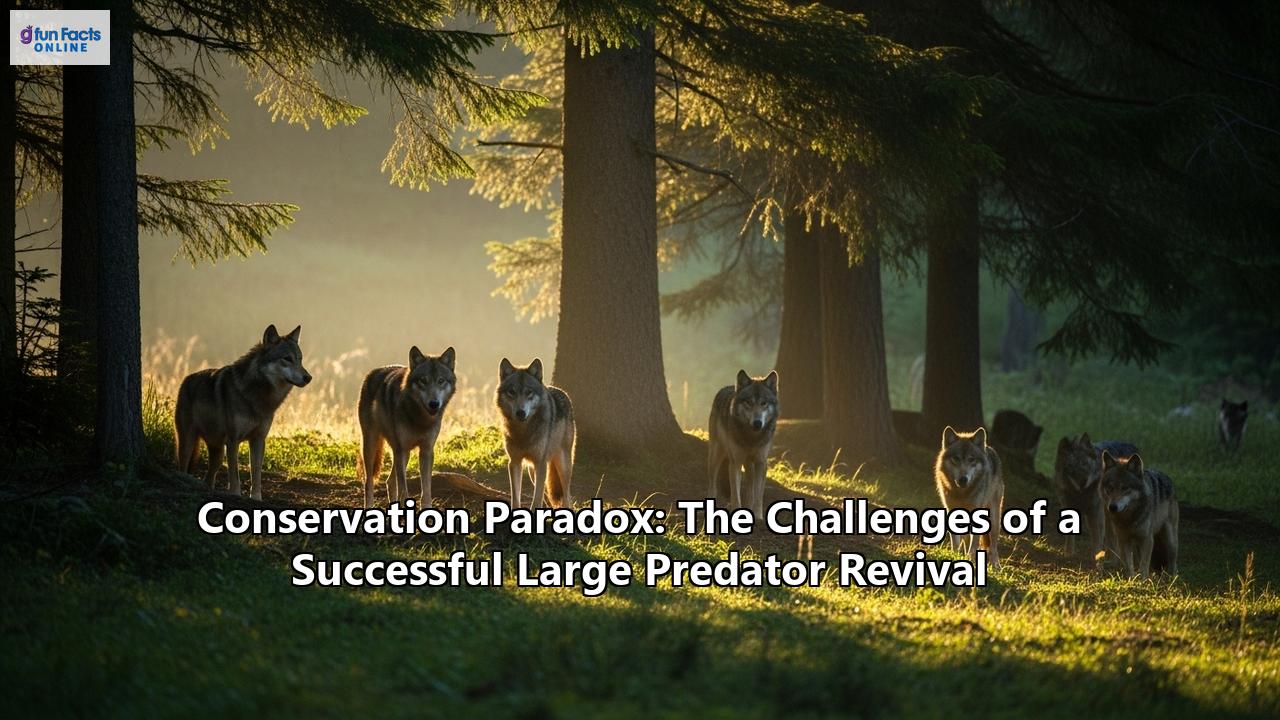
For centuries, humanity waged a relentless war against its ancient adversaries. Large predators—wolves, bears, and great cats—were seen not as integral parts of an ecosystem, but as rivals, threats, and vermin. They were systematically poisoned, trapped, and shot, their numbers plummeting and their vast ranges shrinking to isolated, mountainous redoubts. The mournful howl of the wolf and the formidable presence of the grizzly vanished from the landscapes they had shaped for millennia.
Then, a monumental shift in consciousness occurred. Spurred by a growing ecological awareness and landmark legislation like the Endangered Species Act in the United States and the Habitats Directive in Europe, a concerted effort began to bring these magnificent creatures back from the precipice. And it worked. In one of the most stirring conservation triumphs of our time, populations of gray wolves, grizzly bears, Eurasian lynx, and other apex predators have rebounded in regions they had long since abandoned. Their return has been hailed as a restoration of ecological integrity, a healing of old wounds inflicted on the natural world.
But this victory has revealed a profound and complex challenge, one that strikes at the very heart of what it means for humanity to coexist with wildness. As these predators reclaim their ancestral lands, they are moving beyond the pristine wilderness of national parks and into the multi-use landscapes where people live, work, and play. The success of the revival has given birth to a new and daunting reality: the Conservation Paradox. The very achievement of bringing predators back has ignited a fresh wave of conflict, eroding local support for conservation and forcing us to confront the immense difficulty of sharing a world with the wild, powerful animals we fought so hard to save. This is the story of that paradox—a testament to our success, and a crucible for our future.
The Triumph of Restoration: A World with Predators Reclaimed
The scale of the large carnivore comeback, particularly in North America and Europe, is nothing short of astonishing. It is a story of resilience, both of the animals themselves and of the human commitment to their survival.
In the United States, the gray wolf stands as a potent symbol of this recovery. After being extirpated from almost all of the lower 48 states by the mid-20th century, wolves were granted protection under the Endangered Species Act (ESA) in 1974. The pivotal moment came in 1995 and 1996, when 66 wolves from Canada were reintroduced into the wilds of Yellowstone National Park and central Idaho. From that small seed, a vast recovery grew. The population flourished, expanding across the Northern Rocky Mountains. By the end of 2022, there were an estimated 2,800 wolves distributed across seven western states, including populations that had naturally dispersed into Oregon, Washington, and California. Montana alone now boasts a population six to eight times greater than the minimum federal recovery goal. In a move that underscored the deep political divisions surrounding their return, wolves were even reintroduced to Colorado following a citizen-led ballot initiative.
A similar story unfolded for the grizzly bear. Listed as threatened in 1975, when fewer than 1,000 individuals clung to existence in 2% of their historic range, the grizzly population has since more than doubled to over 2,000 in the lower 48 states. The two flagship recovery zones, the Greater Yellowstone Ecosystem (GYE) and the Northern Continental Divide Ecosystem (NCDE) in Montana, now support robust populations of around 700 and 1,000 bears, respectively. Once again, a species was pulled back from the brink.
Across the Atlantic, the resurgence has been even more widespread, occurring not in vast, federally protected wilderness areas, but in the densely populated, cultural landscapes of Europe. Shielded by the EU's Habitats Directive, large carnivores have demonstrated a remarkable adaptability. The wolf population has exploded to over 21,500 individuals, a nearly 60% jump in just a decade, with breeding packs now established in 23 EU member states. Germany saw its wolf population grow from a single pack in 2000 to 184 packs by 2022. Brown bears, once extinct in much of Western Europe, have re-established themselves through reintroductions in places like the Italian Alps and the Pyrenees. The elusive Eurasian lynx, while facing greater challenges due to habitat fragmentation, has also begun a slow but steady return through reintroduction projects in Switzerland, France, and Germany.
This continental-scale revival was celebrated as a profound ecological victory. The return of these apex predators promised to restore balance to ecosystems long deprived of their key regulators. The most famous example is the "trophic cascade" observed in Yellowstone after the wolves' return. Scientists documented how wolves, by preying on elk, reduced overgrazing, which in turn allowed streamside willows and aspen to recover. This revitalized vegetation provided food and habitat for beavers, whose dams created new wetland habitats for songbirds, amphibians, and fish. For a time, it seemed a simple and powerful narrative: bring back the predators, and the entire ecosystem heals.
But as the populations of these carnivores grew and their ranges expanded, this simple narrative began to fray. The ecological success story collided with the complex reality of human-dominated landscapes, giving rise to conflicts that are testing the limits of public tolerance and challenging the very definition of conservation success.
Case Study: The Wolf's War in the American West
The reintroduction of the gray wolf to the Northern Rocky Mountains is the quintessential example of the conservation paradox. It is a story of stunning ecological success immediately followed by intense social, economic, and political conflict that continues to rage decades later.
Ecological Nuance Replaces a Simple StoryThe initial story of the Yellowstone trophic cascade was a powerful and compelling argument for reintroduction. It suggested that restoring a single species could trigger a domino effect of positive changes, restoring the entire ecosystem to a "natural balance." However, two decades of further research has revealed a much more complex picture. While wolves certainly had an impact, scientists now understand that the initial, romanticized version of the story was too simplistic. Other factors, including drought, human hunting of elk outside the park, and predation by grizzly and black bears, also played significant roles in the changes observed in Yellowstone. Some ecologists now argue that the idea of wolves single-handedly changing the course of rivers is a "demonstrably false" myth that, while appealing, distracts from the true complexity of ecosystem management.
This scientific recalibration is important because the "healing the ecosystem" narrative was a cornerstone of the public campaign for wolf recovery. As the ecological effects prove to be more nuanced and less dramatic than first advertised, it complicates the public discourse, especially when set against the very real and immediate costs borne by those who live with wolves.
The Economic Bite and the Social DivideFor ranchers in the American West, the return of the wolf is not an ecological abstraction; it is a direct threat to their livelihood. While industry-wide statistics show that wolf depredation accounts for less than 1% of livestock losses, this figure is deeply misleading. The costs are not spread evenly but are intensely concentrated on individual producers whose herds share territory with wolf packs. For these ranchers, the economic and emotional impacts can be devastating.
The financial burden extends far beyond the market value of a confirmed kill. Ranchers report significant indirect losses from the constant stress that wolf presence places on their cattle. Studies have documented lower pregnancy rates and reduced weight gain in calves from herds that are persistently harassed by wolves. One recent analysis, though not yet peer-reviewed, estimated that the indirect costs from a single wolf could range from $69,000 to $162,000. Compounding the problem is the difficulty of proving losses. In rugged terrain, many carcasses are never found, leading to a wide and contentious gap between official confirmed kills and the losses reported by ranchers.
This economic pressure has fueled a deep social and political chasm. The conflict over wolves has become a proxy war for broader cultural tensions between urban and rural America. Many rural communities and ranchers view the wolf as an emblem of federal overreach, an animal foisted upon them by distant city-dwellers and environmental groups who do not have to bear the consequences. The debate is no longer just about wolves; it is about competing values, property rights, and a struggle for control over the identity and future of the American West.
From Federal Protection to Political BattlegroundThis conflict has inevitably played out in the political arena, centering on the wolf's status under the Endangered Species Act. After years of legal battles, wolves in the Northern Rockies states of Montana, Idaho, and Wyoming were "delisted," and management authority was transferred from the federal government to the states.
This shift has led to radically different management approaches. States, being more responsive to the pressures from livestock producers and hunters, have instituted aggressive hunting and trapping seasons with the goal of reducing wolf populations. These policies are themselves intensely controversial, sparking new lawsuits from conservation groups who argue that the states are jeopardizing the long-term recovery of the wolf. The cycle of litigation continues, with the wolf caught in a political tug-of-war. The reintroduction in Colorado, mandated by a popular vote that revealed a stark urban-rural split, has opened a new front in this ongoing battle, proving that the paradox of the wolf's successful return is far from being resolved.
Case Study: The Grizzly's Resurgence and the Geography of Fear
If the wolf conflict is defined by economic and social friction, the return of the grizzly bear introduces a more primal element: fear. As grizzly populations have recovered in the Northern Rockies, they are increasingly encountering humans, and the consequences can be uniquely challenging. The grizzly bear paradox is less about livestock losses and more about managing a vast, powerful carnivore that can, in rare but terrifying instances, pose a direct threat to human life.
A Different Kind of ConflictBy the time they were listed under the ESA in 1975, grizzly bears were a ghost species in the lower 48, reduced to a few hundred individuals in the most remote corners of Yellowstone and northwestern Montana. Today, thanks to decades of protection, the population has rebounded to over 2,000. This success means bears are expanding out of their core recovery zones and into landscapes they haven't occupied for a century—landscapes now dotted with towns, ranches, and recreational trails.
This expansion inevitably leads to more human-bear encounters. Between 1992 and 2000, 995 human-grizzly conflicts were recorded in the Greater Yellowstone Ecosystem alone. These conflicts range from bears raiding garbage cans and grain stores to depredating livestock. However, the most significant factor shaping the grizzly debate is the threat to human safety. While fatal grizzly attacks are statistically rare—Yellowstone National Park has recorded only eight in its 150-year history—they are highly publicized and viscerally frightening. The year 2024 was one of the deadliest on record for GYE grizzlies, with 73 known mortalities, the vast majority of them human-caused, stemming from management removals after conflicts, poaching, or bears killed in self-defense. This stark reality places an immense pressure on wildlife managers and creates a climate of anxiety in local communities.
The Stalemate of DelistingMuch like the wolf, the central political battle for the grizzly revolves around delisting it from the ESA. States like Wyoming, Montana, and Idaho argue that the bear is biologically recovered and that state management would provide the necessary flexibility to handle conflicts, including the potential for a limited, highly regulated trophy hunt. Proponents of delisting argue that it is a necessary step to give local communities more control and to address the legitimate safety and livestock concerns of people living with bears.
However, conservation groups, tribal nations, and many scientists have fought delisting tooth and nail. They argue that the core populations in Yellowstone and the NCDE, while growing, remain isolated genetic islands. True recovery, they contend, requires connecting these populations to ensure long-term genetic health, a goal that would be undermined if states were allowed to manage them independently, potentially halting their dispersal. Habitat fragmentation from roads and development remains a critical threat, and opponents of delisting fear that state management would prioritize human development over the bear's need for vast, secure landscapes.
This opposition has been successful in court. Federal judges have twice blocked attempts to delist the Yellowstone grizzly population, ruling that the government failed to adequately consider the impact on the species' overall recovery across its range and the need for genetic connectivity. The result is a protracted legal and political stalemate. The grizzly bear remains protected under the ESA, a conservation success story locked in a paradox: its population is robust enough to generate significant conflict, but its long-term security is deemed too fragile to remove federal oversight.
The Economic Duality: Tourist Magnet and Local BurdenThe economic dimension of the grizzly paradox is sharp. On one hand, the grizzly bear is a massive economic engine. The chance to see a grizzly is a primary draw for the millions of tourists who visit the national parks of the GYE, generating hundreds of millions of dollars in revenue and supporting thousands of jobs in gateway communities. From this perspective, a live grizzly bear is worth far more than a dead one.
On the other hand, the economic benefits of tourism are not always felt by the ranchers who lose livestock or the rural counties that must invest in conflict prevention. The costs of coexistence—of building electric fences, providing bear-resistant garbage containers, and funding wildlife management personnel—are substantial and fall disproportionately on the communities living on the front lines of grizzly recovery. This creates a scenario where the broader public reaps the economic and aesthetic rewards of grizzly recovery, while a much smaller, local population bears the majority of the costs and risks.
Case Study: Europe's Comeback in a Crowded House
The return of large carnivores to Europe demonstrates that the conservation paradox is a global phenomenon, but with a unique continental twist. Here, the challenge is not about managing predators in vast, designated wilderness areas, but about integrating them into ancient, "multi-use" landscapes that have been shaped by humans for centuries and are crisscrossed by borders.
Success in a Human-Dominated WorldThe resurgence of wolves, bears, and lynx across Europe is a testament to their incredible adaptability. Protected by forward-thinking legislation like the EU's Habitats Directive, these species have thrived in a patchwork of forests, farmland, and even semi-urban areas. Wild areas large enough to contain a predator population without human interaction are effectively nonexistent in Europe. This makes the European experience a crucial test case for the future of conservation in the Anthropocene—an era defined by human influence.
The success has been staggering. The wolf population has surpassed 20,000 individuals and is expanding its range across the continent. Brown bear populations in the Cantabrian Mountains of Spain, the Alps of Italy, and the Carpathians have all shown signs of recovery. The Eurasian lynx is being painstakingly reintroduced to its former habitats in Central Europe. This continental revival is a landmark conservation achievement.
The Same Conflicts, A Different ScaleDespite the different landscape, the core conflicts are remarkably similar to those in North America. Livestock depredation is the most common flashpoint. European wolves are estimated to kill around 56,000 domestic animals annually, with compensation costing member states millions of euros. While public attitudes towards predators have generally become more favorable, the expansion of carnivores into new areas is reigniting old tensions with farmers and shepherds.
Competition with hunters for game animals like deer and wild boar is another significant source of friction. And while wolf attacks on humans are virtually unheard of, the risk posed by brown bears, especially in areas where people are unaccustomed to their presence, fuels public anxiety and opposition.
Governance Across BordersWhat sets the European context apart is its complex, transboundary nature. A wolf pack in France may cross into Italy and then Switzerland, traversing different legal systems, languages, and management cultures. This necessitates a high degree of international cooperation. The European Union plays a central role, setting the overarching legal framework through the Habitats Directive. This directive strictly protects these species but includes "derogation" clauses that allow member states to authorize lethal control under specific circumstances, creating a constant point of debate and legal challenge.
In response to rising conflicts, the EU has established innovative governance structures like the "EU Platform on Coexistence between People and Large Carnivores." This body brings together stakeholders from across the continent—including landowners, reindeer herders, hunters, and conservation organizations—to share knowledge and foster dialogue, seeking solutions that can work across Europe's diverse landscapes.
The success has become so pronounced that it is forcing a political reckoning. Citing the dramatic increase in wolf populations and the associated rise in livestock conflicts, the European Commission has proposed downgrading the wolf's status from "strictly protected" to "protected." This move would make it easier for member states to authorize lethal management, including hunting. The proposal is highly contentious, mirroring the delisting debates in the United States and demonstrating that, on both continents, the paradox remains the same: how does a society that has successfully restored its top predators decide when there are "enough," and who gets to make that decision?
Navigating the New Wilderness: The Search for Coexistence
The conservation paradox, with its complex web of ecological, social, and economic challenges, is forcing a fundamental shift in how we approach wildlife management. The goal is no longer simply to bring a species back from the brink of extinction. The new frontier of conservation is coexistence—finding the tools, strategies, and compromises that will allow both humans and large predators to thrive in shared landscapes. This requires a multi-pronged approach that operates at every level, from the pasture fence to the halls of government.
On-the-Ground Solutions: The Coexistence ToolkitThe first line of defense in mitigating conflict is a suite of practical, non-lethal tools designed to keep predators and human property separate. These methods have been tested and refined on the front lines of the paradox in both North America and Europe.
- Livestock Guardian Animals: For centuries, shepherds have used specially bred dogs, such as Great Pyrenees and Anatolian Shepherds, to live among their flocks and protect them from predators. Their presence is a powerful deterrent, and their use is being actively promoted as a first step in conflict prevention. Donkeys and llamas are also used effectively in some contexts.
- Fencing and Fladry: Modern electric fencing is a highly effective tool for securing livestock in pastures at night or protecting calving areas, bee apiaries, and chicken coops. For larger areas, a traditional technique called "fladry"—a line of rope with hanging flags that flap in the wind—can create a psychological barrier that wolves are hesitant to cross, though its effectiveness can diminish over time as animals habituate.
- Range Riders and Human Presence: Reviving the old practice of having riders patrol with livestock herds on public lands can significantly reduce depredation. The constant human presence deters predators who prefer to avoid confrontation. This approach is labor-intensive but highly effective.
- Sanitation and Attractant Management: A core principle of coexistence, particularly with bears, is to eliminate anything that might attract them to human settlements. This means securing garbage in bear-resistant containers, cleaning up fallen fruit from orchards, storing animal feed in secure buildings, and removing livestock carcasses from the landscape promptly. Community-wide "Bear Smart" programs have been instrumental in educating the public and reducing the number of bears that become habituated to human food sources.
Because the costs of living with predators are high and concentrated, financial mechanisms are crucial for building tolerance and incentivizing coexistence.
- Compensation Programs: Most states and countries with large predator populations have programs to compensate ranchers for livestock confirmed to have been killed by predators. However, these programs are often fraught with difficulty. Proving a kill can be hard, payments can be slow, and they don't account for the significant indirect costs of predator harassment.
- Payments for Presence and Performance: More innovative models are emerging that move beyond simple compensation for loss. Some programs offer "payments for presence," rewarding landowners simply for having predators on their land. Others use a "pay-for-performance" model, offering financial rewards to communities or ranchers who achieve verifiable conservation outcomes, such as successfully raising a litter of wolf pups in their area.
- Promoting Economic Benefits: A key strategy is to ensure that local communities see a direct economic benefit from the presence of predators. This often involves developing wildlife tourism economies. In areas like Yellowstone, the revenue from tourists who come to see bears and wolves provides a powerful economic counter-argument to those who see the animals only as a liability. The challenge is ensuring this revenue flows to the local communities that bear the costs of coexistence.
Ultimately, long-term coexistence depends on creating robust governance structures and fostering genuine dialogue among all stakeholders.
- Stakeholder Collaboration: The old model of top-down decision-making by government agencies has proven inadequate for resolving these deeply polarized conflicts. The new model emphasizes collaborative governance. The EU's large carnivore platform is a prime example, bringing hunters, landowners, and conservationists to the same table. In the US, local working groups that include ranchers, environmentalists, and county officials are proving to be effective forums for finding local solutions.
- Adaptive Management: Given the complexity of these ecosystems and social systems, management must be flexible and adaptive. This means moving away from rigid, one-size-fits-all rules. Some have proposed zoning systems, where predator management goals differ based on the landscape—for instance, strict protection in core wilderness areas, active coexistence measures in multi-use zones, and more aggressive lethal control in prime agricultural areas.
- Addressing the Social Conflict: Perhaps the most difficult challenge is bridging the deep cultural and political divides that predators symbolize. This requires moving beyond arguments over data and science to address the underlying values, fears, and sense of identity that fuel the conflict. It demands processes of dialogue and mediation that build trust and mutual respect, recognizing the legitimate concerns and deep-seated connections to the land held by all sides.
Redefining Success: Conservation in a Shared World
The return of the great predators is an undeniable triumph, a reversal of a centuries-long trend of extirpation. It is proof that with commitment and protection, nature can be profoundly resilient. Yet this success has forced us to confront a difficult truth: bringing a species back from the brink is only the first step. The ultimate challenge, and the true measure of success, lies in learning how to live alongside them.
The Conservation Paradox reveals that wildlife conservation is not merely a biological exercise; it is a deeply social, economic, and political one. It is easy to love a wolf that exists only in a pristine, distant wilderness. It is far harder to love that same wolf when it is a recurring presence near your home, your livestock, and your children. The perspectives of a city-dweller who values the wolf as a symbol of wildness and the rancher who sees it as a threat to their family's legacy are both valid, rooted in legitimate experiences and values. Acknowledging this is the first step toward resolution.
Moving forward requires a more mature and nuanced understanding of what "conservation" means in a world increasingly dominated by humans. It means abandoning romanticized notions of a perfect, static "balance of nature" and embracing the reality of dynamic, ever-changing systems where conflict is a given. It means recognizing that in most of the world, there is no clear line between "human" and "wild" landscapes; there are only shared ones.
The solutions—the coexistence toolkit, the innovative financial models, the collaborative platforms—are not magic bullets. They are difficult, expensive, and require a long-term commitment from all sides. They demand that conservationists listen to the real-world concerns of rural communities, and that those communities engage with the proven, science-based methods that can reduce conflict.
The story of the predator revival is ultimately a story about us. It holds up a mirror, asking us to define our relationship with the natural world. Do we see it as a resource to be managed for our exclusive benefit, or as a community of beings with whom we must learn to share? The howls and roars returning to our landscapes are a celebration of a victory won. But they are also a question, a challenge, and an invitation to forge a new, more inclusive, and more durable peace with the wild.
Reference:
- https://lciepub.nina.no/pdf/638593145004513356_LCIE_Manifesto_final_261123.pdf
- https://www.mdpi.com/2071-1050/14/13/7833
- https://www.natureza-portugal.org/?364350/lynx-day-2020
- https://www.rewildingeurope.com/wp-content/uploads/2014/06/Manifesto.pdf
- https://www.face.eu/sites/default/files/attachments/face_policy_requests_on_large_carnivores_.pdf
- https://www.europarc.org/species-management-transboundary-protected-areas/
- https://wwf.panda.org/discover/knowledge_hub/where_we_work/alps/our_solutions22222/large_carnivores/lynx/
- https://www.researchgate.net/publication/389320225_Continuing_recovery_of_wolves_in_Europe
- https://environment.ec.europa.eu/topics/nature-and-biodiversity/habitats-directive/large-carnivores_en
- https://journals.plos.org/sustainabilitytransformation/article?id=10.1371/journal.pstr.0000158
- https://www.theearthandi.org/post/europe-s-wild-wolves-are-back
- https://circabc.europa.eu/sd/a/1c009d14-8bf0-4d3d-90cd-da809e821222/IT%20(ALP)%20-%20Brown%20Bear%20(Ursus%20arctos)%20-%20Final.pdf%20-%20Brown%20Bear%20(Ursus%20arctos)%20-%20Final.pdf)
- https://www.researchgate.net/publication/230068324_Recovery_of_Eurasian_Lynx_in_Europe_What_Part_has_Reintroduction_Played
- https://rm.coe.int/best-practice-integrated-v1-for-goe-lcs/1680b5fa41
- https://environment.ec.europa.eu/topics/nature-and-biodiversity/habitats-directive/large-carnivores/eu-large-carnivore-platform_en
- https://datadryad.org/dataset/doi:10.5061/dryad.np5hqc03g
- https://www.tandfonline.com/doi/full/10.1080/24750263.2021.1968046
- https://www.interregeurope.eu/find-policy-solutions/stories/living-with-large-carnivores
- https://www.europarc.org/wp-content/uploads/2017/02/CDPNews12-Spring2016.pdf
- https://www.smithsonianmag.com/science-nature/why-have-european-wolves-recovered-so-much-in-the-past-decade-180986436/
- https://rewildingeurope.com/tag/european-brown-bear/
- https://rewildingeurope.com/news/new-eu-funding-to-support-living-with-bears-in-europe/
- https://www.europarl.europa.eu/RegData/etudes/STUD/2018/596844/IPOL_STU(2018)596844_EN.pdf596844_EN.pdf)
- https://www.face.eu/wildlife-conservation/large-carnivores/