
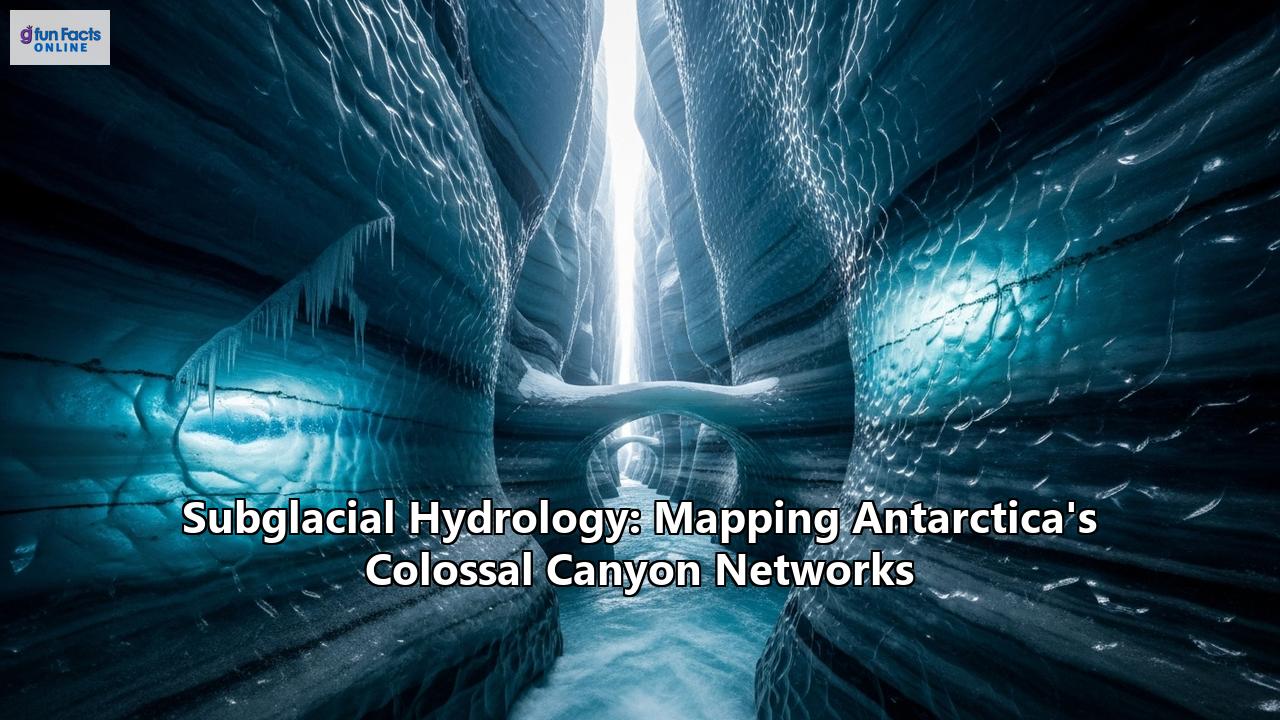
Beneath the colossal ice sheets of Antarctica, a hidden world of immense canyons, vast lakes, and intricate river systems has remained concealed for millennia. This is the realm of subglacial hydrology, a field of science that is revolutionizing our understanding of the frozen continent and its profound impact on the global climate system. The mapping of these colossal canyon networks is not merely an act of discovery; it is a critical endeavor to unravel the secrets of Antarctica's past, present, and future.
The Unveiling of a Secret World
For much of human history, the land beneath Antarctica's ice was a complete mystery, a terra incognita buried under kilometers of frozen water. Early explorers of the "Heroic Age" of Antarctic exploration, such as Robert Falcon Scott and Ernest Shackleton, could only speculate about the continent's hidden topography. The first tantalizing clues emerged in the mid-20th century with the advent of new technologies.
The breakthrough came with the development of radio-echo sounding (RES), a technique that sends radio waves through the ice to map the shape of the rock beneath. This method, first used extensively in the 1960s and 1970s, began to paint a picture of a continent far more complex than previously imagined. These early surveys revealed not a flat, featureless plain, but a landscape of mountains, valleys, and basins.
However, it was the advent of satellite technology and advanced airborne geophysical surveys that truly pulled back the icy curtain. By combining RES with other methods like seismic surveys, gravity measurements, and satellite altimetry, scientists have been able to create increasingly detailed maps of this hidden world. These techniques work in concert: RES provides high-resolution data on ice thickness and bed topography along flight lines; seismic surveys can distinguish between hard rock and soft, water-saturated sediments; and gravity data helps to interpolate between the flight lines and reveal the underlying geological structures. This multi-faceted approach has been instrumental in unveiling the full scale of Antarctica's subglacial features.
The Colossal Canyons of Antarctica
The discoveries made through these mapping efforts have been nothing short of staggering. Scientists have uncovered canyon systems that dwarf some of the most famous on Earth, carving through the ancient rock for hundreds, and in some cases, thousands of kilometers.
The Grand Canyon's Antarctic Rival in Princess Elizabeth Land
One of the most significant discoveries is a vast canyon system in Princess Elizabeth Land, a region previously dubbed one of Antarctica's "Poles of Ignorance" due to the lack of data. Analysis of satellite imagery, later confirmed by radio-echo sounding, revealed a network of canyons and a possible large subglacial lake. The canyon system is thought to be over 1,100 kilometers long and in places up to a kilometer deep, making it comparable in depth to the Grand Canyon but many times longer. It is believed that this immense network was carved by water, either in a distant past before the ice sheet formed or by the persistent flow of water beneath the ice over millions of years.
The discovery of this canyon system was a testament to the ingenuity of scientists. Faint traces of the canyons were first observed in satellite images, which showed subtle features on the ice surface that hinted at the large-scale topography below. Subsequent airborne surveys with ice-penetrating radar confirmed the existence of these massive, winding features buried under several kilometers of ice.
The Deepest Point on Earth: The Denman Glacier's Canyon
Further exploration has revealed another record-breaking feature: the canyon beneath the Denman Glacier in East Antarctica. This is the deepest known land canyon on Earth, plunging to 3,500 meters below sea level. The discovery was made as part of the BedMachine Antarctica project, which used a combination of radar, seismic, and gravity data to create a detailed map of the continent's subglacial topography. The Denman Glacier itself is of significant concern to scientists, as it has retreated nearly 5 kilometers in the last two decades. The deep canyon beneath it could accelerate this retreat, with potentially significant consequences for global sea levels. If the Denman Glacier were to melt entirely, it could contribute to a sea level rise of about 1.5 meters.
The Foundation Trough and the Patuxent Trough
In West Antarctica, the PolarGAP project, funded by the European Space Agency (ESA), has unveiled three vast, subglacial valleys. The largest of these, the Foundation Trough, is over 350 kilometers long and 35 kilometers wide. These valleys play a crucial role in channeling the flow of ice from the center of the continent towards the coast. Their discovery has provided vital information for understanding the interaction between the East and West Antarctic Ice Sheets, which is fundamental to predicting future sea-level rise.
The Patuxent Trough, another major subglacial feature, is part of a landscape that was first described in the early 20th century. The formation is primarily composed of unconsolidated sand and gravel, with layers of clay and silt, suggesting a complex geological history.
The Lifeblood of the Ice Sheet: Subglacial Lakes and Rivers
The colossal canyons of Antarctica are not just static geological features; they are integral components of a dynamic and interconnected hydrological system. This system is comprised of hundreds of subglacial lakes, rivers, and streams that are constantly in motion, influencing the behavior of the ice sheet above.
A Network of Hidden Lakes
To date, over 400 subglacial lakes have been identified beneath the Antarctic ice sheet. These lakes range in size from small ponds to vast bodies of water like Lake Vostok, which is one of the largest lakes in the world. They are formed by a combination of factors, including geothermal heat from the Earth's core, the immense pressure of the overlying ice which lowers the melting point of water, and the insulation provided by the ice sheet itself.
These lakes are not isolated pools of water. Satellite observations have revealed that many of them are interconnected, forming a vast plumbing system that transports water across the continent. Some lakes are considered "active," meaning they fill and drain over time, sometimes in dramatic flood events. For example, between 2003 and 2009, 124 active lakes were identified, many of which were located in coastal areas at the head of large drainage systems.
The discovery of these active lakes has challenged the long-held assumption that subglacial environments are static. It is now understood that water can flow for hundreds of kilometers beneath the ice, from one lake to another.
The Role of Subglacial Rivers
Connecting these lakes are extensive river systems that flow for hundreds of kilometers. These subglacial rivers are not like their counterparts on the surface; they can be vast, high-pressure systems that transport large volumes of water. The discovery of a 460-kilometer-long river beneath the ice sheet has shown that there is more active water flow at the base of the ice than previously thought, which could make the ice sheet more susceptible to climate change.
The Engine of Change: Impact on Ice Dynamics and Sea-Level Rise
The vast networks of canyons, lakes, and rivers beneath the Antarctic ice sheet are not just a geological curiosity; they are a critical factor in the stability of the ice sheet and its contribution to global sea-level rise.
Lubricating the Flow of Ice
The water in these subglacial systems acts as a lubricant, reducing the friction between the base of the ice sheet and the bedrock below. This lubrication allows the ice to flow more rapidly towards the ocean, particularly in the case of ice streams, which are fast-flowing corridors of ice that drain large areas of the ice sheet. The presence of water-saturated sediments at the base of the ice further reduces friction and allows for faster ice flow.
The amount and pressure of the water in these systems can have a significant impact on ice velocity. While a well-connected system of channels can drain water efficiently and have little impact on ice speed, a more dispersed system can increase water pressure at the base of the ice, leading to faster flow.
The Thwaites Glacier: A Case Study in Subglacial Influence
The Thwaites Glacier in West Antarctica, often referred to as the "Doomsday Glacier," provides a stark example of the influence of subglacial hydrology on ice sheet stability. This massive glacier is one of the fastest-changing in Antarctica and is already a major contributor to global sea-level rise.
Beneath the Thwaites Glacier, a network of subglacial lakes has been observed to drain in large flood events. These events release vast quantities of freshwater into the ocean beneath the glacier's floating ice shelf. This freshwater creates a plume that draws up warmer ocean water, which then melts the ice shelf from below. This process, known as basal melting, can temporarily double the melt rate and contribute to the retreat of the glacier's grounding line, the point where the ice detaches from the bedrock and begins to float.
The International Thwaites Glacier Collaboration, a joint UK-US research program, is dedicated to understanding the complex processes that are driving the retreat of this critical glacier. The collaboration involves eight research projects that are studying everything from the glacier's interaction with the ocean to its past behavior, with the ultimate goal of improving predictions of future sea-level rise.
The Link to Sea-Level Rise
The connection between subglacial hydrology and sea-level rise is a critical area of research. Recent studies have shown that failing to account for the evolution of subglacial water systems could lead to a significant underestimation of future sea-level rise. One study suggests that the inclusion of subglacial water in ice sheet models could amplify ice discharge by up to threefold, potentially contributing an additional 2.2 meters to sea-level rise by the year 2300. The study also suggests that tipping points, beyond which ice loss becomes irreversible, could be reached up to 40 years earlier than previously anticipated.
A Window into a Lost World: Paleoclimate and Geological History
The canyons and landscapes hidden beneath Antarctica's ice are not just a product of modern processes; they are also a window into the continent's deep past. The very existence of these features tells a story of a time when Antarctica was a very different place.
From Tropical Forests to a Frozen Continent
For a large part of its history, Antarctica was part of the supercontinent Gondwana and had a temperate or even tropical climate. Fossils of forests, including palm trees, have been found on the continent, indicating a much warmer past. The process of glaciation began around 34 million years ago, as the continent drifted towards the South Pole and atmospheric carbon dioxide levels decreased.
The colossal canyon systems were likely initiated by tectonic forces during the breakup of Gondwana. As the supercontinent fragmented, rift valleys formed, creating the initial depressions that would later be deepened and widened by fluvial and glacial erosion. The landscape we see today is a combination of these ancient fluvial features and the more recent modifications by the overriding ice sheet.
The Human Endeavor: Exploring a Hostile Frontier
Mapping Antarctica's subglacial world is a monumental undertaking, fraught with challenges that push the boundaries of human ingenuity and endurance. The continent's extreme cold, vastness, and unforgiving environment make it one of the most difficult places on Earth to conduct research.
The Challenges of a Frozen Wasteland
The logistical challenges of working in Antarctica are immense. Getting to remote field sites can involve long and arduous journeys by ship and tractor-trailer, and once there, scientists often live in tents on the ice for weeks or even months at a time. The weather is a constant threat, with blizzard conditions and extreme cold making fieldwork dangerous and often impossible.
The technical challenges are equally daunting. Drilling through kilometers of ice to access subglacial lakes and canyons requires specialized equipment and techniques. Hot-water drilling is one of the primary methods used, but it is a complex and time-consuming process. The risk of contaminating these pristine environments is also a major concern, and scientists go to great lengths to ensure that their equipment and procedures are sterile.
The Spirit of International Collaboration
Despite these challenges, the quest to understand Antarctica's subglacial world has been a story of remarkable international collaboration. Projects like BEDMAP, which has produced the most detailed map yet of the continent's subglacial landscape, have involved scientists from dozens of institutions in numerous countries. The International Thwaites Glacier Collaboration is another prime example of this cooperative spirit, bringing together researchers from the UK and the US to tackle one of the most pressing questions in climate science.
This spirit of collaboration is enshrined in the Antarctic Treaty, which sets aside the continent for peaceful purposes and scientific research. It is a testament to the power of science to bring nations together to address common challenges.
The Final Frontier: The Future of Subglacial Exploration
The exploration of Antarctica's subglacial world is far from over. In fact, we are only just beginning to scratch the surface of this hidden realm. The future of research in this field is filled with exciting possibilities, driven by new technologies and a growing understanding of the importance of these environments.
New Technologies for a New Era of Discovery
New technologies are constantly being developed to help scientists explore the subglacial environment in greater detail and with less environmental impact. These include more advanced radar systems that can provide higher-resolution images of the ice bed, autonomous underwater vehicles (AUVs) that can explore subglacial lakes and canyons without the need for a tether to the surface, and new drilling technologies that are cleaner and more efficient.
Machine learning and artificial intelligence are also playing an increasingly important role in analyzing the vast amounts of data that are being collected. These techniques can help to identify patterns and features in the data that would be difficult or impossible for humans to detect.
Unanswered Questions and New Frontiers
There are still many unanswered questions about Antarctica's subglacial world. What is the full extent of the continent's hydrological system? How will these systems respond to a warming climate? And, perhaps most tantalizingly, could life exist in these extreme environments?
The discovery of subglacial lakes has opened up a new frontier in the search for life beyond Earth. These lakes are considered to be analogs for the icy moons of Jupiter and Saturn, such as Europa and Enceladus, which are thought to have liquid water oceans beneath their icy shells. Studying the life that may exist in Antarctica's subglacial lakes could provide valuable insights into the potential for life to exist in these extraterrestrial environments.
The exploration of Antarctica's colossal canyon networks and the intricate hydrological systems they contain is a journey into the unknown, a quest to understand a world that has been hidden from us for millennia. It is a story of scientific discovery, technological innovation, and human endeavor, and it is a story that is far from over. The secrets that are being unlocked from beneath the ice are not just about a remote and frozen continent; they are about the future of our planet.
Reference:
- https://pubs.usgs.gov/publication/ofr20071047KP05
- https://www.youtube.com/watch?v=INWprbF8QUw
- https://www.researchgate.net/publication/258460326_Joint_Seismic_and_Radar_Analysis_of_the_Subglacial_Environment_of_Thwaites_Glacier_West_Antarctica
- https://egusphere.copernicus.org/preprints/2025/egusphere-2025-1905/egusphere-2025-1905.pdf
- https://www.sci.news/geology/worlds-largest-canyon-system-antarctic-ice-sheet-03561.html
- https://www.youtube.com/watch?v=JNI4TQG5wiI
- https://pubmed.ncbi.nlm.nih.gov/26667917/
- https://eos.org/articles/antarctic-ice-may-harbor-huge-network-of-canyons
- https://www.hillcenterdc.org/the-researchers-of-antarctica/
- https://en.wikipedia.org/wiki/Antarctica
- https://www.cambridge.org/core/journals/antarctic-science/article/antarctic-subglacial-hydrology-current-knowledge-and-future-challenges/78173D306E451862DE0590D53EC6E9A6
- https://lithub.com/conquest-and-care-in-antarctica-on-climate-stories-that-complicate-the-narrative/
- https://www.theopennotebook.com/2011/03/21/douglas-fox-antarctica/
- https://www.youtube.com/watch?v=5X5aKLrOxQo
- https://polar-ice.org/polar-explorer-adventures/data-to-the-rescue/activity-1-pack-your-bags/hear-from-a-scientist-who-visited-antarctica/
- http://www.sciencepoles.org/interview/seeking-answers-beneath-the-ice-antarctic-subglacial-lakes
- http://www.sciencepoles.org/interview/lake-ellsworth-and-the-future-of-subglacial-research-in-antarctica
- https://discoveringantarctica.org.uk/oceans-atmosphere-landscape/ice-land-and-sea/tectonic-history-into-the-deep-freeze/
- https://royalsocietypublishing.org/doi/10.1098/rsta.2014.0466
- https://www.nhm.ac.uk/discover/news/2025/august/sailing-in-the-wake-of-scott-and-shackleton.html
- https://www.cambridge.org/core/books/abs/vegetation-of-antarctica-through-geological-time/gondwana-breakup-and-landscape-change-across-the-triassicjurassic-transition-and-beyond/C833A5A0204AD3057C8BD03D2FAE5CB0
- https://www.mdpi.com/journal/remotesensing/special_issues/Antarcitic_application
- https://www.researchgate.net/publication/279956703_Antarctic_subglacial_hydrology_Current_knowledge_and_future_challenges
- https://www.pbs.org/wgbh/nova/video/antarctic-extremes-thwaits-icefin-threatened-glaciers/
- https://www.researchgate.net/publication/287121394_Antarctic_subglacial_lake_exploration_First_results_and_future_plans
- https://www.researchgate.net/publication/47408679_Landscape_evolution_of_Antarctica
- https://www.smithsonianmag.com/history/the-most-terrible-polar-exploration-ever-douglas-mawsons-antarctic-journey-82192685/
- https://www.sustainability-times.com/research/scientists-reveal-life-thrives-beneath-ice-after-uncovering-pristine-microbial-world-fed-by-amorphous-glacier-in-antarctica/
- https://www.researchgate.net/publication/317227104_A_60-year_international_history_of_Antarctic_subglacial_lake_exploration
- https://glassalmanac.com/400-meter-long-structures-found-under-antarctic-ice-raise-big-questions/
- https://www.researchgate.net/publication/385780232_Advancements_in_Remote_Sensing_of_the_Cryosphere_in_Polar_Regions_Contributions_of_Artificial_Intelligence_Techniques_over_the_Last_Decade
- https://egusphere.copernicus.org/preprints/2023/egusphere-2023-1810/
- https://www.youtube.com/watch?v=X5fP9N5XdCI