
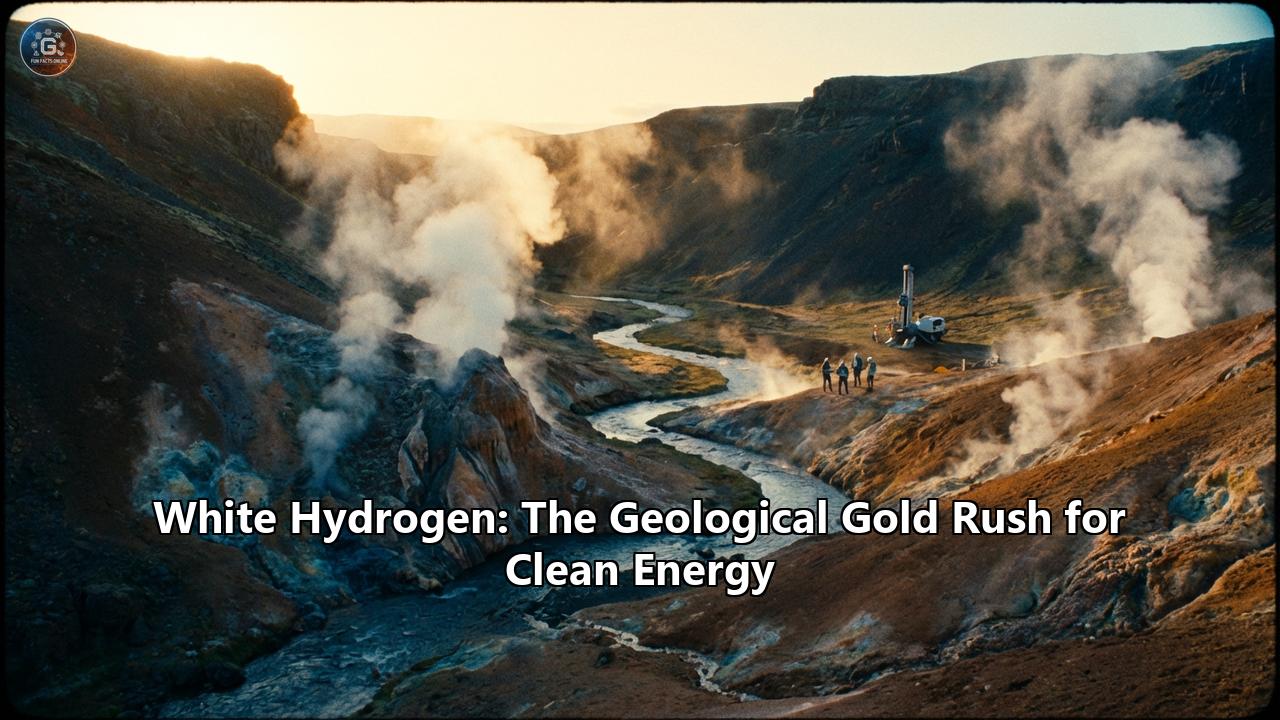
The vast, silent machinery of the global energy transition has long been powered by a simple, color-coded promise: if we can just make green hydrogen cheap enough, we can decarbonize the world. For decades, this meant building forests of wind turbines and fields of solar panels to power expensive electrolyzers, splitting water molecules in a brute-force attempt to replace fossil fuels. It was an engineered solution to a natural problem.
But while scientists and policymakers were looking up at the sun and wind, a revolution was quietly brewing beneath their feet.
Deep within the Earth’s crust, in the fractured veins of ancient rocks and the forgotten corners of failed oil wells, the planet has been manufacturing its own clean fuel for billions of years. It is called white hydrogen—also known as natural, geologic, or gold hydrogen—and it is sparking a modern-day gold rush that spans from the dusty plains of Mali to the verdant hills of France and the cornfields of Nebraska.
This is not just another "potential" energy source. It is a geological reality that challenges the fundamental assumptions of the renewable energy economy. With production costs estimated as low as $0.50 per kilogram—a fraction of the cost of green hydrogen—and zero carbon emissions, white hydrogen represents a wildcard that could accelerate the path to Net Zero by decades. But tapping into this subterranean treasure requires overcoming a minefield of geological mysteries, engineering nightmares, legal voids, and environmental paradoxes.
Part I: The Invisible Ocean
Unlocking the Geological MysteryFor most of the 20th century, geology textbooks taught a simple, dogmatic truth: hydrogen does not exist in its pure form in nature. It is too light, too reactive, and too mobile. It binds with oxygen to form water or carbon to form hydrocarbons. If it ever existed as a gas underground, the logic went, it would have escaped into the atmosphere eons ago.
This dogma was so strong that when oil and gas drillers encountered pockets of pure hydrogen, they often ignored them. In the 1960s and 70s, loggers in Australia and Kansas recorded massive spikes of hydrogen in their detectors. They viewed it as a nuisance—a "dry hole" that contained no oil—and capped the wells, walking away from what we now realize were fortunes.
The Earth as a Hydrogen FactoryThe reality is that the Earth is not just a passive vessel for fossil fuels; it is an active chemical reactor. White hydrogen is generated continuously through several geological processes, turning the crust into a renewable engine.
- Serpentinization: The primary engine of white hydrogen is a process named after the green, snake-skin-like rock it produces: serpentinite. When water trickles down fissures and meets iron-rich ultramafic rocks (like olivine) at high temperatures (200°C to 350°C), a chemical reaction occurs. The water (H2O) oxidizes the iron in the rock, stripping away the oxygen molecules to form rust (iron oxide) and leaving behind pure hydrogen gas (H2). This happens on a massive scale in mid-ocean ridges and ophiolites—sections of oceanic crust that have been thrust up onto land.
- Radiolysis: In the ancient, stable hearts of continents known as cratons, another process is at work. Radioactive elements like uranium, thorium, and potassium naturally decay within the rock. This radiation splits water molecules trapped in the rock's pores, releasing hydrogen. Unlike serpentinization, which requires specific tectonic conditions, radiolysis creates a slow, steady pulse of hydrogen over millions of years.
- Primordial Hydrogen: Some theories suggest a portion of this gas is a remnant from the formation of the Earth, trapped deep in the mantle and slowly leaking upward.
The most visible evidence of this phenomenon looks like a scar on the landscape. In places like Brazil, Russia, and Australia, strange, sub-circular depressions dot the terrain. Known as "fairy circles," these features often have bleached soil and stunted vegetation. For years, they were mysteries. Now, we know that many of them are chimneys where hydrogen is seeping out of the ground, killing the vegetation by consuming the soil's oxygen. These circles have become the treasure maps for modern hydrogen hunters, guiding them to the active leaks that hint at massive reservoirs below.
Part II: The Global Discovery Map
From Accidental Finds to Billion-Dollar PlaysThe narrative of white hydrogen shifted from curiosity to industry in a small village in West Africa, but it has since exploded into a worldwide race.
Mali: The Eternal Flame of BourakébougouThe proof of concept for the entire industry sits in the village of Bourakébougou, Mali. In 1987, a water well driller leaned over a dry borehole with a cigarette. The resulting explosion burned with a blue, smokeless flame that fascinated the locals. It took 25 years for anyone to analyze the gas properly. When they did, they found it was 98% pure hydrogen.
Today, that well is not a relic; it is a power plant. Hydroma Inc., led by Malian entrepreneur Aliou Diallo, installed a Ford engine retrofitted to burn hydrogen, providing carbon-free electricity to the village. The pressure in the well has not dropped in over a decade of use, suggesting the reservoir is being actively refilled by the geological "kitchen" below. It is the world’s first evidence that white hydrogen is not just a finite resource like oil, but a renewable flow like geothermal energy.
France: The Lorraine SurpriseIn 2023, the hunt moved to the heart of Europe. Researchers from the CNRS and Université de Lorraine, exploring the region's old coal mines for methane, lowered a specialized probe 3,000 meters into the earth. At 1,100 meters, they found 14% hydrogen. At 3,000 meters, their models predict concentrations could reach 98%.
This deposit, located in the Lorraine Mining Basin, is estimated to hold between 46 and 260 million tons of hydrogen. To put that in perspective, the entire world currently produces about 90 million tons of hydrogen per year, mostly dirty gray hydrogen from natural gas. A single deposit in France could match global demand for years. Companies like La Française de l'Énergie (FDE) and 45-8 Energy are now racing to secure permits, positioning France as a potential clean energy superpower.
Australia: The Gold Rush Down UnderSouth Australia has arguably the most advanced regulatory environment for white hydrogen, leading to a frenzy of exploration. Gold Hydrogen, listed on the ASX, is re-entering the "Ramsay" wells drilled in the 1930s. Their recent testing confirmed the historical logs: high-purity hydrogen is there.
Meanwhile, HyTerra is looking even further afield, listing on the Australian exchange but operating in the United States. Their focus is the Mid-Continent Rift, a geological scar running through North America that is rich in the iron-bearing rocks needed for serpentinization.
USA: The Billionaire's BetIn the United States, the industry has moved from the fringes to the boardrooms of Silicon Valley. Koloma, a stealthy startup based in Denver, has raised over $305 million from heavyweights like Bill Gates’ Breakthrough Energy Ventures, Amazon, and United Airlines.
Koloma’s approach is data-driven. Instead of wildcat drilling, they are using AI and satellite imagery to identify the "sweet spots" where rock type, fracture networks, and water flow align to create massive hydrogen traps. They are actively leasing land in the Midwest, betting that the same geology that made America an oil giant will make it a hydrogen titan.
Spain: The Pyrenean PlayIn the foothills of the Pyrenees, Helios Aragón is targeting a structure first drilled in 1963. The Monzón-1 well encountered a 100-meter column of pure hydrogen at deep pressure. The company estimates a potential reserve of over 1 million tons—enough to power heavy industry in the region for decades. However, they face a unique European hurdle: Spain’s climate laws currently ban new hydrocarbon exploration, and hydrogen sits in a legal gray area that the company is fighting to clarify.
Part III: The Economic Earthquake
Disrupting the Energy EquationThe enthusiasm for white hydrogen is driven by one number: $1 per kilogram.
Currently, Green Hydrogen (made from renewables via electrolysis) costs between $3 and $8 per kg. It is inextricably potential-bound by the cost of electricity and the efficiency of electrolyzers.
Gray Hydrogen (made from natural gas) costs around $1.50–$2 per kg, but it emits 10 tons of CO2 for every ton of H2. White Hydrogen, if it can be extracted like natural gas, bypasses the need for massive solar farms or carbon capture systems. Early estimates from Mali and projections from U.S. startups suggest a Levelized Cost of Hydrogen (LCOH) of $0.50 to $1.00 per kg.At $1/kg, hydrogen reaches economic parity with diesel and gasoline. It becomes cheap enough not just for niche uses, but to decarbonize heavy trucking, shipping, steel manufacturing, and fertilizer production without massive government subsidies.
The Investment LandscapeThis potential has triggered a flood of capital. Beyond Bill Gates, mining giants like Fortescue (through their investment in HyTerra) and Japanese conglomerates like Mitsubishi Heavy Industries are taking positions. They see white hydrogen not just as a fuel, but as a survival strategy for their existing business models. For oil and gas companies, it is the ultimate lifeline: a way to use their drilling rigs, pipelines, and geologists to produce a product that is 100% green.
Part IV: Engineering the Unknown
Drilling for the Smallest MoleculeWhile the geology is promising, the engineering challenge is immense. Extracting hydrogen is not the same as extracting natural gas (methane).
The Houdini of GasesHydrogen is the smallest molecule in the universe. It is incredibly slippery. It can leak through seals that are tight enough to hold methane. It can permeate solid steel. This creates two major problems: Leakage and Embrittlement.
Hydrogen Embrittlement occurs when hydrogen atoms diffuse into the crystal lattice of metals, making them brittle and prone to catastrophic cracking. Standard oilfield steel tubing (like carbon steel) can shatter like glass if used with high-pressure pure hydrogen.- The Solution: Engineers are turning to specialized materials. High-nickel stainless steels (like 316L with >12% nickel), glass-fiber reinforced composites (GRE), and specialized polymer liners are being tested for downhole tubing. The cost of these materials is higher, but necessary to prevent wells from failing.
White hydrogen rarely comes up pure. In Mali, it is 98%, but in France and Australia, it is often mixed with helium, nitrogen, methane, or CO2.
- The Helium Bonus: Interestingly, this "impurity" might be a savior. Helium is a critical, high-value gas used in MRI machines and semiconductors. Many white hydrogen deposits, like those in the US and Australia, show significant helium concentrations (up to 3-4%). The revenue from selling the helium co-product could cover the entire cost of drilling, effectively making the hydrogen free.
Once out of the ground, moving the gas is the next hurdle. Hydrogen has a low energy density by volume (one third that of natural gas). To move it efficiently, it must be compressed to 700 bar or liquefied at -253°C—both energy-intensive processes.
- Pipeline Blending: The immediate solution is blending. Operators plan to inject white hydrogen into existing natural gas pipelines (up to 20% blends). This requires minimal retrofitting but dilutes the "green" value.
- Dedicated Pipelines: For pure hydrogen, new pipelines made of composite materials or coated steels are required. This infrastructure does not exist yet in most places, meaning early projects will likely rely on local consumption (powering a nearby factory) or truck transport.
Part V: The Legal and Regulatory Void
Who Owns the Air Underground?Technology moves faster than bureaucracy. In many jurisdictions, white hydrogen literally does not exist in the law. Is it a mineral? Is it a gas? Is it water?
The US Split Estate ProblemIn the United States, land ownership often splits "surface rights" (farming, building) from "mineral rights" (oil, gold, gas). But who owns the hydrogen?
- If it is defined as a "mineral," the mineral rights holder owns it.
- If it is produced from water (via stimulated serpentinization), the surface owner (who usually owns water rights) might claim it.
This legal ambiguity is a ticking time bomb for litigation. Companies like Koloma are navigating a patchwork of state laws that were written a century before anyone cared about hydrogen.
Global Patchwork- France moved quickly, amending its mining code in 2022 to include hydrogen, allowing the issuance of exploration permits.
- Spain has a ban on hydrocarbon exploration which inadvertently traps hydrogen projects in limbo, as regulators struggle to differentiate between "mining for gas" and "mining for fossil fuels."
- Australia has been proactive, with South Australia creating a specific licensing tier for hydrogen exploration, attracting global investment.
Part VI: The Environmental Double-Edged Sword
Clean Energy or Climate Risk?White hydrogen is often touted as the "perfect" fuel, but environmental scientists are raising valid cautions.
The Indirect Greenhouse EffectHydrogen itself is not a greenhouse gas. However, if it leaks into the atmosphere, it reacts with hydroxyl radicals (OH). These radicals are the atmosphere's "detergent," responsible for breaking down methane. If they are busy reacting with leaked hydrogen, they cannot break down methane, effectively extending the lifetime of methane in the atmosphere.
- The Warming Power: Recent studies suggest hydrogen’s Global Warming Potential (GWP) is higher than previously thought—about 11 to 13 times that of CO2 over a 100-year horizon. This means that a white hydrogen industry with high leakage rates (through fractured rocks or poor well seals) could accidentally accelerate near-term warming.
In "stimulated" hydrogen projects (where engineers pump water down to hot rocks to accelerate serpentinization—a technique being piloted in Oman and the US), water usage is a concern. While not as thirsty as fracking, injecting millions of gallons of water into arid regions like Oman creates resource conflicts. However, proponents argue that saline or wastewater can be used, avoiding the drain on freshwater supplies.
Part VII: The Future Horizon
2030 and BeyondWe are currently in the "Wildcat Era" of white hydrogen—comparable to the oil industry in 1859 Pennsylvania. The wells are being drilled, the seismic data is being processed, and the first commercial flows are trickling to the surface.
The 2030 Outlook: By the end of the decade, we expect to see the first commercial-scale projects coming online in Australia and France. These will likely be "local hubs"—producing hydrogen to power adjacent ammonia plants or steel mills, bypassing the transport problem. The 2050 Vision: If the "stimulated" hydrogen technology matures—turning the entire crust into a controllable hydrogen factory—white hydrogen could provide a baseload supply of clean fuel that balances the intermittency of wind and solar. It would reshape geopolitics, turning countries with specific geological formations (Mali, France, USA, Australia) into the new energy exporters. Conclusion: The Gold Under Our FeetWhite hydrogen is not a silver bullet; it is a geological lottery ticket. We don't yet know if we have won the jackpot or just a consolation prize. The reserves might be smaller than estimated, or too difficult to extract. But the potential reward—an inexhaustible, localized, carbon-free fuel source beneath our feet—is too great to ignore.
As drilling rigs puncture the soil in Lorraine and Kansas, they are not just looking for gas; they are looking for a new chapter in human history. We spent two centuries digging up carbon to burn. We might spend the next two mining the very element that powers the stars.
White Hydrogen: The Geological Gold Rush for Clean Energy
The global energy transition has long been framed as a battle between the old world of extraction and the new world of manufacturing. We extract oil and gas; we manufacture wind turbines and solar panels. For decades, the consensus was that to save the climate, we must move from digging to building. But what if the Earth had one final, redeeming secret buried in its crust? What if we could dig for a fuel that doesn't cook the planet?
Enter White Hydrogen.
Also known as natural, geologic, or "gold" hydrogen, this resource refers to naturally occurring molecular hydrogen (H2) generated deep underground. Unlike "gray" hydrogen (made from dirty natural gas) or "green" hydrogen (made from expensive electrolysis), white hydrogen is made by the planet itself. It is renewable, potentially vast, and—crucially—projected to be cheaper than any other form of clean energy.
We are witnessing the birth of a new industry. From the birch forests of Eastern France to the arid outback of Australia and the high plains of the American Midwest, a rush is on. Billionaires, major oil companies, and scrappy wildcatters are racing to stake claims on invisible reservoirs that could hold enough clean energy to power humanity for centuries.
This is the comprehensive story of white hydrogen: the science, the discoveries, the economics, and the immense engineering hurdles that stand between us and a geologic revolution.
Part I: The Science of the Subsurface
Breaking the Dogma
For generations, geologists were taught a simple rule: Pure hydrogen does not exist in the ground.
Hydrogen is the lightest element in the universe. It is famously slippery and reactive. The conventional wisdom was that any hydrogen formed underground would either immediately react with other elements (forming water or hydrocarbons) or slip through the rock pores and escape into space. Because of this belief, nobody looked for it. When oil drillers accidentally hit pockets of hydrogen, they cursed their bad luck, capped the "dry" well, and moved on. They were throwing away winning lottery tickets because they didn't know the game existed.
The turning point came not from a lab, but from a mistake. In 1987, in the village of Bourakébougou, Mali, a water well driller leaned over a dry borehole with a cigarette. The resulting explosion left him with burns and the village with a mysterious blue fire that burned without smoke or pollution. It wasn't until 2012 that Aliou Diallo, a Malian businessman, brought in scientists to analyze the gas. The result was shocking: 98% pure hydrogen.
This discovery shattered the geological dogma. It proved that hydrogen could accumulate in massive reservoirs, trapped by rock, just like natural gas.
The Earth’s Hydrogen Kitchens
How does the Earth make this gas? Unlike fossil fuels, which are the cooked remains of ancient dead plants (a finite resource), white hydrogen is produced by inorganic chemical reactions that are happening right now. It is not a fossil fuel; it is a continuous geological flow.
There are three main "engines" driving this production:
1. Serpentinization: The Iron Rusting Engine
This is the most significant source. Deep in the Earth’s crust—and sometimes thrust up to the surface—sit "ultramafic" rocks. These rocks, such as peridotite and olivine, are rich in iron.
When rain or seawater trickles down deep faults and meets these rocks at high temperatures (roughly 200°C to 350°C), a violent chemical reaction occurs. The water molecules (H2O) attack the rock, oxidizing the iron (turning it into rust). In this divorce, the oxygen stays with the iron, and the hydrogen is kicked out as a free gas.
- The Scale: This process happens continuously along the 60,000 km of mid-ocean ridges and in "ophiolite" belts (slices of oceanic crust on land) like those in Oman, New Caledonia, and the Philippines.
2. Radiolysis: The Slow Burn
In the ancient, stable cores of continents (known as "cratons"), rocks are rich in radioactive elements like uranium, thorium, and potassium. As these elements decay, they emit radiation. This radiation acts like a microscopic hammer, smashing water molecules trapped in the rock pores. The water splits into hydrogen and oxygen. While slower than serpentinization, this process has been running for billions of years across vast areas of Canada, Australia, and Russia, potentially building up enormous reserves.
3. Primordial Hydrogen
A more controversial theory suggests that vast quantities of hydrogen were trapped in the Earth's mantle during the planet's formation. This "primordial" gas is slowly leaking upward through deep crustal fractures. While harder to prove, this would represent a finite but colossal reserve.
Fairy Circles: The Treasure Maps
How do prospectors find this invisible gas? They look for "fairy circles."
In regions like Russia, Brazil, and Australia, satellite imagery reveals thousands of sub-circular depressions where vegetation struggles to grow. For years, these were unexplained. Now, researchers know that many of them are hydrogen seeps. As the hydrogen rises, it reacts with the soil, consuming oxygen and changing the pH, creating a dead zone for plants. These circles are now the X-marks-the-spot for exploration companies.
Part II: The Global Gold Rush
The race is no longer theoretical. Drills are turning. Here are the frontlines of the global hunt.
1. France: The Surprise in Lorraine
France, a country with little oil and gas history, has suddenly found itself sitting on a potential energy fortune. In May 2023, researchers from the University of Lorraine and CNRS were testing a probe in the old coal mining region of Lorraine. They were looking for methane (coal bed gas).
Instead, at 1,100 meters down, they found 14% hydrogen. As they projected deeper, the concentration curve spiked. At 3,000 meters, they estimate the concentration exceeds 90%.
- The Numbers: Early estimates suggest the Lorraine basin alone could hold 46 million tons of white hydrogen. That is equivalent to half of the current annual global hydrogen production.
- The Players: La Française de l'Énergie (FDE) is leading the charge, applying for mining permits to exploit what could be the largest deposit in Europe. Another startup, 45-8 Energy (named after the atomic weight of helium), is also active in the region, targeting hydrogen-helium mixes.
2. Mali: The Proof of Concept
Mali remains the spiritual home of the industry. The Bourakébougou field is the only place on Earth where white hydrogen is currently burned for commercial power.
- The Status: Hydroma Inc. has drilled dozens of wells. They have found that the reservoir is shallow (100-1,500 meters) and, miraculously, the pressure recharges. After years of extraction, the well pressure hasn't dropped, proving the "renewable" nature of the resource. Hydroma produces electricity at an estimated cost of $0.50 per kg—cheaper than almost any source of power in West Africa.
3. Australia: The Regulatory Pioneer
South Australia has done something no other region has: they wrote the rulebook first. By adding hydrogen to their Petroleum and Geothermal Energy Act in 2021, they gave companies legal certainty.
- Gold Hydrogen: This company holds the rights to the York Peninsula, where oil prospectors in 1931 found gas that was 80% hydrogen. In late 2023, Gold Hydrogen re-drilled these sites (the Ramsay project) and confirmed high-purity hydrogen flows. They aim to be the first developed nation to produce commercial white hydrogen.
- HyTerra: Another Australian player, though their primary assets are in the US. Backed by an investment from mining giant Fortescue, they are chasing the "Nemaha Ridge" play.
4. USA: Silicon Valley Goes Drilling
In the US, white hydrogen has attracted the "smart money."
- Koloma: Based in Denver, Koloma is the industry unicorn. They have raised over $300 million from Bill Gates’ Breakthrough Energy, Amazon, United Airlines, and Mitsubishi Heavy Industries. Koloma is not just drilling wildcat wells; they are building a geological AI. They are mapping the subsurface of the Mid-Continent Rift (a failed tectonic split running through the Midwest) to find the perfect combination of iron-rich rock and seal. They are currently active in Kansas and Nebraska.
- HyTerra: Operating in Kansas, HyTerra recently announced a massive success at their "Sue Duroche 3" well, measuring 96.1% hydrogen concentration. This is some of the highest purity ever recorded in a new exploration well, validating the American Midwest as a world-class province.
5. Spain: The Legislative Trap
Helios Aragón holds the keys to the Monzón field in Northern Spain. A 1963 deep well here found a massive column of hydrogen. Current estimates put the reserve at over 1 million tons.- The Problem: Spain passed a climate law banning new exploration for fossil fuels. Because hydrogen is extracted using the same techniques as natural gas, it falls into a legal gray area. Helios Aragón is currently fighting a bureaucratic battle to prove that mining for clean hydrogen should be exempt from a ban designed to stop dirty oil.
Part III: The Economic Game Changer
Why is everyone so excited? It comes down to basic math.
The Cost of Color
The hydrogen economy has always been held back by the "Green Premium."
- Green Hydrogen (Electrolysis): Requires massive amounts of renewable electricity and purified water. Even with falling solar costs, it currently costs $3.00 - $6.00 per kg.
- Blue Hydrogen (Gas + Carbon Capture): Cheaper (~$2.00/kg) but technologically complex and still reliant on fossil fuels.
- White Hydrogen: Because the Earth does the work (pressure and heat), the only cost is drilling and transport. Estimates from Mali and the US suggest a production cost of $0.50 - $1.00 per kg.
At $1/kg, hydrogen becomes cheaper than diesel. It becomes viable for steelmaking, shipping, and heavy transport without needing billions in government subsidies.
The Helium Kicker
There is a secret weapon in the economics of white hydrogen: Helium.
Many hydrogen reservoirs (especially in cratons like the US and Australia) are mixed with Helium-3 and Helium-4. Helium is a critical mineral for MRI machines, space exploration, and chip manufacturing, and it sells for up to $400 per thousand cubic feet (compared to natural gas at $3).
If a well produces 95% hydrogen and 5% helium, the helium sales alone could cover the entire cost of the project. This "co-production" model makes the economics of white hydrogen almost bulletproof, even if hydrogen prices crash.
Part IV: Engineering the Impossible
If it's so cheap and abundant, why aren't we burning it yet? Because extracting hydrogen is an engineering nightmare.
The Hydrogen Embrittlement Crisis
Hydrogen is the "Houdini" of elements. It is so small it can diffuse into the solid crystal structure of steel tubing. Once inside, it creates internal pressure, causing the metal to crack and shatter—a phenomenon known as hydrogen embrittlement.
Standard oil and gas pipes (carbon steel) cannot be used. They would fail within months.
- The Solution: Engineers are having to redesign the entire wellbore. They are turning to expensive high-nickel alloys (like stainless steel 316L) or advanced Glass-Reinforced Epoxy (GRE) composites. These materials resist hydrogen attack but drive up the CAPEX of drilling.
The Separation Challenge
In Mali, the gas is pure. But in France and Australia, the hydrogen is often mixed with methane, nitrogen, or CO2.
To sell it as "green" fuel for fuel cells (which need 99.99% purity), the gas must be separated at the surface. This requires Pressure Swing Adsorption (PSA) units or membrane technology at the wellhead. While these technologies exist, deploying them in remote fields adds cost and complexity.
The Midstream Bottleneck
Once you get it out of the ground, how do you move it?
Hydrogen is fluffy. It takes up massive volume for very little energy. To move it, you have to compress it to 700 bar or freeze it to near absolute zero.
- Pipelines: You cannot simply put pure hydrogen into existing steel gas pipelines (due to embrittlement). Retrofitting the global grid requires coating pipelines with polymers or building new composite lines.
- The Blending Bridge: The short-term fix is "blending." Operators can inject up to 20% hydrogen into natural gas grids without damaging the pipes. This decarbonizes the gas supply slightly and creates an immediate market for early white hydrogen projects.
Part V: The Environmental Paradox
Is digging for hydrogen actually good for the planet? The answer is "Yes, but..."
The Indirect Warming Risk
Hydrogen is not a greenhouse gas. It does not trap heat. However, it is an "indirect" greenhouse gas.
When hydrogen leaks into the atmosphere, it reacts with hydroxyl radicals (OH). These radicals are the atmosphere's "cleaning agents"—they break down methane. If the hydroxyls are busy fighting hydrogen, they leave methane alone, extending methane's lifespan in the atmosphere.
Because hydrogen is so small and leaky, a white hydrogen industry with high leakage rates could inadvertently spike global warming in the short term. Scientists estimate hydrogen's Global Warming Potential (GWP) is 11x that of CO2 over 100 years. This means "zero leakage" engineering is not just a safety requirement; it's a climate requirement.
The "Stimulated" Hydrogen Controversy
In Oman, companies like Eden GeoPower are testing a technique called "stimulated" hydrogen. They drill into iron-rich rocks and inject water to force the serpentinization reaction to happen faster.
Critics call this "fracking for hydrogen." It raises concerns about water usage in arid regions and the potential for inducing small earthquakes. However, proponents argue they can use wastewater or seawater, turning a waste product into clean fuel.
Part VI: The Legal Void
In the US, if you own the land, do you own the hydrogen?
It’s a simple question with no answer.
- In a "split estate" (where surface rights and mineral rights are separated), mineral rights usually cover oil, gas, and gold. But hydrogen is not a hydrocarbon. Is it a mineral?
- If the hydrogen is produced by stimulating rocks with water, does the surface owner (who owns the water) have a claim?
This legal ambiguity is stalling projects. In Spain, the ban on hydrocarbon exploration has frozen Helios Aragón because regulators can't decide if hydrogen counts as a "hydrocarbon" activity (it technically isn't). In the US, landmen are scrambling to rewrite leases to specifically include "constituent gases" to avoid future lawsuits.
Conclusion: The Final Energy Frontier
We are standing at the precipice of a new energy epoch. For 150 years, we have relied on the stored sunlight of fossil fuels. For 20 years, we have tried to capture the real-time sunlight of renewables. White hydrogen offers a third path: the Earth's internal energy.
The challenges are real. We need new steel, new laws, and new maps. We need to ensure that in our rush to drill for the "green gold," we don't leak it into the sky.
But the potential is staggering. If the reserves in France, the US, and Australia are proven and recoverable, white hydrogen could provide the "baseload" clean energy that wind and solar cannot. It could decarbonize the industries that batteries cannot reach. It could turn rust belts into energy hubs and old oil fields into clean power plants.
The Gold Rush is on. And this time, the gold is invisible, lighter than air, and might just save the world.
Reference:
- https://www.edf.org/sites/default/files/2024-02/H2WarmingEffectsFactSheet_FEB2024.pdf
- https://medium.com/@pace-ventures/more-difficult-than-it-seems-the-potential-of-white-hydrogen-e15f2f07f226
- https://www.wingoil.com/hydrogen-pipeline-transportation-what-you-need-to-know/
- https://www.swagelok.com/en/blog/avoid-hydrogen-embrittlement
- https://allegianceoil.com/what-is-the-difference-between-mineral-rights-and-surface-rights/
- https://www.haydenoutdoors.com/surface-rights-vs-mineral-rights/
- https://www.petro-ledger.com/blog/mineral-rights-vs-surface-rights-what-owners-should-know
- https://peoplescompany.com/blog/mineral-rights-vs-surface-rights-whats-the-difference-and-why-it-matters
- https://energy.mit.edu/publication/on-the-chemistry-of-the-global-warming-potential-of-hydrogen/
- https://lca-net.com/files/Hydrogen-review-GWP-and-leaks_20230227_public.pdf
- https://www.sercel.com/en/news/natural-hydrogen-challenges-opportunities-and-prospects-energy-transition
- https://rbnenergy.com/daily-posts/blog/hydrogens-unique-properties-make-using-natural-gas-infrastructure-difficult-task