
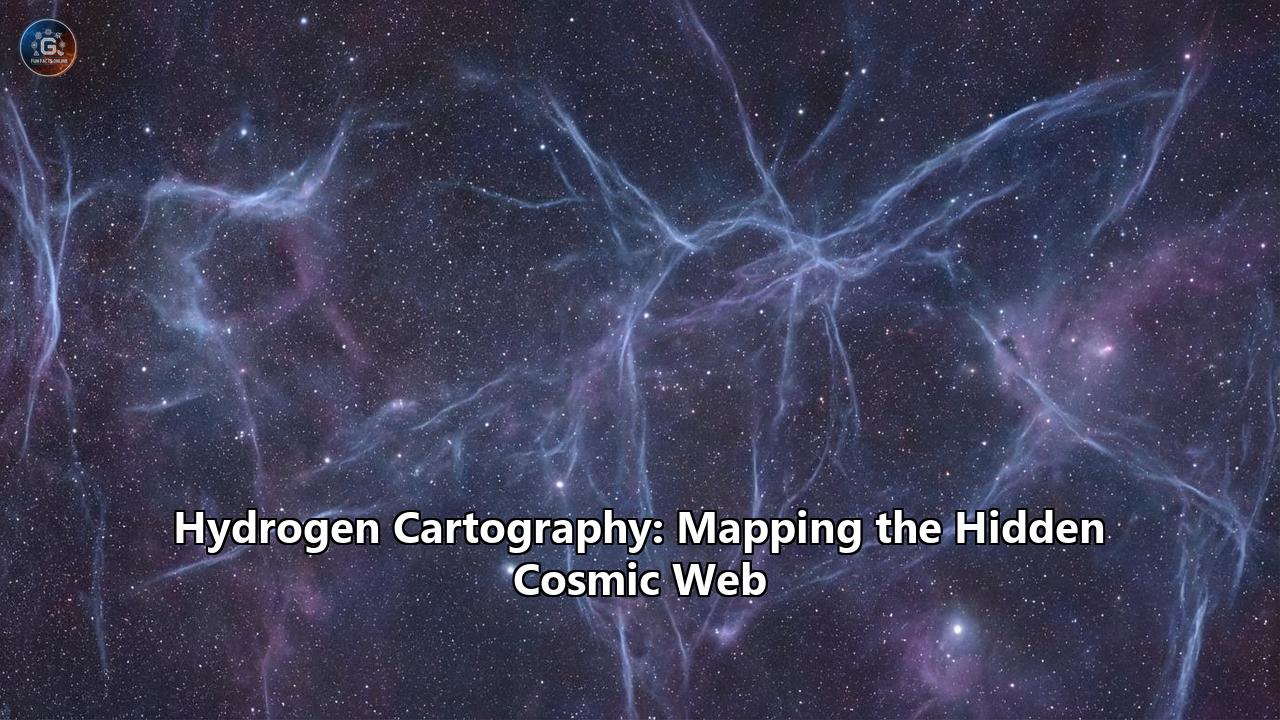
If you were to step outside the universe, transcending the bounds of space and time to view the cosmos in its entirety, you would not see a random scattering of isolated galaxies. You would not find a smooth, featureless void dotted with occasional islands of starlight. Instead, you would be confronted by a staggeringly complex, brilliantly illuminated tapestry. You would see the Cosmic Web—the grandest architectural structure in the universe.
For decades, this macro-structure remained largely theoretical. Cosmologists knew that dark matter, the invisible scaffolding of the universe, gathered into colossal intersecting threads through the relentless pull of gravity. They knew that galaxies should form at the dense intersections of these threads, much like glowing dew drops caught on a spider’s web. Yet, confirming this architecture observationally posed an almost insurmountable challenge. The threads themselves—the intergalactic highways that span millions of light-years across the abyss—are largely devoid of stars. They are comprised of dark matter, which emits no light, and highly diffuse, incredibly faint streams of primordial gas.
To map this hidden universe, astronomers had to become cosmic cartographers, and they needed an "ink" with which to draw their map. They found it in the most abundant, simplest, and oldest element in existence: hydrogen.
Hydrogen cartography has become the vanguard of modern astrophysics. By tracing the faint whispers of hydrogen gas across billions of light-years, scientists are not only illuminating the invisible threads of the Cosmic Web but are also unlocking the secrets of how galaxies are fed, how the universe expands, and how the first stars burned away the cosmic dark ages.
The Missing Scaffolding: Why the Universe is a Web
To understand why mapping hydrogen is so revolutionary, we must first understand how the universe built itself. In the immediate aftermath of the Big Bang, matter was distributed with almost perfect uniformity. However, microscopic quantum fluctuations created infinitesimal differences in density. Over billions of years, gravity amplified these minute differences. Regions with slightly more matter exerted a slightly stronger gravitational pull, drawing in material from their surroundings.
This runaway process sculpted the cosmos into a vast, three-dimensional network. Matter drained out of vast, empty regions known as cosmic "voids" and flowed into immense, interconnected sheets and filaments. Where these filaments intersect, matter pools in deep gravitational wells, giving rise to colossal galaxy clusters bound together by dark matter.
For a long time, astronomers faced a frustrating "missing baryon" problem. Baryons are normal matter—the protons and neutrons that make up stars, planets, and people. When cosmologists measured the total amount of normal matter in the early universe (using the Cosmic Microwave Background radiation) and compared it to the amount of matter locked up in all the stars and galaxies we can see today, the math did not add up. About half of the universe’s normal matter was missing.
Theoretical models suggested that this missing matter hadn't vanished; it was hiding in plain sight. It was strung out along the dark matter filaments in a state known as the Warm-Hot Intergalactic Medium (WHIM). This gas, stretched across millions of light-years, is incredibly sparse—sometimes amounting to just a few atoms per cubic meter. It is also completely invisible to standard optical telescopes. To find the missing matter and map the Cosmic Web, astronomers needed to track down the universe's most elusive, diffuse hydrogen.
The Cartographer's Tools: How to See the Invisible
Mapping the hydrogen of the Cosmic Web requires a symphony of different observational techniques, each tuned to a different state of the gas and a different era of cosmic history. Hydrogen, consisting of a single proton and a single electron, can reveal itself in several distinct ways depending on its environment.
The Lyman-Alpha Forest: Shadows of the Cosmos
The earliest and most established method of hydrogen cartography does not involve looking at the glowing gas itself, but rather looking at the shadows it casts. Astronomers use quasars—the blindingly bright, actively feeding supermassive black holes at the centers of distant galaxies—as cosmic lighthouses.
As the intense ultraviolet light from a quasar journeys across billions of light-years toward Earth, it pierces through the invisible hydrogen filaments of the Cosmic Web. When the light hits a cloud of neutral hydrogen, the atoms absorb a very specific wavelength of ultraviolet light (the Lyman-alpha transition, where an electron jumps from its base energy level to the next level up).
Because the universe is expanding, the light from the quasar is constantly being stretched, or "redshifted," as it travels. Therefore, a hydrogen cloud located three billion light-years away will absorb light at a different observed wavelength than a hydrogen cloud located two billion light-years away. By the time the quasar's light reaches our telescopes, its spectrum is chewed up, featuring a dense thicket of absorption lines known as the "Lyman-alpha forest."
By painstakingly analyzing the Lyman-alpha forests of hundreds of thousands of quasars, astronomers can plot the one-dimensional skewers of hydrogen density along different lines of sight. When stitched together, these skewers begin to reveal the 3D topology of the Cosmic Web. It is akin to mapping a dark room by shining hundreds of laser pointers through it and measuring where the beams are blocked by smoke.
Slime Molds and Cosmic Maps
While the Lyman-alpha forest provides vital data points, connecting the dots to form a cohesive, three-dimensional map of the dark matter filaments requires immensely complex computational modeling. In an astonishing leap of interdisciplinary genius, astrophysicists recently turned to one of Earth's simplest organisms to map the largest structures in the universe: the slime mold Physarum polycephalum.
Slime mold is a single-celled, brainless organism renowned for its extraordinary biological efficiency. When foraging for food, it extends branching tubular networks, constantly optimizing its pathways to find the shortest, most robust connections between nutrient sources. Its network-building behavior has been used by scientists to perfectly recreate the Tokyo subway system and optimize modern road networks.
A team of researchers led by Joseph Burchett at UC Santa Cruz realized that the way slime mold connects food sources is mathematically analogous to how gravity connects galaxies via dark matter filaments. The galaxies are the food; the dark matter is the network. The researchers developed a computational algorithm inspired by the biological growth patterns of the slime mold and applied it to a dataset of 37,000 galaxies mapped by the Sloan Digital Sky Survey within a 300-million-light-year radius.
The algorithm effectively "grew" a cosmic web connecting the galaxies. But to prove that this biologically-inspired map reflected reality, the astronomers needed to check it against the physical presence of hydrogen. They turned to archival data from NASA's Hubble Space Telescope, examining the ultraviolet light from 350 distant quasars that intersected the algorithm's predicted filaments.
The results were a triumph of interdisciplinary science. Exactly where the slime mold algorithm predicted a thick filament of dark matter, Hubble's data showed the telltale absorption signatures of unseen hydrogen gas. The denser the predicted filament, the stronger the hydrogen signal. This marriage of biology and astrophysics provided one of the most accurate, cohesive maps of the local Cosmic Web ever created, proving that the elegant mathematics of network efficiency bridge the microscopic and the macroscopic universes.
Direct Emission: Catching the Faint Glow
While seeing hydrogen via absorption (the shadows) is highly effective, the holy grail of hydrogen cartography is direct emission—actually seeing the gas glow. Because the gas in the intergalactic medium is so sparse and faint, capturing its glow requires staggering technological sensitivity.
Recent breakthroughs have finally made this possible. Using the Multi Unit Spectroscopic Explorer (MUSE) instrument on the Very Large Telescope (VLT) in Chile, a team led by Davide Tornotti captured a stunning direct image of a cosmic filament spanning a breathtaking 3 million light-years.
This colossal thread of hydrogen gas was found connecting two galaxies, both harboring supermassive black holes deep in their cores. The faint glow of the gas was detected as a Lyman-alpha emission, providing a literal photograph of the cosmic highways that ferry raw materials between celestial metropolises. Prior to this, studies focusing on hydrogen's distribution failed because the faint glow was utterly swamped by the brilliance of starlight and galactic glare. By utilizing advanced observational techniques and running corresponding cosmological simulations—which remarkably mirrored the observational data—astronomers are now transitioning from inferring the Web's existence to directly observing its architecture.
Kinematics: The Spinning Highways of the Cosmos
Hydrogen cartography is not just about mapping where the gas is; it is about mapping how it moves. The Cosmic Web is not a static skeleton; it is a living, flowing circulatory system. The filaments are vast pipelines channeling primordial gas into the nodes where galaxies reside, fueling the birth of new stars.
Until recently, it was assumed that these filaments were relatively tranquil rivers of matter drifting passively under the influence of gravity. That assumption was shattered in late 2025 by an astonishing discovery made using a combination of optical surveys and South Africa’s incredibly powerful MeerKAT radio telescope.
An international team led by Dr. Lyla Jung from the University of Oxford focused on a filament containing 14 hydrogen-rich galaxies. The galaxies were aligned in an imposingly thin, needle-like structure, stretching 5.5 million light-years long but only 117,000 light-years wide. By mapping the atomic hydrogen (using the 21-cm radio frequency, an excellent tracer for neutral gas), the team detected the unmistakable kinematic signatures of rotation.
This was not just a river of gas flowing in one direction; the entire 50-million-light-year structure was spinning like a gargantuan cosmic tornado. The researchers calculated the rotational velocity of the filament at a staggering 110 kilometers per second. Even more profoundly, the multi-wavelength approach revealed a coherent spin alignment among the galaxies embedded within it.
Dr. Jung likened the phenomenon to a "teacups ride at a theme park. Each galaxy is like a spinning teacup, but the whole platform, the cosmic filament, is rotating too".
This discovery fundamentally rewrites our understanding of galactic evolution. It demonstrates that the angular momentum (the spin) of galaxies is not purely derived from chaotic local mergers or internal dynamics. Instead, galaxies inherit their spin directly from the massive, rotating filaments of the Cosmic Web. The structure was described as "dynamically cold," meaning it had remained relatively undisturbed since its formation, offering a pristine look at how raw material—atomic hydrogen—funnels through these rotational routes to ignite star formation. Without the ability to map atomic hydrogen dynamically, this monumental feature of cosmic engineering would have remained entirely invisible.
21-cm Cosmology: The Ultimate Radio Map
To push hydrogen cartography to its absolute limits, astronomers rely on a peculiar quirk of quantum mechanics known as the 21-centimeter line. Neutral hydrogen atoms consist of a proton and an electron. Both particles possess a quantum property known as "spin." When the spins of the proton and electron are parallel, the atom is in a slightly higher energy state than when the spins are anti-parallel.
Occasionally—about once every 10 million years for any given atom—the electron will spontaneously flip its spin to anti-parallel, releasing a tiny pulse of energy in the form of a radio wave with a wavelength of exactly 21.1 centimeters. Because a single hydrogen atom takes millions of years to undergo this transition, it might seem useless for observation. However, because the universe is so unfathomably saturated with hydrogen, these rare quantum flips happen constantly on a cosmic scale, creating a continuous, faint radio hum.
Telescopes like the Canadian Hydrogen Intensity Mapping Experiment (CHIME) and the upcoming Square Kilometre Array (SKA) are designed specifically to tune into this 21-cm frequency. Unlike optical telescopes that try to resolve individual galaxies, CHIME uses massive cylindrical parabolic reflectors to measure the aggregate intensity of the 21-cm emission across massive swaths of the sky.
This technique, known as Hydrogen Intensity Mapping, allows cartographers to create deep, three-dimensional maps of the universe's matter distribution on the largest possible scales. By measuring how the 21-cm signal is redshifted, astronomers can slice the universe into time-lapsed layers, plotting the position of hydrogen gas billions of years into the past.
Probing Dark Energy and the Expansion of the Cosmos
Why go through the effort of mapping the macro-distribution of hydrogen using radio waves? The answer lies in the ultimate mystery of modern physics: Dark Energy.
Sprinkled throughout the hydrogen maps are faint, repeating patterns known as Baryon Acoustic Oscillations (BAOs). These are the fossilized imprints of sound waves that rippled through the ultra-hot plasma of the early universe. When the universe cooled and the plasma neutralized into hydrogen gas, these sound waves froze in place, creating vast spherical shells of slightly higher density matter.
Today, these BAO spheres have a known, fixed radius (roughly 500 million light-years across). They act as a "standard cosmic ruler." By mapping the distribution of hydrogen with 21-cm radio astronomy, scientists can locate these BAO rings at different depths in the universe. By measuring how large the rings appear to be at different distances, astronomers can precisely reconstruct the expansion history of the universe. This allows us to track exactly how and when Dark Energy began accelerating the expansion of the cosmos, providing vital clues to the ultimate fate of our universe.
Mapping the Cosmic Dawn: The Epoch of Reionization
If we look far enough back through the hydrogen map, we reach a boundary—a time before the Cosmic Web was illuminated by starlight. Roughly 380,000 years after the Big Bang, the universe had cooled enough for protons and electrons to combine into neutral hydrogen atoms. The brilliant glow of the Big Bang faded, plunging the cosmos into an era known as the "Dark Ages."
During this time, the universe was filled with a thick, opaque fog of neutral hydrogen gas. There were no stars, no galaxies, and no quasars to cast shadows. Slowly, over hundreds of millions of years, gravity pulled the dark matter and hydrogen into the first nodes of the Cosmic Web. Eventually, the gas grew dense enough to ignite, birthing the very first generation of stars.
These primordial stars were massive, burning furiously and unleashing torrents of blinding ultraviolet radiation. This radiation acted like a blowtorch on the surrounding neutral hydrogen fog, ripping the electrons away from the protons in a process called "reionization."
Mapping this era—the Epoch of Reionization—is the final frontier of hydrogen cartography. Radio astronomers are currently attempting to map the 21-cm signal from this exact period. They are looking for a "Swiss cheese" effect. The solid block of cheese is the 21-cm emission from the neutral hydrogen fog. The "holes" in the cheese are the expanding bubbles of ionized space carved out by the light of the first stars.
Detecting these bubbles is incredibly difficult because the faint 21-cm signal from the Cosmic Dawn is buried beneath a deafening roar of foreground radio noise from our own Milky Way galaxy. Yet, next-generation arrays like the SKA are being built with the specific objective of peering through this noise. When complete, they will provide a time-lapse map of the lights turning on in the universe, watching as the primordial hydrogen fog is slowly burned away to reveal the sparkling, web-like architecture we see today.
The Great Cosmic Artery
The endeavor of Hydrogen Cartography represents one of the most profound intellectual achievements of human history. We are a species bound to a rocky planet, orbiting an unremarkable star, tucked away in a quiet spiral arm of the Milky Way. Yet, by decoding the quantum whispers of a single proton and electron, by tracing the shadows cast by ancient black holes, and by borrowing the algorithmic wisdom of a brainless woodland slime mold, we are charting the invisible architecture of infinity.
The Cosmic Web is not merely a structural curiosity; it is the reason we exist. The vast hydrogen filaments flowing across millions of light-years are the great cosmic arteries. They channeled the primordial gas of the Big Bang down into the gravitational wells of dark matter, feeding the birth of galaxies. That hydrogen fueled the stellar furnaces that eventually fused heavier elements—carbon, oxygen, iron—the very atoms that make up our planets and our bodies.
When we look up and map the hidden hydrogen of the Cosmic Web, we are not just observing cold, distant gas. We are looking at our own deep ancestry. We are mapping the roots of the universal tree, tracing the glowing, spinning tributaries that flowed together over billions of years to create the conditions for life, consciousness, and the ability to look back at the stars and draw the map of our origins.
Reference:
- https://science.nasa.gov/mission/hubble/science/science-highlights/mapping-the-cosmic-web/
- https://www.oreateai.com/blog/mapping-the-cosmic-web-how-slime-mold-inspires-astronomical-discoveries/675da840d6540eee71860895aa361aca
- https://scitechdaily.com/astronomers-just-found-a-3-million-light-year-connection-between-galaxies/
- https://www.universetoday.com/articles/a-50-million-light-year-structure-caught-spinning