
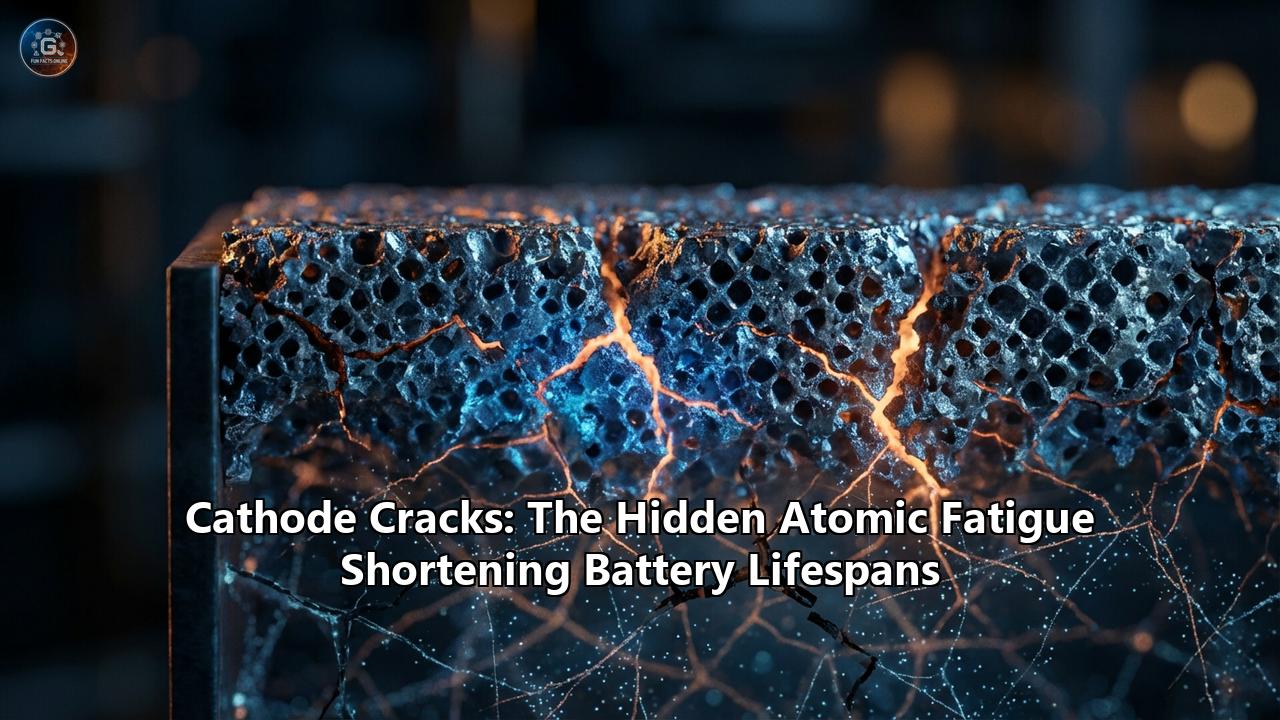
The silent killer of the electric revolution isn't running out of lithium or a sudden scarcity of charging stations; it is a microscopic fracture, thinner than a strand of DNA, occurring billions of times over in the dark heart of your battery pack.
For decades, we have treated batteries as static fuel tanks—inert reservoirs that simply hold energy until we need it. But at the atomic level, a lithium-ion cathode is a violent, heaving landscape. It is a world of constant seismic activity where crystal lattices swell, twist, and shatter under the immense pressure of their own operation. This phenomenon, known as cathode cracking or atomic fatigue, is the primary reason your smartphone creates "phantom" drain after two years and why an electric vehicle (EV) might lose 20% of its range over a decade.
Recent breakthroughs in late 2024 and 2025 have not only unmasked this hidden assassin but have also revealed a shocking paradox: the very cracks that kill your battery are also the only reason it charges fast enough to be useful. This is the story of the atomic civil war inside your battery, and the race to stop it.
The Breathing Lattice: Anatomy of a Fracture
To understand why cathodes crack, we must first abandon the idea of a solid material. A charged battery cathode (typically made of lithium nickel manganese cobalt oxide, or NMC) is like a dried sponge. When you discharge the battery (driving your car or using your phone), lithium ions rush back into this sponge, embedding themselves into the crystal structure.
Imagine a multi-story parking garage where every car that enters forces the concrete pillars to expand by 10%. When the cars leave (charging), the building shrinks back down. Now, imagine doing this daily for ten years.
This process is called anisotropic lattice breathing. As lithium ions shuttle in and out, the crystal lattice of the cathode material expands and contracts. However, it doesn't do so evenly. The crystal might expand by 2% in one direction but contract by 5% in another. This warping creates immense internal tensile stress.
The H2-H3 Phase Transition
The most critical moment occurs during what materials scientists call the H2-H3 phase transition. When a high-nickel battery is charged to near-full capacity (around 4.2V), the material undergoes a sudden, drastic physical shift. The crystal lattice, which has been slowly expanding, suddenly collapses along one axis. This abrupt "snap" is catastrophic at the nanoscale. It pulls the crystal grains apart, creating micro-fissures.
Over hundreds of cycles, these fissures grow. They start as intragranular cracks (hairline fractures inside a single crystal) and evolve into intergranular cracks (massive canyons separating the clumps of crystals).
Once a crack opens, it’s game over for that specific section of the battery. Liquid electrolyte seeps into the fresh fissure, reacting with the exposed raw metal oxide. This reaction creates a "rock-salt" layer—a chemically dead crust that blocks lithium ions from ever entering that part of the crystal again. The active material becomes electrically isolated, effectively "dead weight" that adds mass to your car but stores no energy.
The Single-Crystal Mirage: A Failed Savior?
For years, the battery industry believed they had a silver bullet: Single-Crystal Cathodes.
Traditional cathodes are "polycrystalline"—balls of thousands of tiny nano-crystals glued together. Naturally, these crumble easily, like a popcorn ball falling apart. The logic was sound: if we make the cathode out of one giant, perfect crystal (a "monolith"), there are no boundaries to crack, and the battery should last forever.
By 2024, manufacturers like LG Energy Solution and Tesla began pivoting heavily toward single-crystal high-nickel chemistries. But in late 2025, a landmark study from Argonne National Laboratory and the University of Chicago shattered this optimism.
Researchers discovered a hidden mechanism dubbed "reaction heterogeneity." Even within a perfect single crystal, lithium doesn't move evenly. The core of the crystal might be fully lithiated while the shell is empty, creating a "state-of-charge gradient." The outside of the crystal wants to expand while the inside wants to shrink.
The result? The single crystals didn't crumble from the outside; they tore themselves apart from the inside. This "hidden atomic fatigue" proved that simply removing grain boundaries wasn't enough. We weren't just fighting bad manufacturing; we were fighting the fundamental physics of how lithium moves.
The Faustian Bargain: Why Cracks Are Necessary
Perhaps the most mind-bending discovery of the 2024-2025 research wave came from a team at the University of Michigan, who used a technique inspired by neuroscience to listen to individual battery particles.
They found that cracks are actually beneficial for charging speed.
In a cruel twist of physics, a pristine, uncracked crystal is terrible at fast charging. Lithium ions can only enter through the surface. If the particle is large and uncracked, the ions have a long, slow commute to get to the center. This is why "perfect" batteries often charge painfully slowly.
Cracks act as "atomic highways." They vastly increase the surface area, allowing electrolyte to penetrate deep into the particle and letting lithium ions flood in from all sides simultaneously. The study revealed that the rapid charging speeds we enjoy in modern EVs—adding 200 miles of range in 15 minutes—are partly enabled by the material fracturing.
This presents a Faustian bargain for every EV owner:
- Fast Charging: Relies on cracks to expose more surface area.
- Long Life: Requires preventing cracks to stop side reactions and dead zones.
Every time you supercharge your vehicle, you are essentially trading a tiny slice of its future lifespan for immediate speed, physically tearing open the cathode to let the energy in faster.
Industry Battlegrounds: The Tesla 4680 and the Dry Coating Struggle
The fight against cathode fatigue has moved from the microscope to the factory floor, most visibly in Tesla’s struggle with the 4680 cell.
Tesla's "dry battery electrode" (DBE) process was promised to be a revolution. By eliminating toxic solvents and drying ovens, it would cut costs by 50%. But while dry-coating the anode (negative side) was easy, the cathode (positive side) became a manufacturing nightmare.
The issue? Hardness. Single-crystal, high-nickel cathode powder is incredibly hard and abrasive. When Tesla tried to crush this dry powder into a film using massive steel rollers (calendering), the microscopic hardness of the crystals dented and destroyed the expensive rollers.
The "denting" issue wasn't just a machine failure; it was a symptom of the material's stubbornness. The very rigidity that makes a cathode durable makes it impossible to manufacture with dry methods. Throughout 2024 and 2025, reports emerged of scrap rates as high as 50%—meaning half the cathodes made were thrown away. The atomic resilience of the crystal was destroying the machines trying to build it.
The Startups and The Fix: Atomic Armor
If we can't stop the lattice from breathing, and we can't fully prevent cracks without losing charging speed, what can we do? The answer lies in epitaxial entropy-assisted coatings and atomic doping.
A new wave of startups and research initiatives, including Nano One and researchers at ANSTO, are deploying "atomic armor." Instead of coating the particle in a simple shell, they are infusing the surface of the cathode with "pillar" ions—typically magnesium or aluminum.
Imagine the parking garage again. If you replace the concrete pillars with flexible steel beams (magnesium ions), the building can flex and sway without cracking.
- Entropy-Assisted Coatings (EEC): Developed by Argonne scientists, this technique uses a chaotic mix of elements at the surface of the crystal. This "entropy" (disorder) makes the surface thermodynamically stable, preventing the rock-salt crust from forming even when cracks do appear. It’s like cauterizing a wound the instant it opens.
- Self-Healing Materials: 2025 has seen the first viable prototypes of cathodes that use a "viscoelastic" binder. When a crack opens, the binder stretches rather than snaps, and under heat (generated during charging), it flows back into the crack to seal it, preserving the electrical connection.
The Economic Reality: The Million-Mile Dream
Why does this matter to your wallet? The "Million-Mile Battery" is the holy grail of the EV industry not because you will drive a million miles, but because of Vehicle-to-Grid (V2G) technology.
In the near future, your car will make money for you by selling electricity back to the grid during peak hours. But today, owners are terrified to do this because every cycle causes cathode fatigue. If you sell $5 of electricity but do $10 worth of atomic damage to your cathode, you are losing money.
Solving cathode cracking is the key to unlocking the energy economy. If a battery can cycle 10,000 times without fatigue, your car becomes a permanent asset, a mobile power plant that never degrades. The resale value of used EVs—currently plummeting due to battery health fears—would stabilize.
Conclusion: The Immortal Battery
We are standing at the precipice of a new era in materials science. For thirty years, we have built batteries by trial and error. Now, we are building them atom by atom.
The discovery of hidden atomic fatigue and the dual nature of cracks has fundamentally changed how we design energy storage. We are moving away from "stiff" materials that resist change, toward "living" lattices that breathe, flex, and heal.
The battery of 2030 will not be a static fuel tank. It will be a biological mimic—a structure that thrives on the stress of operation, using controlled fracturing to breathe energy in and self-healing mechanisms to sustain itself for decades. The cracks that once spelled the end of the road are becoming the very channels through which the future flows.
Reference:
- https://www.youtube.com/watch?v=mEBRQ9KWrRY
- https://www.energy.cam.ac.uk/news-and-events/news/insights-lithium-ion-battery-failure-mechanism
- https://www.recurrentauto.com/research/lessons-in-electric-car-battery-health
- https://www.ch.cam.ac.uk/news/fighting-fatigue-lithium-ion-batteries
- https://www.sciencedaily.com/releases/2023/08/230801105006.htm
- https://cleantechnica.com/2023/12/24/tesla-4680-battery-production-is-trapped-in-production-hell/
- https://eepower.com/news/cancelation-looms-as-tesla-pushes-4680d-dry-coating/
- https://www.seaisi.org/details/24036?type=news-rooms