
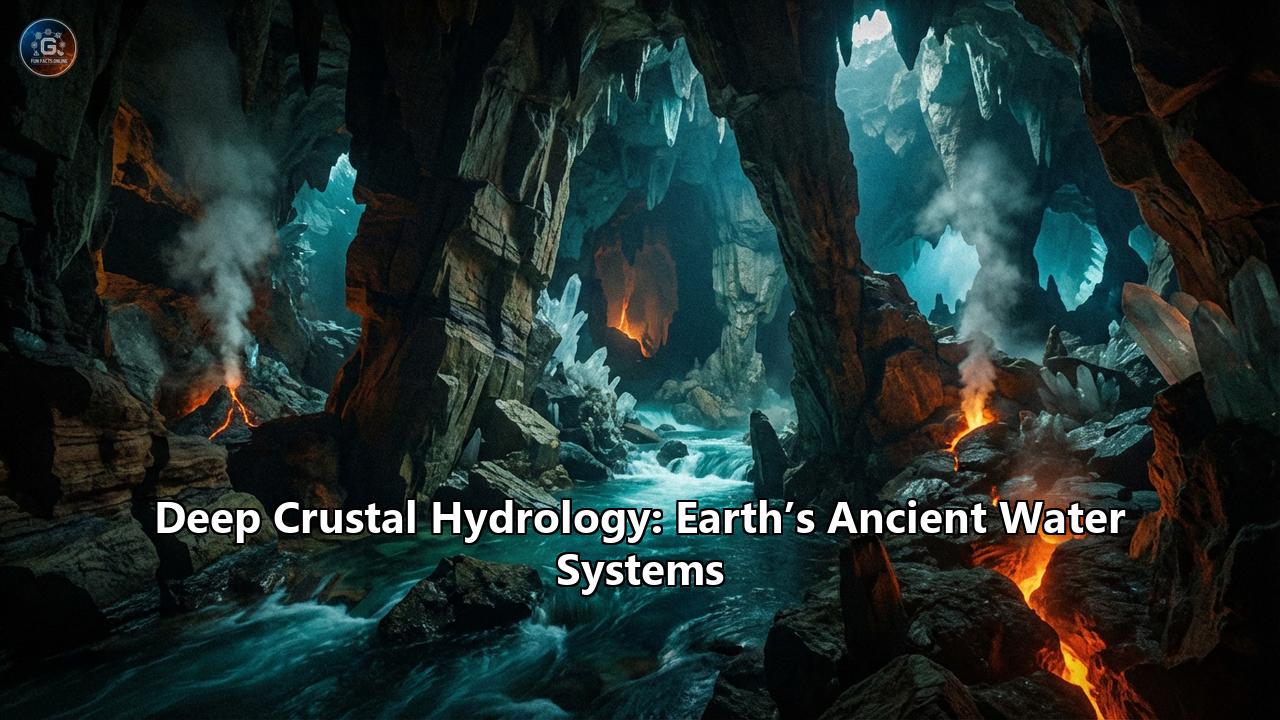
In 2013, deep within the Canadian Shield, a geochemist brought a vial of water to her lips and tasted it. It was not the fresh, crisp liquid one might expect from a pristine underground spring. It was viscous, syrupy, and overwhelmingly salty—eight times saltier than the ocean—with a bitter metallic tang. But the most remarkable quality of this water was not its taste; it was its age. This fluid had been trapped in the rock for over 1.5 billion years, isolated from the surface world since a time before multicellular life existed on Earth.
This discovery at the Kidd Creek Mine in Ontario was a watershed moment in geology, shattering the long-held assumption that groundwater only circulates in the upper few hundred meters of the Earth's crust. Instead, it revealed the existence of a vast, hidden hydrosphere: deep crustal hydrology. This domain, extending kilometers beneath our feet, is not merely a static tomb of ancient rock. It is a dynamic, albeit slow-moving, system where water, rock, and radiation interact to create a chemical engine capable of sustaining life in the dark for billions of years.
To understand Earth, and potentially the habitability of other worlds, we must look beyond the blue oceans on the surface and peer into the dark, saline oceans locked within the stone.
The Architecture of the Deep CrustFor decades, hydrogeology was a science of the surface. It focused on aquifers, water tables, and the hydrologic cycle driven by solar energy—evaporation, precipitation, and river flow. The "deep crust"—the crystalline basement rock that forms the continental plates—was widely considered dry and impermeable.
We now know this is false. The continental crust is riddled with fractures, pores, and fissures. While these spaces are microscopic, cumulatively they possess a volume that is staggering. Recent estimates suggest that the groundwater stored in the top 10 kilometers of the Earth's crust amounts to approximately 44 million cubic kilometers. To put this in perspective, that is more water than is held in all of Earth's ice sheets and glaciers combined.
This water does not flow like a river. In the deepest sections, it moves at a glacial pace, sometimes migrating only meters over millions of years. It is often referred to as "fossil water," a term that implies stagnation. However, "ancient fluid system" is a more accurate descriptor. These fluids are highly evolved brines, their chemistry radically altered by eons of interaction with the surrounding rock.
Case Study: The Time Capsules of Kidd CreekThe Kidd Creek Mine, a copper and zinc mine north of Timmins, Ontario, serves as the premier laboratory for this science. As miners chased ore veins deeper—down to nearly 3 kilometers (9,800 feet)—they encountered fractures gushing with water.
By analyzing the "noble gases" dissolved in this water—specifically isotopes of helium, neon, argon, and xenon—scientists could determine when the water last had contact with the atmosphere.
- Helium-4 accumulates from the radioactive decay of uranium and thorium in the rock.
- Neon-21 is produced when alpha particles collide with oxygen or magnesium.
- Xenon isotopes help track the fluid's origin and evolution.
The results were shocking. The residence time of the fluids at 2.4 kilometers depth was roughly 1.5 billion years. At 3 kilometers, the water dated back 2 billion years. This water had been sealed in the rock since the Great Oxidation Event, effectively serving as a time capsule of the Earth's early atmosphere and ocean chemistry.
The Chemical Engine: Radiolysis and SerpentinizationHow does water survive, and what does it do, in the dark for a billion years? The answer lies in two abiotic (non-biological) chemical processes that turn the deep crust into a chemical reactor.
1. Radiolysis: Splitting Water with RockThe deep crust is rich in radioactive elements like uranium, thorium, and potassium. As these elements decay, they emit ionizing radiation (alpha, beta, and gamma particles). When this radiation strikes a water molecule ($H_2O$), it splits it.
The primary reaction, known as radiolysis, breaks water down into hydrogen gas ($H_2$) and oxidants like hydrogen peroxide ($H_2O_2$) and sulfate ($SO_4^{2-}$).
- Significance: This provides a continuous, slow-burning source of hydrogen—a potent fuel for microbial life—completely independent of photosynthesis or surface biological processes.
In rocks rich in iron and magnesium (ultramafic rocks), water reacts with minerals like olivine to form serpentine minerals, magnetite, and hydrogen gas. This process, serpentinization, is highly exothermic (heat-releasing) and produces highly alkaline fluids.
- The Sabatier Reaction: The hydrogen produced can react with inorganic carbon (like $CO_2$) to form methane ($CH_4$) and water. This is a form of abiotic methane synthesis—creating a hydrocarbon fuel without any biological life involved.
In the deep crust, these two processes create a "chemical soup" rich in hydrogen, methane, and sulfate—essentially a buffet for any organism tough enough to live there.
The Deep Biosphere: Life in the UnderworldThe most profound implication of deep crustal hydrology is biological. Where there is water and chemical energy, there is life.
In the deep gold mines of South Africa, such as Mponeng and Beatrix, scientists have found life thriving at depths of 3 to 4 kilometers. These are not merely surface bacteria that washed down recently; they are ancient lineages adapted to extreme pressure and heat.
- Desulforudis audaxviator: The "Bold Traveler." This bacterium was discovered in 2.8-kilometer-deep fluid in the Mponeng mine. It is a "one-species ecosystem." Unlike surface life, which relies on a food web (plants eat sun, herbivores eat plants, etc.), D. audaxviator does it all. It fixes its own carbon, fixes its own nitrogen, and fuels itself using the hydrogen and sulfate produced by radiolysis. It is a chemosynthetic organism living on nuclear energy (radiation from rocks) rather than solar energy.
- Nematodes of the Deep: In the Beatrix Gold Mine, researchers found tiny worms (nematodes) living in stalactites formed by fissure water 1.4 kilometers underground. These organisms graze on bacterial biofilms, proving that complex, multicellular life can exist deeper than previously imagined.
While deep crustal hydrology focuses on free water in rock fractures, the story of Earth's deep water goes even deeper—into the mantle.
In 2014, scientists analyzing a "trash" diamond from Brazil found an inclusion of a mineral called ringwoodite. Ringwoodite only forms in the "transition zone" of the Earth's mantle, between 410 and 660 kilometers deep. Crucially, this crystal contained hydroxide ions ($OH^-$) trapped in its lattice—about 1.5% water by weight.
This may sound dry, but applied to the massive volume of the transition zone, it implies that this layer of the Earth could hold three times the volume of all surface oceans combined. Unlike the liquid brine of the crust, this "water" is bound within the mineral structure, but it proves that the Earth acts as a massive sponge, cycling volatiles from the surface, through subduction zones, into the deep interior, and back out via volcanism. This "Deep Water Cycle" is likely what has kept our surface oceans stable for billions of years, preventing Earth from becoming a dry desert like Mars.
Astrobiological Implications: The Universal BlueprintThe study of deep crustal hydrology has rewritten the rulebook for astrobiology. If life on Earth can survive for billions of years in deep, dark, isolated fractures powered only by water-rock interactions, then a planet does not need to be in the "Goldilocks Zone" (where liquid water exists on the surface) to be habitable.
- Mars: The Martian surface is hostile—dry, irradiated, and freezing. But the Martian crust is ancient and basaltic, similar to Earth's deep crust. It is highly probable that deep liquid aquifers exist beneath the Martian cryosphere. If life ever evolved on Mars, it likely retreated into these deep, warm, radiolytic sanctuaries billions of years ago. The methane plumes occasionally detected on Mars could be signatures of this deep, abiotic serpentinization or even biological activity.
- Enceladus and Europa: The icy moons of Saturn and Jupiter have subsurface oceans sitting atop rocky cores. The chemistry driving Earth's deep biosphere—serpentinization releasing hydrogen—is almost certainly happening on the seafloors of these moons. The hydrogen plumes detected erupting from Enceladus are direct evidence of this hydrothermal activity.
We often look to the stars to find the alien and the unknown, yet we are standing atop a world just as foreign. Deep crustal hydrology has revealed that the ground beneath us is not solid, dead rock, but a vast, fluid-filled lung that breathes on geological timescales. It stores oceans of ancient water, manufactures its own fuel, and harbors a "shadow biosphere" that has survived unchanged since the dawn of time.
As we continue to drill deeper—into the ancient cratons of South Africa, the shield rocks of Canada, and the seabeds of the Pacific—we are not just exploring Earth's history; we are exploring the fundamental limits of life itself. The discovery of Earth's ancient water systems suggests that the universe may be far wetter, and perhaps far more alive, than the dry surface of our neighbors would lead us to believe.
Reference:
- https://modernengineeringmarvels.com/2025/05/26/ringwoodites-secret-how-a-hidden-ocean-in-earths-mantle-is-rewriting-the-planets-water-story/
- https://pdfs.semanticscholar.org/ddc2/a3cab55352e6463d568580f5ad59950cfbd3.pdf
- https://en.wikipedia.org/wiki/Serpentinization
- https://answersingenesis.org/geology/rocks-and-minerals/diamond-ringwoodite-reveals-water-deep-earths-mantle/