
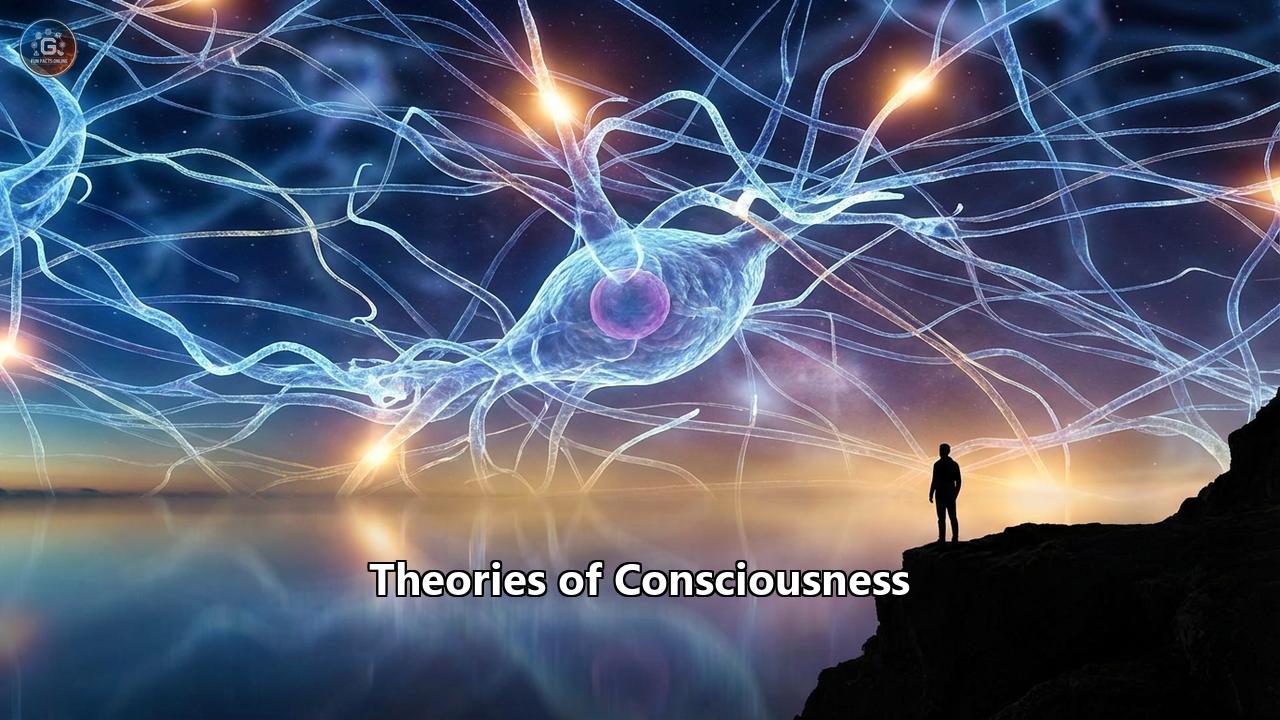
Imagine for a moment that you are a highly sophisticated biological robot. Your eyes are cameras, your ears are microphones, and your brain is a wet, squishy supercomputer processing data streams. But there is something else happening, isn't there? You don't just process the redness of a rose; you experience it. You don't just register pain as a damage signal; it hurts.
This is the Hard Problem of Consciousness, a term coined by philosopher David Chalmers. It asks why physical processing gives rise to a rich inner life. Why doesn't all this neural activity go on "in the dark," without any subjective feeling?
For centuries, this was the playground of mystics and philosophers. But in the last few decades, consciousness has moved into the lab. We are now in a Golden Age of consciousness science, characterized by high-stakes rivalries, billion-dollar experiments, and radical new theories that challenge our very place in the universe.
Here is a journey through the leading theories of consciousness, the dramatic battles being fought between them, and what they mean for the future of AI and our relationship with the animal kingdom.
The Heavyweights: The "Adversarial" Showdown
The scientific landscape is currently dominated by two giants. These two theories are so prominent—and so contradictory—that the scientific community recently organized an "adversarial collaboration," a massive, multi-lab experiment designed to pit them against each other directly.
1. Integrated Information Theory (IIT)
The Architect: Giulio Tononi (University of Wisconsin–Madison) The Big Idea: IIT starts from the inside out. It argues that consciousness is a fundamental property of any system that has a specific kind of causal structure. It’s not about what the brain does (input-output), but what it is.According to IIT, a system is conscious if it possesses "integrated information," quantified by a mathematical value called Phi (Φ). A system with high Phi is more than the sum of its parts; it cannot be reduced to smaller, independent components without losing information.
- The Prediction: IIT predicts that the physical seat of consciousness is in the posterior hot zone (the back of the brain), where the neural grid is incredibly dense and interconnected.
- The Vibe: Panpsychist-adjacent. If a thermostat or a grid of logic gates has a tiny bit of Phi, it has a tiny bit of consciousness.
2. Global Neuronal Workspace Theory (GNWT)
The Architect: Stanislas Dehaene (Collège de France) and Bernard Baars The Big Idea: GNWT is functional and architectural. It views the brain as a collection of specialized unconscious processors (vision, language, motor skills). Consciousness is the "spotlight" of attention.When a piece of information becomes strong enough, it "ignites" and is broadcast to a Global Workspace—a network of neurons primarily in the prefrontal cortex (the front of the brain). Once in the workspace, this information becomes globally available for speech, memory, and action. That global broadcast is the subjective experience.
- The Prediction: Consciousness happens in the front of the brain (prefrontal cortex). It is an "all-or-nothing" event—either you are conscious of a stimulus, or you aren't.
- The Vibe: Computational. Consciousness is software sharing data.
The 2024-2025 Showdown: Who Won?
The results of the massive adversarial collaboration released recently sent shockwaves through the field.
- The Verdict: It was a double knockout.
- IIT’s Stumble: The experiments did confirm that the "posterior hot zone" (back of the brain) was more active during conscious experience than the front. However, the specific type of sustained synchronization between neurons that IIT predicted was not observed.
- GNWT’s Stumble: The theory relies on the idea of an "ignition" in the prefrontal cortex. The experiments found that while the front of the brain lit up at the start of a conscious experience, it didn't stay active, and it didn't light up reliably at the end of the experience, which GNWT strictly requires.
The result? The "Big Two" are both incomplete. The field is now wide open.
The Rising Contender: The Predictive Brain
While IIT and GNWT fight over the "where," a third theory is quietly winning over the "how."
3. Predictive Processing (Active Inference)
The Architect: Karl Friston (University College London) and Anil Seth (University of Sussex) The Big Idea: You are not seeing the world; you are hallucinating it.Predictive Processing suggests the brain is a "prediction machine." It doesn't passively receive sensory data. Instead, it is constantly generating a model of what it expects to see, hear, and feel.
- The Mechanism: The brain projects a "controlled hallucination" outwards. Sensory data from the eyes and ears only serves to correct the prediction (error signals). If you expect to see a dog and you see a cat, your brain updates its model.
- Consciousness: Subjective experience is the "top-down" prediction that best explains the current sensory data.
- The "Beast Machine": Anil Seth argues that our most fundamental prediction is not about the outside world, but about our internal biological state (being alive). We predict our heart rate, our hunger, our temperature. Our sense of "self" is just a control mechanism to keep the biological machine alive. We feel, therefore we are.
The Radical Fringes
If the biological explanations feel too "dry," the fringes of consciousness science offer wilder alternatives.
4. Quantum Consciousness (Orch OR)
The Architects: Sir Roger Penrose (Nobel Laureate) and Stuart Hameroff The Theory: Consciousness isn't a computation; it's a quantum event.They argue that the classical physics of neurons is insufficient to explain the non-computational nature of understanding. Instead, they look inside the neurons, at the microscopic scaffolding called microtubules. They propose that quantum processing occurs in these microtubules and that consciousness is a result of gravity-induced collapse of the quantum wavefunction.
- Status: Long dismissed as fringe, this theory has seen a resurgence. Recent experiments have shown that quantum effects can survive in warm, wet biological environments (quantum biology), making the theory less impossible than previously thought.
5. Illusionism
The Architect: Daniel Dennett and Keith Frankish The Theory: The "Hard Problem" is a magic trick.Illusionists argue that we don't actually have "qualia" (the redness of red). We just think we do. The brain constructs a user-interface that simplifies the complex machinery of neural firing into a "smooth" experience. Introspection is a liar. We are zombies who think we are conscious.
- The Hook: It sounds absurd, but it solves the Hard Problem by deleting it. If there is no subjective experience to explain, the problem vanishes.
The New Frontiers: AI and Animals
The debate over these theories isn't just academic; it determines how we treat the other minds sharing our planet—and the ones we are building.
The New York Declaration on Animal Consciousness (2024)
In April 2024, a group of prominent scientists signed a declaration that fundamentally shifted the ethical landscape.
- The Shift: We used to demand absolute proof before admitting an animal might be conscious. The Declaration argues this is backwards.
- The Scope: It asserts there is a "realistic possibility" of consciousness not just in mammals and birds, but in reptiles, fish, and crucially, invertebrates. This includes octopuses (who are famously intelligent) but also potentially insects and crustaceans.
- The Consequence: If a theory like IIT is correct (where structure matters), a bee or a crab might have a potent, albeit alien, form of consciousness. This demands a revolution in animal welfare laws.
The AI Dilemma: Are We Building "Silicon Zombies"?
With the rise of Large Language Models (LLMs) like GPT-4 and Claude, the question "Is it conscious?" has moved from sci-fi to the boardroom.
- The Test: A recent paper titled "Consciousness in Artificial Intelligence" (2023/2024) proposed a new way to test AI: Indicator Properties. Instead of asking the AI, we check if its architecture matches our best theories.
- The Result: Current LLMs check some boxes (they have attention mechanisms), but fail others.
GNWT View: They lack a true "Global Workspace" that broadcasts information system-wide in a unified way; they are mostly feed-forward statistical engines.
IIT View: Standard computers have incredibly low Phi. Their architecture is linear, not interconnected. According to IIT, you could simulate a human brain perfectly on a digital computer, and it would be a "Zombie"—acting conscious but feeling nothing.
Predictive Processing View: This is where it gets tricky. LLMs are prediction machines. If consciousness is just "next-token prediction" applied to sensory data, we might be closer than we think.
Conclusion: The Mystery Deepens
We are currently in a fascinating scientific limbo. The "Adversarial Collaboration" showed us that our top theories are flawed. The rise of AI is forcing us to define exactly what consciousness is* before we accidentally create it—or deny it to a being that has it.
For now, the only thing we know for sure is the experience itself: the words on this screen, the weight of your device, the feeling of curiosity. Everything else is a theory waiting to be proven.
Reference:
- https://rossdawson.com/theories-consciousness-age-ai/
- https://pub.towardsai.net/what-jailbreaking-actually-teaches-us-about-ai-consciousness-e51bf5beaf34?source=rss----98111c9905da---4
- https://academic.oup.com/nc/article/doi/10.1093/nc/niaf057/8377180
- https://mindmatters.ai/2025/05/what-did-the-multi-year-consciousness-study-really-find/
- https://eyeofheaven.medium.com/predictive-processing-a-theory-of-consciousness-0580d836822d
- https://www.theanimalreader.com/2024/04/22/scientists-emphasize-recognizing-animal-consciousness-welfare/
- https://leoh.ch/announcement/view/100
- https://sites.google.com/nyu.edu/nydeclaration/background
- https://sites.google.com/nyu.edu/nydeclaration/declaration
- https://www.reddit.com/r/ArtificialSentience/comments/1oltkh3/new_research_results_llm_consciousness_claims_are/