
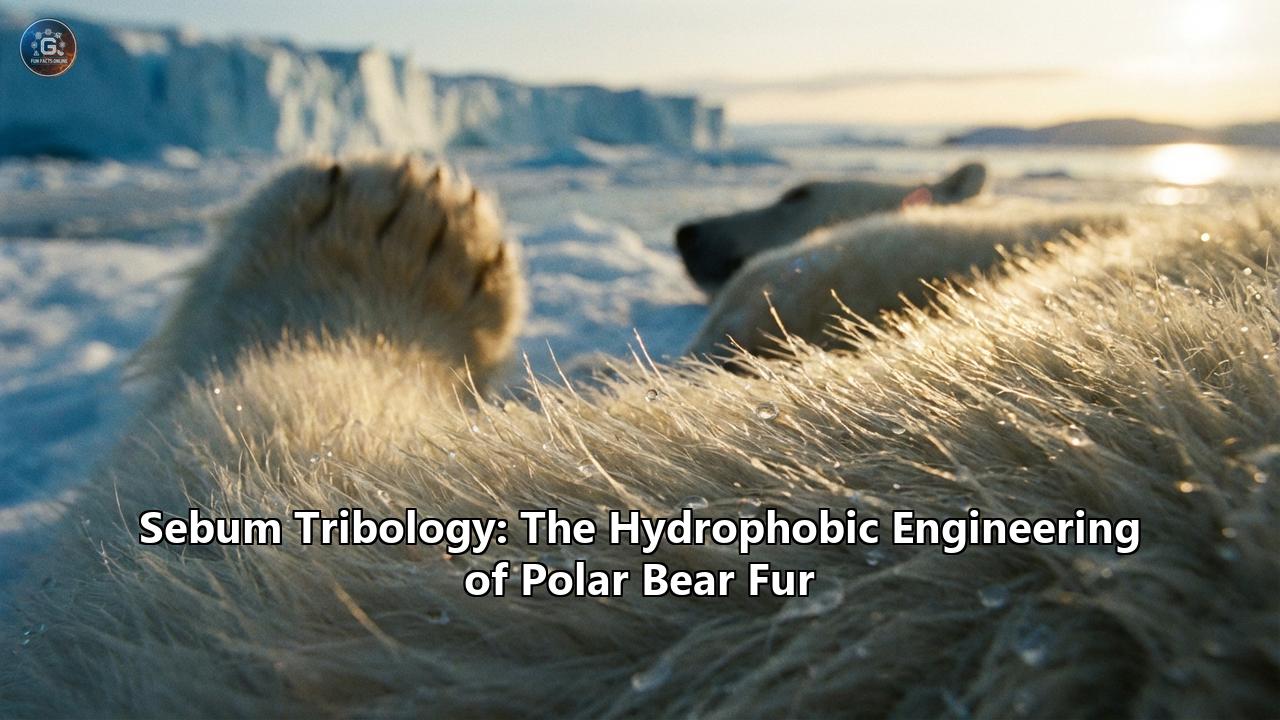
The High Arctic is a laboratory of extremes. Here, in a landscape defined by the crushing physics of phase transitions—where water is a stone and air is a knife—biology does not merely survive; it engineers. Among the pantheon of extremophiles, the polar bear (Ursus maritimus) stands as the apex practitioner of thermodynamic and tribological mastery. For decades, scientists focused on the bear's thermal insulation, marveling at the fat layers and the hollow hairs that capture invisible heat. But a more subtle, slippery secret has arguably been the true key to their conquest of the ice.
This is the story of Sebum Tribology: the complex, hydrophobic engineering of the oily coating that allows a half-ton predator to glide silently over dry snow, shed freezing water instantly, and defy the sticky, lethal grip of Arctic ice. It is a story of molecular selection, where the absence of a single common molecule—squalene—separates the masters of the ice from the frozen masses.
Part I: The Tribological Imperative
To understand the engineering of polar bear fur, one must first understand the tribological nightmare of the Arctic. Tribology is the study of interacting surfaces in relative motion: friction, wear, and lubrication. In the temperate world, friction is often a nuisance. In the Arctic, it is an existential threat.
Water, when frozen, is not merely cold; it is adhesive. Ice possesses a high surface energy that bonds aggressively to most materials. For an animal that hunts on sea ice and swims in sub-zero waters, the risk is not just hypothermia, but encapsulation. If water were to freeze onto a bear’s fur after a swim, the accumulation of heavy ice plates would destroy the fur’s insulating loft, weigh the animal down, and make silent movement impossible. The clatter of frozen fur would announce the predator's arrival long before it reached a seal’s breathing hole.
Furthermore, the bear effectively lives on a giant tribometer. It must generate enough static friction (traction) to walk on slick ice, yet possess low enough kinetic friction to slide when necessary—a behavior often seen when bears navigate fragile ice crusts or descend slopes. The polar bear has solved these contradictions not through mechanical claws alone, but through a sophisticated surface treatment of its pelage: a biological lubricant that defies the standard laws of mammalian biochemistry.
Part II: The Architecture of the Interface
Before analyzing the oil (sebum), we must appreciate the substrate: the fur itself. The polar bear’s coat is a dual-layered composite material designed for optical and thermal management.
The Guard HairsThe outer layer consists of long, coarse guard hairs, approximately 50 to 150 microns in diameter. To the naked eye, they appear white, but under a Scanning Electron Microscope (SEM), they reveal their true nature: they are transparent, hollow tubes made of keratin. This hollowness—the medulla—occupies roughly one-third of the hair’s diameter.
This structure serves a dual purpose. Optically, the chaotic scattering of light inside the hollow core creates the white appearance, much like a cloud, camouflaging the bear against the pack ice. Thermally, the air column provides insulation. But tribologically, the guard hairs are the "contact patch" for the environment. They are the shield that meets the ice.
The Micro-TopographyUnder high magnification, the surface of a guard hair is not smooth. It is shingled with cuticular scales, roughly 500 nanometers thick. This roughness is intentional. In the world of surface physics, roughness determines wetting. A perfectly smooth surface might allow water to spread and bond. A rough surface, however, can trap pockets of air beneath a water droplet, creating a "Cassie-Baxter" state where the water sits on top of the texture rather than penetrating it. This is the first line of defense: a physical structure that encourages hydrophobicity.
However, structure alone is insufficient. Without the right chemical coating, ice would eventually interlock with these scales, creating a bond stronger than the hair itself. This is where the sebum enters the equation.
Part III: The Chemistry of Non-Adhesion
In 2025, a landmark study published in Science Advances fundamentally changed our understanding of polar bear biology. For years, it was assumed that polar bear fur was simply "oily," much like the fur of a beaver or an otter. But when researchers analyzed the chemical composition of polar bear sebum (the natural oil secreted by sebaceous glands), they found a striking anomaly.
The Squalene AnomalyIn almost all other mammals—including humans, otters, and seals—sebum is rich in a hydrocarbon called squalene. Squalene is an excellent moisturizer and antioxidant. However, it has a fatal flaw in the Arctic: it is "sticky" to ice. Squalene possesses high adsorption energy when interacting with water molecules, acting effectively as a coupling agent that promotes ice adhesion.
The polar bear has evolutionarily purged squalene from its skin profile.
Chemical analysis reveals that polar bear sebum is composed of a highly specific cocktail of:
- Cholesterol Esters: High-molecular-weight lipids that form a semi-crystalline wax at low temperatures.
- Diacylglycerols: Specific fats that provide lubrication.
- Branched Fatty Acids: These prevent the sebum itself from freezing into a brittle solid, keeping it pliable even at -40°C.
The absence of squalene and the dominance of cholesterol esters create a surface energy paradox. The sebum has an exceptionally low affinity for ice. In laboratory shear tests, where force is applied to push a block of ice off a surface, unwashed polar bear fur exhibits an ice adhesion strength of less than 50 kilopascals (kPa).
To put this in perspective:
- Aluminum/Steel: ~1600 kPa (Ice bonds like concrete).
- Human Hair (with squalene): ~150+ kPa.
- Teflon (PTFE): ~200 kPa (Surprisingly, ice sticks to Teflon mechanically).
- Polar Bear Fur: < 50 kPa.
This classifies the fur as "super-icephobic." The sebum acts as a boundary lubricant that refuses to interact with the dipole moments of water molecules. When ice crystals try to nucleate on the hair, they find no chemical "handholds." The ice simply rests on the surface, unable to bond. When the bear shakes—a behavior known as "wet dog shake" but perfected by the bear—the centrifugal force easily overcomes the weak 50 kPa adhesion, and the ice flies off like dust.
Part IV: Tribology in Motion
The implications of this hydrophobic engineering extend beyond staying dry. They influence how the bear moves.
The Silent GlideInuit hunters have long noted that polar bears can move with terrifying silence. Part of this is the soft underfur on their paws, but another factor is the low friction of their coat against snow. When a bear is "still-hunting" (stalking a seal), it often slides on its belly to distribute its weight on thin ice.
Here, the sebum acts as a dry lubricant. The friction coefficient of polar bear fur on snow is exceptionally low. As the bear slides, the pressure melts a microscopic layer of water (frictional melting). The hydrophobic sebum repels this water instantly, preventing the "capillary bridges" that cause suction and drag. The bear glides on a cushion of rejected water, silent and swift.
*Indigenous Biomimetics: The Nikorfautaq---
The Inuit, the supreme observers of the Arctic, unlocked this secret centuries before Western science. They utilized pieces of polar bear fur on the bottom of the legs of a nikorfautaq (a hunting stool used while waiting at seal breathing holes).
If the stool legs were wood or seal fur, they would freeze to the ice during the long hours of waiting. When the hunter finally moved to strike, the crack of the ice bond breaking would alert the seal. Polar bear fur, however, never stuck. The stool could be lifted silently. The Inuit were essentially using the cholesterol-rich sebum as a high-performance release agent.
Part V: The Thermodynamics of the Wet State
The most critical test of this system occurs when the bear swims. Arctic water is often -1.8°C (the freezing point of seawater). When the bear emerges, the air temperature may be -30°C.
In a normal material, the water trapped in the fibers would freeze, expanding and shattering the hair or creating a thermally conductive bridge that sucks heat from the body.
The Freezing DelayThe polar bear's sebum coating creates a phenomenon known as "freezing delay." Because the water cannot wet the surface (high contact angle), it beads up into perfect spheres. Spheres have the lowest surface-area-to-volume ratio, minimizing heat transfer. Furthermore, the lack of nucleation sites on the lipid-coated scales means the water remains liquid in a supercooled state for longer.
This delay is crucial. It gives the bear the few seconds it needs to shake. The bear effectively resets its thermal envelope every time it exits the water. The fur goes from wet to dry not through evaporation (which costs immense body heat) but through mechanical shedding facilitated by tribological chemistry.
Part VI: Engineering the Future (Biomimetics)
The discovery of the "squalene-free" mechanism has triggered a gold rush in materials science. We are now seeing the dawn of Ursine Biomimetics.
1. Aerospace Anti-IcingAircraft wings are currently de-iced using glycol sprays—heavy, toxic, and temporary. Engineers are developing synthetic coatings that mimic the polar bear’s lipid profile. By creating porous composite materials infused with cholesterol-like esters (but no squalene), they aim to create "passive" anti-icing surfaces. Ice would simply slide off an airplane wing due to wind shear, just as it slides off a shaking bear.
2. The Next Generation of TextilesSynthetic insulation (like polyester fleece) attempts to mimic the hollow structure of bear hair but often fails the moisture management test. If you sweat in a down jacket in freezing conditions, the down collapses. "Polar-mimetic" fabrics are being designed with hollow fibers coated in hydrophobic, lipid-like polymers. These fabrics would not just be waterproof; they would be "ice-shedding," ideal for high-altitude mountaineering where sweat freezing is a killer.
3. Solar Thermal CollectorsThe "Black Skin" myth—that polar bear hairs act as fiber optics to pipe light to the black skin—has been largely debunked (the hairs absorb UV too quickly). However, the insulation principle is sound. The fur is transparent to solar radiation (letting heat in) but opaque to thermal infrared (blocking body heat from escaping). This "greenhouse effect" is being replicated in aerogels for building insulation. By adding the hydrophobic "sebum" layer to these aerogels, they become self-cleaning and immune to the humidity that usually degrades aerogel performance.
4. Frictionless InfrastructurePower lines and wind turbines suffer catastrophic efficiency losses due to ice loading. A coating derived from the tribological principles of polar bear fur could prevent the "galloping" of icy power lines and keep wind turbine blades turning in the deepest winter, unlocking wind energy potential in the Arctic and Antarctic.
Epilogue: The Master of the Phase Transition
The polar bear is often portrayed as a brute force of nature—a crushing paw, a tearing jaw. But its true power lies in its delicacy. It is a masterpiece of chemical engineering, wrapped in a coat that manages the complex physics of wetting, friction, and thermal transfer with molecular precision.
As the Arctic warms and the ice recedes, the polar bear faces a threat that its engineering cannot solve: the disappearance of its platform. Yet, as we race to develop technologies to survive our own changing climate, we find ourselves looking to the bear not just with pity, but with envy. In the silent chemistry of its fur, in the specific absence of a single molecule, lies the blueprint for navigating a world of extremes. The polar bear does not fight the cold; it simply refuses to let the cold stick.
Reference:
- https://www.researchgate.net/publication/362128001_Bio-Inspired_Anti-Icing_Material_as_an_Energy-Saving_Design_toward_Sustainable_Ice_Repellency
- https://www.researchgate.net/figure/Microscopic-studies-of-polar-bear-hairs-a-A-cross-sectional-SEM-image-of-the-polar_fig14_292175809
- https://polarjournal.net/how-polar-bear-fur-could-inspire-breakthroughs-in-anti-icing-technology/
- https://www.smithsonianmag.com/smart-news/how-do-polar-bears-keep-ice-off-their-fur-new-study-reveals-the-secret-and-it-could-improve-technology-180985941/
- https://discovery.ucl.ac.uk/id/eprint/10205951/1/sciadv.ads7321%20%281%29.pdf
- https://www.researchgate.net/publication/388496564_Anti-icing_properties_of_polar_bear_fur
- https://channel8.com/english/news/34338
- https://www.youtube.com/watch?v=Z6DKDOUHaJs