
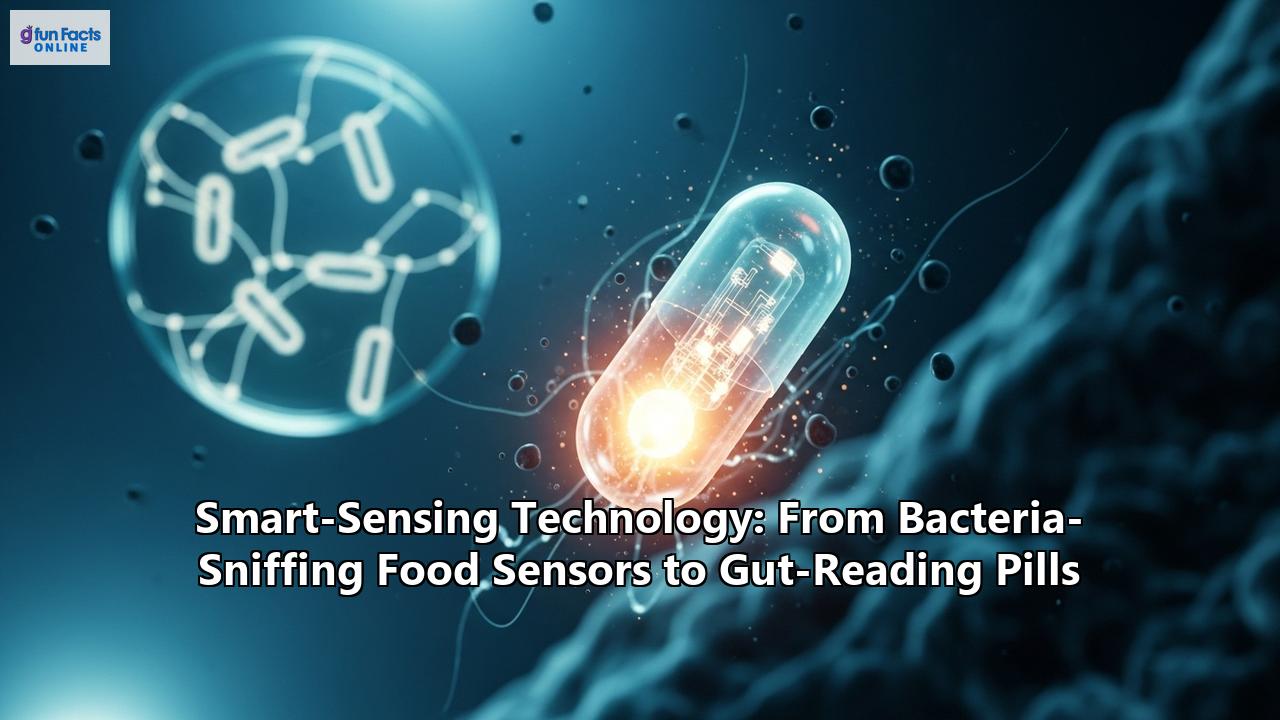
The Unseen Sentinels: How Smart-Sensing Tech from Bacteria-Sniffing Food Sensors to Gut-Reading Pills is Revolutionizing Our World
Imagine a world where your food packaging tells you not by a printed date, but with a real-time color change, that your chicken is on the verge of spoiling. Picture a tiny, swallowable pill that travels through your digestive system, acting as a diagnostic detective, identifying the root cause of a chronic gut ailment without a single incision. This isn't the realm of science fiction; it's the rapidly unfolding reality of smart-sensing technology. These microscopic sentinels are poised to overhaul industries, transform healthcare, and fundamentally change how we interact with the world around us. From the farm to our fork, and even within our own bodies, a revolution is quietly underway, driven by sensors that can see, smell, and feel the world in ways we never thought possible.
At its core, a smart sensor is a device that takes input from the physical environment, uses built-in computing resources to perform a predefined function, and then communicates that information. What makes them "smart" is their ability to process data at the source, enabling automated, accurate, and real-time monitoring and control. This technology is the bedrock of the Internet of Things (IoT), a vast network of interconnected devices that collect and share data, promising a future of unprecedented efficiency and responsiveness. The applications are boundless, spanning from industrial automation and environmental monitoring to creating smarter homes and cities. However, two of the most groundbreaking frontiers for this technology lie in the realms of food safety and personal health, with the development of "bacteria-sniffing" food sensors and "gut-reading" pills.
Sniffing Out Spoilage: A New Era of Food Safety
Foodborne illnesses are a significant global health concern, affecting millions and leading to thousands of deaths annually. A major contributor to this problem is food spoilage, a process that can be difficult to detect with the naked eye. Traditionally, we've relied on "use-by" dates, which are often conservative estimates, leading to immense food waste. Smart-sensing technology offers a more precise and dynamic solution, moving beyond static dates to real-time quality assessment.
These intelligent systems work by detecting the tell-tale signs of spoilage. As food, particularly meat and fish, begins to decompose, microbes break down amino acids, releasing volatile compounds like ammonia and trimethylamine. Smart sensors are designed to "sniff out" these gases, providing a direct indicator of the food's freshness.
The Arsenal of Anti-Spoilage Sensors:
The technology to achieve this comes in various forms, each with its unique approach to detecting decay:
- Biosensors: These are the true "bacteria-sniffers." They utilize biological components, such as antibodies, enzymes, or DNA probes, to specifically target and identify spoilage-causing microorganisms or the toxins they produce. Some advanced biosensors are coated with phage particles, which are viruses that naturally recognize and bind to specific bacteria like Salmonella or Listeria. When bacteria attach to the sensor, the change in mass or other properties triggers a detectable signal.
- Chemical Sensors: These sensors react to chemical changes in the food's environment. For instance, as bacteria multiply, they can alter the pH of the product. Colorimetric sensors, which change color in response to pH shifts or the presence of specific gases like carbon dioxide, are a common type of chemical sensor. An example is a sensor that turns from red to yellow to indicate freshness and from red to reddish-pink to signal spoilage.
- Optical Sensors and Smart Labels: Many food quality sensors are integrated into "smart labels" or "intelligent packaging." These can be optical sensors that provide information on temperature, gas leakage, or color changes. Some smart labels use time-temperature indicators (TTIs), which visually show the cumulative temperature exposure of a product, giving a more accurate picture of its remaining shelf life. Others detect specific gases; for example, a label that changes color in the presence of ethylene can indicate the ripeness of fruit.
- Electronic Noses: These sophisticated devices mimic the human sense of smell. They consist of an array of gas sensors that respond to a wide range of volatile compounds. The combined response of the sensors creates a unique "smell print" that can be analyzed to determine the freshness of a product.
From the Lab to Your Lunchbox:
While some of these technologies are still in development, others are already making their way to the market, offering tangible benefits for consumers and the food industry:
- Commercially Available Indicators: Products like Toxin Guard and Sensor Q™ are designed to detect the growth of spoilage bacteria in meat and poultry. Freshness indicators like Fresh-Check use a color-changing mechanism to signal the quality of perishable goods.
- Reducing Food Waste: Smart labels that accurately track freshness can help reduce the staggering amount of food that is thrown away due to confusing expiration dates. This not only saves money but also has significant environmental benefits, as food waste is a major contributor to greenhouse gas emissions.
- Enhancing Traceability and Preventing Fraud: When combined with technologies like RFID and blockchain, smart labels can provide an unhackable record of a product's journey through the supply chain. This enhances traceability, which is crucial for identifying the source of foodborne illness outbreaks and for combating food fraud.
- Real-Time Monitoring: The ultimate goal is to have sensors that provide continuous, real-time data on food quality. Researchers are developing inexpensive paper-based electrical gas sensors (PEGS) that could be read by a smartphone, allowing consumers to check the freshness of a product in the store or at home.
The development of these bacteria-sniffing sensors represents a paradigm shift in food safety. By providing a transparent and accurate assessment of food quality, this technology empowers consumers to make more informed choices, reduces waste, and creates a more secure and sustainable food supply chain.
The Fantastic Voyage Within: Gut-Reading Pills
Just as smart sensors are revolutionizing how we monitor the world around us, they are also set to transform our understanding of our own internal worlds. The gastrointestinal (GI) tract is a complex and often inaccessible environment, and diagnosing problems within it has traditionally relied on invasive procedures like endoscopy and colonoscopy. Now, a new generation of "smart pills" is emerging, promising to make the diagnostic journey as simple as swallowing a capsule.
These ingestible electronic devices are tiny, self-contained systems equipped with sensors, a power source, and a transmitter. As they travel through the GI tract, they can collect a wealth of data, offering a non-invasive window into the health of our gut.
The Inner Workings of an Ingestible Detective:
Smart pills come in a variety of forms, each designed for a specific diagnostic purpose:
- Capsule Endoscopy: This is one of the earliest and most established forms of smart pill technology. The patient swallows a pill-sized camera (like the PillCam) that takes thousands of pictures as it passes through the small intestine, an area that is difficult to reach with traditional endoscopes. These images are transmitted to a recorder worn by the patient and are later reviewed by a doctor to look for abnormalities.
- Monitoring Motility and pH: Some smart pills, such as the SmartPill, are designed to measure key physiological parameters as they traverse the gut. These pills record data on pH, temperature, and pressure, which can help diagnose motility disorders—conditions that affect the movement of the digestive system.
- Real-Time Location Tracking: A major challenge for ingestible sensors has been knowing their precise location within the winding path of the intestines. Newer technologies, like the iMAG system developed at Caltech, function like a GPS for the gut. These pills use magnetic fields to pinpoint their location with high accuracy, which is crucial for targeted diagnostics and drug delivery.
- Biomarker Detection: The most advanced smart pills are being developed to detect specific biomarkers—molecules that can indicate the presence of disease. Researchers at MIT and other institutions are creating pills that combine engineered living bacteria with electronics. These bacteria are designed to produce light when they encounter a specific molecule, such as nitric oxide, which is associated with inflammatory bowel diseases. The pill's electronics then convert this light into a wireless signal that can be sent to a smartphone.
- Gas Sensing: The composition of gases in the gut can provide valuable clues about gut health. Ingestible sensors are being developed to measure gases like hydrogen, carbon dioxide, and oxygen in real time. This information could revolutionize our understanding of the gut microbiome and its role in various diseases.
A New Era of Gastrointestinal Care:
The potential applications of gut-reading pills are vast and could lead to significant advances in how we diagnose and treat a wide range of conditions:
- Early Disease Detection: By detecting biomarkers associated with inflammation, cancer, or other diseases at an early stage, smart pills could dramatically improve patient outcomes. For example, some are being designed to identify gases linked to gastritis and stomach cancer.
- Personalized Medicine: The data collected by these pills can provide a highly personalized picture of an individual's gut health, allowing for more tailored treatments. The PillTrek, a smart capsule developed at Caltech, can be configured with different sensors to measure a variety of biomarkers, including glucose and serotonin, offering a flexible platform for personalized diagnostics.
- Non-Invasive Diagnostics: For many patients, the prospect of an endoscopy or colonoscopy can be daunting. Smart pills offer a less invasive, more comfortable alternative for diagnosing a variety of GI disorders.
- Monitoring Treatment and Drug Adherence: Smart pills can also be used to monitor the effectiveness of treatments and to ensure that patients are taking their medication as prescribed. The Abilify MyCite, for example, is an FDA-approved pill with an embedded sensor that confirms ingestion, which can be particularly useful for managing chronic conditions.
- Targeted Drug Delivery: Future generations of smart pills may not only diagnose but also treat. These devices could be designed to release medication at a specific location in the GI tract, maximizing its effectiveness and minimizing side effects.
The Road Ahead: Challenges and the Future of Smart Sensing
While the promise of smart-sensing technology is immense, there are still hurdles to overcome. For food sensors, the cost of manufacturing and implementation on a wide scale remains a challenge. For ingestible sensors, issues of data privacy, security, battery life, and regulatory approval need to be addressed.
However, the pace of innovation is rapid. Researchers are continuously developing new materials, more efficient power sources, and more sophisticated AI algorithms to analyze the vast amounts of data these sensors collect. As the technology becomes more affordable and accessible, we can expect to see smart sensors integrated into more aspects of our daily lives.
The future envisioned by this technology is one of proactive and preventative care, both for ourselves and for our environment. It's a future where a simple scan of a food label can provide a wealth of information about its quality and safety, and where a tiny, swallowable device can offer a comprehensive and personalized health check-up. The journey of smart-sensing technology is just beginning, but its impact is already being felt, ushering in an era where the unseen sentinels around us and within us work tirelessly to keep us safe and healthy.
Reference:
- https://news.abplive.com/science/caltech-pilltrek-smart-pill-india-gut-health-diagnostics-gi-diseases-india-1787846
- https://www.universityofcalifornia.edu/news/new-self-powered-ingestible-sensor-opens-fresh-avenues-gut-research
- https://www.nsf.gov/news/smart-pills-help-diagnose-gut-disorders
- https://news.mit.edu/2019/ingestible-expanding-pill-monitors-stomach-0130
- https://pubmed.ncbi.nlm.nih.gov/34416311/
- https://www.medica-tradefair.com/en/digital-health/smart-pill-ai-gastrointestinal-monitoring
- https://mriquestions.com/uploads/3/4/5/7/34572113/acssensors.7b00045.pdf
- https://www.uclahealth.org/news/article/gutoscopy-uses-smart-pill-to-collect-samples
- https://pmc.ncbi.nlm.nih.gov/articles/PMC8891880/
- https://research.birmingham.ac.uk/en/publications/smart-pills-for-gastrointestinal-diagnostics-and-therapy
- https://www.medstarhealth.org/services/smartpill
- https://news.mit.edu/2023/smart-pill-can-track-biological-markers-real-time-0908
- https://www.medicaldesignbriefs.com/component/content/article/49052-smart-pill-tracks-key-biomarkers-in-real-time
- https://pmc.ncbi.nlm.nih.gov/articles/PMC10952964/
- https://gut.bmj.com/content/73/1/186
- https://nyuad.nyu.edu/en/news/latest-news/science-and-technology/2023/february/nyuad-researcher-and-colleagues-develop-novel-smart-pills-that-improve-the-diagnosis-and-treatment-of-gastrointestinal-disorders.html
- https://www.prescouter.com/2019/01/ingestible-sensors-innovations/
- https://tech4future.info/en/edible-electronics-smart-pills-edible-robots/
- https://www.foxnews.com/tech/swallow-pill-learn-about-your-gut-health
- https://scitechdaily.com/caltechs-new-smart-pill-can-read-your-gut-like-never-before/
- https://iotbusinessnews.com/2025/06/19/25152-inside-the-body-how-ingestible-sensors-are-shaping-the-future-of-healthcare/