
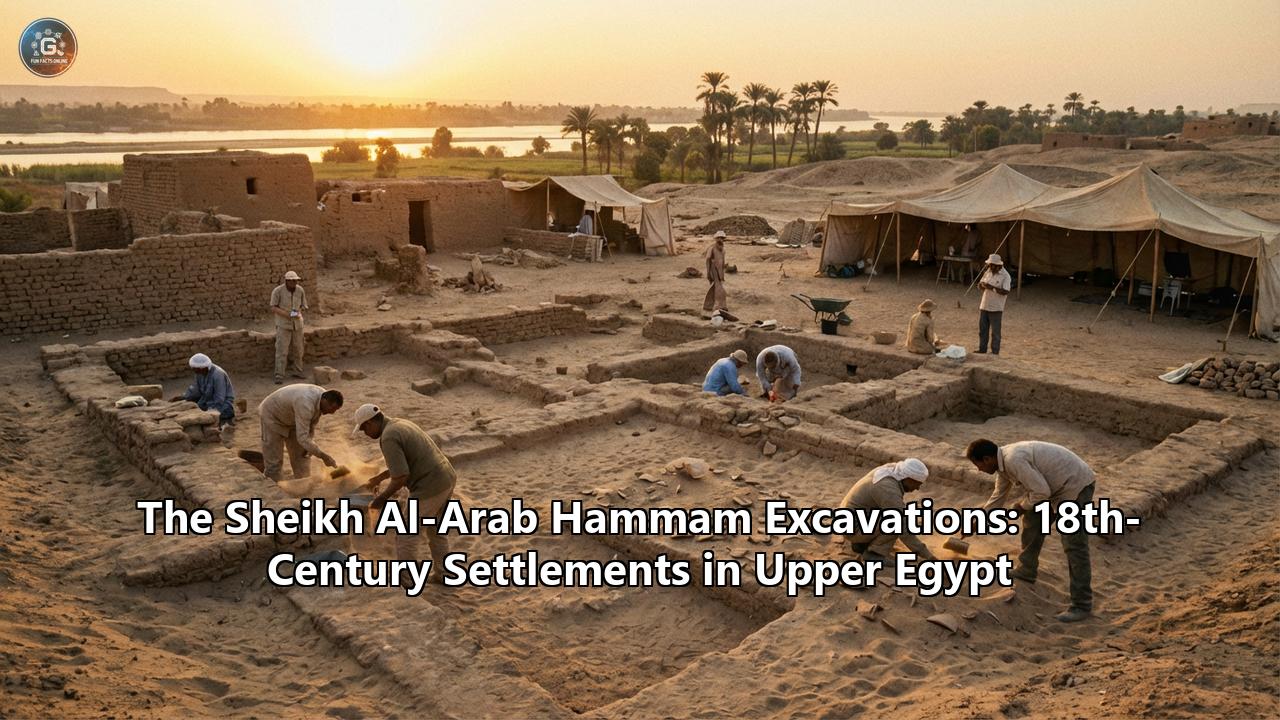
The golden sands of Upper Egypt are most famously known for yielding the colossal monuments, hidden tombs, and gilded artifacts of the pharaohs. For centuries, the world’s archaeological gaze has been fixed firmly on the ancient past—the epochs of the Old, Middle, and New Kingdoms. Yet, the history of Egypt is a tapestry of immense complexity, woven with the threads of countless empires, dynasties, and nomadic tribes. Recently, the sands of the Qena Governorate have pulled back the curtain on a vastly different, yet equally riveting, chapter of Egyptian history.
In a groundbreaking revelation that has reshaped our understanding of Ottoman-era Egypt, a joint Egyptian-French archaeological mission recently unearthed the sprawling remains of an 18th-century mudbrick residential city and a military citadel. Nestled in the village of Al-Arki, roughly six kilometers southwest of the city of Farshout, this discovery serves as a physical testament to the legendary rule of Sheikh Hammam bin Youssef, widely known as Sheikh Al-Arab Hammam.
Beneath the 18th-century layers, the mission also discovered a Byzantine-era Coptic necropolis, a finding that vividly illustrates the continuous, layered habitation of Upper Egypt over millennia. This remarkable dual-discovery—spearheaded by the French Institute for Oriental Archaeology (IFAO), Ain Shams University, and the Egyptian Ministry of Tourism and Antiquities—not only brings a forgotten, semi-independent agrarian state back to life but also highlights the vibrant daily existence, military prowess, and tragic downfall of one of Upper Egypt’s most formidable figures.
The Gateway to the Desert: Al-Arki and the Darb Al-Arba’een
To understand the immense significance of the Sheikh Al-Arab Hammam excavations, one must first understand the geography of the region. The archaeological site lies in the western mountain range north of the village of Al-Arki. For centuries, this village was not merely a sleepy agricultural hamlet; it was a strategic stronghold.
Al-Arki faces Wadi Al-Houl, the primary eastern entrance to the Darb Al-Arba’een (The Forty Days Road). This legendary caravan route stretched from the heart of the African continent, weaving through the treacherous terrain of Sudan and the deep Sahara, before terminating in the bustling markets of Egypt. Darb Al-Arba’een was an artery of wealth, bringing spices, gold, ivory, livestock, and enslaved people into the Mediterranean world. Whoever controlled the terminus of this route controlled an unimaginable flow of wealth.
In the 18th century, the city of Farshout and its fortified outpost at Al-Arki acted as the gateway to the Sa'id (Upper Egypt). It was here that the caravans paid their tolls, rested their camels, and traded their exotic goods for Egyptian grain and textiles. The strategic and economic gravity of this location made it the perfect capital for a ruler ambitious enough to challenge the Mamluk and Ottoman authorities residing far to the north in Cairo. That ruler was Sheikh Al-Arab Hammam.
The Rise of the Hawwara: From Nomads to Lords of the Sa'id
The story of the 18th-century settlements at Al-Arki is inextricably linked to the Hawwara tribe. Originally hailing from the region of Tripolitania in present-day Libya, the Hawwara migrated to Egypt during the Fatimid era in the late 10th century, initially settling in the northwestern reaches of the Nile Delta. Over the centuries, their population and military power swelled, making them a persistent thorn in the side of the ruling dynasties in Cairo.
In 1382, the Burji Mamluk Sultan Barquq enacted a strategic maneuver to neutralize the Hawwara threat. He forcibly relocated the tribe deep into Upper Egypt, granting them the rights to the massive agricultural produce of the Girga Province. Barquq’s intention was twofold: remove a disruptive force from the vicinity of his capital and use the fierce Hawwara to subdue the indigenous Arab tribes of the south.
The plan backfired spectacularly over the long term. Instead of merely acting as Mamluk enforcers, the Hawwara flourished in their new southern domain. They systematically defeated rival tribes, amassed immense wealth from agriculture and the caravan trade, and gradually established themselves as the undisputed lords of Upper Egypt. By the dawn of the 18th century, the Hawwara controlled a vast stretch of the Nile Valley, extending from Asyut down to Aswan, operating with near-total autonomy from the Ottoman-appointed governors in Cairo.
The King of the South: The Legend of Sheikh Al-Arab Hammam
It was from this deeply entrenched tribal power base that Hammam bin Youssef bin Ahmed bin Muhammad bin Hammam Ibn Abu Sobeih Seba was born, around the turn of the 18th century in Farshout. Upon the death of his father, Sheikh Yusuf, Hammam inherited the leadership of the Hawwara. However, he was not content to be merely a tribal chieftain; he possessed the vision of a statesman.
Sheikh Hammam effectively established a state within a state. He extended his authority across all the provinces of Upper Egypt, founding a highly organized administrative system. He created government bureaus (diwans) to manage the affairs of the vast agricultural lands under his control, collected taxes, and took a keen interest in the welfare of the peasantry who worked the fields. His reign brought a rare period of stability, justice, and economic prosperity to the deeply marginalized south.
Moreover, Hammam possessed remarkable diplomatic and military sophistication. Recognizing that his autonomy would eventually be challenged by the northern authorities, he forged alliances across tribal lines. He managed to end long-standing feuds between the Hawwara, native Arab tribes, and noble families. He even offered sanctuary to Mamluk emirs and soldiers who were fleeing the treacherous, cutthroat politics of Cairo. By integrating these battle-hardened Mamluks into his own forces—alongside Hawwara cavalry and Bedouin warriors—Hammam built an awe-inspiring, multi-ethnic army capable of defending his southern empire.
For years, Sheikh Hammam reigned supreme. He was known colloquially as "The King of the Sa'id." The wealth of his state funded monumental building projects, defensive forts, and sprawling residential complexes—the very structures that modern archaeologists are now painstakingly pulling from the sand.
The Betrayal and the Fall: The Clash with Ali Bey Al-Kabir
The existence of a powerful, independent state in Upper Egypt was an intolerable affront to Ali Bey Al-Kabir, the ruthless Mamluk ruler who had seized absolute control of Cairo and sought to consolidate all of Egypt under his sole dominion. Recognizing that he could not achieve total supremacy while Sheikh Hammam controlled the south, Ali Bey declared war.
What followed was a titanic clash between the "State of the North" and the "State of the South". Hammam, well-prepared for the onslaught, mobilized his massive army, appointing his trusted cousin and brother-in-law, Ismail Al-Hawari, as the supreme commander of his forces. For a time, it seemed that the sheer numbers and fierce loyalty of the southern army would be enough to repel the northern invaders.
However, Ali Bey Al-Kabir was a master of political machination. Realizing that defeating the Hawwara in a conventional battle in their home territory would be devastatingly costly, he resorted to subterfuge. Ali Bey opened secret negotiations with Ismail Al-Hawari, offering him unimaginable wealth, titles, and the rulership of Upper Egypt if he turned against his cousin.
Seduced by the promise of ultimate power, Ismail committed one of the most infamous acts of treason in Egyptian history. He withdrew his forces at a critical moment, throwing the southern army into chaos. The Mamluk forces, led by Ali Bey's ferocious general Muhammad Bey Abu Al-Dhahab, ruthlessly exploited the betrayal. They shattered Hammam's defenses, marched into his capital of Farshout, and burned the magnificent city to ashes.
A heartbroken and defeated Sheikh Hammam fled south toward Nubia, desperately hoping to raise a new army to reclaim his homeland. He never reached his destination. He died on the road in 1769, marking the tragic end of the Hawwara state. His sprawling palaces and fortresses at Al-Arki were abandoned, left to be swallowed by the unforgiving desert winds.
Qal’at Sheikh Hammam: Excavating an Ottoman-Era Fortress
For over two and a half centuries, the physical legacy of Sheikh Hammam was thought to be entirely lost, existing only in historical chronicles and local folklore. However, recent archaeological missions have changed the narrative entirely. The crowning architectural jewel of the site at Al-Arki is Qal’at Sheikh Hammam—the Citadel of Sheikh Hammam.
Encompassing a massive area of approximately 34 acres, the citadel is a unique and entirely unprecedented model of Ottoman-era military architecture in Upper Egypt. Prior to the joint Egyptian-French mission led by experts like Dr. Ahmed Al-Shoky of Ain Shams University, this site was considered pristine, having never been subjected to systematic scientific excavation.
The fortress was ingeniously designed. Positioned against the backdrop of the western mountains, it offered an unparalleled vantage point over Wadi Al-Houl and the Darb Al-Arba’een route. The archaeological survey mapped a complex network of structures within the 34-acre boundary. Excavators uncovered the remains of grand palaces where Hammam and his retinue resided, alongside vast military barracks, armories, and administrative outbuildings.
The ruins of the citadel tell the story of its violent end. The heavy damage sustained by the walls correlates directly with the historical accounts of Muhammad Bey Abu Al-Dhahab’s brutal siege in 1769. Yet, despite the destruction and centuries of sandstorms, the foundations and lower walls remain largely intact, allowing archaeologists to use digital modeling and Finite Element Method (FEM) analysis to partially reconstruct the architectural layout of the fortress.
The 2026 Discoveries: Unearthing an 18th-Century Metropolis
While the military citadel provided thrilling insights into Hammam’s martial capabilities, the most recent announcements from February 2026 have shifted the focus toward the daily lives of his subjects. The Supreme Council of Antiquities revealed the discovery of a sprawling mudbrick residential city adjacent to the fortress, offering a vivid snapshot of 18th-century urban life in the Sa'id.
Historical sources about daily life in Upper Egypt during the Ottoman period are notoriously scarce, making this discovery an absolute treasure trove for historians. The excavation teams uncovered an initial block of six massive houses, complete with interconnected service buildings and a dedicated industrial zone.
The architecture of the homes reflects a society of varied means and sophisticated building techniques. Many of the homes featured iconic mudbrick domes, a staple of vernacular Upper Egyptian architecture designed to keep the interiors cool under the punishing desert sun. Other, perhaps less affluent, structures utilized flat roofs constructed from palm trunks and interwoven fronds.
Excavators were particularly struck by the interior aesthetics of the homes. Traces of bright white lime plaster were found clinging to the walls of several rooms. This plaster not only insulated the rooms but also reflected light, brightening the interior spaces and suggesting that the inhabitants took great pride in the beauty and cleanliness of their homes. The presence of an industrial zone indicates that this was not merely a military garrison, but an economically vibrant, self-sustaining city. Kilns, storage silos, and workspaces point to a community heavily engaged in pottery production, metalworking, and agricultural processing.
Artifacts of Daily Life: What the Dust Left Behind
The true magic of the Al-Arki excavations lies in the small, intimate artifacts recovered from the floors of the mudbrick houses. When the city was abandoned following the Mamluk invasion, many everyday objects were left behind in the panic, perfectly preserved by the arid desert environment.
Archaeologists have cataloged a stunning array of artifacts that breathe life into the forgotten citizens of Hammam’s state. Caches of bronze coins were discovered, highlighting the monetized economy of the city and its vibrant trade connections fueled by the caravan route. The wealth of pottery fragments recovered ranges from coarse, utilitarian cooking pots to finely glazed wares likely imported from Cairo or the broader Ottoman Empire.
Perhaps the most poignant discoveries are the children’s toys. Small, hand-crafted clay figurines and playthings offer a deeply humanizing glimpse into the past, reminding us that amidst the grand geopolitics of tribal wars and Mamluk rivalries, children played in the shaded alleyways of this desert city.
The team also unearthed intricate pieces of personal jewelry and well-preserved textile remains. The textiles are particularly valuable; the dry climate prevented the organic fibers from rotting, allowing specialists to study the weaving techniques, dyes, and fashion of the 18th-century Hawwara and local Egyptian populations. Together, these artifacts paint a portrait of a diverse, active, and flourishing community that enjoyed a remarkably high standard of living before the catastrophic fall of their leader.
The Layered Earth: The Byzantine Coptic Necropolis
As is so often the case in Egypt, digging into one era invariably leads to the unearthing of another. While the Egyptian-French mission was primarily focused on exposing the 18th-century city of Sheikh Hammam, their trenches soon broke through to a vastly older stratum of history. Directly underneath and extending outward from the mudbrick city, archaeologists discovered a Coptic necropolis dating back to the Byzantine period (approximately the 4th to 7th centuries AD).
This discovery is of immense historical value. Before the arrival of Islam and the subsequent migration of Arab and Berber tribes like the Hawwara, Upper Egypt was a deeply Christian landscape, dotted with monasteries and thriving Coptic communities. The unearthing of this necropolis provides crucial data on the burial practices, health, and demographics of the Byzantine-era population of the Qena region.
The juxtaposition of the Byzantine necropolis and the 18th-century Islamic city above it is a powerful physical metaphor for the history of Egypt itself. It is a land built upon layers. The Hawwara tribe literally built their capital upon the bones of the region's ancient inhabitants, entirely unaware of the silent city of the dead sleeping just inches below their mudbrick floors. This duality allows the archaeological mission to study two radically different eras of Egyptian history simultaneously, charting the evolution of the region over a millennium and a half.
Modern Science Meets Ancient Mudbrick: The Archaeological Process
The excavation of the Sheikh Al-Arab Hammam site represents a triumph of modern archaeological methodology. Mudbrick (adobe) is notoriously difficult to excavate and preserve. Unlike the colossal limestone and granite blocks of Pharaonic temples, mudbrick is highly susceptible to wind erosion, moisture, and sheer physical collapse once exposed to the elements.
To combat this, the collaborative team from IFAO and Ain Shams University employed cutting-edge conservation techniques. Researchers engaged in the rigorous evaluation of the building materials, analyzing the chemical composition of the 18th-century mudbricks to understand their degradation. Advanced consolidants, such as Paraloid B-72 enhanced with Nano-silica, were tested to strengthen the fragile structural remains, increasing their compressive strength and resistance to weathering.
Furthermore, the mission utilized digital photogrammetry and historic Building Information Modeling (H-BIM) to create precise 3D maps of the site. This digital preservation ensures that even if the physical mudbricks succumb to the elements, the exact layout and architectural nuances of Sheikh Hammam’s city will be recorded for future generations.
The excavation has also served as a vital training ground. For the first time, students from the Excavation Department at the Faculty of Archaeology at Ain Shams University were brought to the site for high-level, hands-on field training. They were instructed in the delicate arts of stratigraphic excavation, artifact documentation, architectural drawing, and the use of modern surveying equipment. By integrating students into this high-profile mission, the project is actively cultivating the next generation of Egyptian archaeologists.
A New Chapter for Egyptian Tourism: Beyond the Pharaohs
The sheer scale and historical importance of the Al-Arki discoveries have prompted immediate action from the highest levels of the Egyptian government. Sherif Fathy, the Minister of Tourism and Antiquities, recently announced ambitious plans to consolidate the ruins, implement comprehensive preservation protocols, and officially prepare the site for inclusion on Egypt’s tourist map.
This initiative marks a refreshing and vital shift in Egypt’s cultural heritage strategy. For decades, tourism in Upper Egypt has been almost exclusively "pharaoh-centric." Millions of visitors flock to the Valley of the Kings, Karnak, and Luxor Temple, largely bypassing the rich tapestry of Islamic, Coptic, and Ottoman history that exists in the very same regions.
The Sheikh Al-Arab Hammam site is perfectly positioned to change this narrative. Located geographically between the stunning Ptolemaic Temple of Hathor at Dendera to the south, and the ancient Pharaonic cult center of Abydos to the north, Al-Arki offers a logical and highly compelling stop for tourists traveling through the governorates of Qena and Sohag.
Opening this site to the public will allow visitors to step out of the world of mythology and ancient gods, and step into the gripping, relatable history of a tribal rebel king who defied an empire. Walking among the mudbrick domes, the remnants of the military citadel, and the ancient Coptic graves, visitors will experience a visceral connection to the multicultural, deeply layered reality of the Egyptian south.
The Enduring Legacy of the King of the Sa'id
The story of Sheikh Al-Arab Hammam has long survived in the oral traditions of Upper Egypt. He is the subject of folk songs, epic poems, and even modern television dramas that celebrate his chivalry, his fierce independence, and his tragic betrayal. Yet, until now, his legacy was largely confined to the realm of myth and memory.
Through the meticulous labor of the joint Egyptian-French archaeological mission, the myth has been grounded in undeniable physical reality. The 34-acre fortress, the bustling industrial zones, the elegant mudbrick domes, and the delicate bronze coins all serve as irrefutable proof of the state he built. The excavations at Al-Arki have not just uncovered a city; they have validated the history of a marginalized region, proving that the Sa'id was not just a quiet provincial backwater under Ottoman rule, but a vibrant, formidable, and highly organized power center in its own right.
As archaeologists continue to brush away the desert sands, revealing more of the houses, the armories, and the graves of Al-Arki, they are doing more than recovering artifacts. They are rewriting the history of 18th-century Egypt from the ground up. In the quiet, wind-swept ruins of Farshout, the spirit of Sheikh Al-Arab Hammam—the last great King of the South—breathes once more, his legacy finally secured not just in the songs of his descendants, but in the very earth of the land he loved.
Reference:
- https://www.google.com/search?q=time+in+%D9%81%D8%B1%D8%B4%D9%88%D8%B7,+EG
- https://www.google.com/search?q=time+in+%D8%A7%D9%84%D8%B8%D9%87%D9%8A%D8%B1+%D8%A7%D9%84%D8%B5%D8%AD%D8%B1%D8%A7%D9%88%D9%89+%D9%84%D9%85%D8%AD%D8%A7%D9%81%D8%B8%D8%A9+%D9%82%D9%86%D8%A7,+EG
- https://en.wataninet.com/choise/archaeologists-unearth-18th-century-mudbrick-fort-coptic-cemetery-in-qena/48303/
- https://www.ifao.egnet.net/newsletters/2021-01/
- https://copticliterature.wordpress.com/2020/07/25/how-the-hawwara-tribe-of-upper-egypt-enslaved-the-copts/
- https://dokumen.pub/imagined-empires-a-history-of-revolt-in-egypt-9780520956537.html
- https://www.quora.com/Are-Egyptians-ethnically-Arab-or-Barber
- https://discovery.researcher.life/article/using-digital-modelling-for-the-partial-reconstruction-of-sheikh-al-arab-hammam-citadel-situated-in-farshout-qena-egypt/fc1f81b8385b3c38bc00444760004578
- https://www.researchgate.net/publication/389060917_Using_digital_modelling_for_the_partial_reconstruction_of_Sheikh_al-Arab_Hammam_citadel_situated_in_Farshout_Qena_Egypt
- https://www.ifao.egnet.net/recherche/formation-recherche/