
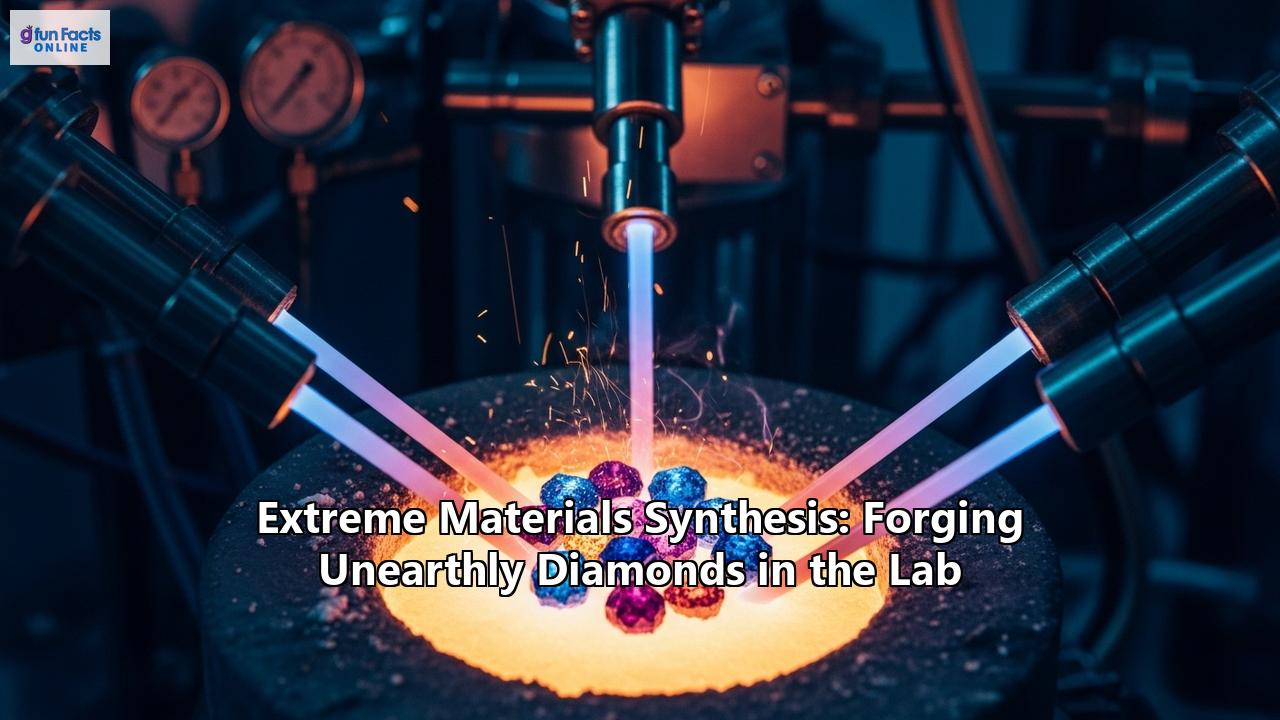
In a world captivated by the allure of natural diamonds, a technological revolution is quietly unfolding in laboratories across the globe. Scientists, wielding the powers of extreme pressure and temperature, are not just replicating nature's most coveted gem; they are transcending it. This is the realm of extreme materials synthesis, a field where the boundaries of physics and chemistry are pushed to their limits to create materials with properties that seem almost unearthly. At the heart of this revolution lies the laboratory-grown diamond, a testament to human ingenuity and a harbinger of a future where materials can be designed and forged to meet our most demanding technological needs.
For centuries, diamonds have been a symbol of luxury, rarity, and enduring love. Their journey from the fiery depths of the Earth's mantle, a process taking billions of years, has imbued them with a mystique that has captivated humanity. But today, we stand at a precipice where science is demystifying this process, not to diminish the diamond's splendor, but to unlock its full potential. The diamonds emerging from laboratories are chemically, physically, and optically identical to their mined counterparts. They are, in every sense of the word, real diamonds. Yet, they are also something more. They are a canvas upon which scientists can paint with atoms, engineering properties that are not found in nature, creating "unearthly" diamonds with functionalities that extend far beyond the realm of jewelry.
This article delves into the fascinating world of extreme materials synthesis, with a special focus on the forging of these extraordinary lab-grown diamonds. We will journey through the history of this audacious scientific endeavor, from the early alchemical dreams to the first reproducible synthesis. We will explore the intricate science behind the two dominant methods of diamond creation: High-Pressure/High-Temperature (HPHT) and Chemical Vapor Deposition (CVD). We will then venture into the realm of the "unearthly," discovering how scientists are crafting diamonds with bespoke colors and implanting defects to create powerful quantum computers. Finally, we will examine the profound economic and environmental implications of this disruptive technology and cast our gaze toward a future where the ability to create extreme materials on demand will reshape our world in ways we are only beginning to imagine.
A Quest for Creation: The History of Diamond Synthesis
The human fascination with creating diamonds is a story as old as our understanding of their fundamental nature. The journey to the modern laboratory began with a pivotal discovery in 1797 by the English chemist Smithson Tennant, who proved that diamonds are a pure form of carbon. This revelation ignited the imaginations of scientists, who for over a century, embarked on a quest to transform humble carbon into the world's most prized gem.
The late 19th and early 20th centuries were rife with claims of diamond synthesis, many of which were later debunked. In 1879, Scottish chemist James Ballantyne Hannay reported creating diamonds by heating a mixture of bone oil, paraffin, and lithium in a sealed iron tube. Around the same time, French chemist Henri Moissan claimed to have synthesized diamonds by rapidly cooling molten iron saturated with carbon, a method inspired by the discovery of diamonds in meteorites. While these early attempts were shrouded in controversy and their results could not be reliably reproduced, they laid the crucial groundwork for future research by highlighting the immense pressures and temperatures required for diamond formation.
The modern era of diamond synthesis truly began in the mid-20th century, fueled by the burgeoning demand for industrial diamonds and the Cold War-era drive for technological supremacy. In the 1940s, systematic research programs were initiated in the United States, Sweden, and the Soviet Union. In the U.S., General Electric (GE) launched "Project Superpressure" in 1941, a concerted effort to create diamonds in the lab. This ambitious project brought together a team of brilliant scientists, including Francis Bundy, H. M. Strong, and Tracy Hall.
After years of relentless experimentation, a breakthrough was finally achieved. On December 16, 1954, Tracy Hall, using a new type of press of his own design, successfully and reproducibly synthesized the first man-made diamonds. The experiment involved subjecting graphite, a common form of carbon, to immense pressure (over 1.5 million pounds per square inch) and high temperature (over 2,000 degrees Celsius) in the presence of a metal catalyst. The announcement of this achievement in 1955 sent shockwaves through the scientific community and marked the dawn of a new industrial age.
While GE was celebrating its success, researchers in other parts of the world were also making significant strides. In 1953, the Swedish electrical engineering company ASEA had also managed to synthesize diamonds, though they kept their discovery a secret for many years. The Soviet Union also developed its own successful synthesis methods around the same time.
These early synthetic diamonds were small and primarily suited for industrial applications, where their exceptional hardness made them invaluable for cutting, grinding, and drilling. The dream of creating large, gem-quality diamonds for jewelry remained elusive for several more decades. However, the fundamental principles established during this pioneering era paved the way for the advanced techniques that are now producing a dazzling array of lab-grown diamonds that rival and, in some cases, surpass their natural counterparts in quality and beauty.
The Alchemist's Forge: Methods of Modern Diamond Synthesis
The creation of a diamond, whether in the Earth's mantle or in a laboratory, requires the transformation of carbon atoms from a disordered state into a highly ordered, crystalline lattice. This is achieved by subjecting the carbon to extreme conditions of pressure and temperature. In the lab, two primary methods have been perfected to replicate and even refine this natural process: High-Pressure/High-Temperature (HPHT) and Chemical Vapor Deposition (CVD).
High-Pressure/High-Temperature (HPHT): Mimicking the Earth's Embrace
The HPHT method is the original and still widely used technique for diamond synthesis, directly mimicking the conditions under which diamonds are formed deep within the Earth. The process begins with a small diamond seed, a tiny fragment of a pre-existing diamond, which acts as a template for the new diamond's growth. This seed is placed in a capsule along with a source of pure carbon, typically graphite, and a metal catalyst, such as iron, nickel, or cobalt.
This capsule is then placed inside a massive press capable of generating immense pressures and temperatures. There are three main types of presses used for HPHT synthesis: the belt press, the cubic press, and the split-sphere (BARS) press. The belt press, the original design used by GE, uses two anvils to apply pressure from above and below. The cubic press utilizes six anvils to apply pressure from all sides, allowing for the creation of larger diamonds. The BARS press, developed in Russia, is the most compact and efficient design, capable of generating the highest pressures.
Inside the press, the temperature is raised to between 1,300 and 1,600 degrees Celsius, and the pressure is increased to over 870,000 pounds per square inch (around 5-6 gigapascals). At these extreme conditions, the metal catalyst melts and dissolves the carbon source. The dissolved carbon atoms then migrate through the molten metal towards the cooler diamond seed and crystallize upon it, layer by layer, forming a new, larger diamond.
The entire process can take anywhere from a few days to several weeks, depending on the desired size and quality of the diamond. The result is a rough diamond that is then cut and polished in the same way as a mined diamond.
HPHT technology has advanced significantly since its inception. Initially, the process could only produce small, yellowish industrial-grade diamonds due to nitrogen impurities in the growth environment. However, with improved control over the purity of the starting materials and the precise regulation of pressure and temperature, scientists can now produce large, colorless, and high-clarity gem-quality diamonds. In fact, HPHT is often preferred for producing high-quality, colorless diamonds as the process can be more tightly controlled to exclude impurities.
Chemical Vapor Deposition (CVD): Painting with Carbon Atoms
The second major method for diamond synthesis is Chemical Vapor Deposition (CVD), a technique that has gained popularity in recent years for producing high-quality gem diamonds. Unlike HPHT, which relies on brute force to create diamonds, CVD is a more finessed process that "grows" diamonds atom by atom from a carbon-rich gas.
The CVD process begins with a thin slice of a diamond seed crystal, which is placed inside a vacuum chamber. The chamber is then filled with a mixture of carbon-containing gases, typically methane, and hydrogen. A source of energy, such as a microwave beam, is used to heat the gases to a plasma state, with temperatures ranging from 800 to 1200 degrees Celsius.
In this superheated plasma, the gas molecules break down, and carbon atoms are released. These carbon atoms are then drawn towards the cooler diamond seed and deposit onto its surface, layer by atomic layer, replicating the crystal structure of the seed. The hydrogen gas plays a crucial role in this process by selectively etching away any non-diamond carbon (graphite) that might form, ensuring the purity of the growing diamond.
The CVD process is a slower and more controlled method of diamond growth compared to HPHT. It can take several weeks to grow a sizable diamond. One of the advantages of CVD is that it operates at much lower pressures and temperatures than HPHT, making the equipment less expensive and the process more energy-efficient. It also allows for greater control over the incorporation of impurities, making it the preferred method for creating certain types of colored diamonds and diamonds with specific electronic properties.
However, the CVD process is not without its challenges. The growth can sometimes be uneven, leading to internal strain and the formation of defects. To overcome this, the process is often stopped periodically to polish the growing diamond surface and remove any imperfections before continuing the growth. Additionally, CVD diamonds can sometimes have a brownish or grayish tint, which may require post-growth treatments, such as HPHT annealing, to improve their color.
Both HPHT and CVD are capable of producing stunning, high-quality diamonds that are indistinguishable from their natural counterparts to the naked eye. The choice of which method to use often depends on the desired characteristics of the final product, with HPHT being favored for its ability to produce large, colorless stones and CVD offering greater control over the creation of colored and specialty diamonds. The ongoing advancements in both technologies are continually pushing the boundaries of what is possible, leading to the creation of ever-larger, purer, and more exotic diamonds.
Beyond Brilliance: Forging Unearthly Diamonds with Exotic Properties
The ability to create diamonds in a lab is not just about replicating nature's beauty; it's about surpassing it. By precisely controlling the growth environment and introducing specific elements or defects, scientists can create "unearthly" diamonds with properties tailored for a new generation of technologies. These are not your grandmother's diamonds; they are functional materials, engineered at the atomic level to perform tasks that were once the stuff of science fiction.
A Spectrum of Splendor: Engineering Colored Diamonds
Naturally colored diamonds are exceedingly rare and, as a result, incredibly expensive. Their vibrant hues are the result of trace elements or structural anomalies that were incorporated into the diamond's crystal lattice as it formed deep within the Earth. For example, the presence of nitrogen can create a yellow or orange color, while boron results in a blue hue. Pink and red diamonds are believed to be caused by distortions in the crystal lattice.
In the controlled environment of the laboratory, scientists can now replicate and even enhance this natural process with remarkable precision. By intentionally introducing specific gases or elements during the growth process, they can create a stunning array of colored diamonds on demand.
In the CVD process, adding nitrogen to the gas mixture results in yellow diamonds, while introducing boron creates blue diamonds. Pink and red diamonds can be produced by subjecting the growing diamond to specific post-growth treatments that alter its crystal structure. Green diamonds are created by exposing the diamond to a controlled dose of radiation after it has been grown.
The ability to create colored diamonds with such control has profound implications. It makes these beautiful and once-unattainable gems more accessible to a wider audience. But more importantly, it allows for the creation of diamonds with specific optical and electronic properties that are valuable for a range of technological applications.
The Quantum Frontier: Diamonds as the Building Blocks of a New Computing Era
Perhaps the most exciting and "unearthly" application of lab-grown diamonds lies in the field of quantum computing. A quantum computer is a revolutionary type of computer that harnesses the bizarre principles of quantum mechanics to perform calculations that are impossible for even the most powerful supercomputers of today. At the heart of a quantum computer is the qubit, the quantum equivalent of the classical bit.
One of the most promising candidates for a stable and reliable qubit is a specific type of defect in a diamond's crystal lattice known as a nitrogen-vacancy (NV) center. An NV center is created when a nitrogen atom substitutes for a carbon atom in the diamond lattice, and an adjacent lattice site is left vacant. This combination of a nitrogen atom and a vacancy creates a tiny, isolated quantum system with unique spin properties that can be manipulated with lasers and microwaves.
The beauty of the NV center is that it is trapped within the rigid, non-reactive diamond lattice, which protects it from external noise and allows it to maintain its quantum state for a relatively long time, even at room temperature. This is a major advantage over other qubit technologies that require extremely cold temperatures to operate.
By precisely implanting NV centers into high-purity, lab-grown diamonds, scientists are building the foundations for a new generation of quantum computers. These diamond-based quantum computers have the potential to revolutionize fields such as medicine, materials science, and artificial intelligence by enabling the simulation of complex molecules, the design of new materials with unprecedented properties, and the development of more powerful machine learning algorithms.
Beyond quantum computing, NV centers in diamonds are also being used to create incredibly sensitive quantum sensors. Because the energy levels of an NV center are affected by its local environment, it can be used to measure magnetic fields, electric fields, temperature, and pressure with nanoscale precision. This has opened up a whole new world of possibilities for medical imaging, geological exploration, and fundamental scientific research.
The Future is Bright: Other Engineered Properties and Applications
The ability to engineer diamonds with specific properties is still in its early stages, and the possibilities are virtually limitless. Scientists are exploring ways to create diamonds with enhanced thermal conductivity for use as heat sinks in high-power electronics and laser systems. They are also developing diamond-based electronic devices that can operate at higher frequencies and temperatures than silicon-based devices, paving the way for faster and more efficient communication technologies.
In the medical field, the biocompatibility and extreme hardness of diamonds make them ideal for a range of applications. Diamond-coated surgical tools can be made sharper and more durable than traditional stainless-steel instruments. And diamond-based biosensors could one day be used for early disease detection and personalized medicine.
The creation of "unearthly" diamonds is a testament to the power of materials science to shape our future. By learning to control matter at the atomic level, we are not just creating new materials; we are creating new possibilities. The diamonds emerging from today's laboratories are more than just beautiful gems; they are the building blocks of a technological revolution that is just beginning to unfold.
A World Transformed: The Economic and Environmental Impact of Lab-Grown Diamonds
The emergence of lab-grown diamonds has sent ripples through the traditional diamond industry and is forcing a re-evaluation of the environmental and ethical implications of our love for this precious stone. The ability to create high-quality diamonds in a laboratory setting is a disruptive technology that is challenging the long-held dominance of the mined diamond market and offering consumers a more sustainable and ethically sourced alternative.
The Shifting Tides of the Diamond Market
For over a century, the diamond market has been controlled by a handful of large mining companies that have carefully managed the supply of diamonds to maintain their high price and aura of rarity. The advent of lab-grown diamonds has thrown a wrench into this carefully constructed system.
Lab-grown diamonds are significantly less expensive than their mined counterparts, often costing 20-40% less for a stone of comparable size and quality. This price difference is due to the much shorter and more efficient supply chain for lab-grown diamonds. The cost of producing a lab-grown diamond is primarily driven by the cost of electricity and the capital investment in the high-tech equipment required for synthesis. As technology improves and economies of scale are achieved, the cost of producing lab-grown diamonds is expected to continue to fall.
This has led to a dramatic shift in consumer behavior, particularly among younger generations who are more price-conscious and ethically-minded. In the United States, the largest market for diamond jewelry, lab-grown diamonds now account for a significant and rapidly growing share of engagement ring sales.
The rise of lab-grown diamonds is creating new opportunities for manufacturers and retailers, but it is also posing a significant threat to the traditional diamond mining industry and the economies of countries that are heavily dependent on diamond exports. Countries like Botswana, where diamonds account for a substantial portion of the national GDP, are facing a potential economic crisis as the demand for mined diamonds wanes. The long-term economic impact of this shift will depend on a variety of factors, including the ability of mining-dependent countries to diversify their economies and the extent to which consumers embrace lab-grown diamonds as a permanent alternative to mined stones.
A Greener Sparkle: The Environmental and Ethical calculus
The diamond mining industry has long been plagued by concerns about its environmental impact and its connection to human rights abuses. The process of mining diamonds can be incredibly destructive, involving the removal of vast quantities of earth and the use of large amounts of water and energy. Open-pit diamond mines can leave behind massive scars on the landscape that are difficult to remediate. Furthermore, the history of the diamond trade is marred by the issue of "conflict diamonds," stones that are mined in war-torn regions and sold to fund conflicts.
Lab-grown diamonds offer a compelling alternative for consumers who are concerned about these issues. The process of creating a diamond in a lab has a significantly smaller environmental footprint than mining a diamond from the Earth. A study by the consulting firm Frost & Sullivan found that mining a diamond produces over 4,000 times more waste and uses nearly seven times more water than growing a diamond in a lab.
The primary environmental impact of lab-grown diamonds is the significant amount of energy required to power the HPHT presses and CVD reactors. However, many lab-grown diamond producers are actively working to reduce their carbon footprint by using renewable energy sources, such as solar and wind power, to power their facilities.
From an ethical standpoint, lab-grown diamonds are inherently conflict-free. Because they are created in a controlled laboratory environment, their origin is fully traceable, giving consumers peace of mind that their purchase is not contributing to violence or exploitation.
The debate over the relative merits of mined versus lab-grown diamonds is likely to continue for some time. The traditional diamond industry argues that it provides vital jobs and economic benefits to many developing countries. However, the clear environmental and ethical advantages of lab-grown diamonds are resonating with a growing number of consumers who are looking for a more responsible and sustainable way to express their love and commitment.
The Dawn of a New Material Age: The Future of Extreme Materials Synthesis
The creation of unearthly diamonds in the lab is just the beginning. We are standing on the cusp of a new material age, an era where our ability to design and create materials with precisely tailored properties will unlock solutions to some of the world's most pressing challenges. The field of extreme materials synthesis, which encompasses the creation of materials under conditions of extreme pressure, temperature, and other exotic environments, is poised to revolutionize everything from energy and medicine to computing and transportation.
The same techniques that are used to create diamonds can also be used to synthesize other novel materials with extraordinary properties. For example, scientists are exploring the creation of new super-hard materials that could be even tougher than diamond, opening up new possibilities for cutting tools, protective coatings, and wear-resistant components.
The ability to create materials with novel electronic and optical properties is also a major focus of research. The development of high-temperature superconductors, materials that can conduct electricity with zero resistance at relatively high temperatures, could revolutionize the energy industry by enabling the creation of ultra-efficient power grids and powerful magnets for fusion reactors.
In the field of medicine, the ability to create biocompatible materials with specific functionalities could lead to the development of more effective drug delivery systems, advanced medical implants, and new diagnostic tools.
The future of extreme materials synthesis will also be driven by the convergence of materials science with other fields, such as artificial intelligence and robotics. AI algorithms are already being used to accelerate the discovery of new materials by predicting their properties before they are even synthesized. And robotic systems are being developed to automate the process of materials synthesis and characterization, allowing scientists to test new ideas and iterate on their designs more quickly.
The journey to create the perfect diamond in the lab has been a long and arduous one, but it has taught us a profound lesson: the materials of the future will not be discovered, they will be designed. As we continue to push the boundaries of extreme materials synthesis, we will unlock a world of possibilities that we can only begin to imagine today. The unearthly diamonds sparkling in our laboratories are a brilliant reminder that the future is not something we wait for; it is something we create, one atom at a time.
Reference:
- https://www.growndiamondcorp.com/blog/hpht-lab-grown-diamonds-history-process-and-benefits/
- https://kindle-tech.com/faqs/how-the-pressure-and-temperature-process-is-used-to-make-a-synthetic-diamond
- https://johnatencio.com/blogs/blog/lab-grown-colored-diamonds-how-are-they-made
- https://zuvelio.com/blogs/education/the-history-of-diamond-synthesis-1879-1928-from-alchemical-dreams-to-scientific-triumphs
- https://www.starsgem.com/news/lab-grown-colored-diamonds-how-are-they-made.html
- https://en.wikipedia.org/wiki/Synthetic_diamond
- https://www.gem.org.au/ag-article/the-early-history-of-synthetic-diamond/
- https://mgc-labs.ru/en/publication/sinteticheskii-almaz-istoriya-poyavleniya-i-metoda-sinteza/
- https://www.gemsociety.org/article/brief-history-of-lab-grown-diamonds/
- https://www.invent.org/blog/inventors/synthetic-diamond
- https://www.invent.org/inductees/herbert-m-strong
- https://www.ebsco.com/research-starters/history/diamond-synthesizing
- https://www.newworlddiamonds.com/blogs/news/how-lab-grown-colored-diamonds-are-created-in-lab
- https://www.diamond-heaven.co.uk/blog/hpht-and-cvd-diamond-growth-processes-explained
- https://www.gia.edu/hpht-and-cvd-diamond-growth-processes
- https://www.huanghewhirlwind.com/Introduction-to-HPHT-Diamond-Press-Revolutionizing-Diamond-Synthesis.html
- https://ethica.diamonds/blogs/news/lab-grown-diamonds-impact-on-the-environment-sustainability
- https://www.whiteflash.com/diamond-education/cvd-vs-hpht-lab-grown-diamonds/
- https://www.fortunebusinessinsights.com/lab-grown-diamond-market-110569
- https://kindle-tech.com/faqs/how-does-chemical-vapor-deposition-work-for-diamonds
- https://www.queensmith.co.uk/diamond-guides/lab-grown-diamonds/cvd-diamonds-what-are-they
- https://shannonabrasives.com/demystifying-cvd-diamond/
- https://www.growndiamondcorp.com/blog/cvd-diamonds-everything-you-need-to-know/
- https://diamondrensu.com/blogs/education/hpht-vs-cvd
- https://lgdeal.com/education/colors-of-lab-grown-diamonds
- https://www.qutube.nl/quantum-computer-12/nv-center-qubits-173
- https://www.quera.com/glossary/diamond-vacancy
- https://en.wikipedia.org/wiki/Nitrogen-vacancy_center
- https://bdta.abcd.usp.br/directbitstream/269e640d-4959-4f11-b7f9-96f256dcabf0/Lucas%20Tsunaki%2006102020.pdf
- https://www.queensmith.co.uk/journal/are-lab-grown-diamonds-more-ethical
- https://finegrowndiamonds.com/blog/who-benefits-from-the-production-of-lab-grown-diamonds
- https://discoveryalert.com.au/news/diamond-dependency-crisis-lab-grown-gems-botswana-2025/
- https://www.gordonbrothers.com/insight/the-rise-of-lab-grown-diamonds-a-multifaceted-challenge-for-jewelers/
- https://www.diamondguidance.com/education/market/economic-impact-of-lab-made-diamonds-market-disruption-and-growth/
- https://rjpn.org/ijcspub/papers/IJCSP24A1042.pdf
- https://www.labgrown.diamonds/guides/diamond-guides/the-environmental-impact-of-lab-grown-diamonds
- https://everydaydiamonds.in/blogs/everyday-tips/the-environmental-impact-of-lab-grown-diamonds-vs-mined-diamonds
- https://www.revediamonds.com/us/blog/are-lab-grown-diamonds-better-for-the-environment-find-out