
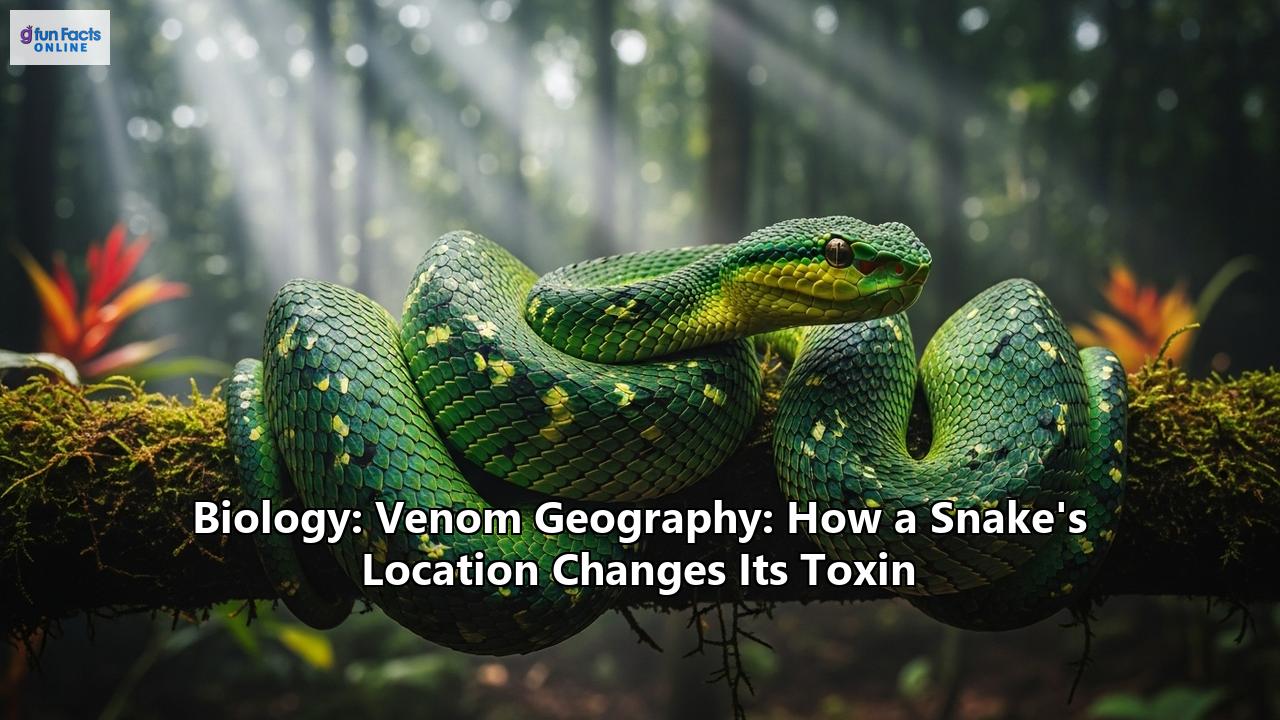
Imagine two snakebite victims, both rushed to a hospital in the dead of night. Both were bitten by the same species of snake, let's say the formidable Mojave rattlesnake. Logic dictates they should receive the same treatment and expect similar outcomes. Yet, one patient develops rapid, terrifying paralysis, their breathing muscles failing, while the other suffers from massive swelling, excruciating tissue decay, and uncontrolled bleeding. The same snake, but two drastically different and life-threatening results. How is this possible?
The answer lies in one of modern biology's most fascinating and medically critical fields: venom geography. The venom of a snake is not a static, unchanging chemical weapon. It is a dynamic, evolving cocktail of toxins, and one of the most powerful forces shaping its composition is the snake's address. From the arid deserts of the American Southwest to the dense rainforests of the Amazon and the remote islands of Australia, a snake's location dictates its diet, its predators, and its environment. These local pressures sculpt its venom at a molecular level, creating a life-or-death geographic mosaic that scientists are only now beginning to fully map.
This is not merely an academic curiosity. This variation is at the heart of a global medical crisis, complicating snakebite treatment and challenging the very foundation of how we create antivenom. To understand this intricate evolutionary dance is to understand why a treatment that saves a life in one region might fail tragically in another. This journey into venom geography takes us from the macroscopic level of ecological pressures down to the very genes that code for these deadly proteins, revealing a hidden world of rapid evolution where a snake's toxin is a liquid reflection of the land it calls home.
The Alchemist's Brew: What is Venom?
Before delving into its geographical variations, it's essential to understand what snake venom truly is. Far from a simple poison, venom is one of the most complex secretions in the natural world. It is a highly sophisticated arsenal of biologically active molecules, primarily composed of proteins and smaller chains of amino acids called peptides. Some venoms can contain over 100 different proteins, each with a specific and often synergistic role.
These toxic compounds are produced and stored in modified parotid salivary glands, located on the sides of the snake's head, and are delivered through specialized teeth known as fangs. The primary purpose of this potent brew is not, as many believe, for defense. It evolved principally as a tool for predation—to rapidly immobilize, kill, and even begin digesting prey. Defense is a secondary, albeit effective, application.
The toxins within this cocktail can be broadly categorized by their devastating effects on the body:
- Neurotoxins: These toxins target the nervous system. Some, called presynaptic neurotoxins, prevent the release of neurotransmitters, the chemical messengers that allow nerves to communicate with muscles. Others, postsynaptic neurotoxins, block the receptors on the muscle cells themselves. The end result is the same: a swift and efficient paralysis that can lead to respiratory failure as the diaphragm and other breathing muscles cease to function. The venom of mambas, cobras, and kraits are infamous for their potent neurotoxicity.
- Hemotoxins: This class of toxins wreaks havoc on the blood and cardiovascular system. They can act in several ways. Some are procoagulants, causing the blood to clot so rampantly throughout the body that clotting factors are depleted, leading to uncontrollable bleeding elsewhere. Others are anticoagulants, preventing blood from clotting at all. Many viper venoms are rich in hemotoxins, causing symptoms like internal bleeding, circulatory collapse, and stroke.
- Cytotoxins: These toxins cause cell death, or necrosis. They are responsible for the horrific local effects seen in many snakebites: extreme pain, swelling, blistering, and the progressive decay of muscle, skin, and bone around the bite site. Spitting cobras have perfected the use of cytotoxins as a defensive tool, aiming for the eyes of a perceived threat to cause intense pain and blindness.
- Myotoxins: A specialized type of cytotoxin, myotoxins specifically target muscle tissue. They cause rhabdomyolysis, a condition where muscle fibers break down and release their contents into the bloodstream, which can lead to kidney failure.
A single snake's venom is rarely composed of just one type of toxin. It's the precise mixture and relative abundance of these different protein families that determines its overall effect, creating a unique toxicological signature for each species—and, as we will see, for different populations within that species.
Venom Geography: A Map of Toxin Variation
The groundbreaking concept of venom geography, or intraspecific venom variation, is the recognition that the venom profile of a single species is not uniform across its entire geographic range. Think of it like regional dialects of a language; the core vocabulary and grammar are the same, but pronunciation, slang, and specific phrases can vary dramatically from one place to another. For snakes, these "dialects" are written in a language of proteins and peptides, with life-or-death consequences.
This phenomenon is driven by the fundamental principle of evolution: natural selection. A snake's venom must be optimized for its specific circumstances. A venom that is highly effective against the lizards in one area may be less effective against the rodents that are the primary food source for the same snake species just a few hundred miles away. Over generations, the snakes whose venom is best suited to their local prey are more likely to survive, reproduce, and pass on the genes for that specific venom cocktail. This creates distinct venom "phenotypes"—observable characteristics—in different geographic regions.
The Evolutionary Drivers: Why Location Matters
Several powerful evolutionary forces work in concert to shape a snake's venom profile, with geography being the stage upon which they act.
Diet: The Ultimate Selective PressureThe most significant driver of venom variation is, overwhelmingly, diet. This is often called the "prey-driven hypothesis." Snakes are specialists, and their venom evolves to be exquisitely tuned to the physiology of their local prey. This co-evolutionary arms race is a relentless cycle of adaptation and counter-adaptation. A snake develops a toxin that is particularly effective against a local mouse species. Over time, some mice may develop partial resistance to that toxin. This, in turn, puts selective pressure back on the snake to evolve a modified or novel toxin to overcome that resistance.
This dynamic explains why venom can change so dramatically over relatively short distances if the available prey changes. A population of snakes on a mainland feeding primarily on frogs will have a venom optimized for amphibian physiology. If a group of these snakes colonizes a nearby island where the most abundant food source is nesting seabirds, evolutionary pressure will favor snakes whose venom is more effective against avian physiology. Over thousands of years, the island population's venom can become remarkably different from its mainland ancestors.
Defense and Predator PressureWhile predation is the primary driver, defense also plays a role. The evolution of spitting in some African and Asian cobras is a prime example. This adaptation is purely defensive, aimed at deterring large, threatening animals, including our own primate ancestors. Research suggests that the rise of spitting in cobras on different continents occurred convergently, meaning it evolved independently in response to similar threats. This defensive pressure selected for venom with higher concentrations of pain-inducing toxins, like phospholipase A2s (PLA₂s), making the venom a more effective deterrent when sprayed into sensitive eyes.
Geographic Isolation and Genetic DriftSometimes, venom variation can arise simply from geographic separation. When a population becomes isolated by a mountain range, a river, or the formation of an island, it can no longer interbreed with other populations. This isolation allows for genetic drift, where random genetic mutations can become fixed in the population over time, not because they offer a strong advantage, but simply by chance. This can lead to divergent venom profiles even in the absence of strong, differing selective pressures from prey.
Environmental FactorsAbiotic factors like temperature, precipitation, and altitude can also indirectly influence venom composition. These environmental conditions dictate the overall habitat and, consequently, the types and abundance of prey animals available. A recent study on the Mojave rattlesnake found a strong correlation between venom type and environmental variables like seasonal temperature fluctuations, suggesting that these factors play a crucial role in determining which venom profile is most advantageous in a given location.
Case Studies: Snakes on the Map
To truly appreciate the impact of venom geography, we must look at the snakes themselves. Several species have become classic models for studying this phenomenon, revealing just how profoundly location can alter a species' toxic kiss.
*The Mojave Rattlesnake (Crotalus scutulatus): The Poster Child of Venom Variation
No snake better illustrates venom geography than the Mojave rattlesnake of the American Southwest and Mexico. For decades, herpetologists and clinicians were puzzled by the wildly different symptoms of its bite. Today, we know this is because the species possesses two primary, dramatically different venom types.
- Venom Type A: This is the infamous neurotoxic venom. Its lethality is driven by a potent neurotoxin complex called Mojave Toxin. This toxin works presynaptically, preventing nerve endings from releasing the signals that tell muscles to contract, leading to systemic paralysis and respiratory failure. A bite from a Type A Mojave is characterized by delayed onset of symptoms and minimal local tissue damage, making it deceptively dangerous.
- Venom Type B: This venom is primarily hemorrhagic and proteolytic, meaning it destroys tissues and disrupts blood clotting. It lacks Mojave Toxin but is rich in snake venom metalloproteinases (SVMPs), enzymes that degrade blood vessel walls and other tissues. A bite from a Type B snake causes immediate and severe pain, massive swelling, and extensive tissue necrosis, similar to a bite from its cousin, the Western Diamondback rattlesnake.
The geographic distribution of these venoms is a fascinating mosaic. Type A venom is predominant in much of the Mojave's range, including Southern California, Nevada, and parts of Texas. Type B venom, once thought to be rare, is now known to be concentrated in specific regions, particularly in south-central Arizona and parts of Mexico. Even more intriguingly, in the zones where these populations meet and interbreed, snakes with Venom Type A+B exist. These "hybrids" possess both Mojave Toxin and the hemorrhagic SVMPs, producing a doubly dangerous cocktail.
The Russell's Viper (Daboia russelii): India's Medical Menace
The Russell's Viper is responsible for more snakebite deaths and severe morbidity in India than any other species. This is due not only to its potent venom and wide distribution but also to the extreme venom variation across different biogeographic zones of the subcontinent.
A landmark 2021 study revealed that the venom composition, toxicity, and pharmacological effects of Russell's Vipers from five distinct regions of India were remarkably different. Snakes from northern and western India have venom that can be twice as toxic as that from southern populations. The key difference lies in the relative abundance of toxin families like PLA₂s and Snake Venom Serine Proteases (SVSPs), which affect blood coagulation and tissue damage.
This variation has profound clinical consequences. A bite from a Russell's Viper in one part of India might cause predominantly neurotoxic symptoms, while a bite in another region leads to kidney failure, and in a third, severe blood clotting disorders. This creates a nightmare for doctors and, as we will explore later, a monumental challenge for antivenom effectiveness.
The Tiger Snake (Notechis scutatus): An Island Evolution Experiment
Australia's Tiger snake provides a perfect natural experiment in how diet shapes venom. Mainland populations typically inhabit swampy areas and feed largely on frogs. However, on various offshore islands, the available prey is drastically different. On Chappell Island in the Bass Strait, for instance, the snakes are much larger and prey almost exclusively on the plump chicks of nesting mutton-birds (short-tailed shearwaters).
This dietary shift has driven a corresponding shift in venom. While the components are largely the same (a mix of neurotoxins, coagulants, and myotoxins), the venom of the Chappell Island snakes is produced in enormous quantities—the average venom yield is more than double that of mainland snakes. While less toxic drop-for-drop, the sheer volume injected makes them incredibly dangerous. This demonstrates an evolutionary trade-off: instead of evolving higher potency, selection has favored the ability to deliver a massive, overwhelming dose to quickly dispatch their larger, avian prey.
Spitting Cobras (Naja species): A Defensive Innovation
The ability to "spit" venom is a remarkable defensive adaptation that has evolved independently in cobra lineages in both Africa and Asia. This is not a fine mist, but a targeted squirt of venom aimed at the eyes of a potential threat. The venom of spitting cobras is characterized by a high concentration of cytotoxins, especially pain-inducing PLA₂ toxins. The evolutionary hypothesis is that the arrival of early bipedal primates, with their upright posture and forward-facing eyes, created a strong selective pressure for this long-range, eye-targeting defense mechanism. Comparing the venom of spitting and non-spitting cobras reveals a clear molecular signature of this adaptation: the spitters have convergently evolved to up-regulate the genes responsible for these highly irritating, pain-causing components, making their venom a more effective deterrent.
The Molecular Machinery: A Glimpse into the "Venom-ome"
The incredible diversity of venom is not magic; it is the product of tangible genetic processes happening within the snake's DNA. The study of this genetic arsenal is known as venomics, a field that integrates different "omics" technologies to paint a complete picture.
- Genomics: The study of the snake's entire genome (the complete set of DNA), looking for the genes that code for toxins.
- Transcriptomics: The analysis of the transcriptome—the set of all messenger RNA (mRNA) molecules in the venom gland. This tells scientists which toxin genes are actually being "switched on" and transcribed into instructions for building proteins.
- Proteomics: The direct analysis of the final product—the proteins and peptides present in the venom itself. This confirms which toxins are actually produced and in what quantities.
By combining these approaches, scientists can trace the evolutionary journey of a toxin from gene to fang-tip. The process begins with what is known as gene recruitment and duplication.
It all starts with an ordinary gene coding for a normal body protein with a physiological function—for instance, a digestive enzyme produced in the pancreas or a protein involved in blood pressure regulation. The prevailing theory is that through a random mutation, a copy of this gene is created—a gene duplication event. Now, the snake has two copies: the original, which continues to perform its vital function, and a spare copy.
This spare copy is free from the intense selective pressure that keeps the original gene unchanged. It can accumulate mutations without harming the snake. Another key step is its recruitment into the venom gland, meaning it begins to be expressed there, likely due to changes in its regulatory regions. Once this duplicated gene is expressed in the venom (initially as a slightly modified salivary protein), it is subject to a powerful evolutionary force known as positive selection. Any mutation that makes the resulting protein even slightly more toxic or effective at disabling prey provides a survival advantage. Over millennia, this process of duplication, recruitment, mutation, and intense selection transforms a mundane body protein into a deadly toxin. Families of toxins like the disintegrins (which interfere with cell adhesion) and phospholipases (PLA₂s) clearly show this evolutionary history, with multiple gene copies having been fine-tuned for a stunning variety of toxic functions.
The Medical Crisis: A Life-and-Death Map
The geographical variation in snake venom is not just an evolutionary marvel; it is a matter of life and death for the estimated 2.7 million people who are envenomated by snakes each year, leading to over 130,000 deaths and 400,000 cases of permanent disability. The vast majority of these incidents occur in poor, rural communities in Africa, Asia, and Latin America. The primary and often only treatment is antivenom, and its effectiveness is directly threatened by venom geography.
The Antivenom Problem
Antivenom production is a century-old technology. It involves "milking" venom from specific snake species and injecting small, non-lethal doses into a large host animal, usually a horse or sheep. The animal's immune system recognizes the toxins as foreign invaders and produces polyclonal antibodies against them. Over time, the animal's blood is drawn, and these antibodies are purified, concentrated, and formulated into antivenom.
Herein lies the critical problem: the antibodies produced are highly specific to the venom used in the immunization process. An antivenom created using venom from Russell's Vipers in Southern India may be highly effective against a bite in that region, but it can be alarmingly ineffective against a bite from the same species* in Northern India, where the venom composition is different. This forces doctors into a desperate situation, often having to administer huge quantities of antivenom, increasing the risk of severe allergic reactions to the foreign horse proteins, with no guarantee of success. In some cases, the antivenom simply fails, leading to treatment failure and death in cases that should have been survivable.
This "antivenom crisis" is compounded by economic factors. Many manufacturers have ceased production due to low profitability, and the market has sometimes been flooded with inappropriate or ineffective antivenoms imported from other regions. A patient in Nigeria might be treated with an antivenom made for a South African puff adder, a scenario with potentially fatal consequences due to the documented venom variation between these populations.
The Cutting Edge: The Future of Venom Research and Treatment
Faced with this crisis, scientists are racing to develop a new generation of snakebite therapies that can overcome the challenge of venom geography.
Recombinant Antivenoms: Building Antibodies in the LabThe most promising frontier is the development of recombinant antivenoms. Instead of using horses, this approach uses modern biotechnology to produce monoclonal antibodies (mAbs) in a laboratory setting. Using techniques like phage display, scientists can screen vast libraries containing billions of human antibodies to find those that bind most effectively to key toxins.
Once these highly effective antibodies are identified, their genetic blueprints can be inserted into cultured cells (like Chinese Hamster Ovary, or CHO, cells), which then act as tiny biological factories, churning out large quantities of pure, specific, and humanized antibodies. The goal is to create an "oligoclonal" cocktail—a mixture of a few, highly potent monoclonal antibodies—that can neutralize the most important toxins in a snake's venom.
The advantages are enormous:
- Safety: Because the antibodies are human or humanized, the risk of severe allergic reactions is drastically reduced.
- Consistency: Every batch is identical, eliminating the variability inherent in animal-derived products.
- Potency: The antivenom is composed only of active, neutralizing antibodies, not the mix of relevant and irrelevant antibodies found in horse serum.
While the initial research and development costs are high, the manufacturing cost for recombinant antivenoms could eventually be comparable to or even lower than traditional methods, making them a more sustainable solution for the developing world.
The Quest for a Universal AntivenomThe ultimate dream is a single, universal antivenom that would be effective against the bite of any medically significant snake in the world. For a long time, this was considered science fiction. But recent breakthroughs have brought it into the realm of possibility.
One of the most exciting developments comes from an unexpected source: the blood of Tim Friede, an amateur herpetologist who has spent nearly two decades self-immunizing by injecting himself with the venom of a wide array of deadly snakes. Scientists, hypothesizing that his body must have produced uniquely powerful and broadly acting antibodies, studied his blood. They discovered several antibodies that can neutralize toxins from a vast range of elapid snakes (cobras, mambas, kraits, taipans) from different continents.
By analyzing the structure of these antibodies, scientists have identified conserved sites on the toxins that do not change much between species. By targeting these critical, unchanging regions, a single antibody can neutralize toxins from many different snakes. Researchers believe that a cocktail of just four or five of these broadly neutralizing antibodies could potentially offer protection against the venom of any medically relevant snake. While human trials are still on the horizon, this research represents a paradigm shift in the fight against snakebite.
Conclusion: An Evolving Understanding
Venom geography reveals that a snake is more than just its species name; it is a product of its specific place in the world. Its venom is a liquid diary, recording millennia of evolutionary pressures, from the type of prey it stalks in the undergrowth to the climate that shapes its landscape. This intricate variability, a testament to the power of natural selection, is also a formidable challenge to modern medicine. The tragic reality is that where you are bitten can determine whether you live or die, simply because the antivenom on the hospital shelf may not match the venom in your veins.
Yet, in this challenge lies immense opportunity. By mapping these venomous landscapes and understanding the genetic and molecular forces that create them, we are not only unraveling fundamental questions about evolution but are also paving the way for a revolution in snakebite treatment. The future of antivenom lies not in the fields with immunized horses, but in the gleaming bioreactors of the laboratory, producing defined, safe, and potent recombinant antibodies. The quest for a universal antivenom, once a distant dream, is now an active and achievable goal. The study of venom geography is a stark reminder that the deepest biological secrets often have the most profound human consequences, and that in the intricate dance between predator and prey, there are life-saving lessons to be learned.
Reference:
- https://pmc.ncbi.nlm.nih.gov/articles/PMC5814581/
- https://en.wikipedia.org/wiki/Evolution_of_snake_venom
- https://www.theguardian.com/science/2025/may/02/snake-bite-immunity-universal-antivenom
- https://www.antibodysociety.org/snakebite-antivenoms-global-challenges-and-progress-toward-recombinant-antibody-therapeutics/
- https://tredig.com/other/snake-enthusiasts-blood-inspires-universal-antivenom-breakthrough/
- https://www.scripps.edu/news-and-events/press-room/2024/20240221-jardine-antivenom.html
- https://www.frontiersin.org/journals/bioengineering-and-biotechnology/articles/10.3389/fbioe.2020.00703/full
- https://academic.oup.com/mbe/article/25/11/2391/1086403
- https://www.researchgate.net/publication/362082616_The_roles_of_balancing_selection_and_recombination_in_the_evolution_of_rattlesnake_venom
- https://www.numberanalytics.com/blog/predator-prey-co-evolution-evolutionary-arms-race
- https://www.numberanalytics.com/blog/evolutionary-arms-race-deep-dive
- https://www.oist.jp/news-center/news/2021/12/23/venoms-snakes-and-salivary-protein-mammals-share-common-origin
- https://www.researchgate.net/figure/Venomics-Advancing-proteomic-transcriptomic-and-genomic-platforms-supported-by_fig1_359619961
- https://pubmed.ncbi.nlm.nih.gov/15741511/
- https://www.creative-proteomics.com/venom/venom-genomics-and-transcriptomics-services.html
- https://www.creative-proteomics.com/venom/venom-transcriptome-sequencing.html
- https://pubmed.ncbi.nlm.nih.gov/18701431/
- https://pmc.ncbi.nlm.nih.gov/articles/PMC7920473/
- https://www.annualreviews.org/doi/pdf/10.1146/annurev-animal-013120-024716
- https://www.tandfonline.com/doi/full/10.1080/17460441.2025.2495943
- https://pmc.ncbi.nlm.nih.gov/articles/PMC6164461/
- https://pmc.ncbi.nlm.nih.gov/articles/PMC3870661/
- https://orbit.dtu.dk/files/273256639/giac024.pdf
- https://scispace.com/pdf/restriction-and-recruitment-gene-duplication-and-the-origin-47htpdlpuo.pdf
- https://pmc.ncbi.nlm.nih.gov/articles/PMC4231632/
- https://pmc.ncbi.nlm.nih.gov/articles/PMC9888523/
- https://enviroliteracy.org/animals/how-is-antivenom-created/
- https://www.naturalis.nl/en/science/origin-and-evolution-of-snake-venom-genes
- https://www.biotechacademy.dk/en/high-school-projects/venom-and-antivenom/case-1-recombinant-antidote-developed-in-denmark/
- https://www.bhu.ac.in/research_pub/jsr/Volumes/JSR_66_05_2022/8.pdf
- https://pmc.ncbi.nlm.nih.gov/articles/PMC9503307/
- https://www.semanticscholar.org/paper/Recent-Advances-in-Next-Generation-Snakebite-Knudsen-Laustsen/f087b2b6a9e790b39d31649ae8da8745563305f5
- https://britainherald.com/universal-snakebite-antivenom-discovery/
- https://www.cuimc.columbia.edu/news/scientists-develop-new-antivenom-counter-many-snakebites