
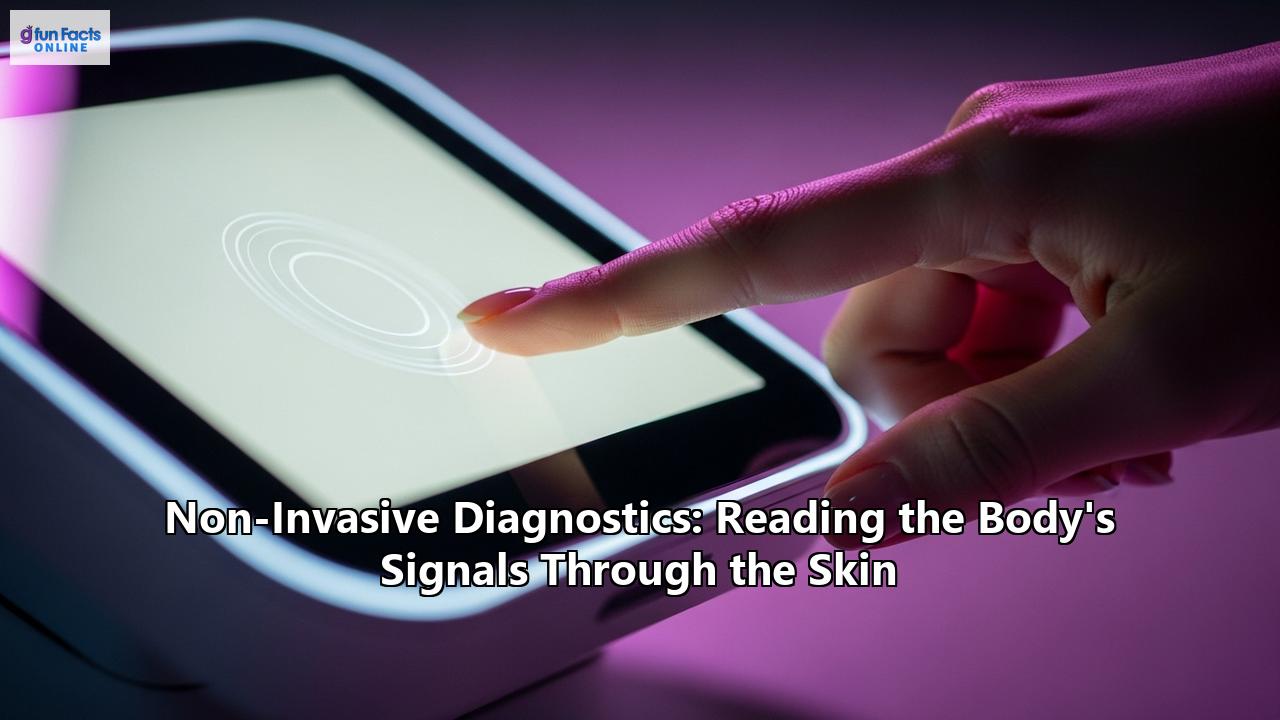
A Window to Within: How Non-Invasive Diagnostics are Reading the Body's Signals Through the Skin
For centuries, the practice of medicine has often involved a necessary intrusion. To understand the inner workings of the human body, to diagnose illness and monitor health, we have relied on drawing blood, taking tissue samples, and other invasive procedures. While invaluable, these methods can be painful, carry risks of infection, and provide only a snapshot in time of a person's physiological state. But what if our largest organ, the skin, could serve as a dynamic, continuous source of information about our health? This is the promise of non-invasive diagnostics, a revolutionary field of medicine that is transforming how we listen to the body's subtle signals.
This burgeoning area of healthcare leverages advanced technologies to analyze our bodies without a single incision, needle prick, or invasive procedure. From sophisticated imaging techniques that peer deep beneath the skin's surface to intelligent wearable sensors that continuously track our vital signs, non-invasive diagnostics are making healthcare safer, faster, and more personalized. This paradigm shift is not just about patient comfort; it's about unlocking a wealth of real-time data that can lead to earlier disease detection, more effective treatments, and a more proactive approach to our well-being.
The Rise of Wearable Sentinels: A Revolution on Your Wrist
Perhaps the most visible and widely adopted form of non-invasive diagnostics is the wearable sensor. Smartwatches, fitness trackers, and skin patches have evolved from simple step counters to sophisticated health monitoring devices. These wearables are equipped with a variety of sensors that can track a wide range of physiological parameters, offering a continuous stream of data about our health.
Optical Sensors: Illuminating Your Health
Many of the most common wearable devices utilize optical sensors, particularly a technology called photoplethysmography (PPG), to measure heart rate and blood oxygen saturation (SpO2). These sensors work by shining light, typically from light-emitting diodes (LEDs), onto the skin and then measuring the amount of light that is reflected or scattered back.
- Heart Rate Monitoring: When your heart beats, it pumps blood through your arteries, causing them to expand. This change in blood volume affects how much light is absorbed. By tracking these fluctuations in light absorption, optical sensors can accurately determine your heart rate. Green light is often used for this purpose because it is strongly absorbed by blood.
- Blood Oxygen Saturation (SpO2): The color of your blood varies depending on its oxygen level. Oxygenated hemoglobin absorbs more infrared light, while deoxygenated hemoglobin absorbs more red light. By using a combination of red and infrared LEDs, optical sensors can measure the ratio of these two types of hemoglobin and estimate your blood oxygen saturation.
Beyond heart rate and SpO2, researchers are exploring the use of optical sensors for monitoring other vital signs, such as breathing rate and even blood pressure, by analyzing the subtle nuances of the PPG waveform.
Electrochemical Sensors: Decoding Your Sweat
Our sweat is a rich source of biochemical information, containing a variety of biomarkers that can reveal a great deal about our health. Wearable electrochemical sensors, often in the form of flexible skin patches or integrated into textiles, are designed to analyze sweat in real-time. These sensors typically consist of electrodes coated with enzymes or other reactive materials that trigger a measurable electrical signal in the presence of specific biomarkers.
- Glucose Monitoring: For individuals with diabetes, continuous glucose monitoring is crucial for managing their condition. While traditional methods involve finger pricks or invasive sensors, electrochemical sweat sensors offer a non-invasive alternative. These sensors use enzymes like glucose oxidase to detect glucose in sweat, with research focused on establishing a reliable correlation between sweat glucose and blood glucose levels.
- Lactate Monitoring: Lactate is a biomarker that is produced during intense physical activity and can indicate muscle fatigue. Wearable lactate sensors are valuable for athletes looking to optimize their training and performance.
- Electrolyte and pH Monitoring: Electrochemical sensors can also measure the concentration of electrolytes like sodium and potassium in sweat, which is important for hydration management. They can also monitor sweat pH, which can be an indicator of various physiological conditions.
Physical Sensors: Tracking Your Every Move
In addition to optical and electrochemical sensors, wearables are often equipped with physical sensors that monitor movement, temperature, and other physical parameters.
- Accelerometers and Gyroscopes: These sensors track movement and orientation, providing data on physical activity levels, sleep patterns, and even fall detection. They are the cornerstone of fitness tracking, measuring everything from steps taken to calories burned.
- Temperature Sensors: Wearable temperature sensors can monitor skin temperature, providing insights into fever, inflammation, and metabolic activity.
- Pressure Sensors: These sensors can be used to monitor altitude changes in fitness bands or to measure the dynamic loads on prosthetics.
Beyond Wearables: Advanced Imaging and Spectroscopy
While wearable sensors are ideal for continuous monitoring of dynamic physiological data, a different class of non-invasive technologies provides a more detailed, in-depth look at the structure and composition of the skin. These advanced imaging and spectroscopic techniques are particularly valuable in dermatology for the early detection and diagnosis of skin cancer and other skin conditions.
Reflectance Confocal Microscopy (RCM): A Virtual Biopsy
Reflectance confocal microscopy (RCM) is a non-invasive imaging technique that provides high-resolution, real-time images of the skin at a cellular level, often referred to as a "virtual biopsy." It uses a low-power laser to illuminate a single point in the skin, and the reflected light is captured to create a detailed image of the skin's structure down to the superficial dermis. RCM has shown high sensitivity and specificity in diagnosing melanoma and other skin cancers, helping to reduce the number of unnecessary biopsies.
Optical Coherence Tomography (OCT): Peering Beneath the Surface
Optical coherence tomography (OCT) is another non-invasive imaging technique that provides cross-sectional images of the skin, similar to an ultrasound but using light instead of sound waves. OCT can visualize the different layers of the skin, including the epidermis, dermis, and even blood vessels, making it a valuable tool for diagnosing skin cancers, inflammatory skin diseases, and monitoring treatment responses. The combination of OCT with other imaging modalities, such as photoacoustic imaging, is further enhancing its diagnostic capabilities.
Raman Spectroscopy: A Molecular Fingerprint
Raman spectroscopy is an optical technique that can identify the molecular composition of a substance by analyzing how it scatters light. In the context of non-invasive diagnostics, Raman spectroscopy is being explored for the transcutaneous measurement of various biomarkers, most notably glucose. By shining a laser on the skin and analyzing the scattered light, researchers can detect the unique "molecular fingerprint" of glucose in the interstitial fluid. While still largely in the research phase for this application, Raman spectroscopy holds great promise for a truly non-invasive and continuous glucose monitoring solution.
Other Spectroscopic and Imaging Techniques
- Diffuse Reflectance Spectroscopy (DRS): This technique analyzes the light that is scattered back from the skin to provide information about skin pigments like melanin and hemoglobin. It has applications in diagnosing skin diseases and assessing skin reactions to topical products.
- Fluorescence Spectroscopy: This method uses the natural fluorescence of certain molecules in the skin to differentiate between healthy and diseased tissue. It has shown potential in discriminating between different types of skin disorders, including basal cell carcinoma and psoriasis.
- Thermography: Infrared thermography can detect abnormal temperature patterns on the skin's surface that may be associated with cancerous tissue, which often has higher metabolic activity.
Beyond Sweat: The Diagnostic Potential of Other Skin Secretions
While sweat has been the primary focus of non-invasive biochemical analysis, researchers are also exploring the diagnostic potential of other skin secretions, particularly sebum. Sebum is a lipid-rich substance that coats the skin and contains a diverse range of metabolites that can be influenced by age, diet, and disease.
Analysis of sebum and other skin surface lipids has been linked to a variety of conditions, including neurodegenerative diseases like Parkinson's, diabetes, and various dermatological disorders. As analytical techniques become more sensitive, the analysis of these skin surface lipids could provide a new avenue for non-invasive biomarker discovery and disease diagnosis.
The Brains Behind the Brawn: The Crucial Role of Artificial Intelligence
The vast amounts of data generated by these non-invasive diagnostic technologies, from the continuous stream of a wearable sensor to the complex images of a confocal microscope, would be overwhelming without the power of artificial intelligence (AI) and machine learning (ML). AI algorithms are the "brains" that can make sense of this data, identify subtle patterns, and provide actionable insights.
AI in Medical Imaging
In dermatology, AI, particularly deep learning models like convolutional neural networks (CNNs), is revolutionizing the analysis of medical images. These algorithms can be trained on large datasets of images of skin lesions to recognize the subtle features that distinguish between benign moles and malignant melanomas. Studies have shown that AI algorithms can achieve a diagnostic accuracy comparable to, and in some cases exceeding, that of experienced dermatologists. AI is also being applied to the analysis of OCT images to automatically segment different skin layers and identify abnormalities.
AI in Wearable Data Analysis
For wearable devices, AI is essential for filtering out "noise" from the data, such as motion artifacts, and for translating the raw sensor readings into meaningful health metrics. AI algorithms can also analyze long-term trends in the data to predict health risks and provide personalized recommendations. For example, an AI-powered wearable could detect subtle changes in a person's gait that may indicate an increased risk of falling, or it could identify patterns in heart rate variability that suggest a higher risk of cardiovascular disease.
Challenges and the Future of AI in Non-Invasive Diagnostics
Despite its immense potential, the use of AI in medicine also presents challenges. The "black box" nature of some AI models, where it is difficult to understand how they arrive at a particular decision, is a significant concern for clinicians. Algorithmic bias, which can arise from training data that is not representative of the broader population, is another critical issue that needs to be addressed to ensure equitable healthcare.
The future of AI in this field lies in developing more transparent and explainable AI models, as well as in the use of techniques like federated learning, which allows AI models to be trained on data from multiple sources without the need to share sensitive patient information. The emergence of large language models and multi-modal AI, which can analyze and integrate data from various sources (e.g., images, text, and sensor data), will further enhance the power and utility of AI in non-invasive diagnostics.
The Horizon of Non-Invasive Diagnostics: A Glimpse into the Future
The field of non-invasive diagnostics is in a constant state of evolution, with researchers continually pushing the boundaries of what is possible. The future of this field is likely to be shaped by a convergence of innovations in materials science, energy harvesting, and sensor technology.
The Rise of Smart Textiles and E-Tattoos
The next generation of wearable sensors will be seamlessly integrated into our daily lives. "Smart textiles," which have conductive fibers and electronic components woven directly into the fabric, will transform our clothing into health-monitoring garments. These smart clothes could continuously track a wide range of vital signs, from heart rate and respiration to body temperature and movement, without the need for a separate device.
"E-tattoos," which are ultra-thin, flexible electronic patches that adhere directly to the skin, represent another exciting frontier. These devices could be used for a wide range of applications, from monitoring muscle activity and brain waves to delivering drugs through the skin.
Powering the Future: Innovations in Energy Harvesting
A key challenge for wearable and implantable devices is battery life. The future of non-invasive diagnostics will depend on the development of new and innovative ways to power these devices. Enzymatic biofuel cells, which can generate electricity from metabolites present in body fluids like sweat and tears, are a particularly promising area of research. These biofuel cells could one day enable self-powered wearable devices that never need to be charged.
Multi-Modal Sensor Fusion: A Holistic View of Health
The future of non-invasive diagnostics will also be characterized by a move towards multi-modal sensor fusion. This involves combining data from multiple sensors to create a more complete and accurate picture of a person's health. For example, a wearable device could combine data from an optical sensor, an accelerometer, and a temperature sensor to provide a more comprehensive assessment of cardiovascular health.
Theranostics: Combining Diagnosis and Therapy
The ultimate goal of non-invasive diagnostics is not just to detect disease but also to treat it. "Theranostics" is an emerging field that combines diagnostics and therapeutics into a single platform. For example, a "smart" microneedle patch could be developed that not only senses a biomarker in the interstitial fluid but also delivers a targeted drug in response. This could lead to highly personalized and automated treatments for a wide range of conditions.
Navigating the Challenges: The Road to Widespread Adoption
Despite the incredible promise of non-invasive diagnostics, there are still a number of challenges that need to be addressed before these technologies can be widely adopted in clinical practice.
- Accuracy and Reliability: Ensuring the accuracy and reliability of non-invasive diagnostic devices is paramount. These devices need to undergo rigorous testing and validation to ensure that they provide data that is as accurate as traditional diagnostic methods.
- Data Security and Privacy: The sensitive nature of health data makes data security and privacy a major concern. Robust security measures need to be in place to protect this data from unauthorized access and misuse.
- Regulatory Hurdles: The regulatory landscape for medical devices can be complex and challenging to navigate. Obtaining regulatory approval for new non-invasive diagnostic devices can be a long and expensive process.
- Clinical Integration: Integrating these new technologies into existing clinical workflows is another significant challenge. Healthcare providers need to be trained on how to use these devices and how to interpret the data they generate.
- Cost and Accessibility: The high cost of some of these advanced technologies can be a barrier to their widespread adoption, particularly in low-resource settings.
Conclusion: A Healthier, More Connected Future
Non-invasive diagnostics are poised to revolutionize healthcare as we know it. By providing a continuous and comprehensive view of our health, these technologies will empower us to take a more proactive role in our own well-being. They will enable earlier disease detection, more personalized treatments, and a shift from a reactive to a preventive model of healthcare.
While there are still challenges to overcome, the pace of innovation in this field is relentless. As technology continues to advance, we can expect to see a future where our bodies are seamlessly connected to the digital world, providing us with a constant stream of information about our health and well-being. This is a future where medicine is less about intrusion and more about insight, a future where the skin is not just a protective barrier but a window to our inner health.
Reference:
- https://www.salignostics.com/blog/the-importance-of-non-invasive-testing-methods/
- https://www.somatco.com/the-future-of-non-invasive-diagnostics/
- https://www.vivascope.com/knowledge-base/non-invasive-diagnostic-techniques/
- https://www.nuom.health/insights/the-future-of-healthcare-how-personalised-medicine-is-changing-the-game
- https://www.forbes.com/councils/forbestechcouncil/2024/06/11/14-emerging-wearable-health-technologies-transforming-remote-care/
- https://www.londondaily.news/emerging-trends-in-non-invasive-hemodynamic-monitoring-system-technology/
- https://www.mskcc.org/news/noninvasive-imaging-tools-enable-better-detection-skin
- https://pmc.ncbi.nlm.nih.gov/articles/PMC10850773/
- https://www.biosciencetoday.co.uk/from-x-rays-to-lasers-the-future-of-non-invasive-medical-diagnostics/
- http://www.aimspress.com/article/doi/10.3934/bioeng.2023022?viewType=HTML
- https://pmc.ncbi.nlm.nih.gov/articles/PMC8651504/
- https://novosound.net/how-emerging-technologies-are-redefining-consumer-health-monitoring/
- https://www.mdpi.com/journal/sensors/special_issues/GY9C6L1XFL
- https://pubmed.ncbi.nlm.nih.gov/38385813/
- https://pmc.ncbi.nlm.nih.gov/articles/PMC7878112/
- https://www.precedenceresearch.com/non-invasive-cancer-diagnostics-market
- https://www.techtarget.com/pharmalifesciences/feature/Understanding-regulatory-pathways-for-medical-devices
- https://www.researchgate.net/publication/384867044_Global_Regulatory_Challenges_for_Medical_Devices_Impact_on_Innovation_and_Market_Access
- https://www.fda.gov/apology_objects/abuse-detection-apology.html
- https://www.medicaljournals.se/acta/content/html/10.2340/00015555-2720
- https://www.medicaldesignbriefs.com/component/content/article/40149-wearable-biofuel-cells-produce-electricity-from-lactate
- https://pmc.ncbi.nlm.nih.gov/articles/PMC9301358/
- https://www.mdpi.com/2079-6374/15/4/218
- https://consensus.app/questions/what-latest-advancements-noninvasive-diagnostic-tools/
- https://morphedo.com/blog/transforming-diagnostics-innovations-in-non-invasive-devices
- https://www.researchgate.net/publication/347655285_Theranostic_Microneedle_Devices_Innovative_Biosensing_and_Transdermal_Drugs_Administration
- https://optris.com/application/pharmaceutical-medical/early-detection-of-skin-cancer-through-noncontact-infrared-thermography/
- https://newzapiens.com/magazine/personalized-longevity-how-years-is-shaping-the-future-of-preventive-medicine
- https://www.thno.org/v12p3372.htm
- https://pmc.ncbi.nlm.nih.gov/articles/PMC7877825/
- https://www.hilarispublisher.com/open-access/challenges-and-opportunities-in-modern-medical-diagnostics.pdf
- https://www.numberanalytics.com/blog/future-of-personalized-medicine-trends-insights
- https://www.researchgate.net/publication/388261785_Multi-Modal_Sensing_in_Wearable_Health_Monitors
- https://www.routledge.com/Handbook-of-Non-Invasive-Methods-and-the-Skin/Serup-Jemec-Grove/p/book/9780849314377
- https://www2.deloitte.com/content/dam/Deloitte/global/Documents/Life-Sciences-Health-Care/gx-future-diagnostics-main-report-2022.pdf
- https://www.researchgate.net/publication/304000026_Wearable_Biofuel_Cells_A_Review
- https://pubs.acs.org/doi/abs/10.1021/acsami.2c00313
- https://www.scitepress.org/Papers/2022/108381/108381.pdf
- https://scai.ethz.ch/research/continuous-biosensing-and-wearable-technologies.html
- https://bme.sysu.edu.cn/bmenano/article/260
- https://www.mdpi.com/2076-3417/14/20/9304
- https://www.mdpi.com/2077-0383/11/10/2707
- https://www.jneonatalsurg.com/index.php/jns/article/download/8039/7030/25661