
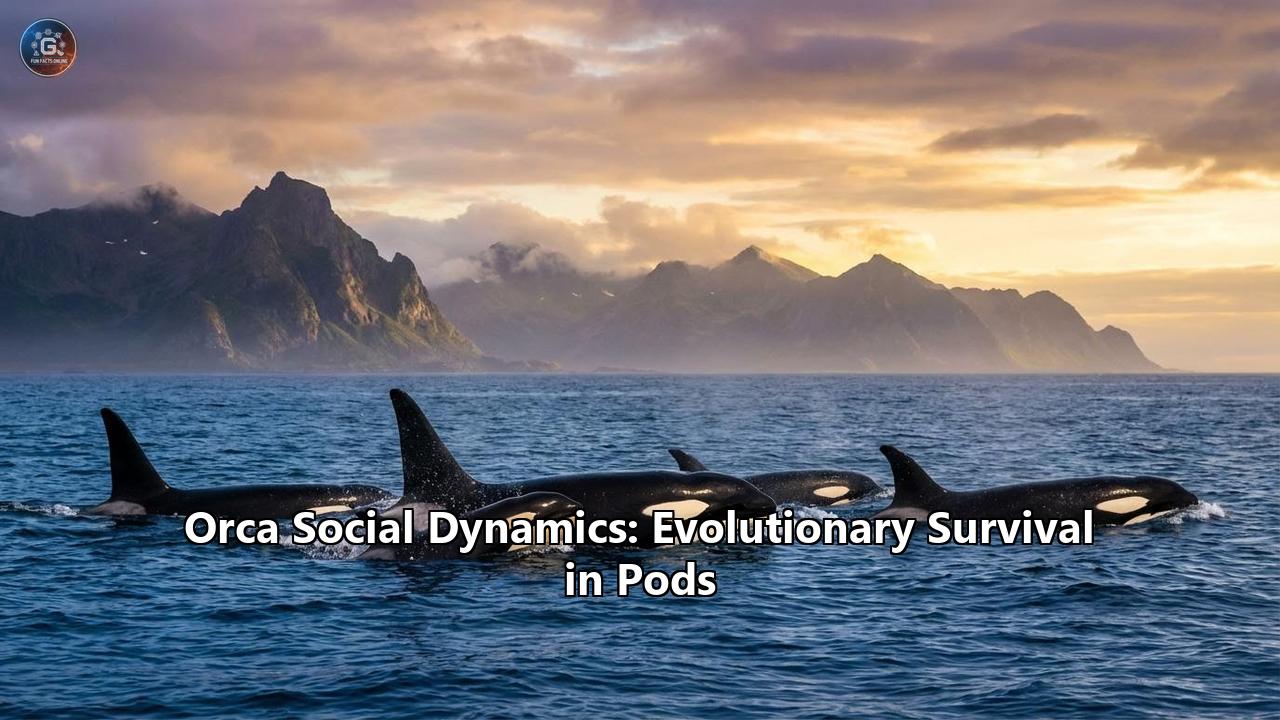
Beneath the rolling, sun-dappled waves of the world’s oceans lies a civilization as complex, layered, and deeply emotional as our own. The orca (Orcinus orca), universally recognized by its striking black-and-white patterning and towering dorsal fin, has long been saddled with the ominous moniker of "killer whale." Yet, this title barely scratches the surface of their true nature. To truly understand the orca is to look past its status as the ocean's apex predator and to dive deep into a highly evolved society built upon sophisticated communication, cultural transmission, and unbreakable family bonds. The evolutionary survival of orcas is not merely a product of their physical prowess, but of their profound social dynamics.
The Matriarchal Throne and the Evolutionary Marvel of MenopauseAt the heart of every resident orca community is a deeply ingrained matriarchal structure. These marine mammals live in closely-knit family groups called pods, which can consist of multiple generations and are almost exclusively led by the oldest female. This social architecture brings us to one of the most fascinating evolutionary anomalies in the animal kingdom: menopause.
Aside from humans and a handful of other cetaceans, almost no other species experiences menopause. Female orcas can live up to 90 years in the wild, yet they typically stop reproducing in their 30s or 40s. Why would evolution strip a female of her reproductive capabilities for the last half of her life? The answer lies in the "Grandmother Hypothesis." By stepping away from reproduction, older female orcas avoid competing with their own daughters for resources and mating opportunities. Instead, they transition into a role of supreme ecological importance: the keepers of generational knowledge.
During periods of environmental hardship or prey scarcity, the survival of the entire pod hinges on the matriarch. She holds decades of mental maps detailing ocean currents, salmon migration routes, and hidden foraging grounds. The evolutionary benefit of her extended post-reproductive lifespan is realized through the increased survival rates of her offspring and grand-offspring. In the harsh, unforgiving expanse of the ocean, a grandmother’s memory is the ultimate survival tool.
The Architecture of the Pod: Fission-Fusion DynamicsOrca societies are not rigid; they are fluid, adaptable, and highly dynamic. Recent biological observations have shed light on how these communities organize themselves to maximize survival. In regions like the Azores, researchers have documented fascinating "fission-fusion" dynamics within mid-Atlantic orca populations. Rather than remaining in a static group, these orcas form mixed-age and mixed-sex social units characterized by a brilliant combination of long-term bonds and casual, intermittent associations.
Some individuals in these waters have been sighted together consistently over spans of 9, 10, and even 11 years, maintaining tight, multi-decadal associations, while other males are occasionally sighted dispersing or traveling alone. This dynamic social behavior is directly influenced by their foraging strategies. When food is abundant, pods may fuse together, forming massive super-pods to socialize and mate. When resources are scarce, they fission into smaller, more agile hunting units. This flexibility ensures that the pod rarely exhausts the resources of a single area, balancing the nutritional needs of the group with the carrying capacity of their environment.
Dialects, Language, and the Echoes of CultureIf you were to drop a hydrophone into the waters of the Pacific Northwest and then do the same off the coast of Norway, you would hear something astonishing: orcas speak in distinct regional dialects. Testament to an extraordinary intelligence nearly unparalleled in the animal kingdom, orcas are one of the few species other than humans that display unique cultures and ethnic groups.
Their vocalizations—a complex symphony of clicks, whistles, and pulsed calls—are not hardwired at birth. They are learned. A calf learns the specific acoustic repertoire of its mother's pod, effectively acquiring a native language that distinguishes its family from neighboring groups. In the Strait of Gibraltar, for example, researchers recently discovered that the local orca population, once thought to be relatively quiet, actually utilizes a completely distinct array of vocal signals and a high level of communicative activity. These new calls are so markedly different from previously documented sounds that they represent a unique dialect. This acoustic identity acts as a social badge, allowing individuals to recognize their kin over vast distances and preventing inbreeding by ensuring mating occurs only with whales that "speak" a different dialect.
Cooperative Hunting: A Masterclass in Deadly TeamworkWhen it comes to securing a meal, orcas do not rely on brute force alone; they rely on each other. Cooperative hunting is arguably the most spectacular manifestation of orca social dynamics, requiring intense coordination, planning, and communication. Different populations have developed specialized, culturally transmitted hunting tactics that are passed down through generations.
In the icy waters of the Antarctic, orcas work together in eerie synchronization to create massive waves that wash unsuspecting seals off floating ice floes. In Patagonia, select pods have mastered the incredibly dangerous art of intentional stranding, surging onto the beach to snatch sea lion pups from the breakers before wriggling backward into the surf.
Perhaps the most mathematically precise hunting strategy is found along the Norwegian coast, where orcas hunt vast schools of herring. A groundbreaking 2025 study utilizing drone footage revealed that these hunts are spatially coordinated with a strict division of labor. Whales assume specific roles based on their size and experience: larger individuals typically act as "strikers," using powerful underwater tail slaps to stun the herring, while others act as "helpers" to corral the fish into tight bait balls.
At the onset of a joint strike, the whales position themselves in specific, highly coordinated geometrical patterns. What makes this even more remarkable is that individuals have preferred hunting partners with whom they share multi-decadal social bonds. This long-term bonding provides them with repeated opportunities over a lifetime to practice and perfect their geometric positioning and timing, significantly increasing their feeding success. It is a breathtaking display of developmental learning and teamwork that cements their status as the ocean's apex tacticians.
Intimacy, Play, and the "Social Glue"While their hunting prowess is terrifyingly efficient, orcas also possess a deeply profound capacity for gentleness, play, and intimacy. The emotional centers of their exceptionally developed brains are highly complex, driving an intense need for social interaction and physical contact.
In a mesmerizing 2025 discovery in the fjords of northern Norway, scientists captured footage of wild orcas engaging in a behavior described as "tongue-nibbling" or "French kissing". For nearly two minutes, two killer whales hovered in the water with their jaws slightly open, trading gentle nibbles on each other’s tongues before peacefully parting ways.
Far from being aggressive, biologists view this cetacean etiquette as a vital form of "social glue". Much like mutual grooming in primates, this affiliative behavior helps reinforce trust, allows younger whales to practice jaw control, and maintains the tight social cohesion necessary for a species that relies on sharing food and hunting cooperatively.
The Cognitive Architecture: The Brain and the FinThe foundation of these intricate social dynamics lies in their biology. Inside the skull of an orca sits the second-largest brain on the planet. This brain is hyper-developed in the paralimbic system—the area responsible for spatial memory, emotional processing, and social bonding. They possess the capacity to experience grief, joy, frustration, and empathy in ways that scientists are only just beginning to comprehend.
Even their physical anatomy is tailored for social living. The iconic dorsal fin, which is not made of bone but of dense, fibrous connective tissue called collagen, serves multiple evolutionary purposes. While it primarily acts as a stabilizing keel during high-speed swimming and aids in thermoregulation by managing body temperature in icy waters, it is also a critical social tool. The dorsal fin serves as a visual marker that helps individuals recognize each other and coordinate movements during chaotic, cooperative hunts, ensuring group cohesion is maintained even in the murky depths.
The Dark Side of Intelligence: The Gibraltar PhenomenonThe profound intelligence and cultural adaptability of orcas also mean that their behaviors can evolve rapidly in response to their environment. This has never been more apparent than in the recent phenomenon occurring off the Iberian coast. Since May 2020, there have been over 700 recorded interactions between a specific population of Gibraltar orcas and human maritime vessels, predominantly sailboats.
Often led by a matriarch named White Gladis, these orcas have developed a distinct pattern of approaching boats from the stern, deliberately striking the rudder, and then losing interest once the vessel is immobilized. While these encounters have caused significant damage to boats and deeply shaken sailors, marine biologists are quick to point out that there are no documented cases of fatal wild orca attacks on humans.
This suggests that the behavior is not driven by malicious intent or a desire to consume humans. Instead, it is likely rooted in natural instinct, intense curiosity, or a complex form of play. Some experts hypothesize that it could be a self-taught, culturally transmitted fad among the juveniles of the pod, or perhaps a defensive reaction shaped by past negative encounters with vessels. Whatever the catalyst, the rapid spread of this boat-ramming behavior throughout the pod is a stunning, real-time demonstration of orca cultural transmission. It shows how quickly a new social trend can be adopted and practiced by the group, further reshaping our understanding of their social structure.
The Legacy of the PodThe evolutionary survival of the orca is a testament to the power of community. They have conquered every ocean on Earth not because they are the largest creatures in the sea, nor simply because they have the sharpest teeth. They have thrived because they understand the absolute value of the collective.
From the wise matriarch guiding her family through treacherous, barren waters, to the coordinated strikes of hunting partners who have swam side-by-side for decades; from the gentle, tongue-nibbling reassurances of trust, to the passing down of distinct ancestral dialects—every aspect of an orca's life is inextricably linked to its pod.
Their society is a mirror held up to the deep blue, reflecting a world of intelligence, culture, and profound emotional depth. As we continue to study and observe these magnificent marine mammals, it becomes increasingly clear that their greatest evolutionary adaptation is not a physical trait, but a social one: the enduring, unbreakable bond of family. Protecting their environment means more than just saving a species; it means preserving a culture, a language, and a sophisticated oceanic civilization that has been thriving in the deep long before humanity ever set sail.
Reference:
- https://www.quora.com/What-are-some-interesting-facts-about-orcas-cognition-playfulness-and-sociality-that-may-explain-their-behavior-towards-boats
- https://a-z-animals.com/blog/discover-where-exactly-orcas-are-attacking-boats/
- https://www.researchgate.net/publication/390916558_First_insights_of_orca_social_dynamics_in_Sao_Miguel_Azores
- https://112.ua/en/kosatki-bila-gibraltaru-rozmovlaut-novou-movou-so-vidkrili-biologi-144368
- https://www.zmescience.com/science/oceanography/a-tourists-gopro-caught-two-wild-orcas-french-kissing-and-it-might-mean-more-than-you-think/
- https://pubmed.ncbi.nlm.nih.gov/40614718/
- https://www.youtube.com/watch?v=DyNHYvw-vpc