
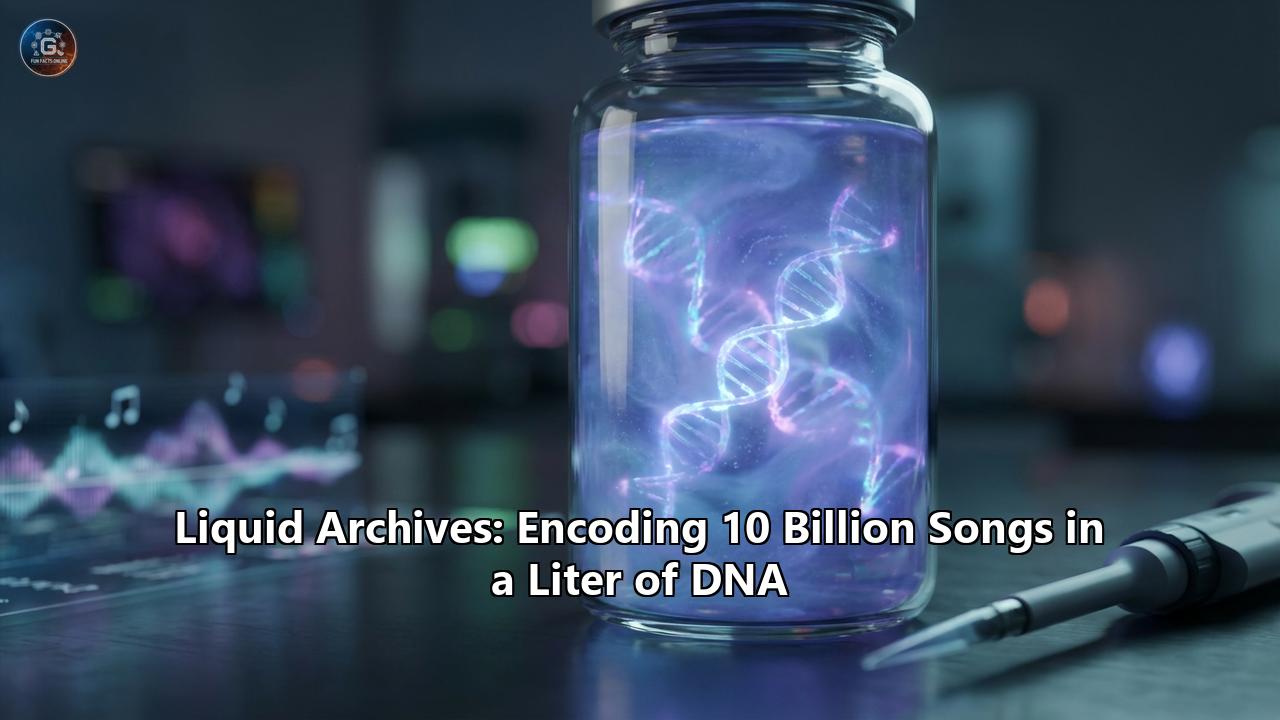
The vial sits on the table, shimmering slightly under the laboratory lights. It is a standard 1000ml borosilicate glass container, the kind you might see in a high school chemistry class holding distilled water. But the liquid inside is not water—or rather, it is not just water. It is a viscous, pale-pink solution that looks underwhelmingly ordinary.
Yet, if you were to drop this vial, the loss would be incalculable.
Inside this single liter of liquid swims the genetic encoding of sixty petabytes of digital information. To put that in perspective, sixty petabytes is enough space to store approximately 10 billion songs—essentially every piece of recorded music in human history, with room left over for a few million high-definition movies. It is the entire Spotify library, the Apple Music catalog, the Library of Congress audio archives, and the private SoundCloud uploads of every teenager on Earth, all swirling in a space no larger than a quart of milk.
This is the Atlas Eon 100, the newly announced flagship product from Atlas Data Storage, a company that has, as of this week, fundamentally changed the physics of human memory.
For decades, we have been warned of the coming "Data Apocalypse"—a point where our creation of digital information outpaces our ability to store it. In 2025, humanity generated approximately 180 zettabytes of data. Our silicon chips are hitting physical limits; our magnetic tapes are too slow; our hard drives are energy-hungry beasts that turn data centers into blast furnaces.
But nature solved this problem three and a half billion years ago. The solution isn't silicon. It’s DNA.
As we stand here in early 2026, looking at a liter of liquid that could hold the cultural heritage of our species, we have to ask: How did we get here? How does it work? And are we ready to trust our history to a molecule that can be destroyed by a splash of bleach?
This is the story of the Liquid Archive revolution.
Part I: The Silicon Wall
To understand the genius of liquid storage, you first have to understand the stupidity of our current situation.
For the last forty years, the digital world has been built on a concept called "planar scaling." We make things smaller and flatter. We etch billions of transistors onto 2D silicon wafers. We coat miles of plastic tape with magnetic particles. We spin aluminum platters at 7,200 revolutions per minute.
This approach has served us well, giving us the smartphone and the cloud. But by the early 2020s, the cracks were showing. The primary issue is density.
A modern hard drive is a miracle of engineering, but it is mostly air and metal housing. The actual data storage layer is infinitesimally thin. If you look at a server rack in a data center—those humming, blinking monoliths that power the internet—99% of the volume is wasted space: cooling fans, power supplies, plastic casing, and the air gaps required to keep the machines from melting.
Then there is the energy problem. In 2024, data centers consumed roughly 2% of the world's total electricity. By late 2025, driven by the voracious appetite of generative AI models, that number had crept toward 4%. We are burning coal and natural gas just to keep our digital memories from fading.
And fade they do. This is the longevity crisis.
- Hard Drives: Life expectancy of 3–5 years.
- SSDs: Data retention issues if left unpowered for a few years.
- LTO Magnetic Tape: The gold standard for archiving, lasting 30 years if kept in strictly controlled humidity and temperature.
Thirty years is a blink of an eye in historical terms. If we had stored the works of Shakespeare on magnetic tape in 1616, we would have had to copy them onto new tapes thirteen times by now to ensure they survived.
"We were building libraries out of sand," says Dr. Elena Kogan, a synthetic biologist at the forefront of the DNA storage movement. "We were desperately stacking sandcastles while the tide of data was coming in. We needed a medium that wasn't just denser, but eternal."
Enter the molecule of life.
Part II: The Ultimate Hard Drive
DNA (Deoxyribonucleic acid) is, fundamentally, a coding language. It does not use the binary 0s and 1s of computers, but a quaternary code of four chemical bases: Adenine (A), Cytosine (C), Guanine (G), and Thymine (T).
The density of DNA is difficult to comprehend. A single gram of DNA can theoretically store 215 petabytes of data. To visualize this: you could store all the data currently on the entire internet—every tweet, video, email, and website—in a shoebox full of DNA.
But theory is one thing; practice is another. The road to the "Atlas Eon 100" has been paved with slow, expensive failures.
The Rosetta Stone of 2012
The modern era of DNA storage began in 2012, when Harvard geneticist George Church encoded a 53,000-word book into DNA. It was a proof of concept. It was slow, and it cost a fortune, but it worked. The book was recovered with zero errors.
The Microsoft Leap
By 2016, Microsoft had entered the game, purchasing 10 million strands of synthetic DNA from Twist Bioscience. They weren't storing books; they were storing deep archival data. They managed to encode "This Land is Your Land" by Woody Guthrie and a high-definition video by the band OK Go.
The problem, however, was always cost and speed.
In 2020, writing a few megabytes of data into DNA cost thousands of dollars. Chemical synthesis—building the DNA strand molecule by molecule—was a toxic, slow process involving harsh solvents. It was like trying to write a novel by carving each letter into stone.
The Enzymatic Revolution (2024–2025)
The breakthrough that led to today’s announcement wasn't in storage, but in writing.
"The shift from chemical synthesis to enzymatic synthesis was the Gutenberg moment for DNA," explains Bill Banyai, founder of Atlas Data Storage.
Instead of forcing molecules together with harsh chemicals, scientists engineered enzymes—biological catalysts—that could build DNA strands naturally, just like the cells in your body do, but at super-speeds.
- Chemical Synthesis: 3 minutes per base. Toxic waste. 200-base length limit.
- Enzymatic Synthesis (2026): Milliseconds per base. Water-based. 10,000+ base capability.
This is what makes the Atlas Eon 100 possible. It is not just a container; it is the result of a new manufacturing process that "prints" DNA fast enough to make it commercially viable for high-value data.
Part III: Inside the Atlas Eon 100
So, how do you get 10 billion songs into a liter of pink liquid?
Step 1: Translation
First, the digital file (an MP3, a WAV, a text file) is broken down from binary (011001) into the quaternary code of DNA.
- 00 might become A
- 01 might become C
- 10 might become G
- 11 might become T
However, it's not that simple. DNA hates repetition. A long string of "AAAAA" (which might represent a silence in a song) causes biological errors—the DNA strand folds up or breaks. So, algorithms randomize the data, adding "error correction codes" similar to those used in QR codes. This ensures that even if a few strands break, the song can still be played perfectly.
Step 2: Synthesis (The Write)
This is where the Atlas machine hums. Millions of microscopic nozzles deposit enzymes that grab nucleotides from the air and stitch them into strands. This is the "Liquid Archive." The result is a soup of trillions of floating DNA fragments. Each fragment has a "barcode" on the end—an address label telling the computer where this piece belongs in the larger file.
Step 3: Preservation
This is the crucial "Atlas" innovation. DNA in water can degrade if it gets too hot or is exposed to UV light.
The Atlas Eon 100 uses encapsulation. The DNA strands are trapped inside microscopic silica (glass) beads or metallic capsules, suspended in the liquid. This protects the DNA from the elements.
"You could boil this liter of liquid," Banyai claims, "and the data would survive. You could leave it in the desert for a thousand years, add water, and play the Beatles."
Step 4: Retrieval (The Read)
To play a song back, you don't "play" the liquid. You take a tiny pipette drop—a microliter. Because of the biological amplification method (PCR), you can use enzymes to "search" the liquid. You introduce a primer that matches the "barcode" of the song "Bohemian Rhapsody."
The biology ignores the billions of other songs and only copies the strands associated with Queen.
These copies are then run through a DNA sequencer (a device now the size of a smartphone), which reads the letters, converts them back to binary, and voila—music plays.
Part IV: The Landscape of Immortality
Atlas Data Storage is not alone. The year 2026 is shaping up to be the "War of the Archives." While DNA conquers density, other technologies are fighting for the crown of durability.
The Glass Contender: Microsoft Project Silica
While Atlas plays with liquid, Microsoft has bet on solidity. Project Silica stores data in quartz glass.
Using femtosecond lasers (lasers that pulse for a quadrillionth of a second), they etch 3D "voxels" into plates of glass the size of a DVD.
- Capacity (2026): ~10 Terabytes per glass square.
- Durability: 10,000+ years.
- Advantage: It is "Write Once, Read Many" (WORM). You cannot accidentally delete or hack the data once it is etched in glass. It is physically permanent.
- Status: In 2026, Microsoft is already using this for Azure Cold Storage. The "Superman" movie was their first demo; now they are storing sensitive government archives.
The Ceramic Challenger: Cerabyte
Out of Germany comes Cerabyte, a startup that uses a ceramic-on-glass technology. They etch data into nano-layers of ceramic, creating something akin to microscopic QR codes that are fireproof, floodproof, and EMP-proof.
- Capacity: Petabyte-scale cartridges.
- The Pitch: "Data on Ceramics." It sounds ancient, like Sumerian clay tablets, and that's the point. Ceramics last forever. Cerabyte's systems are currently rolling out to data centers that need to store data for 50-100 years without electricity.
DNA vs. Glass vs. Ceramic
- DNA (Atlas) wins on Density. Nothing beats it. You can hide an entire data center in a perfume bottle. It is perfect for "Deep Cold" storage—data you might not need for 100 years, or data you need to smuggle.
- Glass (Silica) and Ceramic (Cerabyte) win on Access Speed. Reading a glass plate is faster than sequencing DNA. They are better for "Warm" storage—data you might need to access once a month.
Part V: The Hall of Fame
The "10 billion songs" claim is a marketing hook, but the reality of what is being stored in these liquid archives is far more profound. As of 2026, here are some of the "artifacts" that have been encoded into DNA or etched into glass for eternity:
- The Lunar Library: The Arch Mission Foundation has already placed DNA archives on the Moon. These contain the English Wikipedia, the Project Gutenberg library, and linguistic keys to 5,000 languages. If Earth falls, the backup is on the Moon.
- The Global Music Vault: Buried deep in the permafrost of Svalbard (near the famous Seed Vault), this vault uses Microsoft's silica glass to store master quality recordings of indigenous music from around the world, ensuring that the songs of vanishing cultures can never be truly lost.
- The "DNA of Things" (DoT): In a bizarre twist, manufacturers are now mixing DNA into the plastic of high-end products. A 3D-printed bunny was created in 2020 containing the instructions to print itself encoded in its own plastic. In 2026, luxury watchmakers are embedding DNA certificates of authenticity into the metal casing of their watches.
- Bio-Malware? In a controlled experiment, researchers encoded a computer virus into a strand of DNA. When a gene sequencer read the DNA, the software processing the data "executed" the code and crashed. It was a stark warning: biological data can hack digital systems.
Part VI: The Economics of Eternity
The elephant in the room is price.
In 2020, storing 1MB in DNA cost $3,000.
In 2026, thanks to the Atlas Eon 100's enzymatic process, that price has plummeted to roughly $0.01 per Megabyte.
That is still expensive compared to a hard drive (which is fractions of a cent), but for archival data, the math is different.
The Total Cost of Ownership (TCO) Argument:A hard drive costs money to buy, but it also costs money to power (electricity) and cool (AC) every hour of every day. And you have to replace it every 5 years.
A DNA capsule costs money to synthesize once. After that, it sits on a shelf at room temperature. It consumes zero energy. It takes up zero space. It needs no maintenance.
Over a period of 50 years, DNA storage is now cheaper than hard drives for data that doesn't need to be read often.
This is why the target market for the Atlas Eon 100 isn't you or me (yet). It is Hollywood studios archiving master reels. It is oil companies storing seismic data. It is governments storing census records. It is hospitals storing the genomes of millions of patients.
Part VII: The Future - "Living" Drives
If 2026 is the year of Liquid Archives, what does 2030 hold?
The frontier is In-Vivo Storage.
Right now, the Atlas Eon 100 uses "dead" DNA in a test tube. But scientists are working on encoding data into the genomes of living bacteria.
Imagine a colony of E. coli in your gut that stores your medical passwords. Imagine a tree whose leaves contain the history of the land it grows on.
This is not science fiction. Researchers have already used CRISPR to edit a GIF of a galloping horse into the DNA of living bacteria, which then multiplied and passed the GIF down to their children. The movie survived for generations.
We are moving toward a world where "Biology" and "Technology" are indistinguishable. Where the "Cloud" isn't a server farm in Virginia, but a biological slurry in a vat, computing and storing data with the efficiency of life itself.
Conclusion: The Weight of Memory
As we look at the Atlas Eon 100, we are forced to confront a philosophical question: What is worth saving?
When storage was expensive, we had to curate. We chose which photos to keep, which documents to archive.
When storage becomes infinite—when 10 billion songs fit in a liter—we lose the filter. We will save everything. Every bad take, every surveillance video, every embarrassing moment. The "Right to be Forgotten" may become the defining legal battle of the late 2020s, not against Google, but against the very molecules we use to store our lives.
But for now, there is something poetic about the loop closing.
Life began as information encoded in DNA, floating in a primordial soup.
Billions of years later, intelligent life has learned to encode its own music, its art, and its history back into that same soup.
The "Liquid Archive" is not just a storage device. It is a message to the future, written in the language of life, saying: We were here. We sang these songs. And we found a way to make them last.
Technical Addendum: The 2026 DNA Storage Fact Sheet
| Feature | Hard Drive (HDD) | LTO Tape | Atlas Eon 100 (DNA) | Project Silica (Glass) |
| :--- | :--- | :--- | :--- | :--- |
| Density | Low | Medium | Extreme (Exabytes/mm³) | High (TB/mm³) |
| Longevity | 5 Years | 30 Years | 1,000+ Years | 10,000+ Years |
| Energy (at rest) | High | Zero | Zero | Zero |
| Read Speed | Fast (ms) | Slow (min) | Very Slow (hours) | Fast (ms) |
| Durability | Fragile | Fragile | High (if encapsulated) | Indestructible |
| Best For | Daily Use | Backups | Deep Archive / Time Capsules | Cloud Cold Storage |
Author's Note: The Atlas Eon 100 is currently available for enterprise partners. Consumer "DNA Home Kits" are rumored for release in Q4 2028.Reference:
- https://en.wikipedia.org/wiki/Arch_Mission_Foundation
- https://potomacinstitute.org/images/Publications/PDF/Future_of_DNA_Data_Storage.pdf
- https://explodingtopics.com/blog/data-storage-trends
- https://uppcsmagazine.com/dna-based-data-storage-the-future-of-information-archiving/
- https://www.coherentmi.com/industry-reports/dna-data-storage-market
- https://www.mordorintelligence.com/industry-reports/dna-storage-for-data-archiving-market
- https://academic.oup.com/gigascience/article/8/6/giz075/5521158
- https://pmc.ncbi.nlm.nih.gov/articles/PMC11999466/
- https://www.astrobotic.com/guest-post-arch-mission-foundation-more-lunar-more-library/
- https://formtek.com/blog/the-glass-revolution-project-silicas-promise-for-data-storage/
- https://www.microsoft.com/en-us/research/project/project-silica/news-and-awards/
- https://www.marketsandmarkets.com/industry-news/Zero-Loss-Data-Storage-Capacity-Leaps-To-10,000-Years-Led-By-Microsoft
- https://www.pl-talents.com/next-gen-storage-revolution-cerabyte-unveils-ceramic-based-technology/
- https://www.youtube.com/watch?v=tmSTPwww-Lk
- https://www.microsoft.com/en-us/research/project/project-silica/
- https://www.hpcwire.com/2024/07/20/can-cerabyte-crack-the-1-per-petabyte-barrier-with-ceramic-storage/
- https://blocksandfiles.com/2023/09/04/cerabytes-last-for-ever-ceramic-nano-memory-storage-and-yottabyte-era-roadmap/
- https://www.prweb.com/releases/the-arch-mission-foundation-announces-digital-data-stored-in-dna-added-to-lunar-library-creating-groundbreaking-archive-of-knowledge-on-the-moon-880270814.html
- https://www.allaboutcircuits.com/news/cerabyte-aims-to-revolutionize-data-storage-with-nanodots-ceramic/