
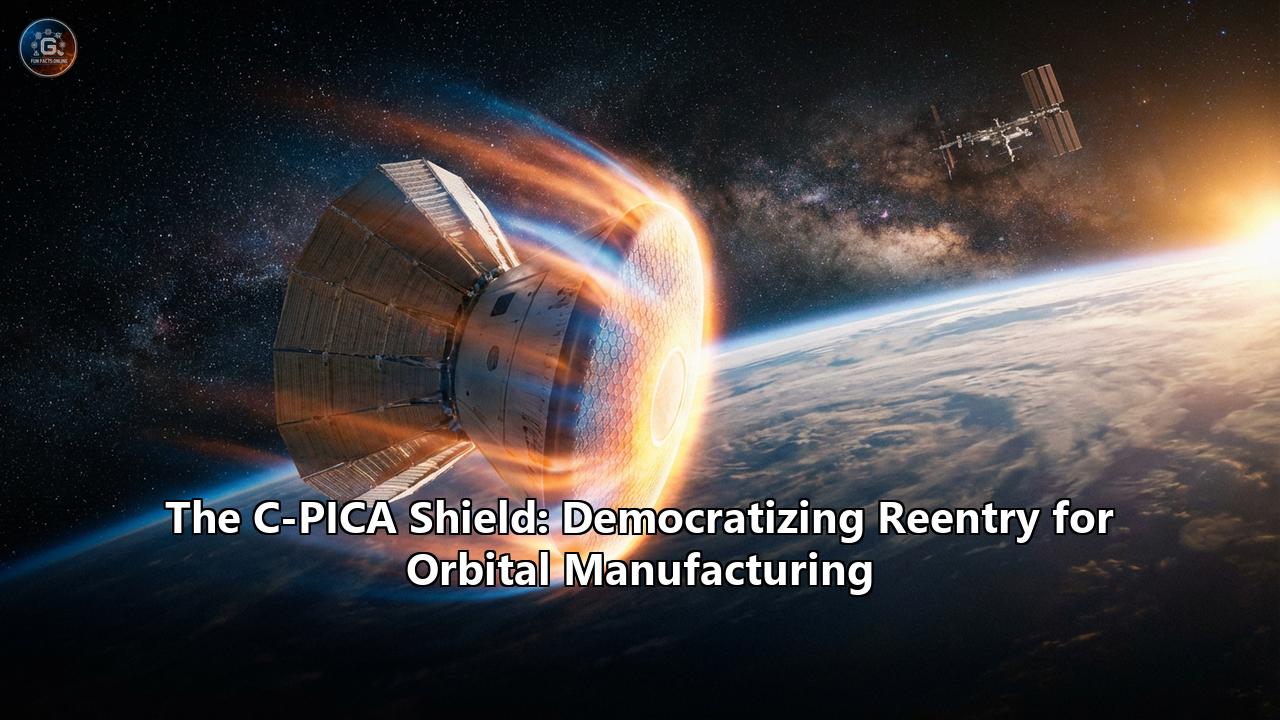
The red dust of the South Australian outback has barely settled, but the impact of what happened yesterday at the Koonibba Test Range is already sending shockwaves through the aerospace industry. When Varda Space Industries’ W-5 capsule streaked across the sky and touched down on January 29, 2026, it didn't just deliver a payload of space-manufactured pharmaceuticals; it delivered a message. That message, written in the charred, ablative crust of its heat shield, is that the era of "bespoke reentry" is over. The age of mass-producible, industrial-grade return from orbit has begun.
For decades, the conversation about the space economy has been dominated by a single vector: launch. We obsessed over dollars per kilogram to orbit, celebrating every reusable booster landing and every drop in the price of a Falcon 9 flight. But launch is only half the equation. If we are to build a true orbital economy—one where we don't just visit space, but work there, build there, and bring value back—we need to solve the problem of getting home. We need a way to bring goods back from orbit that doesn't cost a fortune, doesn't require a national-scale engineering effort for every mission, and doesn't rely on technology frozen in the Apollo era.
Enter the C-PICA Shield.
The technology that protected the W-5 capsule, and which is now poised to protect a fleet of commercial spacecraft from Varda, Inversion Space, and others, is a material known as Conformal Phenolic Impregnated Carbon Ablator, or C-PICA. It is an innovation that might lack the visceral roar of a Raptor engine or the sci-fi silhouette of a Starship, but it is arguably just as critical to the next decade of space industrialization. By turning the most dangerous phase of spaceflight—hypersonic atmospheric entry—into a manageable, scalable industrial process, C-PICA is doing for reentry what the Falcon 9 did for launch: democratizing it.
This article explores the deep technical, economic, and historical significance of this new material. We will journey from the high-tech looms of NASA Ames Research Center to the factory floors of El Segundo, examine the physics of shedding gigajoules of kinetic energy, and analyze how a sheet of carbon felt is unlocking a multi-billion-dollar orbital manufacturing market.
Part I: The Heat Problem and the Legacy of PICA
To understand why C-PICA is revolutionary, we must first appreciate the brutality of the problem it solves. Returning from Low Earth Orbit (LEO) requires a spacecraft to shed orbital velocities of approximately 7.8 kilometers per second (about 17,500 mph). When a capsule hits the atmosphere at that speed, it is compressing the air ahead of it so violently that the gas molecules cannot get out of the way. They are crushed into a shockwave where temperatures can soar above 2,500 degrees Celsius—hot enough to vaporize steel.
For the first half-century of spaceflight, solving this "heat problem" was the domain of superpowers. The solutions were heavy, complex, and ruinously expensive. The Apollo capsules used AVCOAT, an epoxy-novolac resin injected into a fiberglass honeycomb. It was effective, but manufacturing it was an agonizingly manual process. Gun-wielding technicians had to inject the material into hundreds of thousands of individual honeycomb cells, and the resulting shield was heavy and difficult to scale. The Space Shuttle took a different approach with its reusable silica tiles and Reinforced Carbon-Carbon (RCC) panels. While reusable, these systems were fragile, complex to maintain, and notoriously unforgiving of damage—a lesson learned in the most tragic way possible with the loss of Columbia.
Then came PICA.
Developed in the 1990s at NASA Ames Research Center, Phenolic Impregnated Carbon Ablator (PICA) was a quantum leap forward. It was a low-density ablative material, meaning it was designed to burn away. As the heat of reentry attacked the shield, the PICA would char, pyrolysis gases would flow out to form a cool boundary layer, and the heat would be carried away with the shedding material. PICA was lighter than AVCOAT and could withstand higher heat fluxes, making it capable of surviving the blistering speeds of a return from Mars or an asteroid. It famously protected the Stardust capsule in 2006, which hit the atmosphere at a record-breaking 12.9 km/s.
But "legacy PICA" had a fatal flaw for the commercial era: it was hard to make.
The backbone of traditional PICA is a material called FiberForm, a rigid, block-like carbon preform originally designed as insulation for high-temperature vacuum furnaces. Manufacturing a heat shield out of FiberForm is a subtractive process. You have to buy large, expensive billets of this rigid material, machine them into precise tiles, and then painstakingly assemble them into a mosaic on the spacecraft's aerosol. It is like tiling a bathroom floor, if the tiles cost thousands of dollars each and a single gap meant the destruction of the house.
Because FiberForm is rigid and brittle, you can't just wrap it around a curved surface. You are forced to use a tiled approach for anything larger than a very small probe. This introduces "gap fillers"—materials needed to seal the spaces between tiles—which adds complexity, failure points, and labor hours. For a company like SpaceX, which uses a proprietary version of PICA (PICA-X) for its Dragon capsules, or for NASA's Mars missions, this complexity is manageable. But for a startup wanting to bring back a small capsule of pharmaceuticals every month? It was a bottleneck.
This is where the genius of C-PICA lies. It didn't just improve the material; it changed the form factor entirely.
Part II: The Felt Revolution
"Conformal" is an engineering term that sounds dry but implies magic. In the context of C-PICA, it means "flexible." Instead of starting with a rigid block of FiberForm, C-PICA starts with a rayon-based carbon felt—a soft, compliant textile that looks and feels a bit like a high-tech blanket.
This shift from rigid block to flexible felt changes everything about the manufacturing process.
1. The End of Tiling: Because the underlying carbon matrix is flexible, it can be shaped. A single large sheet of C-PICA precursor can be molded over the curve of a heat shield's substructure. This allows for the creation of large, monolithic heat shields without the need for hundreds of individual tiles. For a vehicle the size of Varda’s W-series capsules (roughly 1 meter in diameter), a C-PICA shield can be manufactured as a single, seamless unit. This eliminates the need for gap fillers, reduces the aerodynamic trip hazards that can cause uneven heating, and dramatically simplifies the assembly process. 2. Supply Chain Resilience: The rigid FiberForm used in legacy PICA is a niche product with a limited supply chain. Carbon felt, on the other hand, is a more commoditized industrial material. By decoupling high-performance reentry from a boutique supply chain, NASA Ames and its commercial partners have made the material more accessible and less prone to shortages. 3. Mass and Cost Efficiency: C-PICA is not just easier to use; it is better. It offers a mass savings of approximately 50% compared to traditional PICA for the same thermal protection capability. In the tyranny of the rocket equation, where every gram counts, saving half the mass of your heat shield is a monumental victory. It means more payload capacity for the pharmaceuticals, fiber optics, or semiconductors being manufactured in orbit. Furthermore, because it reduces the touch-labor required for machining and assembly, the cost per unit drops significantly. Varda produces its C-PICA shields in-house at their El Segundo facility, a feat that would have been nearly impossible for a startup using the old AVCOAT or tiled PICA methods. 4. The Impregnation Process: The "Phenolic Impregnated" part of the name remains the same. The carbon felt is impregnated with a phenolic resin aerogel. This is the "magic sauce" that gives the material its ablative properties. When heated, the phenolic resin absorbs energy as it decomposes, turning into a char that radiates heat away from the spacecraft. The process of impregnating the felt is more uniform and controllable than impregnating dense rigid blocks, leading to a more consistent material performance.The success of yesterday’s W-5 landing is the ultimate validation of this "felt revolution." It proves that you don't need a billion-dollar government program to build a hypersonic entry vehicle. You need a roll of carbon felt, some phenolic resin, and the engineering daring to embrace a new paradigm.
Part III: The Pioneers—Varda and Inversion
While NASA Ames developed the technology, it is the commercial sector that is actively weaponizing it to build a business. Two companies, in particular, stand out as the primary beneficiaries and drivers of the C-PICA ecosystem: Varda Space Industries and Inversion Space.
Varda Space Industries:Varda is the poster child for the "space factory" concept. Founded by former SpaceX engineer Will Bruey and Founders Fund principal Delian Asparouhov, Varda’s thesis is simple: gravity is a manufacturing variable. On Earth, gravity causes sedimentation, convection, and buoyancy—forces that interfere with the formation of perfect crystal structures. By manufacturing in microgravity, Varda can create pharmaceutical crystals that are purer, more uniform, and more effective than anything made on the ground.
But Varda isn't just a pharma company; it's a reentry company. As Asparouhov has famously quipped, they are effectively a "drug delivery" company in the most literal sense. The W-series capsules are their delivery trucks.
For Varda, C-PICA is the enabler of their business model. Their goal is a high cadence of missions—eventually reaching monthly launches and landings. To achieve this, they need a heat shield that can be mass-produced on an assembly line, not crafted by artisans. The W-5 mission, which utilized a C-PICA shield manufactured entirely in-house by Varda, marks the transition from "experimental prototype" to "production hardware."
The economics of Varda's model rely on the high value density of their payload. Pharmaceuticals like Ritonavir (used for HIV treatment) or experimental cancer drugs can be worth thousands of dollars per gram. This high value justifies the cost of launch and reentry. However, as C-PICA drives down the cost of the return leg, the threshold for what is "economically viable" to manufacture in space lowers. Today it is life-saving drugs; tomorrow it could be exotic fiber optic cables (like ZBLAN) or high-performance semiconductors.
Inversion Space:While Varda focuses on manufacturing, Inversion Space is focused on logistics. Their vision is "space as a shortcut." They aim to use orbital capsules to deliver cargo anywhere on Earth in under an hour. It is a concept that the military has dreamed of for decades, but Inversion is approaching it with a commercial mindset.
Inversion’s "Ray" and "Arc" vehicles are designed to store cargo in orbit and deploy it on demand to precise locations on Earth. For them, C-PICA is equally critical. A logistics vehicle needs to be cheap and robust. If you are delivering medical supplies to a disaster zone or a critical part to a remote manufacturing site, you cannot afford a heat shield that costs millions. Inversion has worked closely with NASA Ames to adapt C-PICA for their specific flight profiles, which involve high-G, precision landings.
The collaboration between these startups and NASA is a textbook example of successful technology transfer. NASA developed the fundamental material science (TRL 1-6), and companies like Varda and Inversion are taking it through the "valley of death" to commercial operations (TRL 7-9). The "Tipping Point" awards and Space Act Agreements that facilitated this transfer have likely generated a higher ROI for the American taxpayer than almost any other recent space technology program.
Part IV: The Economics of Democratized Reentry
The landing of W-5 offers a prime opportunity to reassess the economics of the Low Earth Orbit (LEO) economy. Market analysts project the in-space manufacturing market to grow from roughly $1.2 billion in 2025 to over $1.5 billion by the end of 2026, with a trajectory toward $3.5 billion by 2030. These numbers, however, are conservative estimates that often fail to account for the non-linear growth unlocked by reliable reentry.
Historically, the space economy was a "one-way street." We sent satellites up, and they stayed there until they burned up or became junk. The only things that came back were government astronauts and negligible amounts of scientific samples. This limited the LEO economy to services that could be delivered via electromagnetic waves: communications, GPS, and Earth observation imagery.
C-PICA turns the street into a two-way highway.
1. The Cost Curve:By reducing the cost of the heat shield—one of the most expensive subsystems of a reentry vehicle—C-PICA lowers the overall mission cost. Varda has targeted a cost-per-flight of roughly $2.5 million once they reach maturity. If a capsule can carry 100 kg of payload, the cost of return drops to $25,000 per kg. While still high compared to air freight, this is orders of magnitude cheaper than previous sample return missions, which cost hundreds of millions of dollars for a few kilograms.
2. The Cadence Factor:The "democratization" comes from speed as much as cost. A flexible, felt-based manufacturing process allows for rapid curing and molding. Varda doesn't need to wait months for a supplier to machine a billet of FiberForm. They can impregnate and mold a shield in days. This supports their goal of a monthly cadence. Frequent flights mean faster iteration cycles for their pharmaceutical partners. In drug development, time is money. Cutting years off a drug's formulation phase by utilizing microgravity crystallization is worth billions to big pharma.
3. The "Orbital Industrial Park":With reliable reentry, the concept of an orbital industrial park becomes feasible. Companies can launch "factory modules" that dock with commercial space stations (like the upcoming stations from Vast, Blue Origin, or Axiom). They can process materials for months, then load the finished products into a small, C-PICA-equipped capsule for return to Earth. This decouples the "factory" (the station) from the "truck" (the capsule), allowing for specialized logistics chains.
4. The Geopolitical Angle:The landing of W-5 in Australia highlights another economic dimension: the global market for landing rights. Reentry is a violent event. It creates sonic booms and requires large, unpopulated safety zones. The United States has limited ranges for this (Utah Test and Training Range, White Sands). By partnering with Southern Launch in Australia, Varda has opened up a new corridor for space commerce. This creates a new export industry for nations with large, empty landmasses. Australia, with its vast outback and stable political environment, is positioning itself as the "Earth's Loading Dock."
Part V: Beyond LEO – C-PICA on Mars
While the immediate commercial application is bringing drugs back from LEO, the lineage of C-PICA points toward the Red Planet.
NASA’s original interest in PICA was for high-speed entries. The Stardust mission proved PICA’s worth at 12.9 km/s. C-PICA retains these high-performance thermal characteristics. As we look toward future Mars sample return missions or even human landings, C-PICA offers a compelling solution for the "backshell" of these vehicles—the rear part of the heat shield that experiences lower heating than the main face but still requires protection.
Currently, Mars landers use tiled PICA or other heavier materials for their backshells. Switching to C-PICA could save hundreds of kilograms of mass. On a Mars mission, where the "gear ratio" (the amount of fuel needed to launch payload) is huge, saving 100 kg on the entry vehicle might save thousands of kilograms of launch fuel, or allow for an extra science rover to be included.
Furthermore, the "conformal" nature of the material opens up new vehicle shapes. We are no longer limited to the classic blunt-body capsule shapes of Apollo and Orion. C-PICA could enable slender, lifting-body designs or complex geometries that offer better aerodynamic control during descent. This is crucial for landing in the thin Martian atmosphere, where precision is notoriously difficult.
Part VI: The Technical Deep Dive – Why Felt Matters
To truly appreciate the C-PICA Shield, we need to zoom in to the microscopic level.
Standard PICA is a composite of a carbon fiber preform (FiberForm) and a phenolic resin. The FiberForm provides the structural skeleton, while the phenolic resin provides the ablative mass. The key to PICA's performance is its high porosity. It is mostly empty space. This makes it an incredible insulator. You could hold a blowtorch to one side of a PICA tile and place your hand on the other side without getting burned.
However, the carbon fibers in FiberForm are arranged in a specific, rigid orientation. This gives it anisotropic properties—it is stronger in one direction than another.
C-PICA uses a carbon felt. Felt is a non-woven textile where fibers are matted together randomly. This gives the material a few distinct advantages:
- Isotropy: The random orientation of fibers makes the material's properties more uniform in the plane of the felt. This simplifies the thermal modeling. Engineers don't have to worry as much about the "grain" of the material.
- Strain Compliance: This is the big one. Rigid materials crack when they expand or contract at different rates than the structure they are glued to. This is why the Space Shuttle tiles had to be separated by gaps—to allow for thermal expansion. C-PICA is "compliant," meaning it has a bit of give. It can stretch and compress slightly without cracking. This allows it to be bonded directly to the aluminum or composite structure of the capsule without complex strain isolation pads (SIPs) or gap fillers. It moves with the vehicle, not against it.
- Graded Density: The manufacturing process for C-PICA allows for "functionally graded" materials. You can potentially densify the outer surface (where the heat is highest) while keeping the inner layers light and airy (for maximum insulation). This allows for a heat shield that is optimized layer-by-layer, shaving off even more precious mass.
The W-5 capsule's survival was a test of this compliance. As it slammed into the atmosphere, the vehicle structure likely flexed and heated up. A rigid shield might have cracked or delaminated. The C-PICA shield, acting like a flexible, charred skin, absorbed the punishment and held firm.
Part VII: The Future of the C-PICA Ecosystem
As we stand in January 2026, the successful return of W-5 is just the opening salvo. What does the next five years look like for this technology?
1. Standardization: We will likely see C-PICA become the "standard" for small to medium-sized reentry vehicles. Just as carbon fiber replaced aluminum for high-performance aircraft structures, C-PICA will replace tiled PICA and cork-based ablators for a wide swath of missions. 2. Off-the-Shelf Reentry: Companies may emerge that sell "reentry kits"—pre-manufactured C-PICA nose cones and heat shields that can be bolted onto standard satellite buses. This would allow university cubesat teams or small nations to conduct sample return missions without needing to develop their own thermal protection materials. 3. The Scaling Challenge: The current limitation of C-PICA is size. While you can make a 1-meter shield in one piece, making a 5-meter shield for a Starship-class vehicle or a large human capsule would still require seaming multiple sheets of felt together. Developing reliable seaming techniques for C-PICA is the next engineering frontier. If solved, we could see massive C-PICA shields protecting commercial space stations or heavy-lift cargo landers. 4. Hybrid Systems: We may see hybrid systems that combine the durability of C-PICA with the reusability of metallic or ceramic manufacturing. For example, a vehicle might use a C-PICA nose cap (which takes the brunt of the heat and is replaced after each flight) combined with reusable metallic thermal protection on the leeward side.Conclusion: The Quiet Revolution
Space exploration is often defined by its loudest moments: the roar of the rocket, the cheer of the control room, the sonic boom of the return. But often, progress is defined by the quiet revolution of materials science. It is the story of how a lighter alloy allowed for a bigger engine, or how a better battery enabled a longer rover drive.
The C-PICA Shield is one of these quiet revolutions. It is a piece of black, fuzzy carbon felt that has solved a problem that bedeviled engineers for sixty years. It has taken the "art" of heat shield manufacturing and turned it into a "process."
By lowering the barrier to entry for reentry, C-PICA has effectively completed the circuit of the space economy. We now have a scalable way up (Falcon 9, Electron, Starship) and a scalable way down (C-PICA capsules). The loop is closed.
As Varda’s technicians in Australia begin the process of dismantling the W-5 capsule to retrieve their crystal payload, they are not just unloading cargo. They are unpacking the future. A future where "Made in Space" is not a novelty stamped on a souvenir, but a standard origin label on the medicines that save our lives and the chips that power our computers. The door to the orbital factory is open, and C-PICA is the doormat.
Technical Appendix: C-PICA vs. The RestFor the technically inclined, a comparison of the leading ablative Thermal Protection Systems (TPS) highlights the specific niche dominance of C-PICA.
| Feature | Legacy PICA (Stardust/Dragon) | AVCOAT (Apollo/Orion) | C-PICA (Varda/Inversion) |
| :--- | :--- | :--- | :--- |
| Base Material | Rigid Carbon Fiber Preform (FiberForm) | Epoxy-Novolac Resin in Fiberglass Honeycomb | Rayon-based Carbon Felt |
| Form Factor | Tiled Blocks | Monolithic (Gun-injected) | Monolithic / Conformal Sheet |
| Density | Low (~0.27 g/cm³) | Medium (~0.5 g/cm³) | Low (~0.2-0.25 g/cm³) |
| Manufacturing | Machining & Tiling (High Labor) | Injection into Honeycomb (High Labor) | Molding & Impregnation (Low Labor) |
| Strain Compliance | Low (Brittle) | Medium | High (Flexible) |
| Gap Fillers? | Required for large shields | No (but honeycomb creates cells) | Not required (Seamless) |
| Cost | High | High | Low |
| Scalability | Linear (Hard to scale up) | Linear | Exponential (Batch processing) |
Industry Impact Analysis: The "FedEx" MomentIn logistics, the "FedEx Moment" refers to the point where reliable, overnight delivery became a standard business expectation rather than a luxury. The space industry is approaching its own version of this.
Until now, returning a payload from space was akin to sending a package via the Pony Express. It was slow, dangerous, expensive, and you only did it if the package was incredibly valuable. The successful deployment and recovery of C-PICA shields marks the transition to a modern logistics model.
With companies like Varda aiming for monthly cadences by late 2026, we are seeing the establishment of a "supply chain rhythm." Pharmaceutical companies can now plan their R&D pipelines around scheduled orbital drops. This reliability is far more valuable than raw speed. If a researcher knows that their crystals will be back in the lab on the 15th of every month, they can build a robust testing program around that date.
This rhythm is supported by the regulatory breakthroughs that have accompanied the technology. Varda’s navigation of the FAA Part 450 license process, and their precedent-setting landing approvals in Australia, have cleared the regulatory brush for those who follow. The C-PICA shield is the hardware component of this success, but the "software" (regulation, insurance, range safety) is just as important.
Final ThoughtsThe red dust of the outback will wash off the W-5 capsule. The data recorders will be downloaded. The Ritonavir crystals will be analyzed. But the legacy of this mission will remain. We have witnessed the democratization of the return ticket. Space is no longer a place you go to and stay; it is a place you go to work, and then come home. And you come home behind a shield of C-PICA.
Reference:
- https://forum.nasaspaceflight.com/index.php?topic=37310.140
- https://www.nasa.gov/general/nasa-helps-emerging-space-companies-take-the-heat/
- https://www.researchandmarkets.com/report/in-space-manufacturing
- https://www.reddit.com/r/spacex/comments/27nbsk/avcoat_vs_picax_heatshields/
- https://ntrs.nasa.gov/api/citations/20240006803/downloads/IPPW_2024_Borner.pdf
- https://forum.nasaspaceflight.com/index.php?topic=36039.0
- https://aviationweek.com/space/operations-safety/varda-completes-first-landing-reentry-capsule-26
- https://www.hou.usra.edu/meetings/OPAG2021Aug/eposter/6008.pdf
- https://www.factoriesinspace.com/varda-space
- https://newspaceeconomy.ca/2025/07/14/varda-space-industries/
- https://en.wikipedia.org/wiki/Varda_Space_Industries
- https://patents.google.com/patent/US20070224407A1/en
- https://www.360iresearch.com/library/intelligence/in-space-manufacturing
- https://aerospaceamerica.aiaa.org/analysis-the-space-manufacturing-market-doesnt-yet-exist-but-some-companies-say-it-will-soon/