
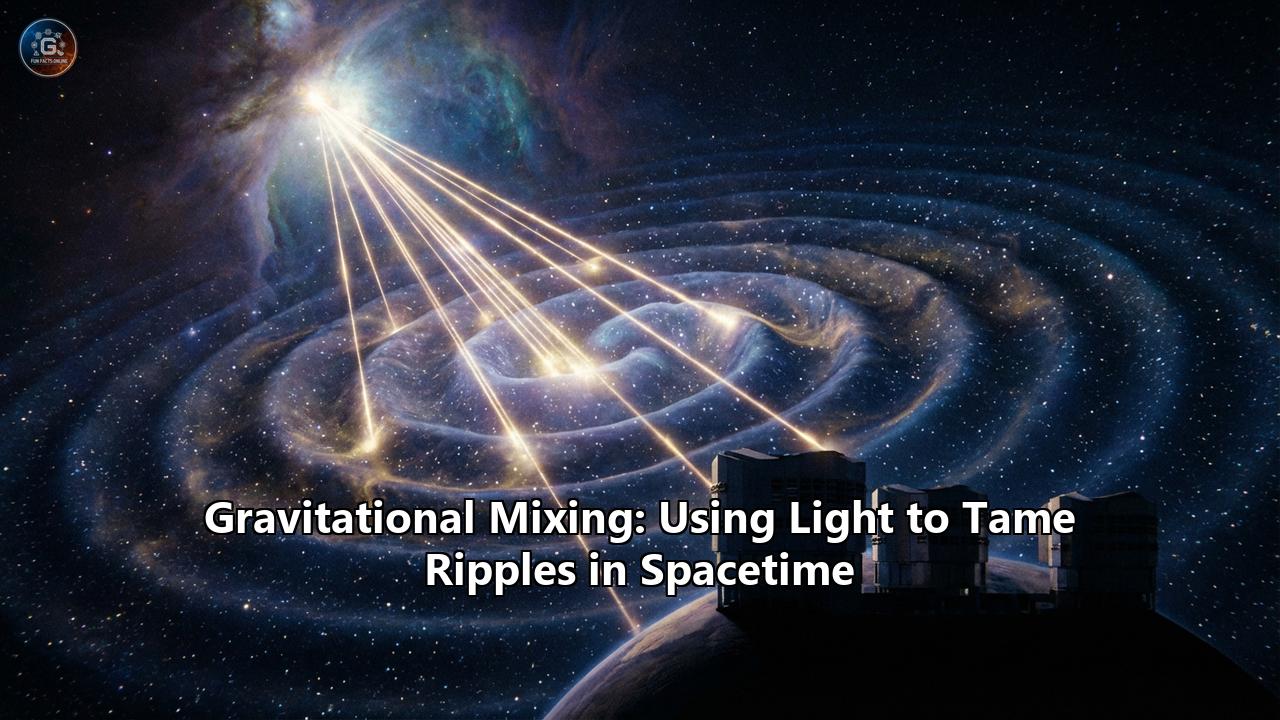
For a century, humanity stood on the shores of the cosmic ocean, watching the waves roll in. We built monumental ears—LIGO, Virgo, KAGRA—to listen to the splashes made by black holes colliding in the dark. We were passive observers, marveling at the faint trembling of spacetime that washed over our planet.
That changed this year.
The physics community is currently reeling from a paradigm-shifting revelation that has been quietly brewing in theoretical circles and has now exploded into the mainstream scientific consciousness. It is no longer enough to simply detect gravitational waves. The new frontier is Gravitational Mixing: the active use of high-intensity light to interact with, modify, and potentially "tame" the ripples of spacetime itself.
This isn't just a new detection method; it is the first step toward becoming active participants in the mechanics of general relativity. We are moving from the era of listening to gravity to the era of engineering it.
Part I: The Unreachable Wave
To understand why "taming" gravitational waves is such a monumental concept, we must first appreciate the elusive nature of the beast.
When Albert Einstein published his General Theory of Relativity in 1915, he described gravity not as a force, but as a curvature. Matter tells spacetime how to curve; spacetime tells matter how to move. When massive objects accelerate—like two neutron stars death-spiraling into one another—they don't just pull on each other; they churn the fabric of the universe, sending out ripples that propagate at the speed of light.
These are gravitational waves.
The Stiffness of Space
The reason it took us until 2015 to detect them directly is that spacetime is incredibly "stiff." It takes a cataclysmic amount of energy to create even a microscopic ripple. The collision of black holes converts multiple suns' worth of mass into pure gravitational energy in a fraction of a second, yet by the time that wave reaches Earth, it distorts our planet by less than the width of a proton.
For decades, the idea of interacting with such a wave—let alone modifying it—was considered science fiction. Gravitational waves were thought to be "ghosts," passing through stars, planets, and detectors with almost zero interaction. They do not scatter like light; they do not absorb like sound. They simply pass.
Or so we thought.
Part II: The 2025 Breakthroughs
The turning point came in late 2024 and throughout 2025, driven by two parallel but converging lines of research that have fundamentally altered our understanding of the photon-graviton relationship.
1. The Schützhold Mechanism: Giving Light Weight
The first major domino fell with the work of Prof. Ralf Schützhold at the Helmholtz-Zentrum Dresden-Rossendorf (HZDR). For years, quantum field theorists have speculated about the interaction between electromagnetic fields (light) and gravitational fields. We knew gravity bends light (gravitational lensing), but this is a one-way street in classical physics: gravity acts, light reacts.
Schützhold’s team proposed and theoretically demonstrated that the street acts both ways, and more importantly, that the traffic can be controlled.
The core concept is stimulated graviton emission/absorption. Just as an atom can absorb a photon and jump to a higher energy state, or emit a photon and drop down, Schützhold proposed that a high-intensity light wave can exchange energy with a passing gravitational wave.
In this process, coined "Gravitational Mixing," a laser beam doesn't just get bent; it actively trades "packets" of energy (quanta) with the gravitational wave.
- The Dampening Effect: A laser can impart energy to the gravitational wave, slightly increasing the wave's amplitude while the light loses energy (redshifts).
- The Taming Effect: Conversely, and most excitingly, the process can be reversed. A laser can be tuned to absorb energy from a gravitational wave. The light gains energy (blueshifts), and the ripple in spacetime loses power.
For the first time, we have a theoretical framework where a human-made device (a laser) can reduce the intensity of a ripple in spacetime.
2. The "Twist of Light" and Non-Reciprocity
While HZDR focused on energy exchange, researchers at Florida Atlantic University and collaborators in South Korea uncovered a geometric secret. They discovered that when polarized light travels through curved spacetime, it exhibits non-reciprocity.
Normally, light behaves the same way going forward as it does coming backward. But in the presence of the twisting gravity of a rotating black hole or a passing wave, this symmetry breaks. The "twist" of the light's polarization becomes locked in a way that doesn't undo itself upon return.
This finding was the "key" to the lock. It suggested that we can create optical systems—loops of laser light—that act as "diodes" for gravity, allowing us to trap or amplify gravitational interactions that would otherwise be imperceptibly weak.
Part III: How Gravitational Mixing Works
"Gravitational Mixing" is the term adopted to describe the non-linear coupling of the electromagnetic tensor (light) and the Riemann curvature tensor (gravity).
In classical physics, we treat these equations as linear approximations because the effects are so small. We assume: Light + Gravity = Light moving in a curved line.
But in the regime of Gravitational Mixing, we look at the non-linear terms.
Imagine mixing two colors of paint. Blue and Yellow make Green. In linear physics, the Blue and Yellow would stay separate dots. In non-linear mixing, they become a new entity.
The Mixing Chamber: A Kilometer-Long Laser Trap
To achieve this mixing, you cannot simply shine a flashlight at a black hole. The interaction requires the electromagnetic field to be incredibly intense and perfectly synchronized (coherent) with the frequency of the gravitational wave.
The proposed device—a "Gravitational Mixer"—resembles a massive interferometer, like LIGO, but with a twist. Instead of just measuring the length change of the arms, the device circulates a high-power laser pulse back and forth millions of times, trapping it between mirrors.
The Process:- Inversion: The laser system is pumped to a specific high-energy state.
- Incidence: A gravitational wave enters the "mixing chamber" (the optical path).
- Resonance: The frequency of the laser light is modulated so that the difference between the laser frequency and the "scattered" light frequency matches the frequency of the gravitational wave.
- The Exchange: This resonance forces a quantum exchange. The gravitational wave is forced to give up a graviton to the photon field.
- Result: The gravitational wave exits the chamber slightly weaker (tamed), and the laser beam exits with a distinct "sideband" of higher frequency light.
This "sideband" is the smoking gun. It is the visible evidence that the light has "eaten" a piece of the gravitational wave.
Part IV: Taming the Ripples
Why do we want to "tame" spacetime? The implications of this technology extend far beyond simple bragging rights.
1. The Ultimate Noise-Canceling Headphones
The most immediate application of Gravitational Mixing is in detection. Current detectors are plagued by quantum noise and thermal vibration. By using mixing techniques, we can create a "squeezed state" of light that is hypersensitive to gravity while ignoring other noise.
But more radically, we could theoretically build active dampening systems for precision experiments. Imagine a laboratory in space that needs to be perfectly still, isolated from the "hum" of the universe. Gravitational Mixing lasers could act as active stabilizers, absorbing the background gravitational noise to create a zone of "flat" spacetime for sensitive quantum computing or antimatter storage.
2. Gravitational Communication (Grav-Comms)
If we can modulate a gravitational wave—adding energy to it or taking it away—we can encode information into it.
- The Problem with Radio: Radio waves are blocked by planets, absorbed by water, and scattered by plasma.
- The Gravity Solution: A signal sent via gravitational mixing would pass straight through the Earth, straight through the Sun, and could reach the other side of the galaxy without losing coherence.
By "mixing" a data stream into a passing gravitational wave (or generating a high-frequency micro-wave of our own using a "Gaser" or Gravity Laser), we could create a communication network that is impossible to block or jam.
Part V: The Philosophical Shift
The concept of Gravitational Mixing forces a profound philosophical reckoning.
For all of human history, Space and Time were the stage upon which we acted. We moved through space; we waited for time. General Relativity told us the stage was flexible, but it was still the stage—massive, indifferent, and moved only by gods (black holes) and titans (stars).
Gravitational Mixing implies that the stage is not just flexible; it is responsive. It suggests that the fabric of reality is a material that can be woven by electromagnetic looms.
If we can exchange energy between light and gravity, we are blurring the line between the "container" of the universe (spacetime) and the "contents" of the universe (matter and energy). We are realizing they are arguably the same fluid in different states of freezing.
Part VI: The Road Ahead
We are currently in the "transistor era" of this technology. Just as the first transistor was a clunky, inefficient piece of germanium that hinted at the computer age, the current proposals for Gravitational Mixing involve kilometer-scale lasers to affect sub-atomic changes in spacetime waves.
However, the path is clear.
- Next 5 Years: We will likely see the first laboratory demonstration of "Light-Gravity Non-Reciprocity," proving that light can be "twisted" by local gravity in a controlled setting.
- Next 10 Years: The first "active" gravitational wave detector may come online, using mixing to amplify weak signals from the dawn of the universe.
- Next 50 Years: We may see the first "Gravity Modulators"—devices capable of sending pulses of information through the bulk of the Earth using the mixing principle.
Conclusion
"Gravitational Mixing" is more than a buzzword; it is the breaking of a seal. We have unlocked the door to the control room of General Relativity. By using light—our oldest and most mastered tool—to tame the ripples of spacetime, we are stepping out of the cradle of passive observation.
We are no longer just watching the cosmic ocean breathe. We are learning to swim.
Reference:
- https://science.nasa.gov/universe/how-gravity-warps-light/
- https://medium.com/starts-with-a-bang/all-of-spacetime-is-rippling-with-gravitational-waves-9efc609f5a33
- https://www.advancedsciencenews.com/understanding-gravitational-waves-ripples-in-spacetime-explained/
- https://en.wikipedia.org/wiki/Gravitational_wave
- https://idw-online.de/en/news863509
- https://www.esa.int/Science_Exploration/Space_Science/LISA/Gravitational_waves_ripples_in_spacetime
- https://physics.stackexchange.com/questions/249281/do-gravitational-waves-affect-light
- https://www.space.com/dark-matter-gently-wobbling-space-time-scientists-may-finally-detect-it
- https://scitechdaily.com/physicists-propose-first-ever-experiment-to-manipulate-gravitational-waves/
- https://www.researchgate.net/publication/294193093_The_Generation_of_Gravitational_Waves_by_Lasers
- https://medium.com/starts-with-a-bang/ligos-lasers-can-see-gravitational-waves-even-though-the-waves-stretch-the-light-itself-62296deb5616
- https://www.fau.edu/newsdesk/articles/twist-of-light.php
- https://www.sciencedaily.com/releases/2024/06/240617173533.htm