
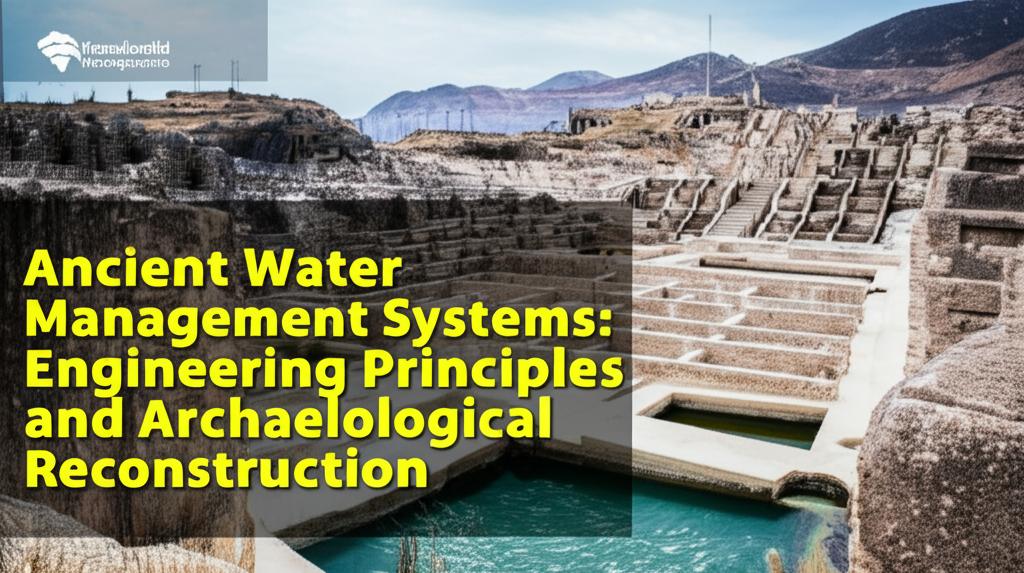
Water, the lifeblood of civilization, has always presented a fundamental challenge: securing a reliable supply and managing its excess. Ancient societies, lacking modern technology, developed remarkably sophisticated water management systems. Understanding their engineering principles and how archaeologists reconstruct them offers invaluable insights into human ingenuity and adaptation.
Engineering Principles of Ancient Systems
Ancient water engineers mastered several core principles, often adapting them brilliantly to local environmental conditions:
- Gravity Flow: The most fundamental principle. Aqueducts (like those of Rome), canals, and qanats (or karez systems in Persia and Central Asia) were meticulously graded over long distances to transport water using only gravitational pull. This required precise surveying and construction.
Example:* Roman aqueducts often maintained gradients as shallow as 1:3000, demanding incredible precision.
- Water Storage: To cope with seasonal variations, ancients built reservoirs, cisterns, and tanks. These ranged from small, household-level storage in Harappan cities to massive state-sponsored reservoirs like those built by the Nabataeans in Petra or the Sinhalese kings in Sri Lanka.
- Distribution Networks: Getting water from the source or storage to the users (homes, baths, fields, fountains) required intricate networks. Terracotta pipes, lead pipes (in Roman systems, though toxicity was a concern), and open channels were common.
- Water Lifting: While gravity was preferred, simple machines like the shaduf (a counterweighted lever) and Archimedes' screw were used to lift water from lower sources.
- Filtration and Purification: Basic methods were employed, such as settling tanks within aqueduct systems (piscinae limariae) to allow sediment to settle out before water reached the city.
- Drainage and Flood Control: Equally important was managing excess water. The Indus Valley Civilization featured advanced covered drains and sanitation systems. Flood control involved dykes, levees, and diversion channels.
- Water Harvesting: In arid regions, techniques like runoff farming, check dams, and terracing were developed to capture precious rainwater.
Archaeological Reconstruction
Reconstructing these often-buried or repurposed systems requires a multi-disciplinary archaeological approach:
- Survey and Mapping: Identifying potential features like canals, reservoirs, or qanat shafts through surface inspection, often aided by historical texts or local knowledge. GPS and GIS are crucial for mapping extensive systems.
- Remote Sensing: Techniques like aerial photography, satellite imagery (especially infrared), LiDAR (Light Detection and Ranging), and GPR (Ground Penetrating Radar) can reveal buried channels or structures invisible on the surface.
- Excavation: Careful digging uncovers the physical remains – channels, pipes, foundations of reservoirs, sluice gates, and associated structures. Stratigraphy helps date construction phases.
- Material Analysis: Studying construction materials (mortars, ceramics, stone types) can reveal sources, techniques, and potential trade connections.
- Paleohydrology and Geoarchaeology: Analyzing sediments, soil profiles, and microfossils within or around water features helps reconstruct past water flow, environmental conditions, and the system's operational history.
- Hydraulic Modelling: Using discovered gradients and dimensions, researchers can sometimes model the likely flow rates and carrying capacity of ancient systems.
- Experimental Archaeology: Replicating ancient construction techniques or tools (like Roman surveying instruments) provides insights into the practical challenges faced.
Significance and Legacy
Studying ancient water management reveals not just engineering prowess but also social organization, political power (large projects required central authority), and human-environment interaction. Many ancient principles remain relevant today, particularly in sustainable water management discussions for arid regions. These systems stand as testaments to the enduring human drive to control and harness water, shaping landscapes and enabling the rise of complex societies.