
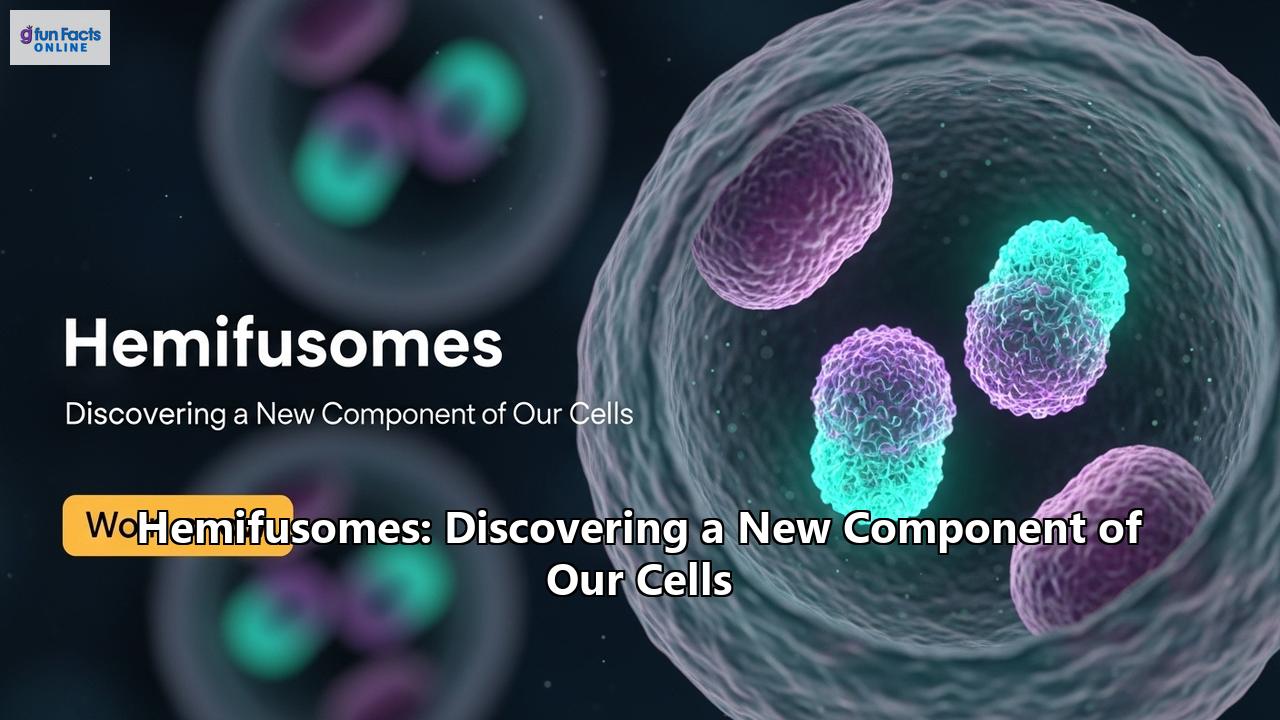
A New Chapter in Cell Biology: Unveiling the Hemifusome
Deep within the bustling metropolis of our cells, a previously unknown structure has been quietly carrying out its essential functions, hidden from view until now. In a landmark discovery that has sent ripples through the world of cell biology, researchers at the University of Virginia School of Medicine and the National Institutes of Health (NIH) have identified a new organelle, which they have named the "hemifusome." This remarkable finding, detailed in the prestigious journal Nature Communications, not only adds a new component to the intricate map of the cell but also promises to reshape our understanding of cellular maintenance and the origins of several devastating genetic diseases.
The discovery of a new organelle is a rare and momentous occasion in modern biology. It is akin to finding a new, vital organ in the human body. This tiny structure, the hemifusome, appears to act as a cellular recycling and cargo management center, a sort of sophisticated loading dock that ensures the proper sorting, processing, and disposal of materials within the cell. Its discovery offers a fresh lens through which to examine the fundamental processes that sustain life and provides a potential turning point for understanding diseases where these cellular housekeeping systems break down.
The Spark of Discovery: A Glimpse into the Unknown
The journey to uncovering the hemifusome began not with a direct search for a new organelle, but during investigations into the cell's cytoskeleton. Dr. Seham Ebrahim, an assistant professor at the University of Virginia, and her team were using advanced imaging techniques to observe the filaments that provide cells with their shape. They began noticing a peculiar and recurring structure in their three-dimensional images—what at first might have been dismissed as an artifact, but its consistent appearance hinted at something far more significant.
This initial observation sparked a collaboration with Dr. Bechara Kachar and his colleagues, Dr. Amirrasoul Tavakoli and Dr. Shiqiong Hu, at the National Institutes of Health. Dr. Kachar's laboratory at the NIH's National Institute on Deafness and Other Communication Disorders (NIDCD) specializes in the high-resolution imaging of cellular structures. By combining their expertise, the team was able to confirm that they were looking at a genuine, previously uncharacterised cellular component.
The name "hemifusome" was inspired by its unique structure. It consists of two balloon-like vesicles in a state of "hemifusion," where they are partially merged but remain separated by a two-layer barrier of fat, or lipid. This state, long theorized by biophysicists but never before directly observed in a living cell, represents a breakthrough in itself. Dr. Ebrahim described the moment of realization as incredibly exciting, noting that finding something truly new inside a cell is a rare event that opens up entirely new avenues of research.
A Technological Leap: Seeing the Invisible
The reason hemifusomes remained hidden for so long lies in their transient and delicate nature. Traditional electron microscopy techniques often require chemical fixation and staining processes that can damage or destroy such fleeting structures. Furthermore, the hemifusome is incredibly small, measuring around 100 nanometers in diameter, making it appear as just a blur with less powerful imaging methods.
The key to this discovery was a revolutionary technology called cryo-electron tomography (cryo-ET). This cutting-edge imaging method involves flash-freezing cells at temperatures so low that the water inside them vitrifies, turning into a glass-like solid without forming damaging ice crystals. This process preserves the cell and its components in a near-native, pristine state. The frozen cells are then imaged from multiple angles, and these images are computationally reconstructed to create a high-resolution, three-dimensional view of the cell's interior.
As Dr. Ebrahim explained, cryo-ET provides a "snapshot in time without any kind of chemical or any kind of stain," allowing scientists to peer inside cells as if they were made of glass. This unparalleled level of detail was essential to not only see the hemifusome but to understand its intricate architecture. It allowed the researchers to visualize these structures that were "completely invisible with conventional microscopy," according to Dr. Kachar.
The Architecture of a Hemifusome: A Detailed Look
Through the lens of cryo-ET, the researchers were able to piece together the unique structure of the hemifusome. They found that these organelles are surprisingly common, making up as much as 10% of the vesicular organelles found at the cell's periphery.
A hemifusome is characterized by two vesicles joined by a shared membrane feature called a hemifusion diaphragm. This diaphragm is a relatively large, flat patch of shared membrane, averaging about 160 nanometers across. This is significantly larger and more stable than the transient, 10-nanometer hemifusion states that were previously theorized to occur for only fleeting moments during full vesicle fusion.
The two vesicles that make up the hemifusome are typically different in size and content. The larger vesicle often contains granular material, similar to that found in endosomes, while the smaller vesicle usually has a smooth, translucent interior, suggesting it contains a dilute, protein-free solution.
The researchers identified two main configurations of hemifusomes:
- Direct Hemifusomes: In this form, a smaller vesicle is attached to the outer, or cytoplasmic, side of a larger vesicle.
- Flipped Hemifusomes: Here, the smaller vesicle is found on the inner, or luminal, side of the larger vesicle's membrane.
A crucial and consistent feature of every hemifusome is the presence of a tiny, dense particle, about 42 nanometers in diameter, lodged at the rim of the hemifusion site. The researchers have termed this a proteolipid nanodroplet (PND), as its composition includes both proteins and lipids. These PNDs, which have never been observed in this role before, appear to be critical for the hemifusome's formation and stability, possibly acting as a scaffold for the assembly of new vesicles.
A New Cellular Pathway: Rethinking How Cells Work
Perhaps the most profound implication of the hemifusome's discovery is that it suggests a completely new pathway for a fundamental cellular process: the formation of multivesicular bodies (MVBs). MVBs are essential cellular sorting stations, a type of endosome filled with smaller internal vesicles. They play a critical role in sequestering and transporting cellular waste, such as damaged proteins, to the lysosome for degradation. This process is vital for immune function, cell-to-cell communication, and preventing the buildup of toxic materials.
For decades, the formation of MVBs was thought to be almost exclusively driven by a complex protein machinery known as the Endosomal Sorting Complex Required for Transport (ESCRT). The ESCRT pathway involves a series of protein complexes (ESCRT-0, -I, -II, and -III) that work in sequence to recognize and sort ubiquitinated cargo (proteins tagged for destruction), bend the endosomal membrane inward, and finally pinch off the intraluminal vesicles (ILVs) that fill the MVB. This is a protein-driven process of membrane remodeling.
The discovery of the hemifusome challenges this dogma by revealing what appears to be an ESCRT-independent pathway for MVB formation. The research team proposes a model where hemifusomes are the precursors to MVBs, following a pathway that relies on lipid-based remodeling rather than a complex protein scaffold.
The proposed mechanism begins with a proteolipid nanodroplet (PND). These PNDs may either form spontaneously or be delivered to an existing vesicle. The PND then integrates into the vesicle's membrane and appears to kickstart the formation of a new, smaller vesicle, resulting in a direct hemifusome. This structure can then transform into a "flipped" hemifusome, with the smaller vesicle budding inward. Eventually, this inwardly budded vesicle could be pinched off to become a free-floating intraluminal vesicle inside what is now an MVB.
This alternative pathway is significant because it solves a long-standing puzzle in cell biology: how cells form these internal vesicles without relying solely on the complex ESCRT machinery. To confirm that hemifusomes were not part of the classical endocytic pathway, the researchers used gold nanoparticles to trace the journey of materials taken into the cell. While these nanoparticles showed up in known endosomes and lysosomes, they never appeared inside hemifusomes, suggesting that hemifusomes operate as a separate system.
Hemifusomes and Human Disease: A New Frontier for Medicine
The discovery of a fundamental cellular component like the hemifusome has far-reaching implications for human health. Many diseases are rooted in problems with cellular "housekeeping"—the inability of cells to properly manage and dispose of their internal cargo. The hemifusome, as a key player in this process, immediately becomes a new focal point for understanding and potentially treating these conditions.
Hermansky-Pudlak Syndrome (HPS)The researchers have specifically highlighted a potential link to Hermansky-Pudlak syndrome (HPS). HPS is a rare genetic disorder characterized by oculocutaneous albinism (lack of pigment in the skin, hair, and eyes), vision problems, a bleeding diathesis due to dysfunctional platelets, and in its most severe forms, a fatal progressive pulmonary fibrosis.
At its core, HPS is a disease of vesicle trafficking. It is caused by mutations in one of several genes that provide the instructions for making proteins that form complexes (such as BLOC-1, -2, -3, and AP-3) essential for the formation and movement of lysosome-related organelles. These organelles include melanosomes in pigment cells and dense granules in platelets. The dysfunction in their formation leads directly to the symptoms of HPS. Given that hemifusomes are involved in vesicle formation and cargo sorting, it is plausible that defects in the hemifusome pathway could be a contributing factor to the cellular pathology of HPS. Understanding this connection could lead to new therapeutic strategies for this and other lysosomal storage diseases.
Neurodegenerative DiseasesThe implications extend to more common and complex diseases as well, particularly neurodegenerative disorders like Alzheimer's disease. A growing body of evidence shows that dysfunction of the endosomal-lysosomal network is one of the earliest and most significant features of Alzheimer's.
In Alzheimer's disease, the brain struggles to clear abnormal proteins, leading to the toxic buildup of amyloid plaques and tau tangles. This clearance problem is fundamentally a trafficking problem. Pathological changes, such as abnormally enlarged early endosomes (often positive for a protein called Rab5), are known to appear in neurons long before the classic hallmarks of the disease are evident. This endosomal "traffic jam" is thought to disrupt the proper processing and trafficking of the amyloid precursor protein (APP), contributing to the generation of toxic amyloid-beta fragments.
The discovery of the hemifusome and its role in an alternative vesicle formation pathway opens up a new set of questions. Could a faulty hemifusome pathway contribute to the endosomal dysfunction seen in Alzheimer's? Could targeting this pathway offer a new therapeutic angle to restore proper cellular clearance in the brain? Dr. Ebrahim and her colleagues believe that understanding how hemifusomes work could unlock new insights into how diseases like Alzheimer's manifest.
The People Behind the Discovery
This landmark discovery is a testament to the power of curiosity-driven research and collaboration.
Dr. Seham Ebrahim, an Assistant Professor in the Department of Molecular Physiology and Biological Physics at the University of Virginia, led the study. She obtained her M.Sc. in Biotechnology in Germany and her Ph.D. in Biological Sciences from Queen Mary University of London. Her research focuses on the cytoskeleton's role in health and disease, utilizing high-resolution microscopy to unravel the complexities of cellular architecture. It was her team's keen observation during their cytoskeletal research that set the stage for the hemifusome's discovery. Dr. Bechara Kachar is a senior investigator and Chief of the Laboratory of Cell Structure and Dynamics at the NIH's National Institute on Deafness and Other Communication Disorders (NIDCD). He received his M.D. from the University of Sao Paulo, Brazil, and has had a long and distinguished career at the NIH, where he is a leading expert in using advanced microscopy to understand cell structure, particularly in the auditory system. His lab's expertise in cryo-ET was instrumental in visualizing and validating the existence of the hemifusome.The research team also included Dr. Amirrasoul Tavakoli and Dr. Shiqiong Hu from the NIH, who were integral to the data acquisition and analysis. Dr. Tavakoli is listed as the first author on the Nature Communications paper, signifying his central role in the research. The collaboration was further supported by UVA's Molecular Electron Microscopy Core, directed by Michael Purdy, PhD.
The Future of Hemifusome Research
The identification of the hemifusome is not an end point, but rather the beginning of a whole new field of study. As Dr. Ebrahim states, "This is just the beginning. Now that we know hemifusomes exist, we can start asking how they behave in healthy cells and what happens when things go wrong."
Future research will likely focus on several key areas:
- Molecular Composition: A primary goal will be to identify the specific proteins and lipids that make up the hemifusome and the associated proteolipid nanodroplets. What are these PNDs made of, and how do they trigger vesicle formation?
- Regulation: How is the formation and disassembly of hemifusomes controlled by the cell? Are there specific signaling pathways that call these structures into action when needed?
- Function in Different Cell Types: The initial study observed hemifusomes in four different mammalian cell lines. Researchers will now need to investigate their presence and function in a wider variety of specialized cells and tissues throughout the body.
- Disease Mechanisms: The links to diseases like HPS and Alzheimer's are, for now, compelling hypotheses. The next step is to conduct detailed studies in disease models to determine if and how the hemifusome pathway is disrupted and whether manipulating this pathway could offer therapeutic benefits.
The discovery of the hemifusome is a powerful reminder that even in the well-charted territory of the human cell, there are still profound secrets waiting to be uncovered. It is a triumph of advanced technology, collaborative science, and the persistent curiosity of researchers. This new organelle, a tiny recycling center operating in the periphery of our cells, has opened a new door in our quest to understand the intricate machinery of life and the molecular basis of disease. The story of the hemifusome is just beginning to be written, and its next chapters promise to be just as exciting as its first.
Reference:
- https://www.news-medical.net/news/20250626/Unknown-organelle-discovery-could-open-the-door-to-new-treatments-for-inherited-diseases.aspx
- https://journals.biologists.com/jcs/article-pdf/doi/10.1242/jcs.262163/3567305/jcs262163.pdf
- https://www.sci.news/biology/hemifusomes-14018.html
- https://bioengineer.org/scientists-unveil-previously-unknown-organelle-within-human-cells/
- https://www.biorxiv.org/content/10.1101/2021.07.28.454169v1
- https://www.earth.com/news/hemifusome-newly-discovered-organelle-inside-human-cells-with-immense-potential/
- https://pmc.ncbi.nlm.nih.gov/articles/PMC3148405/
- https://www.eurekalert.org/news-releases/1088244
- https://www.newsweek.com/cells-unknown-structure-organelle-hemifusome-genetic-disorders-2091057
- https://rupress.org/jcb/article/221/4/e202106086/213057/In-situ-cryo-electron-tomography-reveals-local
- https://pubmed.ncbi.nlm.nih.gov/39253452/
- https://pmc.ncbi.nlm.nih.gov/articles/PMC10763975/
- https://www.mdpi.com/2077-0375/12/5/498
- https://www.researchgate.net/figure/Through-both-ESCRT-dependent-and-ESCRT-independent-pathways-multivesicular-bodies-MVBs_fig2_385720845
- https://scienceblog.com/scientists-find-hidden-organelle-in-human-cells/
- https://pubmed.ncbi.nlm.nih.gov/35262630/
- https://encyclopedia.pub/entry/43100
- https://orcid.org/0000-0002-7991-9858
- https://www.researchgate.net/figure/ESCRT-dependent-and-ESCRT-independent-pathway-of-extracellular-vesicles-EVs-that-are_fig1_356685159
- https://pubs.acs.org/doi/abs/10.1021/acs.langmuir.1c02492