
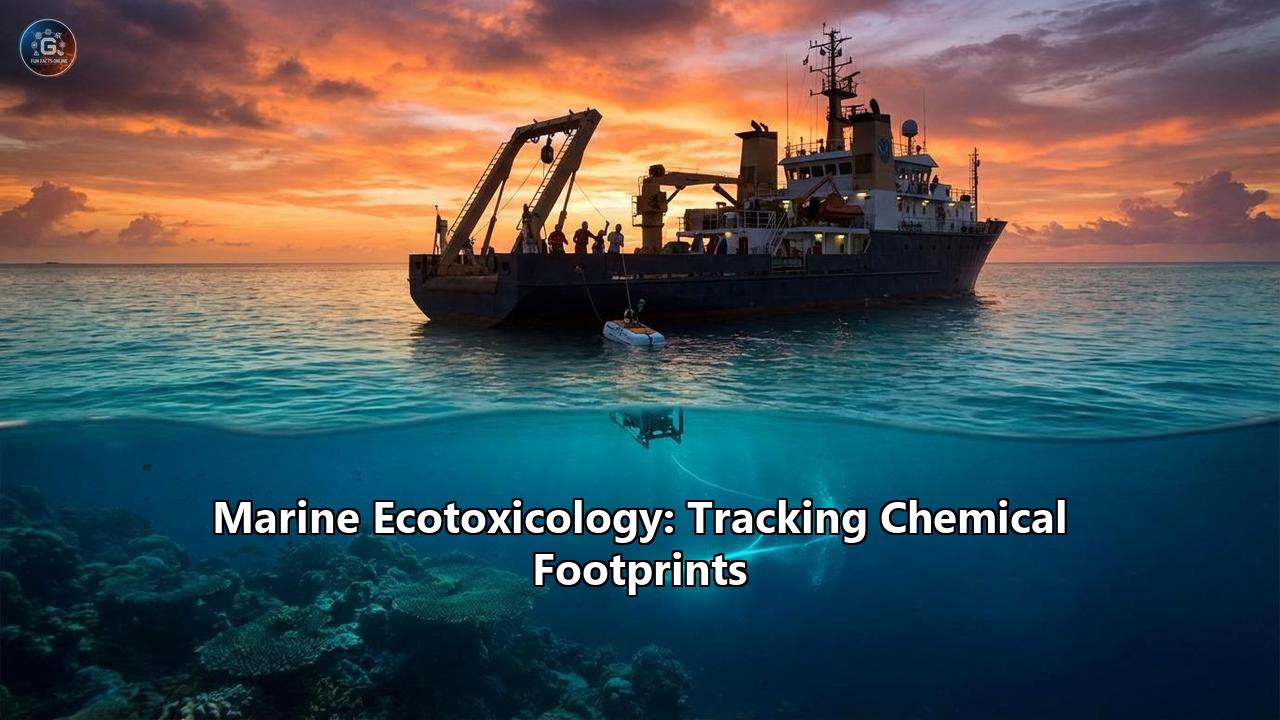
The ocean is a master of illusion. From the shoreline, its vast, glittering expanse looks as untamed and pristine as it did a millennium ago. Yet, beneath the rolling waves and sunlit shallows lies a hidden narrative written entirely in molecules. Every drop of seawater, every grain of abyssal sediment, and every microscopic plankton carries the chemical memory of human civilization. This invisible ledger is what scientists call our "chemical footprint."
Understanding, tracking, and mitigating this footprint is the domain of marine ecotoxicology. Operating at the intersection of ecology, chemistry, toxicology, and molecular biology, this scientific discipline seeks to decode the complex relationships between chemical pollutants and marine life. As industrial activities, agricultural runoff, and consumer habits continuously introduce novel compounds into the environment, marine ecotoxicology has never been more critical. It is the science of the ocean's immune system, a diagnostic tool for a watery world under unprecedented stress.
To truly grasp the scale and significance of our chemical footprint, one must dive deep into the types of pollutants entering our seas, the intricate biological mechanisms through which they wreak havoc, the cutting-edge technologies being deployed to track them, and the profound implications for both marine biodiversity and human survival.
The Rogues’ Gallery: Unveiling the Ocean’s Invisible Invaders
Our chemical footprint is not made of a single substance but is a complex cocktail of thousands of anthropogenic (human-made) chemicals. While spectacular disasters like oil spills capture global headlines, the more insidious threat comes from invisible, chronic pollution. The most formidable culprits in marine ecotoxicology can be categorized into several distinct groups.
The "Forever Chemicals": Per- and Polyfluoroalkyl Substances (PFAS)PFAS are a vast family of synthetic chemicals used for decades in non-stick cookware, water-repellent clothing, and firefighting foams. They are defined by their carbon-fluorine bonds, one of the strongest bonds in organic chemistry, earning them the moniker "forever chemicals" because they simply do not degrade in nature.
Recent discoveries in the mid-2020s have fundamentally reshaped our understanding of PFAS in the marine biome. Historically, researchers assumed that deep-sea and offshore marine species were buffered from the worst of this pollution. However, comprehensive studies published in late 2025 and 2026 have shattered this illusion. Marine ecologists have found unprecedented levels of PFAS in deep-diving species like sperm whales and deep-trench amphipods. These animals, which forage in the cold, dark layers of the ocean far removed from coastal industrial zones, carry heavy chemical burdens that rival those of coastal species. The contaminants are transported via atmospheric currents, ocean mixing, and the sinking of marine snow, proving that no zone of the ocean lies beyond the reach of human industry.
Microplastics and Nanoplastics: The Trojan HorsesPlastics are ubiquitous, but the most dangerous forms are the ones we can barely see. Microplastics (fragments smaller than 5 millimeters) and nanoplastics (smaller than 0.1 micrometers) are everywhere—from Arctic sea ice to the Marianas Trench. However, in the realm of ecotoxicology, the physical hazard of ingesting plastic is only half the story.
Microplastics act as "Trojan horses" or chemical sponges. Due to their hydrophobic nature, these tiny plastic particles attract and absorb heavy metals and persistent organic pollutants (POPs) floating in the water column. When a filter-feeding organism, like a mussel, ingests a microplastic particle, it is also ingesting a highly concentrated dose of toxic chemicals. Furthermore, plastics slowly leach their own chemical additives, such as phthalates and bisphenol A (BPA), which are known endocrine disruptors.
Pharmaceuticals and Personal Care Products (PPCPs)Every time we take a medication, apply sunscreen, or use fragranced cosmetics, a portion of those chemicals eventually washes down the drain and into the sea. Marine ecotoxicologists are increasingly focused on the subtle, sublethal effects of PPCPs. Antidepressants, for instance, have been found to alter the swimming and feeding behaviors of fish, making them bolder and more vulnerable to predators. Hormones from birth control pills can cause the feminization of male fish, leading to population crashes.
Perhaps the most famous PPCP crisis involves coral reefs. Oxybenzone and octinoxate, common UV-filtering ingredients in sunscreens, have been proven to cause coral bleaching, DNA damage to coral larvae, and skeletal deformities even at concentrations equivalent to a single drop in six Olympic-sized swimming pools.
Legacy Pollutants: Heavy Metals and POPsLong before PFAS and microplastics dominated the conversation, heavy metals like mercury, lead, and cadmium, along with persistent organic pollutants (POPs) such as polychlorinated biphenyls (PCBs) and the pesticide DDT, were the primary focus of ecotoxicology. While many of these were banned globally under treaties like the 2001 Stockholm Convention, they are highly persistent. They continue to linger in ocean sediments, acting as "legacy pollutants" that can be resuspended by storms or bottom-trawling fishing nets, re-entering the food web decades after their use was halted.
The Mechanics of Toxicity: How Chemicals Infiltrate the Web of Life
To track a chemical footprint, scientists must understand how toxins move through the biological machinery of the ocean. It is rarely as simple as a chemical directly killing a fish. The true danger lies in the stealthy, systemic infiltration of the food web.
Bioaccumulation and BiomagnificationThese two concepts are the foundational pillars of ecotoxicology. Bioaccumulation refers to the build-up of a chemical in the tissues of a single organism over its lifetime. When an oyster continuously filters contaminated water, it absorbs toxins faster than its body can excrete them, leading to a high concentration of chemicals in its tissue.
Biomagnification, on the other hand, describes how chemical concentrations increase as they move up the food chain. Plankton absorb trace amounts of a toxin. A small fish eats thousands of plankton, absorbing all their toxins. A larger fish eats hundreds of small fish, and so on. By the time an apex predator—like an Orca, a Great White Shark, or a human—eats a meal, the concentration of the chemical can be millions of times higher than it is in the surrounding seawater. This is why marine mammals, with their thick layers of fat (blubber) where organic pollutants are stored, often carry the heaviest chemical footprints on Earth. Sublethal Effects and Endocrine DisruptionHistorically, toxicology focused on the LC50—the lethal concentration required to kill 50% of a test population. Today, marine ecotoxicology is far more concerned with sublethal effects. A chemical might not kill a fish, but it might disrupt its endocrine (hormone) system, impair its immune response, or cause oxidative stress that damages cellular DNA.
Endocrine disruptors mimic or block natural hormones. In marine environments, this can lead to catastrophic reproductive failures. For example, high levels of PCBs in certain Orca pods off the coast of the Pacific Northwest and Scotland have severely depressed their birth rates, pushing these specific populations toward localized extinction. Sublethal effects also manifest as behavioral changes; neurotoxic chemicals can impair a fish's ability to navigate, school, or detect the scent of predators.
Biomonitoring 2.0: The Technological Revolution
For decades, tracking the chemical footprint required catching fish, lethally dissecting them, and running expensive mass spectrometry tests on their tissues in a lab. Today, marine ecotoxicology is undergoing a technological renaissance, transitioning into what scientists refer to as "Biomonitoring 2.0." This revolution is characterized by non-invasive, highly sensitive, and computationally advanced methods.
Environmental DNA (eDNA) and MetabarcodingThe most transformative tool in modern ecotoxicology is Environmental DNA (eDNA). As marine organisms swim, they constantly shed genetic material into the water—scales, mucus, skin cells, and metabolic waste. By scooping up a single liter of seawater, scientists can extract this free-floating DNA, sequence it using a technique called metabarcoding, and identify exactly which species have been in that water column recently.
But how does eDNA track chemical footprints? Ecotoxicologists use eDNA to monitor the overall health and biodiversity of an ecosystem before, during, and after chemical exposure. A sudden drop in the genetic diversity of sensitive species, or a bloom of pollution-tolerant bacteria identified via eDNA, serves as a powerful, indirect bio-indicator of toxic contamination. It allows scientists to see the ecological reaction to a chemical footprint in real-time, without disturbing the habitat.
New Approach Methodologies (NAMs) and 'Omics'The field is rapidly moving away from traditional animal testing toward New Approach Methodologies (NAMs). These include in vitro (cell culture) testing, organ-on-a-chip technologies, and advanced computational models (like structure-activity relationships) that can predict a chemical's toxicity based purely on its molecular shape.
Simultaneously, the "omics" revolution—genomics, transcriptomics, proteomics, and metabolomics—is allowing scientists to look at toxic stress at the molecular level. By examining the transcriptomic profile (which genes are turned on or off) of a marine organism exposed to water from a specific bay, researchers can identify the exact type of stress the animal is experiencing. For instance, an up-regulation of the gene that produces cytochrome P450 (an enzyme used to break down toxins) is a clear biological alarm bell indicating the presence of organic pollutants like oil or pesticides.
Sentinel Species and Passive SamplersNature has already designed some of the best pollution monitors. Bivalves like mussels and oysters are stationary filter-feeders that process vast amounts of water, making them perfect "sentinel species." Programs like the global "Mussel Watch" analyze the tissues of these organisms to track coastal pollution trends over decades.
To complement sentinel species, scientists use artificial "passive samplers." These are devices, often made of specialized silicone or lipid-like gels, anchored to the seafloor. Over weeks or months, they absorb organic pollutants from the water column in a manner that mimics biological tissue. Because they do not metabolize the chemicals, passive samplers provide a highly accurate, continuous reading of the chemical footprint in a specific marine area.
Decoding the Footprint: Case Studies from the Deep
The application of these advanced tracking methods has revealed startling narratives about our relationship with the ocean, exposing both hidden tragedies and unexpected victories.
The Deep-Sea ParadoxAs mentioned earlier, 2025 and 2026 research utilizing advanced mass spectrometry on stranded deep-water marine mammals revealed that the chemical footprint extends to the ocean's abyssal plains. Species like sperm whales and deep-trench amphipods exhibited overlapping PFAS ranges with coastal animals. This research modeled ocean currents, salinity shifts, and vertical mixing patterns, proving that long-chain molecules resist decay and travel effortlessly across ocean basins and vertical depth zones. It underscored a harsh reality: diluting pollution in the vastness of the ocean is a myth. The sea is a closed-loop system, and our chemical footprint ultimately reaches its darkest corners.
The Acoustic Ghosts of the Baltic SeaIn the Baltic Sea, ecotoxicologists have been tracking the footprint of submerged munitions from World War II. Millions of tons of conventional and chemical weapons were dumped into the sea after the war. Decades later, the metal casings are corroding, leaking TNT and chemical warfare agents like mustard gas into the sediment. Using autonomous underwater vehicles (AUVs) equipped with chemical sensors and eDNA sampling capabilities, scientists are now tracking these toxic plumes. The localized impact is severe, causing liver tumors in bottom-dwelling flatfish and altering the microbial communities of the sediment, creating silent, toxic dead zones.
The Bright Spot: Reversing the Legacy FootprintMarine ecotoxicology is not merely a chronicle of despair; it is a vital tool for proving that environmental policy works. A landmark global meta-analysis published in the journal Science in late 2025 offered a profound beacon of hope: legacy PFAS levels in marine fish have dropped by 40% to 72% globally since international phase-outs and strict regulatory frameworks began taking effect.
This remarkable decrease demonstrates that the ocean has an inherent capacity for recovery if the influx of pollutants is halted. By continuously tracking the chemical footprint of these legacy compounds in species ranging from wild Pacific salmon to deep-water cod, ecotoxicologists provided irrefutable evidence that legislative actions—like the Stockholm Convention and the EPA's aggressive drinking water and wastewater standards—translate directly into a cleaner, healthier marine biome.
Turning the Tide: Solutions for a Healthier Ocean
The ultimate goal of tracking our chemical footprint is to figure out how to erase it. The insights gained from marine ecotoxicology are driving innovative solutions across multiple sectors.
Green Chemistry and Circular EconomiesThe most effective way to protect the marine environment is to prevent toxicants from being created in the first place. The principles of "Green Chemistry" advocate for the design of chemical products and processes that reduce or eliminate the generation of hazardous substances. This means engineering biodegradable alternatives to PFAS for waterproof fabrics, designing plastics that seamlessly break down into harmless organic matter in seawater, and formulating pharmaceuticals that fully metabolize in the human body before reaching wastewater treatment plants.
Bioremediation: Harnessing Nature's Cleanup CrewWhen pollution has already occurred, scientists are turning to the ocean's own biological toolkit for cleanup—a process known as bioremediation. Ecotoxicologists have identified specific strains of marine bacteria that naturally degrade polycyclic aromatic hydrocarbons (PAHs) found in crude oil. Advances in biotechnology are allowing researchers to cultivate these naturally occurring, oil-eating bacteria to be deployed in the wake of oil spills. Similarly, the discovery of plastic-degrading marine fungi and enzymes offers a tantalizing, albeit nascent, biological solution to the microplastic crisis.
Strengthening Global Regulatory FrameworksThe ocean does not recognize geopolitical borders; a chemical spilled off the coast of one nation can easily bioaccumulate in the fisheries of another. Therefore, international cooperation is paramount. The data generated by marine ecotoxicologists is actively used to inform the United Nations Environment Programme (UNEP) and update the MARPOL convention (The International Convention for the Prevention of Pollution from Ships). As biomonitoring technologies like eDNA and passive sampling become cheaper and more standardized, they are being integrated into mandatory environmental impact assessments for offshore drilling, deep-sea mining, and coastal development.
The Inseparable Bond of Health
Marine ecotoxicology reveals a fundamental truth about our planet: the illusion of separation is exactly that—an illusion. The ocean is not a bottomless sink capable of endlessly absorbing the byproducts of human advancement. It is a highly sensitive, interconnected circulatory system that sustains all life on Earth.
When we track the chemical footprint in the ocean, we are ultimately tracking a mirror image of our own health. The microplastics found in the gills of a deep-sea fish, the pharmaceutical residues altering the behavior of coastal crabs, and the forever chemicals stored in the blubber of a migrating whale eventually find their way back to humanity. They return through the seafood we consume, the water we rely on, and the complex climate systems the ocean regulates.
Yet, as the technological leaps in eDNA, metabolomics, and predictive modeling give us unprecedented clarity into this invisible world, they also equip us with the tools for remediation. The recent, dramatic declines in legacy pollutants prove that human intervention can reverse decades of damage. By continuing to support and expand the vital science of marine ecotoxicology, we do more than just track our chemical footprint—we learn how to walk lighter, ensuring that the ocean's invisible ledger records not our negligence, but our stewardship.
Reference:
- https://www.earth.com/news/forever-chemicals-found-at-unprecedented-levels-in-marine-animals/
- https://superage.com/microplastics-are-in-our-seafood-heres-how-to-protect-yourself/
- https://www.frontiersin.org/journals/marine-science/articles/10.3389/fmars.2024.1402991/full
- https://iipseries.org/assets/docupload/rsl20249158AB44BD32930.pdf
- https://pmc.ncbi.nlm.nih.gov/articles/PMC8451586/
- https://pubmed.ncbi.nlm.nih.gov/38242519/
- https://www.mdpi.com/2073-4441/17/8/1109
- https://www.nal.usda.gov/sites/default/files/page-files/Ecotoxicology%20Bibliography%20for%20website%20updated%20August%202025%20508.pdf
- https://www.hunton.com/the-nickel-report/what-to-watch-for-in-2026-epa-highlights-major-pfas-actions-in-2025-and-plans-for-next-steps