
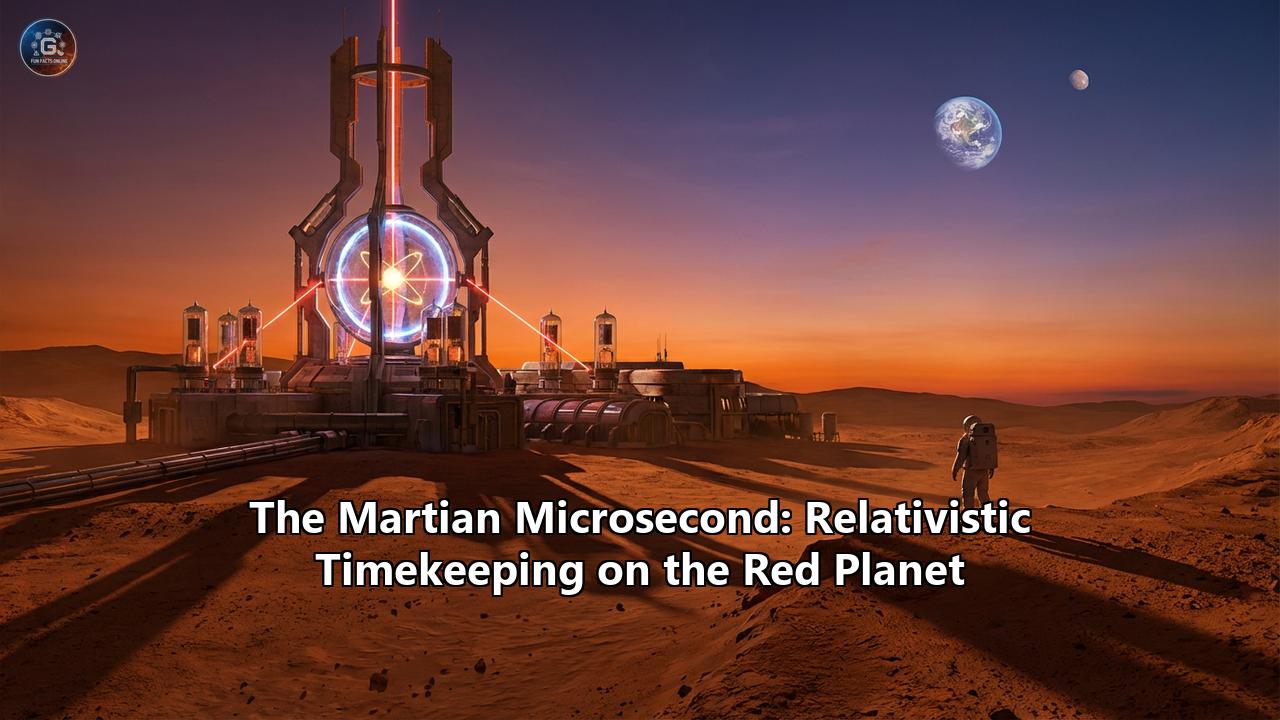
I. The Invisible Chasm
To the uninitiated, the distance between Earth and Mars is measured in kilometers—an average of 225 million of them, a gulf of cold vacuum that chemical rockets struggle to bridge. But to a physicist, a navigator, or a future colonist, the true distance is measured in time. And not just the months of travel or the minutes of light-speed delay, but a fundamental, insidious discrepancy in the passage of reality itself.
There is a ghost in the machine of interplanetary exploration. It is a ghost made of pure physics, born from the mind of Albert Einstein. If you were to take two perfectly synchronized atomic clocks, leave one on Earth and send the other to the surface of Mars, they would not agree when they met again. The clock on Mars would be running fast.
Specifically, it would gain approximately 477 microseconds per day relative to its terrestrial twin.
To a human checking a wristwatch, 477 microseconds—0.000477 seconds—is nothing. It is less than the blink of an eye, less than the firing of a single neuron. But in the realm of high-precision navigation, 477 microseconds is an eternity. Light travels at 300 kilometers per millisecond. An error of 477 microseconds translates to a position error of roughly 143 kilometers every single day. If a GPS satellite around Mars ignored this relativistic drift for just a week, a colonist asking for directions to the habitat airlock would be guided into the side of a canyon a thousand kilometers away.
This phenomenon, often dubbed "The Martian Microsecond," represents one of the most profound and underappreciated challenges of becoming a multi-planetary species. It is not merely a technical glitch to be patched; it is a fundamental reality of the universe. As humanity prepares to extend its civilization to the Red Planet, we are not just crossing space; we are stepping into a different stream of time. We are facing a future where "now" is a relative concept, where calendars drift apart, where biology fights against planetary rotation, and where the simple question "What time is it?" becomes a calculation involving gravity, velocity, and the speed of light.
This article explores the comprehensive reality of time on Mars—from the relativistic physics that warp it, to the engineering that measures it, to the biology that endures it, and finally, to the civilization that will one day live by it.
II. The Physics of Red Time: Why Mars Ticks Faster
To understand why time behaves differently on Mars, we must look under the hood of the universe, at the mechanics laid out in Einstein’s Theories of Relativity. There are two distinct forces at play here, pulling time in opposite directions: General Relativity (gravity) and Special Relativity (velocity).
1. The Gravitational Well (General Relativity)
Einstein’s General Relativity dictates that gravity is not just a force, but a curvature of spacetime. Massive objects like planets and stars warp the fabric of reality around them. One of the consequences of this warping is gravitational time dilation.
Clocks tick slower the closer they are to a massive body. The deeper you are in a "gravity well," the more dragged-out time becomes. Earth, being significantly more massive than Mars, has a deeper gravity well.
- Earth’s Surface Gravity: 9.81 m/s²
- Mars’ Surface Gravity: 3.71 m/s²
Because Earth is heavier, it drags on time more than Mars does. If you consider only gravity, a clock on the surface of Mars—sitting in a shallower well—runs faster than a clock on Earth. It is "less burdened" by gravity. This effect is the dominant driver of the time difference between the two planets. The difference in gravitational potential between the Earth's surface and the Martian surface causes the Martian clock to gain significant time.
2. The Velocity Factor (Special Relativity)
Special Relativity, however, argues the opposite. It states that time slows down for objects that are moving fast relative to an observer. This is the famous "time dilation" effect.
- Earth’s Orbital Speed: ~29.78 km/s
- Mars’ Orbital Speed: ~24.07 km/s
Earth moves faster around the Sun than Mars does. According to Special Relativity, clocks on the faster-moving Earth should tick slower than clocks on the slower-moving Mars.
3. The Net Result
So, we have a tug-of-war.
- General Relativity: Earth has higher gravity -> Earth time is slower (Mars is faster).
- Special Relativity: Earth has higher velocity -> Earth time is slower (Mars is faster).
In this specific case, both theories conspire in the same direction. Earth is both more massive and moving faster. Both effects cause Earth's clocks to lag behind Mars. When physicists at the National Institute of Standards and Technology (NIST) and other institutions run the numbers, combining the gravitational potentials of the Sun, Earth, and Mars with their relative velocities, the result is definitive.
A clock on the Martian surface ticks faster than a clock on Earth's surface by approximately 477 microseconds (µs) per Earth day.
This drift is not constant. Mars has a highly eccentric orbit (eccentricity of 0.093 compared to Earth’s 0.017). As Mars swings closer to the Sun (perihelion) and speeds up, and then moves further away (aphelion) and slows down, the magnitude of this relativistic offset fluctuates. It can vary by as much as 20-30 microseconds throughout the Martian year.
For a rover driving at 5 centimeters per second, this doesn't matter. But for a future internet node, a stock market server, or a satellite constellation trying to synchronize with Earth, this drift is catastrophic. A one-second discrepancy—which would accumulate in just over five years—is enough to break almost every digital communication protocol we currently use.
III. The Pulse of the Red Planet: Defining Martian Time
Before we can solve the relativistic drift, we have to answer a more basic question: How do we measure time on Mars locally?
We cannot simply export Earth's 24-hour day. Mars rotates at a different speed. A "day" on Mars—defined as the time it takes for the Sun to return to the same position in the sky—is called a Sol.
The Sol: 24 Hours, 39 Minutes, 35.244 Seconds
A Sol is roughly 2.7% longer than an Earth day. This 39-minute difference seems negligible, but it effectively destroys the utility of standard Earth clocks. If you took a standard Rolex to Mars, it would be useless within a few days. By the end of the first week, your watch would say it's noon (lunchtime), but outside it would be pitch black (midnight).
To cope with this, NASA engineers and scientists have historically used a "stretched" time unit. They take the Sol and divide it into 24 "Martian hours."
- 1 Martian Hour = 1 hour, 1 minute, 39 seconds (Earth time).
- 1 Martian Minute = 1 minute, 1.6 seconds (Earth time).
- 1 Martian Second = 1.027 Earth seconds.
This allows mission control to use familiar terms ("We'll meet at 09:00") while staying synchronized with the Sun. However, this "stretched second" is a nightmare for physics. The SI (Standard International) second is defined by the vibration of a cesium-133 atom. You cannot just "stretch" an atomic constant. Therefore, while "Martian hours" are useful for scheduling lunch, they cannot be used for navigation or scientific data logging.
MTC: Coordinated Mars Time
Just as Earth has UTC (Coordinated Universal Time) anchored to the Prime Meridian at Greenwich, Mars has MTC (Coordinated Mars Time).
The Martian Prime Meridian (0° longitude) doesn't pass through a grand observatory in London. It passes through a small, unassuming crater named Airy-0, located inside the larger Airy crater in the Sinus Meridiani region. This crater was arbitrarily chosen by astronomers in the 19th century and refined by Mariner 9 imagery in the 1970s.
MTC is the "Mean Solar Time" at Airy-0. It is the master clock for the planet. When we talk about the relativistic drift of 477 microseconds, we are comparing Earth’s UTC against Mars’ MTC.
Currently, there are no time zones on Mars. Every lander mission effectively operates on "Local Lander Time." When the Curiosity rover wakes up, it is "morning" in Gale Crater, regardless of what time it is at Airy-0. But as we build a civilization, this patchwork of local times will have to be standardized into zones, likely 15-degree wide strips just like on Earth, all referencing MTC.
IV. The Engineering of Eternity: Keeping Time in Deep Space
Knowing the physics is one thing; building the machines to handle it is another. How do you navigate a spaceship or a colony when your clocks are drifting apart at 143 kilometers per day?
1. The Deep Space Atomic Clock (DSAC)
Until recently, deep space navigation was a "two-way" affair. A spacecraft would send a ping to Earth; Earth would receive it, calculate the distance based on the time delay, and send the position data back to the ship. This requires massive antennas (the Deep Space Network) and, crucially, depends on Earth clocks.
To achieve autonomy—where a Mars ship knows where it is without asking Earth—NASA developed the Deep Space Atomic Clock (DSAC). Launched in 2019 for testing, this is a toaster-sized mercury-ion atomic clock.
Earth-based atomic clocks are the size of refrigerators. DSAC is a marvel of miniaturization. It is stable to within one microsecond every 10 years. By placing these clocks on Mars satellites, we can create a "Mars GPS" constellation. These satellites would broadcast time signals just like Earth GPS.
However, the satellites themselves must account for the 477-microsecond drift relative to Earth if they are to communicate with the home planet. The software onboard these satellites essentially runs two timelines:
- SI Time (Proper Time): The actual physical ticking of the clock, used for local positioning.
- Coordinate Time (TCB/TDB): A mathematical construct that "slows down" the Mars clock to match the solar system barycenter, allowing synchronization with Earth data.
2. Pulsar Navigation (XNAV)
What if the satellites fail? What if Earth goes silent? The ultimate backup is the stars themselves.
XNAV (X-ray Pulsar-based Navigation) uses millisecond pulsars—dead stars that spin hundreds of times per second—as celestial lighthouses. These pulsars emit X-ray pulses with regularity that rivals atomic clocks.By observing the arrival time of pulses from three or four different pulsars, a ship or colony on Mars can triangulate its position in the solar system with an accuracy of roughly 5 kilometers. This system is completely immune to the relativistic drift between Earth and Mars because it relies on external, galactic reference points. It is the "sextant" of the 21st century, allowing a Martian civilization to navigate the dark independant of Earth.
3. The Interplanetary Internet (DTN)
The time drift also wreaks havoc on the internet. TCP/IP, the protocol that runs the Earth's web, is "chatty." It requires constant handshakes: "Did you get this packet?" "Yes, send the next one."
With a light-speed delay of 4 to 24 minutes between Earth and Mars, a standard TCP/IP connection would time out instantly. The 477-microsecond drift is just the icing on the cake of connection failures.
To solve this, Vint Cerf (one of the fathers of the internet) and NASA developed DTN (Delay/Disruption Tolerant Networking). DTN doesn't care about continuous connections. It uses a "Store and Forward" bundle protocol. If a node (a satellite) has data for Mars but the link is down or the clocks are syncing, it holds the data. It effectively turns the internet into a highly sophisticated postal service rather than a telephone conversation. DTN nodes on Mars will likely run their own local time (MTC) and only convert to Earth time (UTC) at the specific gateway nodes that transmit across the void.
V. The Circadian Frontier: The Biology of the Sol
While physicists worry about microseconds, biologists worry about minutes. Specifically, the 39 extra minutes in a Martian day.
The human body runs on a circadian rhythm, a roughly 24-hour internal cycle regulated by the suprachiasmatic nucleus in the brain. This clock is entrained by sunlight. On Earth, the 24-hour rotation matches our biology perfectly.
On Mars, the day is 24.65 hours. This seems close, but it is chemically distinct. It is effectively a permanent state of jet lag. Living on Mars is like traveling two time zones west every three days, forever.
The "Mars Lag" Experience
We have already run this experiment. During the Mars Pathfinder, Phoenix, and Mars Exploration Rover (Spirit and Opportunity) missions, the flight teams at NASA’s Jet Propulsion Laboratory (JPL) lived on "Mars Time." When the rover woke up (Martian dawn), the scientists had to be at their desks.
Because the Martian day drifts relative to Earth, their work shifts rotated. One week they worked 9 AM to 5 PM. A few weeks later, they were working 3 AM to 11 AM. They put black curtains over their windows and wore "Mars Watches" calibrated to the 24h 39m Sol.
The results were brutal.
- Chronic Fatigue: Staff reported high levels of exhaustion. The human body struggles to "stretch" its cycle to 24.65 hours. The internal clock naturally drifts to about 24.2 hours in the absence of light, but 24.65 is just beyond the comfortable elastic limit for many.
- Circasemidian Rhythms: In studies of the Phoenix lander team, researchers found that as the team became desynchronized, their bodies started adopting a 12-hour "circasemidian" rhythm, resulting in fragmented sleep and lower cognitive performance.
- Social Isolation: Living on Mars time while physically on Earth meant being out of sync with family, sunlight, and traffic.
The Colonist's Dilemma
For future colonists actually on Mars, the problem might be easier because the sun will actually rise and set on a 24.65-hour cycle. The powerful "zeitgeber" (time-giver) of natural sunlight will help force their circadian rhythms to stretch.
However, experiments suggest that blue-light therapy and strict lighting controls will be essential. Habitats will likely simulate a "noon" that is brighter and bluer than the dusty, reddish Martian reality to trick the brain into wakefulness. Even then, a significant percentage of the population may suffer from chronic "free-running" sleep disorders, where their body refuses to sync to the Sol, drifting in and out of phase with the rest of the colony.
VI. Living on Mars Time: Calendars and Culture
If a colony is to succeed, it needs a calendar. You cannot run a society on "Sol 453 of Mission Year 12." You need weekends, holidays, and paydays.
The Problem with Mars Years
A Martian year is 668.59 Sols (roughly 687 Earth days). It is almost exactly twice as long as an Earth year. This makes the seasons twice as long. A "winter" on Mars lasts six Earth months.
If we simply used the Gregorian calendar (January–December), the seasons would drift wildly. January would be mid-summer one year and dead winter the next. We need a new system.
The Darian Calendar
The frontrunner for a civil calendar is the Darian Calendar, designed by aerospace engineer Thomas Gangale in 1985. It is a masterpiece of temporal architecture designed to bridge Earth heritage with Martian reality.
- 24 Months: To keep the "month" roughly aligned with the human experience (and the biological menstrual cycle), the Darian calendar splits the 668-sol year into 24 months of 27 or 28 sols each.
- Names: The months are named after the Latin and Sanskrit names for the zodiac constellations. (e.g., Sagittarius, Dhanus, Capricornus, Makara).
- The 7-Day Week: The calendar keeps the 7-day week (Sol Solis, Sol Lunae, Sol Martis, etc.).
- The Reset: Crucially, the Darian calendar resets the week at the start of each month. The first day of every month is always a Sunday (Sol Solis). This makes scheduling easy but creates a "long weekend" effect at the end of the 27-sol months where a day is skipped or added to the count.
The "Time Slip"
One of the most controversial proposals for daily timekeeping is the Time Slip.
Instead of stretching the second (which breaks physics), some suggest keeping the standard Earth second, minute, and hour.
- You run a standard 24-hour clock.
- At 12:00:00 Midnight, the clock stops.
- It effectively "pauses" for 39 minutes and 35 seconds. This is the "Time Slip" or the "Witching Hour."
- During this time, no official clocks tick. It is uncounted time. Then, the clock restarts at 00:00:01.
While poetic, this is a nightmare for computers. Automation systems hate "gaps" in time. It is far more likely that Mars will adopt a fully decimal time or simply accept that their "seconds" are slightly longer for civil purposes, while scientific instruments run on a separate, rigorous SI timeline.
Leap Years on Mars
Just like Earth, Mars has a fractional day in its year (668.59). We need leap years. The Darian system proposes a leap year (adding one Sol) in all odd-numbered years and years divisible by 10, with exceptions for centuries. This keeps the calendar in sync with the Martian seasons for thousands of years.
VII. The Future: A Tale of Two Worlds
As we look toward the late 21st century, the divergence of Earth and Mars time will move from a scientific curiosity to a geopolitical and economic reality.
The Economic Lag
Imagine a stock market on Mars. Due to the light speed delay (4 to 24 minutes), "high-frequency trading" between planets is impossible. Arbitrage is dead. Mars will inevitably develop its own independent economy because it physically cannot react to Earth's market fluctuations in real-time.
But the relativistic drift adds another layer. Contracts specified in "years" need to specify which year. Interest rates calculated "per annum" mean something very different on a 687-day orbit. Banking software will need to handle "multi-planetary currency conversion" that accounts not just for exchange rates, but for the exchange of time duration.
The Navigation Constellation (MarsNet)
ESA (European Space Agency) and NASA are currently conceptualizing MarsNet and Moonlight (for the Moon). These are constellations of satellites that will provide dedicated internet and GPS services.
By 2040, Mars will likely have its own "Areostationary" orbit (roughly 17,000 km altitude) filled with com-sats. These satellites will be the gatekeepers of the Martian Microsecond. They will constantly broadcast the offset between Earth-Time (UTC) and Mars-Time (MTC), acting as the translators of temporal reality.
A New Culture of Time
Ultimately, the Martian Microsecond is a symbol of independence. As long as a colony relies on Earth for its clock, it is a subordinate outpost. The moment Mars adopts its own Prime Meridian, its own Calendar, and its own Time Standard—accepting that its reality ticks at a different rate—it becomes a world of its own.
Future generations of Martians, born under the salmon-colored sky, will find Earth's 24-hour day frantically short. They will find our years dizzyingly fast. They will look at the Earth as a frantic, heavy world where time drags heavily in a deep gravity well, while they live in the lighter, faster, stretched-out reality of the Red Planet.
VIII. Conclusion
The 477 microseconds that separate Earth and Mars each day are more than just a variable in an equation. They are the boundary line of a new era. Crossing that line requires the most precise engineering humanity has ever devised—atomic clocks that lose a second in a million years, pulsar navigation that spans the galaxy, and internet protocols that can tolerate the silence of the void.
But it also requires a philosophical shift. We are leaving the cradle of Earth's time. We are becoming a species that lives in multiple timelines simultaneously. The "Martian Microsecond" is not an error; it is the heartbeat of a new civilization, ticking slightly faster, marching to its own rhythm, separated by the vastness of space but connected by the human drive to explore, measure, and understand.
When the first child is born on Mars, they will not just be born on a new planet. They will be born into a new time. And for them, the 477-microsecond gap will not be a drift away from the norm; it will be the norm. It will be Earth that is running slow.
Reference:
- https://www.reddit.com/r/space/comments/18uctxt/how_would_timekeeping_work_once_we_colonize_other/
- https://marsti.me/
- https://en.wikipedia.org/wiki/Timekeeping_on_Mars
- https://marspapers.org/paper/Fairman_2019_contrib.pdf
- https://rddmars.com/en/darien.php
- https://en.wikipedia.org/wiki/Darian_calendar
- http://www.digitaltrust.co.uk/mars/
- https://wakefieldinstitute.org/wiki/Coordinated_Mars_Time
- https://en.wiktionary.org/wiki/Coordinated_Mars_Time
- https://space.stackexchange.com/questions/28039/what-is-the-official-universal-time-system-of-mars
- https://science.nasa.gov/photojournal/the-martian-prime-meridian-longitude-zero/
- https://interimm.org/mars-clock/en/cal-doc.html
- https://marscalendar.com/sites/default/media/pdf/Gangale,%202006%20-%20The%20Architecture%20of%20Time,%20Part%202%20-%20The%20Darian%20System%20for%20Mars.pdf
- https://marspapers.org/paper/MAR98095.pdf
- https://www.quora.com/Does-Mars-have-leap-years-If-so-how-often-and-how-many-extra-sols